
Welcome to our third Love & Fool’s Gold devlog!
Things have been busy as ever over the past few weeks as we gear up for our Chapter 2 closed playtest at the end of this month. We’re also hoping to release a public, remastered/freshened-up version of Ch1 to go with it, to replace our existing demo. So, as you can imagine, there’s been a lot of processes running in conjunction whilst we try to hit this deadline.
One such area which has required a lot of careful planning and coordination is voiceover, which is what I’m going to be focusing on in today’s devlog, as it’s one of the big milestones we’ve hit since our last update.
By its nature, there are a TON of dependencies when it comes to getting voiceover in, especially for such a tight turnaround (yay, indie game dev). You can, of course, proceed with casting your voice actors before the scripts have been finalised, but once you’ve sent the scripts out for recording, that’s a hard content lock - no more chances to make last-minute edits to the in-game dialogue. So, when you send those scripts out, you better make sure you’re happy with it!
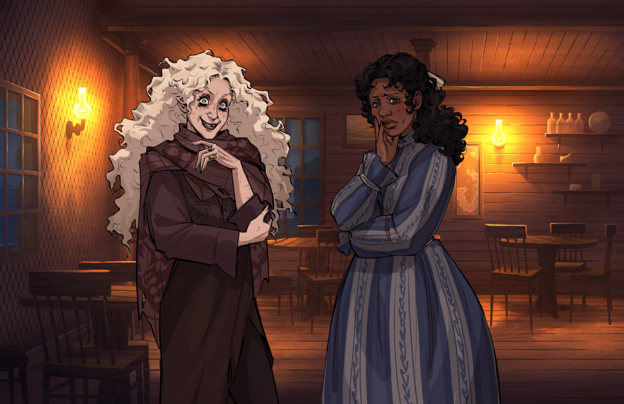
One of my favourite parts of working on Love & Fool’s Gold is all the character design work. We have a pretty extensive ‘Character Bible’ which has a breakdown of ALL the characters in the story - even the minor background characters whose names might not even appear in-game. (E.g. above: meet Amanda and Mary.) For reference, currently, the Character Bible contains the biographies of 33 characters, and this is only set to expand by a few as we finish up the final two chapters of the game.
Because I love to nerd out on this stuff, I’m going to share a complete list of what is contained in the character biography for each of the Holy Trinity: name, image, nickname, age, birthday, height, romance strategy, likes, dislikes, fears, skills, MBTI, first appearance, personality, flaws, motivations, goals, character progression, physical description, clothing, background, references/inspirations, family, friends, enemies, horse, quirks. I’d love to share the full character biographies for each of the characters, but as you can imagine, these contain a significant amount of spoilers, so I can’t do that just yet.
All this character design work (or, at least… a small portion of it…) is really helpful when it comes to casting voice actors. Within reason, the more info about a character you can send to an actor, the better the performance you’ll get. Obviously there’s a line to draw here, because a voice actor hardly needs to knows the personality flaws of Crowd Man #2 for his audition, much less the name and breed of his horse.
For the demo, the initial core dev team (of myself, Lilli, and Megan) handled all the auditions and casting ourselves - the three of us were involved in assessing all the auditions for each character, creating a shortlist, and then selecting our favourite. This was such a fun process, but it took soooo much time, so we knew we’d need some assistance when it came to casting the game’s remaining characters. This step is where our amazing new Casting and Voice Director, Kathryn, comes into play.
The first thing Kathryn did was take the relevant pieces of information from the Character Bible and put it into an audition sides document. As well as key personality/background information for each character, a few sample lines to read from, and the role they play in the story, this also included the character’s image, gender, age range, accent, ethnicity, and a link to reference performances. By including all this information, the prospective voice actors are able to choose to audition only for the characters they think they’d do a good job of voicing, rather than just applying blindly to half the characters on the list.
Kathryn then handled the audition process and shortlisted a number of VA auditions for each character, and I had the incredibly fun (but also often very tricky) task of choosing my favourite voice for each character. For some characters, this was a super easy decision, as the voice would immediately jump out to me as being exactly what I had envisioned in my head. For others this was really tricky, because all the potential voices could’ve worked really well - but of course, only a single choice can be made.
By the time the VAs are chosen, and contracts and NDAs are in place, it’s then time to commit and polish that script for the final time. Oh boy. This is one of the moments I dislike the most as the game’s Lead Writer, because I can’t always trust myself to have checked everything over to perfection. There is always some lingering doubt.
For each character, the scripts contain dialogue for the other characters present in the scene so that the VA knows the context of their lines, of course. In many cases you also need to provide some wider context to the scene/the character so that the VA knows the significance of the conversation, if applicable. You can also add delivery notes to lines, just like you’d seen in any other screenplay. I love to trust the VAs to interpret their character lines within the contexts I’ve provided them, but I also have a clear vision when I’m writing the dialogue of how the character speaks the line - so this process is about finding that balance of being helpfully prescriptive without being creatively restricting. Trust the process, etc etc.
Once the scripts are out, it’s time for the recording sessions to begin! We do all of these remotely (maybe one day, when Games with DNA is a big ol’ established studio with a swanky HQ in Los Angeles blah blah blah we can have a recording studio and fly in our talent for the day… that would be nice), as all our VAs have an appropriate home recording set-up for doing their lines, and all are familiar with remote recording. Kathryn is able to offer a live direction sessions with some of the big roles, which is fantastic, as this is of course what would be happening if VO was all recorded on-site - and it means I can relax and know the direction process is in good hands.
Then the recording files are all sent in, and we hand those over to our audio engineer Xavier, who splices them up according to the best take. Then he does the mixing and balancing.
During the production of our demo - back before we had any kind of funding - we had to tackle the audio engineering/sound design process within that core three-man (woman) team I mentioned earlier. This involved us doing the entirety of the audio engineering in Audacity - yikes. Between us, Megan and I probably spent a good two weeks, if not longer, splicing up the VO takes and tweaking the quality as best we could - manually editing out clicks, normalising the volume, removing large gaps; occasionally even splicing together two takes if it made for a better overall delivery. We tried our best, and we certainly put in the hours, but for two amateurs who don’t have any training in (and/or knowledge of) audio engineering, this obviously had somewhat of a questionable output. To say that it’s been a relief to pass this process off to Xavier is a criminal understatement. Anyway, look forward to better-balanced sounds in the remastered version of the demo!
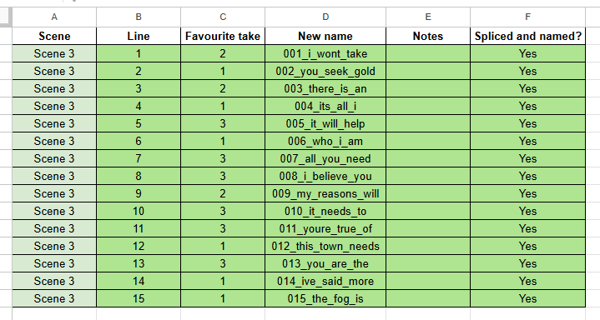
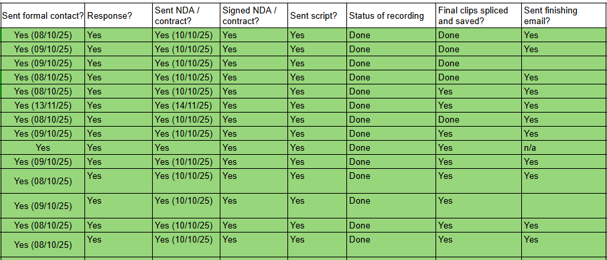
A behind-the-scenes look at some of the documents we used to track the VO process for the demo. Admin for literal days
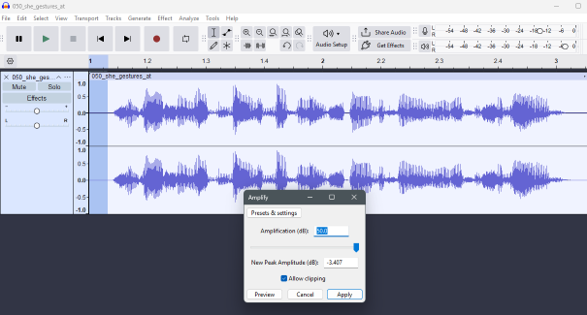
POV: you’re me pretending to know what you’re doing in Audacity
And now, like a well-oiled machine, all the voiceover is now perfectly cut, balanced, and with the right naming conventions, thus rendering it ready for implementation into Unity.
Voiceover truly makes a ton of difference to the gameplay - it may be clichéd to say so, but it truly brings the characters and story to life. There are lots of extra costs that come with having a fully-voiced visual novel - the money AND time of preparing auditions, casting, selection, recording, splicing, balancing, mixing, naming, organising, implementing - but every penny (or dollar, for my American friends) is absolutely a worthwhile cost in my opinion.
As with many aspects of a creative project, there’s always going to be an element of subjectivity when it comes to character voices. Some people will love a particular character’s choice of voice, while others will not. With that said, voiceover does feel like a particularly sensitive area to navigate, because it is such a critical factor in player immersion. We wouldn’t want to make any decisions which end up being detrimental to the player, and in the case of the demo, one repeated piece of feedback we received was that most people would prefer NOT to have a voiced Main Character. And personally, I absolutely understand this perspective - in fact it was something I had contemplated on as far back as 2024, in the early days of our vertical slice - should the MC have a voice or not? There are a number of arguments both for and against, all rooted in game design theory, I’m sure - but ultimately, we made the decision that best emphasises player immersion. And the fact of the matter is, for the majority of players, hearing someone else speak the MC’s lines will often break the illusion that the player themselves is in the scene. So, for Chapter 2, and for our soon-to-be-released Chapter 1/demo, the MC will no longer be voiced. It was a tricky decision, but one I believe is best for the game in the long-run.
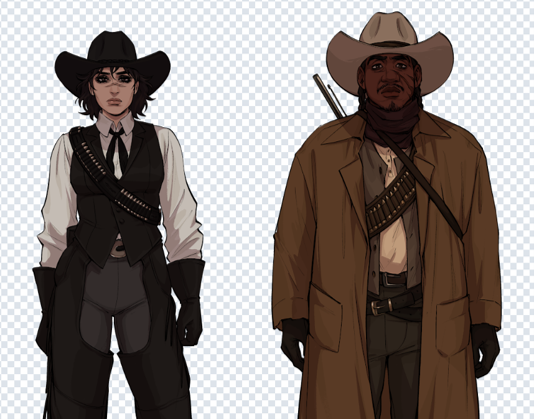
A preview of our two new MC options we’re including in Ch2 and our revised Ch1 - meet Quinn and Alonzo. (Obviously you can name them whatever you want, but I’m a sucker for coming up with lore for each MC design, so they all get names. Jolene and Sterling are the names of the current MCs in the demo.)
Anyway, we come to an end of devlog #3. By the time I write the next update, our Ch2 closed playtest will be live, and I’ll get to see all the player opinions on our new voiceover. I’m positive you’ll all love them.
In the meantime, keep your eye on our socials for announcements on how to get involved in the playtest on socials, or join our Discord community for direct updates!
Beware The Elk,
- Anna (Alu)
Read the Devlog #2 here!