
When we created the announcement trailer and Steam page of First Moon of Mercury, we had only been working on the game for a month. Barely anything had been done, but in this uncertain time for games it was crucial that we got the word out about what we were up to. Game announcements are not just about letting players know that a new game is coming out, but are also used to gauge interest for publishers, investors, and government grants. But such an early announcement has its cons. One such con is that things change between that original announcement and the release date.
A few things have changed since we made our announcement, but the most obvious one is the art style. This change happened for a variety of reasons, but a big one was because of audience and playtester feedback.
So, combined with technical and time limitations, we took that feedback into account and changed things up. We spoke with Art Director Jeffrey Flores, Junior Artist Evan Sawatsky, and 3D Generalist, Lennard about these visual changes.
What were the motivations behind changing up the look of the game?
Evan: At the end of the day, the decision was made in order to keep the game within a reasonable scope. The art team was a big fan of First Moon's initial visual identity, but unfortunately the time needed to create a game of this scale while adhering to a more organic, less real-world-inspired art style proved to be a major issue.
Lennard: Yeah. A lot of the more organic designs were very arduous to model and create, and playtesters had trouble understanding which elements were interactable.
Jeffrey: There were many factors. After our initial announcement trailer some feedback was that it was too whimsical in design. While we refined that style during the creation of the first infant station and the Oxygen Garden modules, we found that it was very time consuming to get the curvature of the SDF blending to look right as well as be consistent across artists.
When we lost an artist for a handful of months and were down to two modellers, we were faced with looking at a schedule where producing the planned amount of modules at the current pace would be impossible. We needed to come up with a style that would be less bespoke, more modular, and quicker to model. We needed a style that could be produced efficiently while maintaining the same story and gameplay aspects.
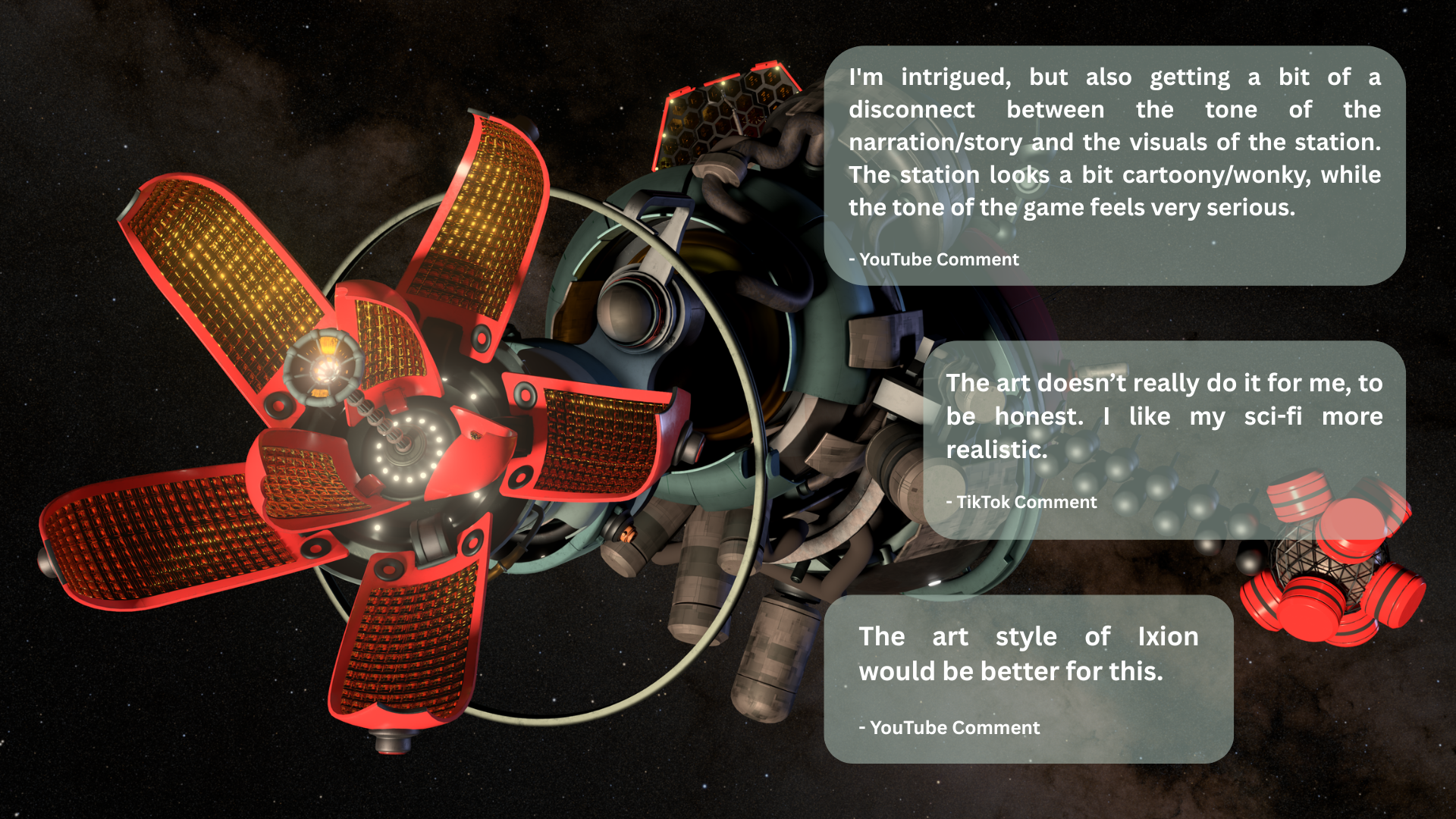 Original station design with community feedback.
What was your approach when coming up with ideas for the change?
Jeffrey: A lot of it was conversations within the art team. What could be kept from the early direction? What slowed us down? Where could we save time? What forms made sense from a stylistic perspective and from a production standpoint?
We came up with a proposal for a modular kit-based approach that used modular caps and hulls along with greebles and puzzle elements that could be appended to them. While that was the ideal scenario it never fully ended that way as the puzzle designs demanded a level of bespoke modelling that was incompatible with that approach.
Lennard: We had to create simpler surfaces that relied on trim sheets and tiling materials with minimal greebles. That helped players focus on puzzle elements without getting lost [based on playtest feedback].
Creating a limited palette to indicate which elements were interactable also created a simple visual hierarchy.
Evan: It was a very collaborative process across the rest of the team as well, especially design.
Jeffrey: In the end, we looked to simpler forms and removed any unnecessary details as ways to build both a consistent visual style and an efficient modelling approach.
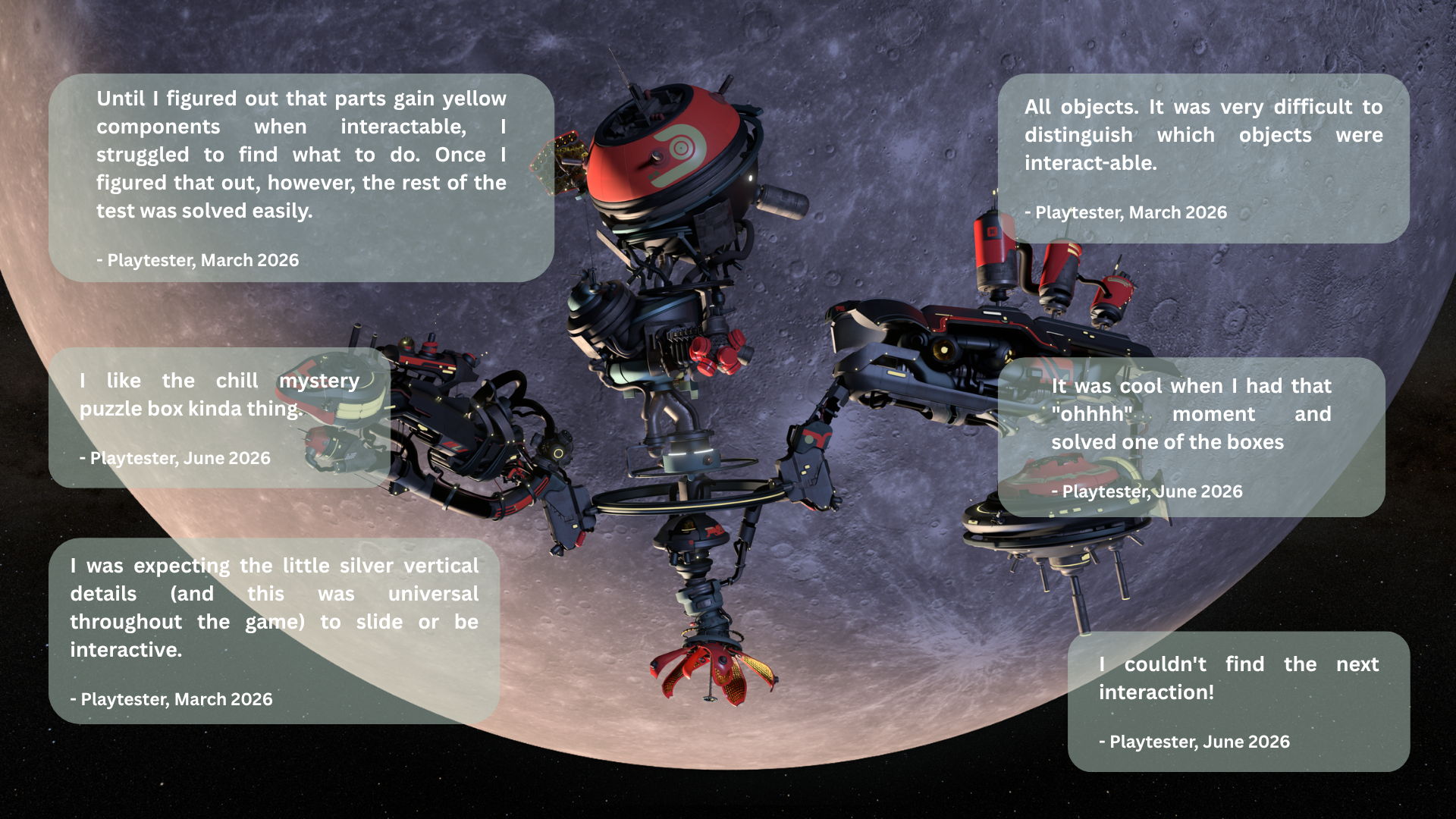 Original station design with playtester feedback about interactables.
What were your priorities in regards to the changes?
Jeffrey: I viewed the priorities in regards to the changes as balancing the needs of the puzzle requirements, the artists' time, and supporting the player through design.
With every design of a module it was and still is about approaching it in a way that stays true to the intention of the puzzle while layering it with elements that further world-building and aid in user experience. All the while still being artistically gratifying and efficient to make.
Evan: Cool complicated space stations don't always make for the most effective puzzle boxes, we found out.
Lennard: It really came down to speed of production, visual readability for players, and repeatable interaction language with satisfying payoffs.
90% of the art is made with about three tiling textures and six trim sheets. If they are bespoke, unwrapped, and textured assets they almost all use the same uber material stack which makes authoring very quick.
Evan: [Laughing] Developing an art style for a game is HARD.
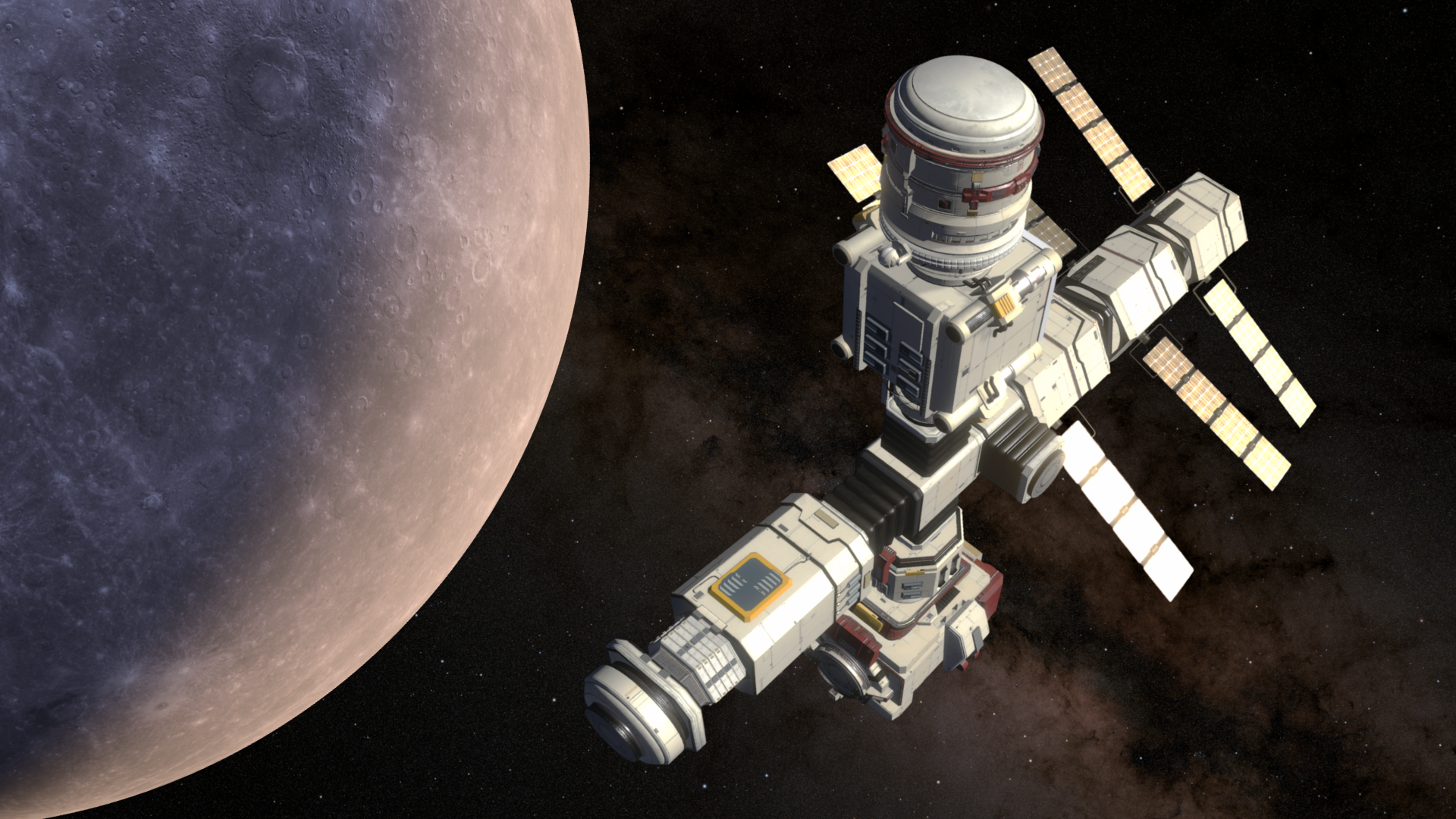 New station design with a more realistic style.
We’re about to embark on our biggest playtest to date in just two days: July 16 through July 19, 2026.
Help shape First Moon of Mercury like those before and join the mission with over 250 other playtesters: Sign Up Now!