
Happy Wednesday everyone, I’m Tinto Community Manager Ryagi, and we’re taking the opportunity to look back on our most recent release, the 1.4 ‘Río Salado’ update, and the Across the Pillars DLC. Due to time constraints, and also in the spirit of keeping our message clear, we’ll be separating this retrospective into 2 parts broadly. Today, Part 1, will primarily focus on the content of the Chronicle Pack itself, and will be hosted by Pavía, our Content Design Lead. Part 2, next week, will focus on 1.4 alongside the Open Beta process and the general state of the game, and will be hosted by Johan.
Our wonderful Content Design Lead @Pavía will take it from here:
Across the Pillars
Let’s start with the very basics: we’re disappointed with the release of Across the Pillars (AtP from now on). We have put care, love, and a lot of effort into it, but it hasn’t turned out the way either you, the players, or us, the devs, would have liked it to be. And, on a personal note, this hurts me double, as the Late Medieval and Early Modern History of the Iberian Peninsula is something that I’ve devoted the last 15 years of my life to work on in different ways, and I think that I haven’t been able to correctly transmit that as Paradox Tinto’s Content Design Lead for this DLC.
So I want to acknowledge and do three things now: tackling some of the most glaring issues you’ve pointed out; sharing more insight into them; and, finally, and more importantly, reading and listening to your comments and thoughts. Regarding that, something that will also help us regarding your comments is a format that we use in our internal retrospectives: telling us what you think we should keep doing, what it’s ok but we could improve, and what we should stop doing. I’ll also be around this morning and afternoon, replying to comments in the forum post, as usual.
One of the most common complaints we received around AtP boils down to many players not finding the value for the price, or finding that the content within AtP is simply not up to an expected Quality Standard. According to the feedback we’ve received, I think it’s good to structure it into two different sections: Content Visualization & Quantity, and Content Quality.
Content Communication
A small but notable chunk of this problem comes down to communication. Be that pre-release (Such as Tinto Talks and feature videos), or in-game. In-game, our current Visual Content Delivery Systems in 1.4 are not yet adequate and cannot yet deliver you the same level of concise info that something like a mission/focus tree can. Systems like the event viewer are a good step, no doubt, but they can’t stand on their own. This is a fundamental challenge we identified before this release, and now that AtP reactions are in, it’s clear you (collectively) agree.
In this regard, one important thing that we will be addressing in next week’s patch (1.4.9) is the DLC Content Panel. We think that a very basic issue is that it’s difficult for a player to identify what’s coming in the DLC, which countries are actually getting the content, etc.: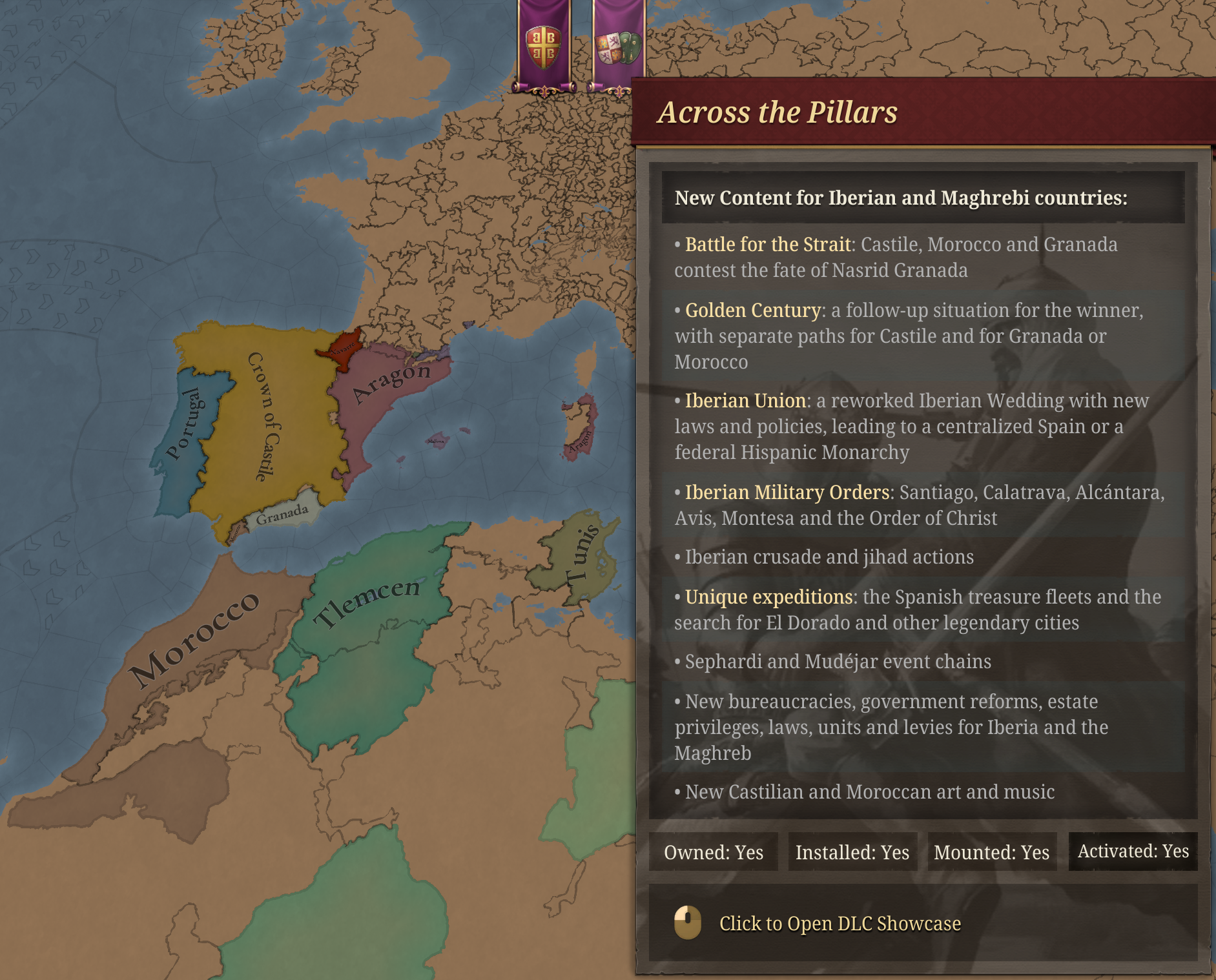
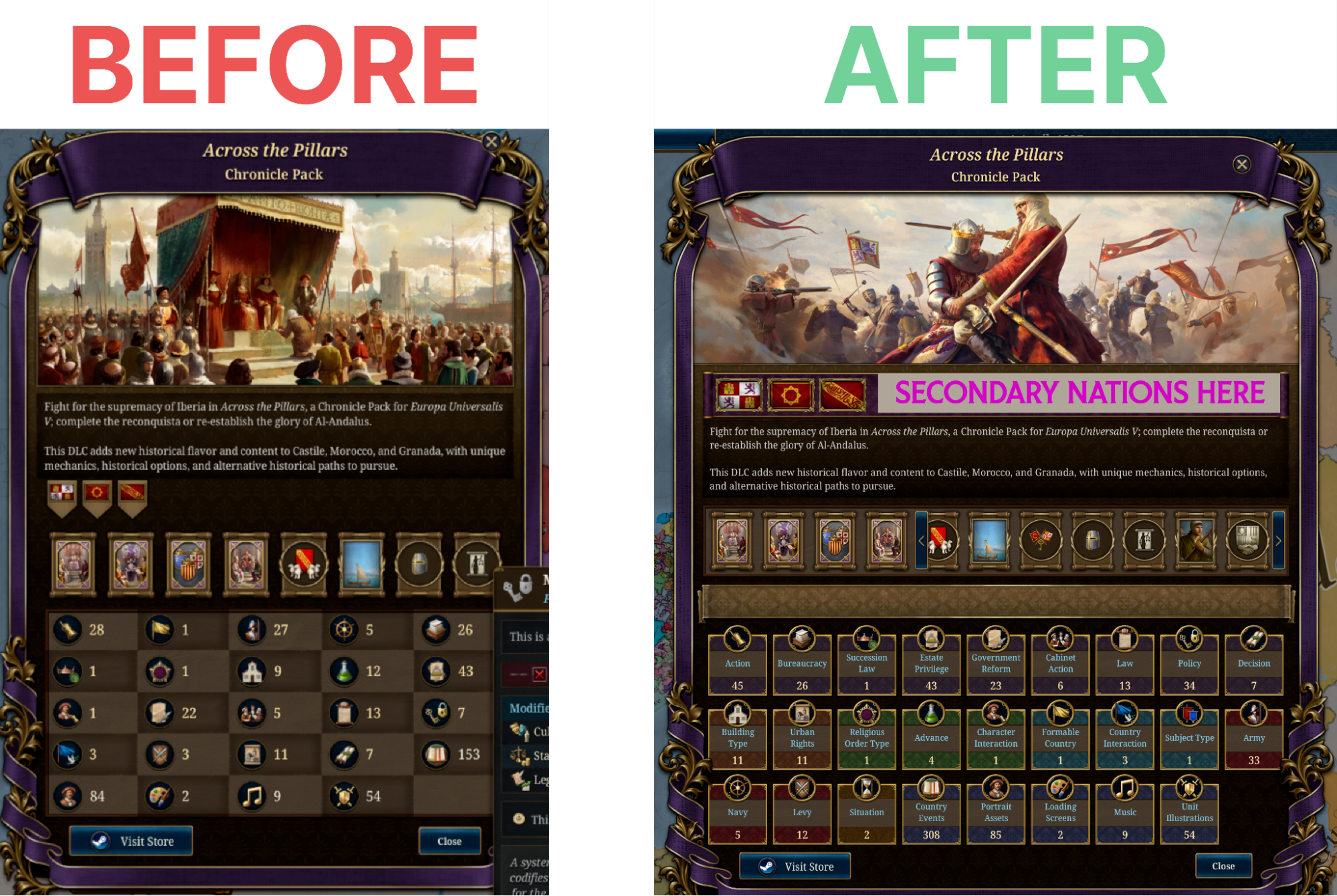 WIP. We’re doing some extra polishing today, so we can have it ready for next week’s patch.
Speaking of that, we focused most of the DLC content and the marketing campaign on the Castile-Morocco-Granada trifecta, while other countries in Iberia and the Maghreb also received content, despite not being the main protagonists of the DLC - we’ll talk more about that specific action point later down this TT. By numbers alone, with more than 700 new content assets, AtP has a plethora of content: 300+ events, 11 Unique Expeditions, 100+ Privileges and Government reforms, 30+ new unit types, etc.
But raw numbers don’t always tell the whole story. We think that something that you could help us with is better identifying meaningful content, and how do you think it should play out with the base gameplay mechanics. An example of this is Battle of the Strait, with divisive comments across the players: for some it’s not historically grounded enough; others would like it to be more of a regional struggle between Iberian and Maghrebi nations; others think that some aspects of it (e.g., the unique Cabinet Actions) play too standalone; while others think that it should feel more immersive and rewarding. What would help us the most regarding this getting a more clear picture of which aspects of the content you like and you think we’re doing good, and which others we should rethink.
Content Quality and Bugs
However, as pointed out, better communication about what content is there doesn’t mean the content itself doesn’t have room for improvement. Therefore, let’s now talk about quality.
Let me start talking about our processes. We play and test the game a lot, with these testing layers:
Daily automated nightly tests.
Weekly internal dev SP and MP sessions.
Functional QA testing (= testing each content asset separately).
Exploratory QA testing (= long playthroughs).
Closed Beta testing
Play & Fix - this is a dedicated week, some time before release (in this case, for AtP, it was in September) in which each developer both plays and fixes stuff on the go (with separate SP and MP sessions)
Open Beta testing
Influencer Early Access
For example, I personally played Granada, Morocco, and Tunis (great country for a cozy learning game!) during this process, and I’ve been playing Castile in our internal MP since September.
Then you may come with a natural question, which is: ‘Ok, then how do bugs slip through your process and reach the release?’ - a question we ask ourselves every single release. There are multiple reasons, but in general terms, something to account for is that GSGs in general are very complex games, and EU5 in particular is kind of the pinnacle of that. So I’m going to talk a bit about some of the most glaring issues and explain what happened with them.
Let’s start with this: >= 50. That is, the bug on the clause to form Spain more straightforwardly with the Iberian Union. This is a change that was introduced after internal playtesting - there was a valid report saying that it was too easy to form Spain with this mechanic compared to the regular formable one, and that it could happen that a country with less than half the territory, but that had formed the Union, could create Spain, while having a country holding more than 50% of the territory. This is not a common issue, so it was reported on October 16th. On the fix, the mistake was made in thinking that this was a function in which the = operated as having 50 or more of the count, but it was one in which it required >= instead, as the syntax in EU4 worked that way. Then, we failed to have the resolved bug report regressed in time. A second report on this came from one influencer on Monday 26th, which led to a bug ticket created on Tuesday 27th, and a fix already deployed on Wednesday 28th - so it was already fixed by the time it was noticed by the players.
Another bug that we fixed in the Day 2 hotfix was the one with the missing starting Castilian navy. This happened because the calculations for the starting navy are different in the base game compared to the DLC, due to the Iberian Religious Orders adding some units at start. Here, the main issue was not having a good testing suite to compare the base game state against the DLC state - in our internal testing branch, we’re usually playtesting with the whole DLC setup on, while on the 1.4 Open Beta, the players were playing without the DLC assets, which is also why we weren’t able to get feedback in time for the full 1.4 release. Here, the action point for the future is relatively simple - better base game vs DLC testing suites.
The final example is another issue that we’re addressing this week, in the 1.4.8 hotfix - the starting balance of the Moroccan army. This is the most complex, by far, because we have been working the entire summer on balancing in parallel both Castile and Morocco power levels, so they interact correctly with each other, but also with their neighbours. Therefore, several adjustments and iterations have been made over this period. In the final version, we made the Moroccan tribal levies more powerful, as that worked well with their new Tribal mechanics. However, you’ve told us that it is a bit too much, so the approach we’ve taken this time is more gradual than in other patches - we’ve started by reducing them by about 20% for the 1.4.8 open beta, so they’re less powerful, but not so much; and also making it possible to be tested by you as an opt-in. Depending on this feedback, we’ll adjust them accordingly. A side fix that we’re doing for 1.4.9, after our internal QA playtest, is to raise the transport capacity of Fustas from 60 to 150 men - this means that with its starting fleet, Morocco will be able to ferry 5,000 troops per trip, making it easier to reach the Iberian Peninsula.
In summary, we have to keep working on improving our Pre-Release processes, although we think that our Post-Release Support worked relatively well, given cases like these.
Going Forward
So after all that, you’re probably wondering, “Ok, but what are you going to do about it?”
And we’ve got some bittersweet news on that front: we’ve taken a look at our future plans and readjusted some things. We’re not ready to share everything quite yet, but the things we do want to touch on are as follows:
Our core intention when it comes to making any content is simple: Is this fun to play? Then, as follow-ups, what we also try to address are two goals on top of that: Do I want to care and/or get involved with this content? Am I feeling immersed in this content in both the gameplay and historicity? While relatively simple, these are not trivial questions to answer, as they sit at the heart of the Content Design discipline.
Therefore, we are learning from the lessons of Fate of the Phoenix and Across the Pillars, and we are aiming towards making our content lean towards something the player actively wants to play with, without hijacking the core gameplay. In that regard, it may not be a surprise to say that we’re working towards making the Hundred Years’ War and all its related content the focus of Auld Alliance. But we also want to have more gameplay-driving options, and more variety in the narrative, which makes different countries of the region play somewhat differently, experience the same central events, and that end up leading to diverging paths.
Better communication in-game content is a high priority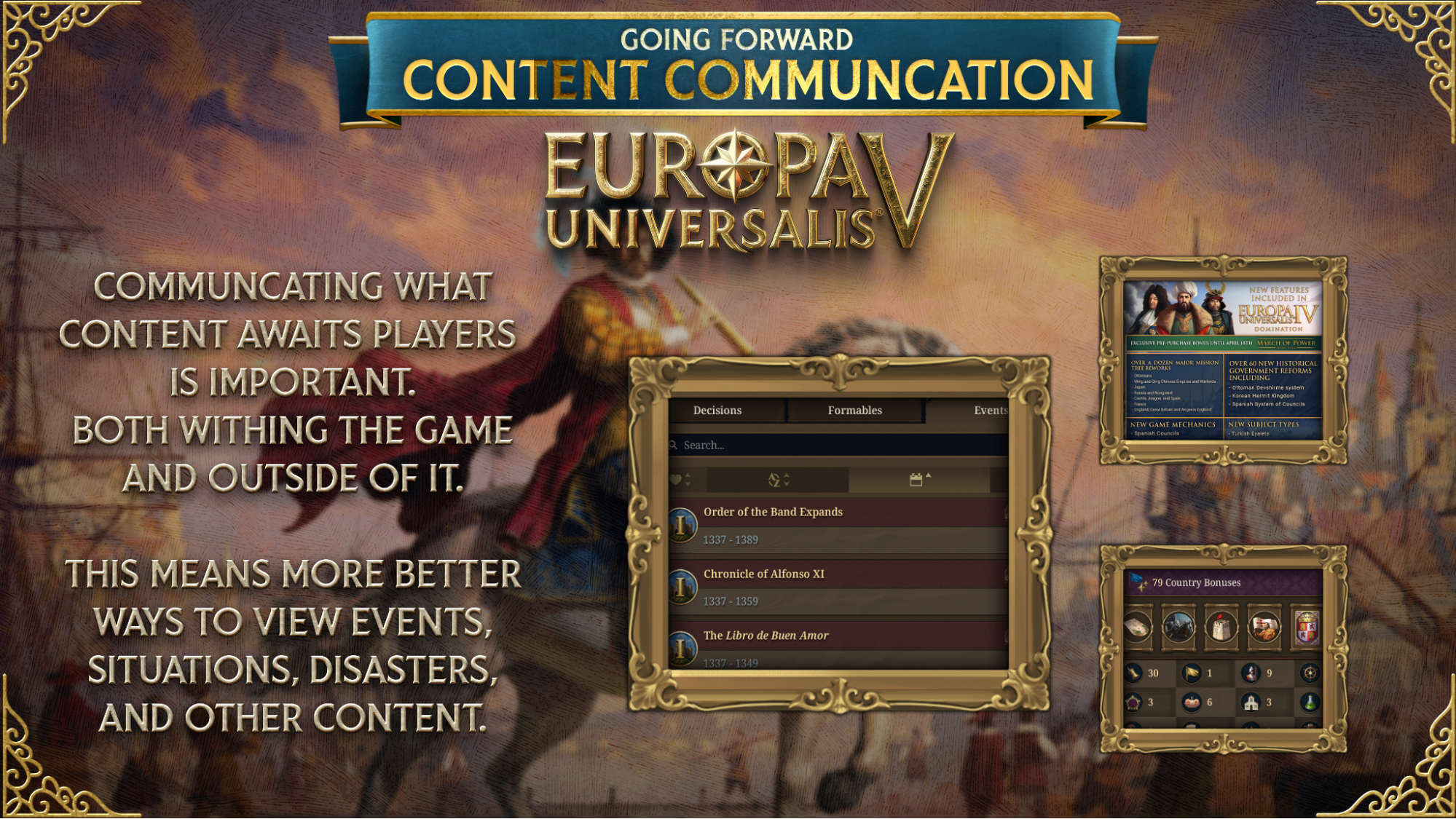
We haven’t shown all that much about what was in store for 2.0, but we did talk about how it was going to be a series of parts that aimed to improve how you experience content in EU5. Especially future narrative-based content.
What we’re currently investigating is how we can take some of those parts and re-prioritize them for 1.5 so you have a better experience overall. This doesn’t mean a full rework of how content in EU5 works, and we still have big plans for 2.0 Content. It just means we’re cherry-picking what we think could be most effective now rather than later.
This philosophy also applies outside the game too. We need to do a better job showing what’s coming, even if it means some rough pre-release edges.
Auld Alliance is changing scope a bit
We’ve introduced you to the concept of our Immersion Packs and Chronicle Packs. Immersion Packs take the shape of a single country flavor DLC, and Chronicle Packs are double that in terms of raw volume, focusing on 2-3 countries. This basic guideline around what a Chronicle Pack is still holds true, but we’re readjusting the Auld Alliance Pack to shine some more light on the region of France and the British Isles as a whole, rather than just keeping a sole focus on the titular Auld Alliance (France + Scotland). We’re excited to share more details with you about this in the future! But for now, rest assured that we’ve taken the feedback “I would rather have a pack with a region instead of just 2 countries” to heart - and there will be plenty of content for French and British, with many more countries involved in the DLC’s content and narrative.
QA processes are being looked at
When AtP launched, it had a handful of major bugs that we should have spotted before the release. Our Post-Release Support was in correctly in its place, and these were resolved before the weekend in the first hotfix, while some more have been fixed in the 1.4.8 open beta (our ‘Day 7’ patch).
To prevent these issues from slipping through the cracks in the future, one thing we’ll be doing is reinforcing our internal QA team, giving it more of the time and resources they need to properly identify issues on live builds, along with tweaking some of the testing procedures for the entire production process. If there’s enough interest in this topic, we’d be open to highlighting more specifics in a future Tinto Talks or Bonus Tinto Talks - just let us know!
Final Thoughts
Across the Pillars didn’t launch as we’d like, and we’re here to acknowledge it and address your feedback; we’re learning from it, and we’ll be taking the lessons to just outright put them into practice for future Chronicle Packs. In any case, thanks to all of you who played and enjoyed it, and who have been involved in giving us this feedback, reporting bugs, and that will come here to tell what you liked and what not. In the end it all makes for a better Europa Universalis V, which is our shared objective.
There was some “We’ll share more later”, but thank you for bearing with us, and we hope you can appreciate our honest retrospective. Next week, we’re doing part 2 of this, and as we said, for that we are taking a deeper look into 1.4, including the beta, ticks, performance, and more.
Today, November 12th, we'll be hosting a Community Manager AMA (Ask Me Anything) over on the EU5 subreddit (Link here!). Feel free to drop by and ask, well… anything.
Until next time!