
Hello everyone,
This update focuses on performance, stability during larger enemy hordes, and a few practical options menu improvements.
In recent builds, later parts of a run could put a large number of enemies on the map at once. That started creating spikes in physics, navigation, and collision work. The result could be stuttering movement, worse frame pacing during diagonal movement, and uneven performance exactly when combat should feel most intense.
The goal of this update is to keep the pressure of large hordes while making their behavior more predictable and cheaper for the engine to process.
Smoother Game Performance
- Project physics now runs at 30 physics ticks per second.
- This reduces the amount of expensive work the game has to process every second when many enemies are active.
- Enemies no longer use a global alternating-frame update skip that created uneven heavy and light frames.
- Enemy movement should now feel steadier and less prone to regular stutter patterns.
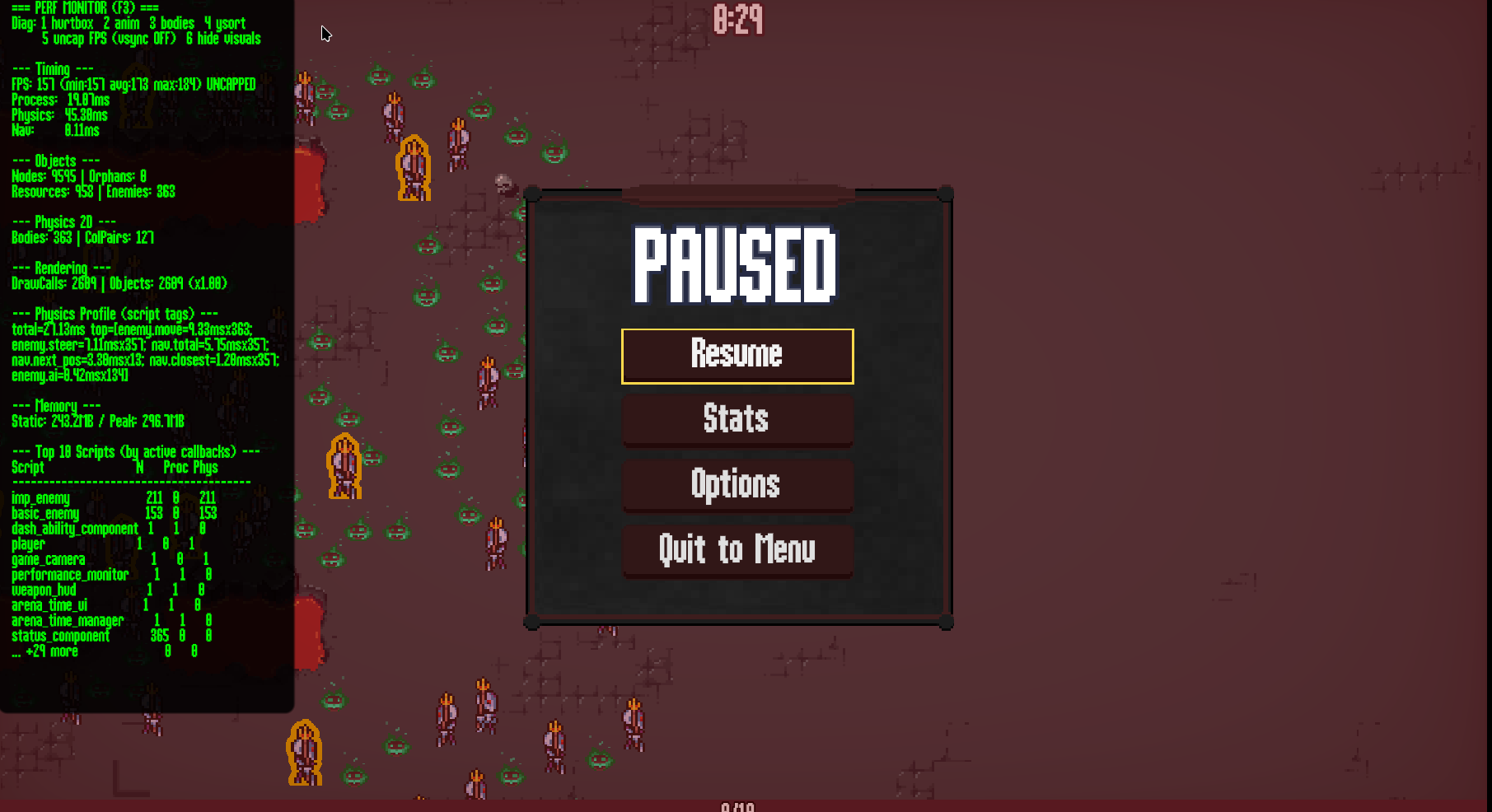
Better Enemy Horde Pacing
Enemy spawning has been reworked so the game is no longer driven only by an endlessly growing number of enemies spawned in a single tick.
- The Enemy Manager now uses a linear target alive-enemy count based on run progress.
- The game gradually fills toward the intended horde size instead of creating sharp spawn jumps.
- Spawn timing stays more stable, while intensity grows mainly through the target number of living enemies.
- The debug command spawn_enemy can now reliably create exact enemy batches without breaking normal pacing.
Special Enemy Control
Some enemies have a larger impact on both performance and combat readability than the regular horde. This update adds stricter rules for how often they can appear.
- Support enemies are limited based on the current horde size.
- Demon Head now has its own maximum alive count.
- Demon Head appears less often so it does not dominate the entire run.
- Enemy types now unlock based on run progress instead of only the older difficulty value.
Navigation Optimization
Navigation was one of the main areas where a large enemy count could create sudden load spikes.
- Enemies use direct chasing more often when they are close enough to the player.
- Reading the next point from a navigation path now happens less often.
- After assigning a new navigation target, enemies no longer request another path result in the same frame.
- If a new path is not ready yet, enemies temporarily use the last known waypoint or direct steering.
Far Enemy Optimization
Enemies far away from the player do not need to be processed with the same priority as enemies currently involved in combat. They can now use a cheaper update mode.
- Far enemies can temporarily disable their hurtboxes.
- Far enemies can skip more expensive movement physics until they come closer again.
- Far enemy animations can pause to reduce unnecessary off-screen work.
- Distance checks are staggered across frames to avoid creating another single-frame spike.
Collision and Crowd Movement
For dense enemy groups, it was important to preserve collisions with the environment while reducing the cost of movement calculations.
- Low-speed and crowd-pressure movement now uses collision-aware movement.
- Enemies should no longer rely on raw position changes that could push them through obstacles.
- Crowd behavior should be more stable when large groups push around the player or around map obstacles.
Encircle AI and Phase Dash
Additional optimizations were made for enemies with more complex movement behavior.
- Encircle AI now caches the player reference instead of searching for it repeatedly.
- More expensive steering calculations for encircle behavior are staggered across multiple frames.
- Phase Dash checks its trigger less often while keeping a similar overall chance to activate.
- Dash targets are validated against the map and obstacles so teleports are not placed in invalid locations.
More Reliable Boss Spawning
Boss spawning has been made more robust for cases where the map around the player is heavily occupied.
- The game first looks for an ideal off-camera spawn position with a clear path.
- If that fails, it gradually relaxes the requirements.
- As a final fallback, the boss has a guaranteed spawn option so the run does not get stuck without a boss.
- Debug time warps to the end of a run now trigger boss spawning directly and more reliably.
New VSync Setting
The Options menu now includes a VSync toggle.
- The VSync toggle is placed next to the Window Mode setting.
- The setting is saved to a local config file.
- The Options menu layout was adjusted to better fit the project resolution.
- Settings are now more compact, and the menu uses a scroll area when needed.
Other Changes
- The light was removed from the player scene to reduce rendering cost.
- Internal debug tools are more consistent with the new time and spawning systems.
- Several enemy scenes were adjusted to match the new performance rules.
What This Means In Game
The biggest difference should be noticeable when many enemies are active at the same time. The goal is not to make the game easier, but to reduce technical performance drops that could affect controls, movement feel, and combat readability.
This update also prepares the game for more work on larger hordes. We tested approaches such as GPU instancing through MultiMesh and swarm proxy systems, but fully functional enemies still need collisions, damage interactions, and ability behavior. For that reason, this patch focuses mainly on optimizing the existing enemy scenes and managers.
Thank you for playing Knightmared, and thank you for the performance feedback. It helps us focus on the parts of the game that matter most during longer runs.