
Most faces aboard Night Plane belonged to someone real first.
Not all of them but the vast majority you check in, seat, second-guess, and eventually decide the fate of were living people who stood in front of a camera and agreed to this. Friends, family, coworkers, and the occasional stranger who walked up to a booth at an event and said yes before reading the form.
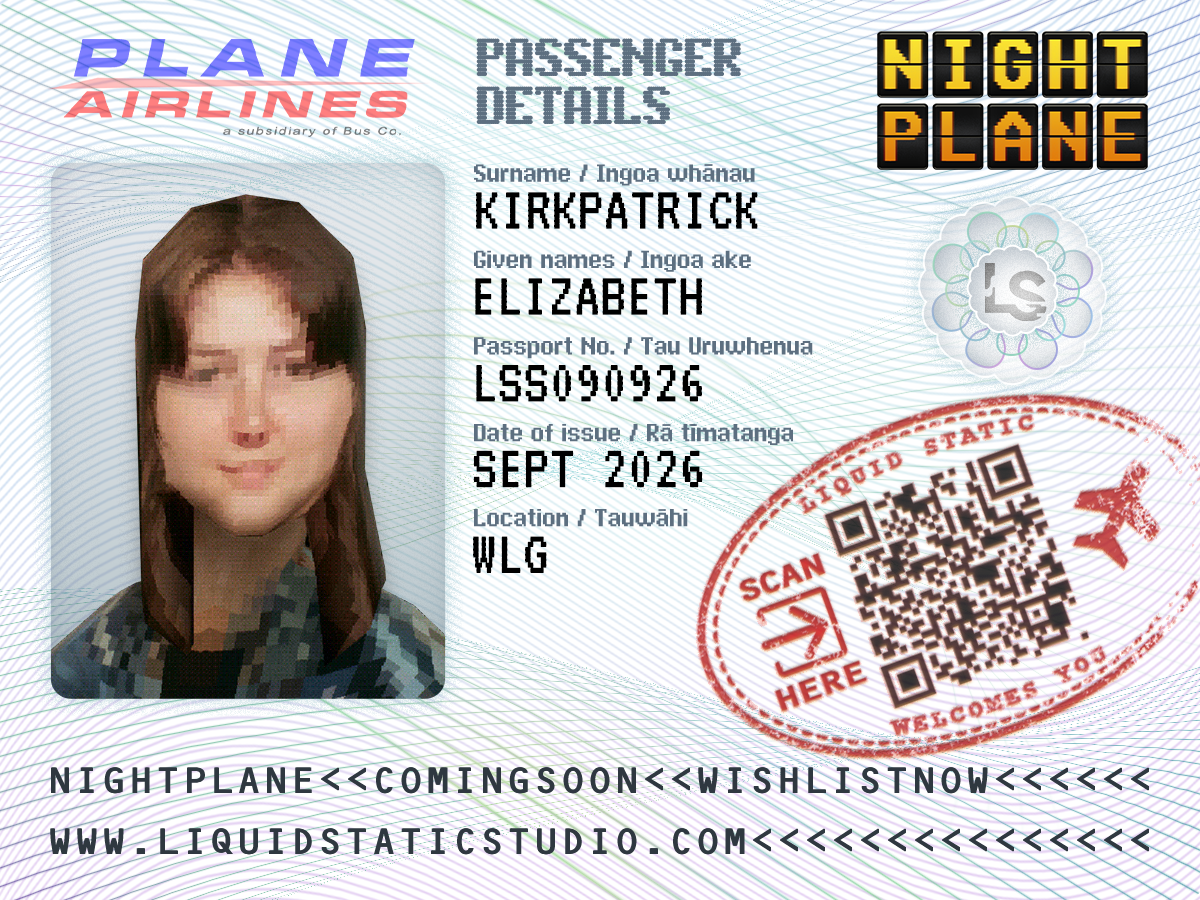
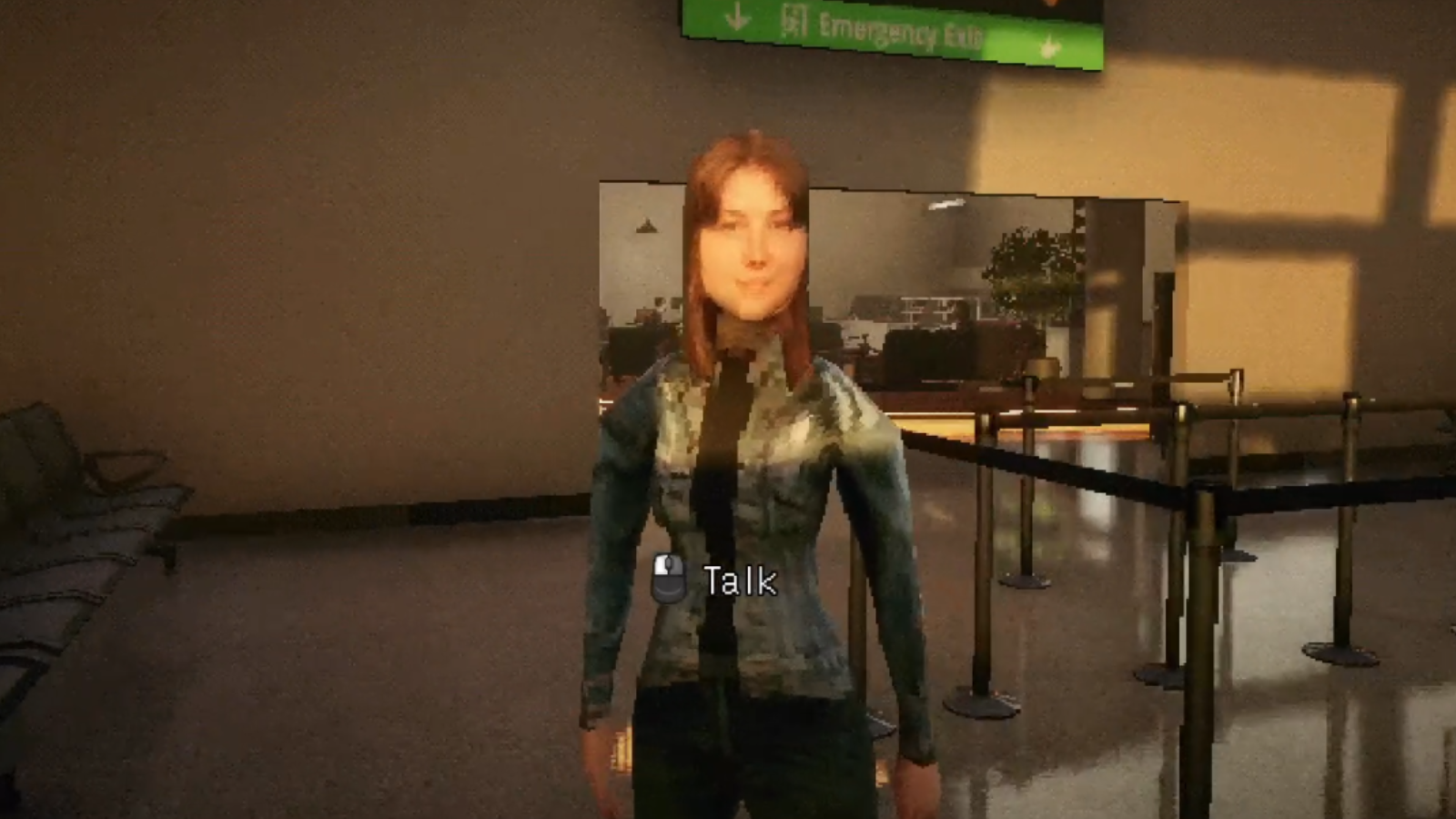
Which brings us to today's example. Somewhere in Night Plane there is a passenger named Elizabeth Kirkpatrick, assuming she boards your flight at all, and assuming she boards it human. Whether she's a person or a demon is decided at departure, and not up to her.
Off the clock, she's one of our developers. She helped build the plane, then handed herself over to it anyway.
Start to finish, turning a real person into a permanent Plane Airlines™ member takes time. We've become efficient at it in a way that occasionally worries us.
Intake
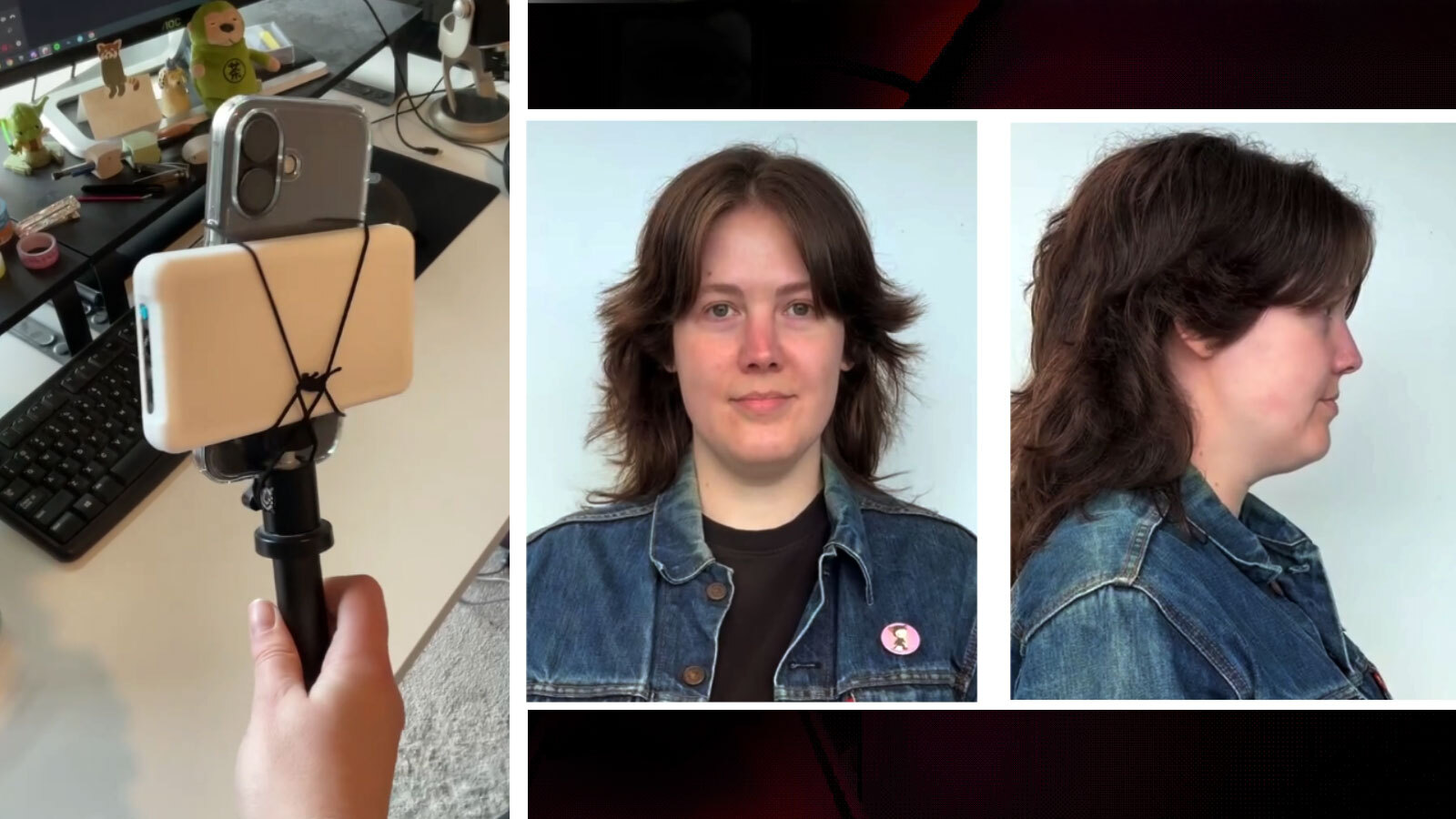
Elizabeth arrives in a denim jacket that belonged to her grandfather, because the flight departs in 1999 and the wardrobe should agree.
Intake is two photographs: one of the face straight on, one from the side. That is the whole biometric requirement. No scanning rig, no lasers, no satanic ceremony.
The equipment on record was a phone fastened to a portable LED panel with one hair tie, propped on a stand on a balcony (highly efficient DIY).
The rest is just knowing what makes a usable face. Flat, overcast light, because any shadow you bring becomes a permanent feature. A neutral expression, mouth shut, because whatever you land on is what you'll wear at 35,000 feet for eternity. And both angles, front and side. The profile is the only reason the finished face has a back to its head instead of being a sticker of a person.
Two good photos and that's intake. Elizabeth is now data.
Processing
The photographs go into Photoshop, and this is where Elizabeth stops being a woman on a balcony and becomes a layout.
Her face is cut from its background and laid flat against a template; a whole human being, filleted.
Imagine a papercraft model before anyone glues it together: a face panel, a scalp, two hands, a torso, all flattened into a single sheet that will later be wrapped back around a body. This sheet is called a texture, and hers is 2048 pixels square which means everything Elizabeth now is could be printed at home and pinned to a wall.
There is a shortcut here we refuse to take. The efficient thing would be to build the sheet symmetrically: paint half a face, mirror it down the centre, save ourselves the trouble. We don't.
A real face is never the same on both sides, and a mirrored one reads as subtly, unplaceably wrong. Our earliest passengers were built that way, and you can still pick them out of a crowd: too even and balanced
The fiddly part is the blending. A face comes from more than one photo; the straight-on shot has to melt into the side view without a visible join, so the edges get smudged together by hand until you can't tell where one angle ends and the next begins.
The clothes are their own puzzle: the jacket is broken apart and rebuilt flat, sleeves and collar and back all rearranged so that when the panel wraps around a body, the seams fall where nobody's looking.
Done right, there's no seam on the face at all. Done wrong, there's a person with a hairline crack running through them, and we'd rather not.
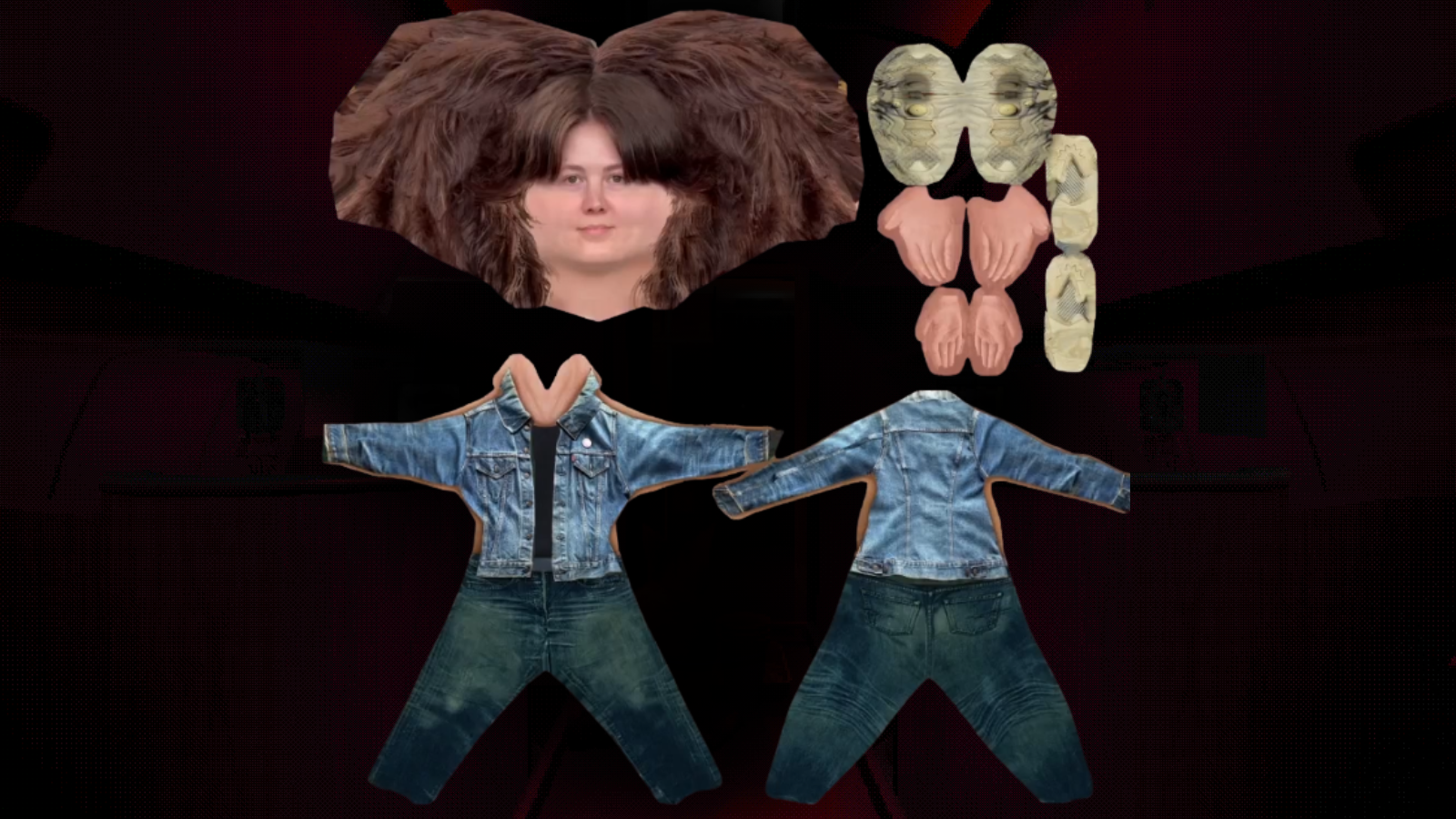
Then she gets dressed. Here is where the jacket goes. It was taken off, laid flat, and photographed on its own, and that photograph is painted straight onto her torso panel.
We texture from photographs of actual objects wherever we can, because a photographed thing carries a weight an invented thing never quite manages. This airline has always preferred the real.
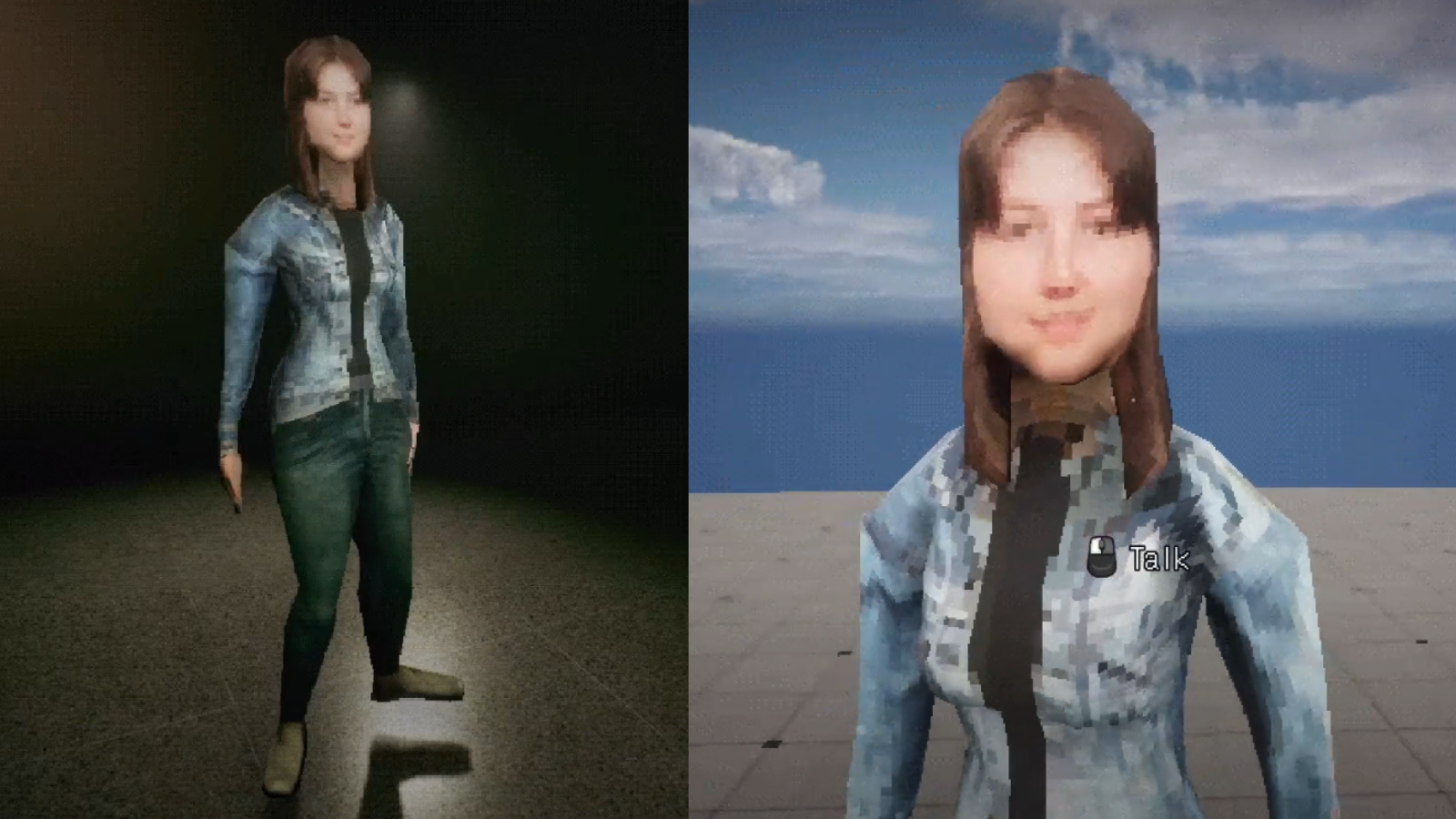
The finished sheet is wrapped around a low-poly body in Unreal Engine. Elizabeth now exists in three dimensions. She looks, at this stage, almost too good.
Compression
Which is why the last thing we do to her is make her worse.
The clean, high-resolution face is crushed down to the chunky, smeared, late-'90s texture that gives Night Plane its whole look. Hours of careful blending, ruined in a single pass.
We consider this the moment she actually joins us. Sharp enough that you know precisely who she is. Blurred enough that you are never entirely sure if she isn't looking back.
Boarding
Elizabeth takes her seat among the rest. There are around seventy of them on file now, each one run through the same machine: photographed, flattened, blended, dressed, and crushed.
Each one waiting in the terminal for a flight attendant to look at their face and decide whether they get to fly.
She can walk. She can be spoken to. She will hold your gaze. And somewhere under the pixels is a developer who built this plane with her own hands, then climbed aboard in her grandfather's jacket and smiled for the camera, knowing exactly where it would end.
Say hello, if you find her!
Thank you for choosing Plane Airlines™ ✈️