
Getting to Other Planets
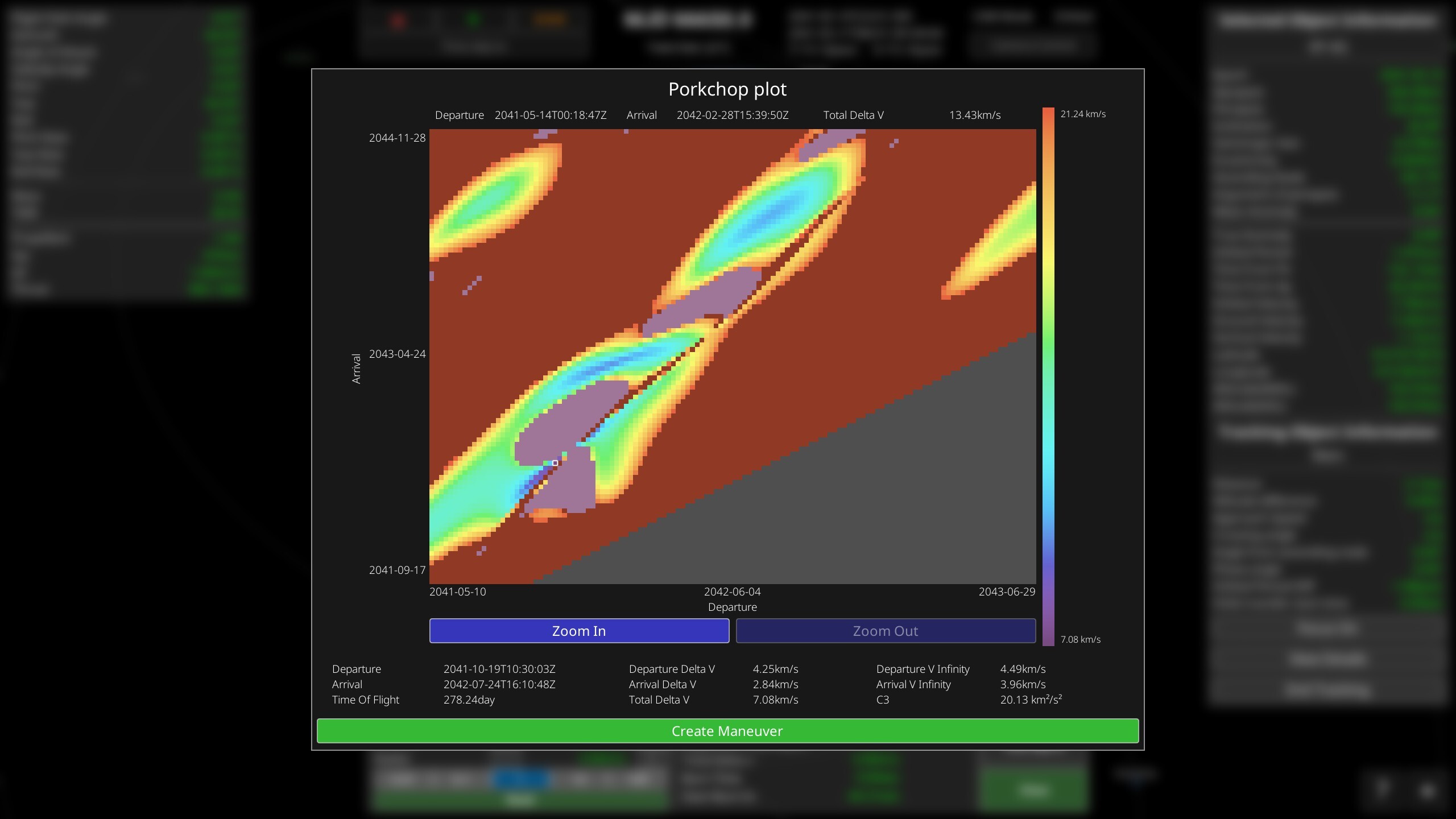
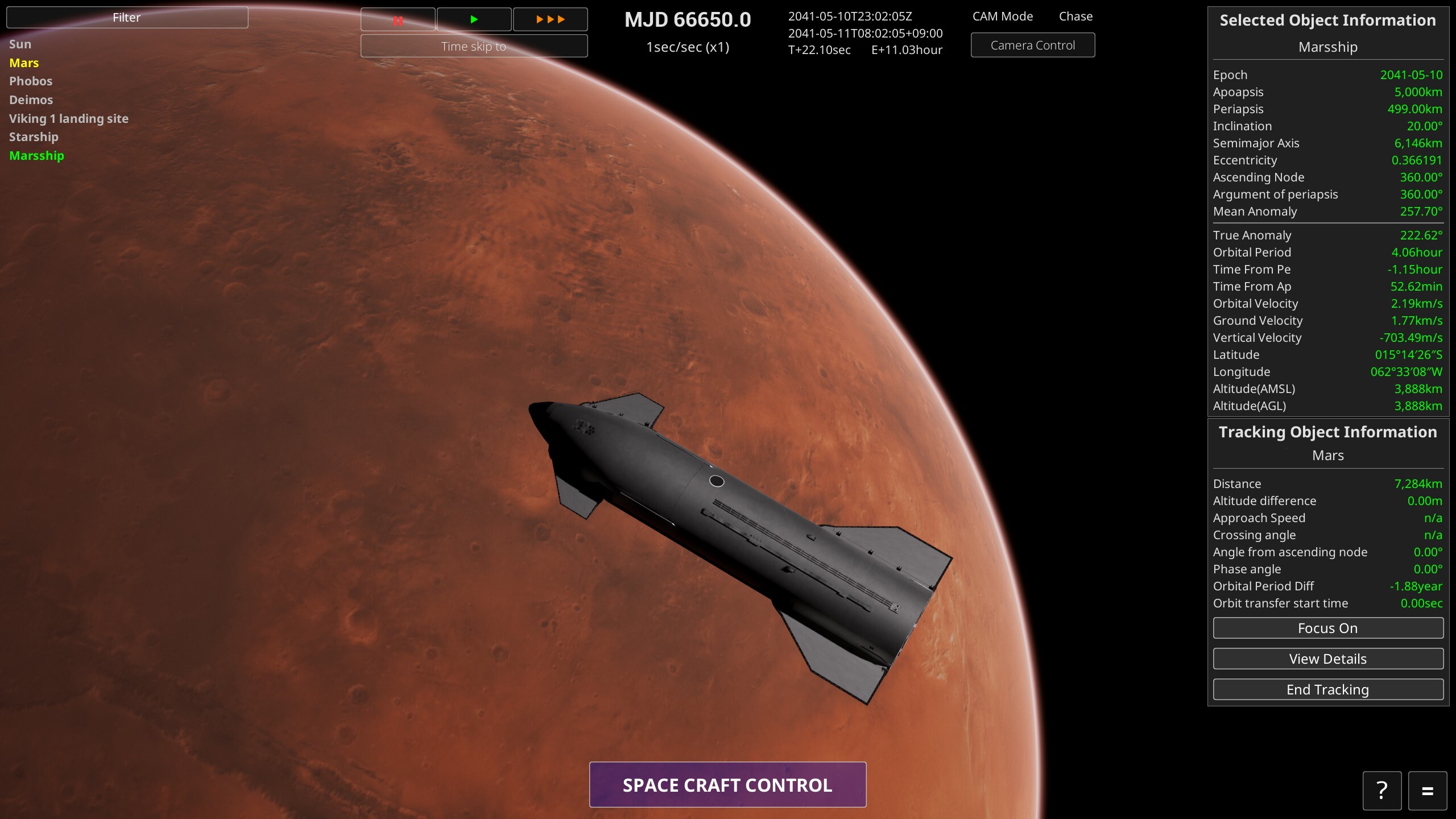
Transfers to the Moon and Mars can now be planned from a porkchop plot.
Open the transfer dialog from the maneuver planner to see the required delta-v for every departure and arrival date at a glance; the transfer you pick is written straight into your maneuver node.
The lowest total delta-v transfer is selected automatically when the dialog opens. Zoom in and out to change the step between dates.
Once you have left Earth's sphere of influence, you can add a trajectory correction maneuver (TCM) to re-aim at your destination.
You can now fast-forward to the time of a maneuver.
Fixed automatic maneuver execution cutting off early and leaving the orbit short. The longer the burn, the larger the shortfall: a lunar transfer was ending up tens of thousands of kilometres low at apogee.
Jump Straight to the Key Moments
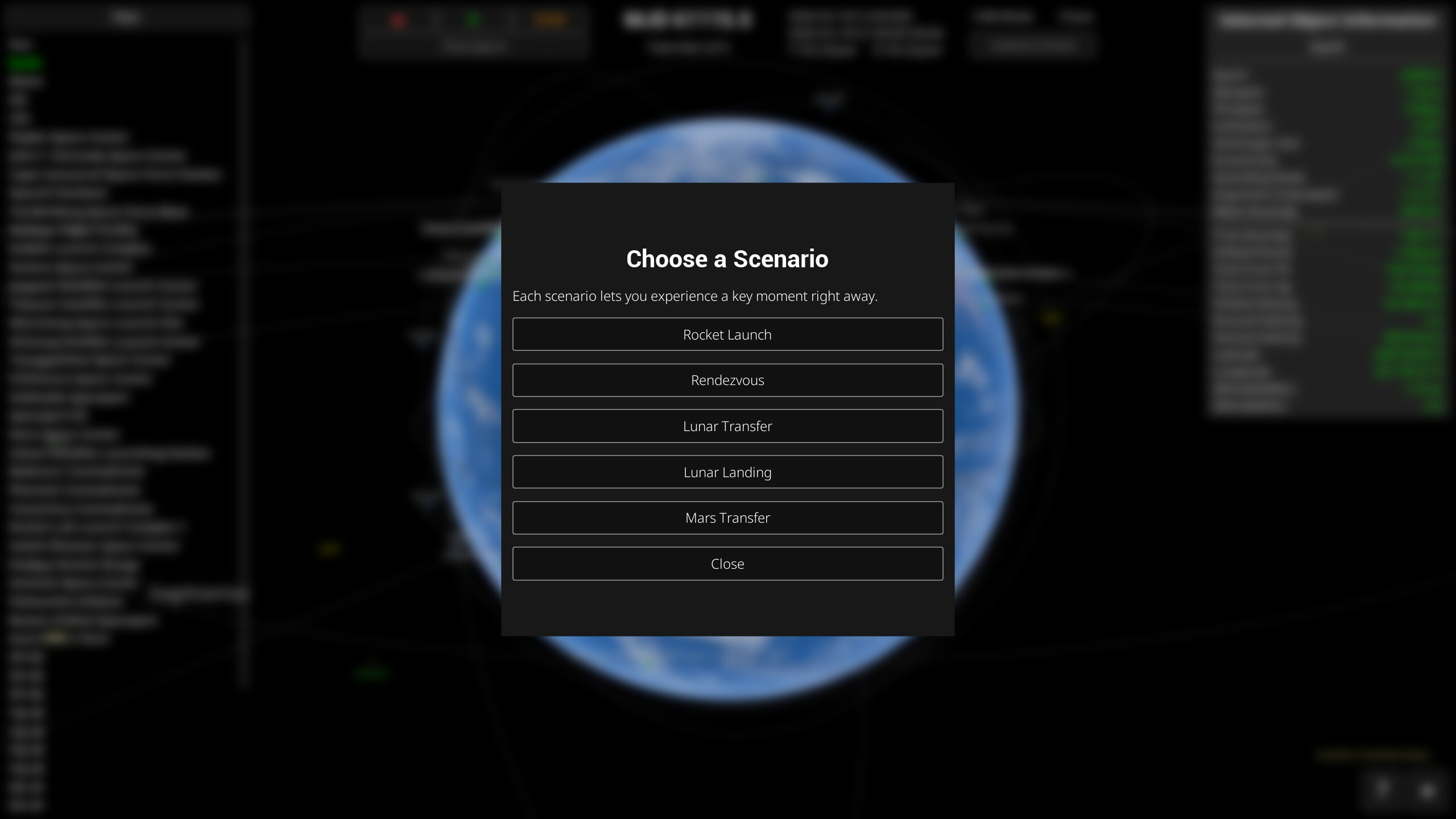
A Scenarios entry has been added to the menu. Launch, rendezvous, lunar transfer and lunar landing can each be started from just before the moment itself.
Atmospheres on Mars, Venus and Titan
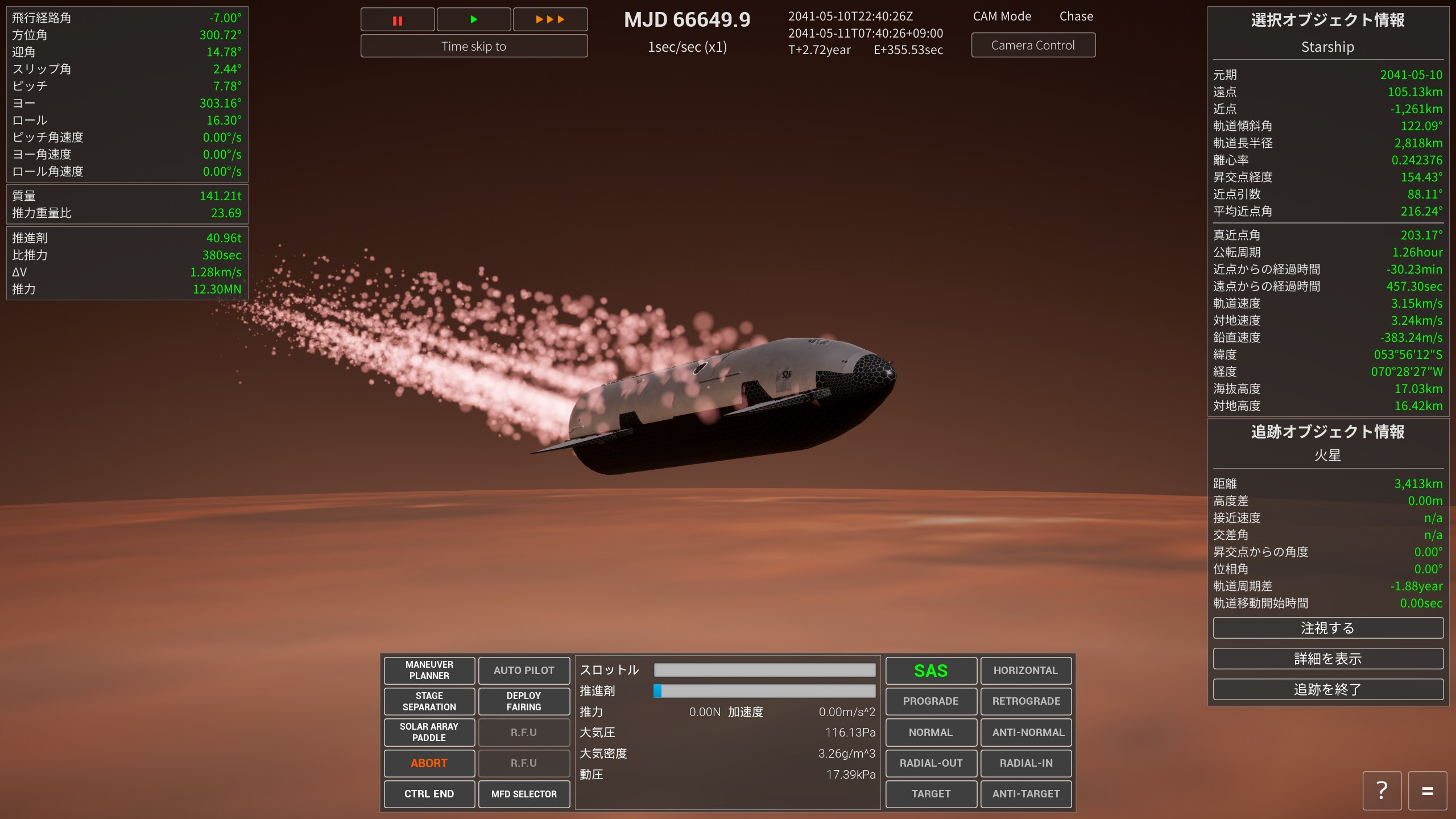
Mars, Venus and Titan now have atmospheres, with drag, aerodynamic heating and pressure-dependent engine performance.
Until now only Earth had a physical atmosphere — Mars had a visible one but produced no drag at all. Aerobraking and reentry heating now work there.
Improved Sphere-of-Influence Display
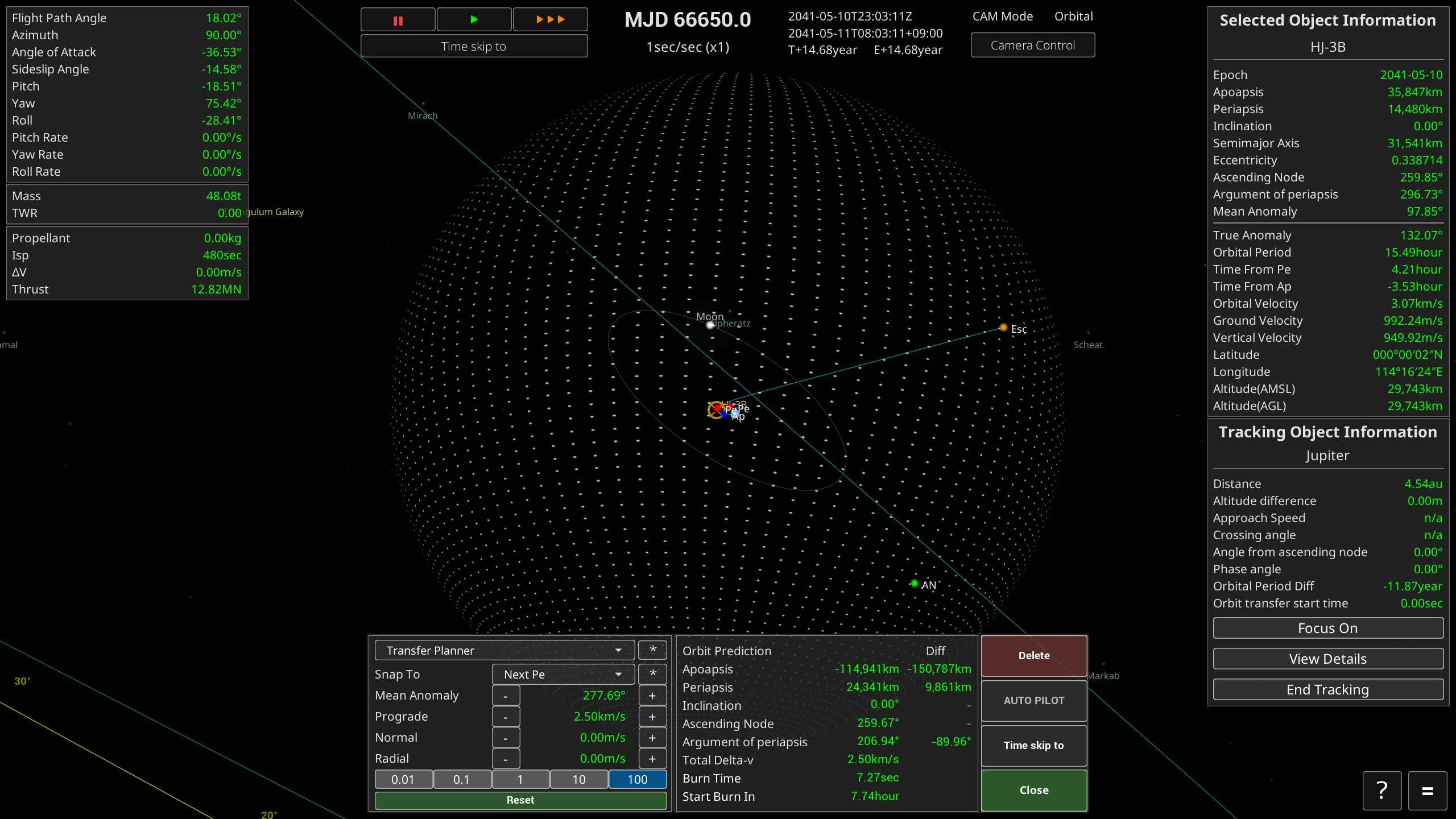
Spheres of influence are now shown for every body.
The points where your orbit leaves or enters a sphere of influence are now marked Esc / Enc instead of being labelled Ap.
When your sphere of influence changes, the camera moves to the new central body over about a second and pulls back to fit the new orbit on screen.
The time acceleration limit on hyperbolic and escape trajectories is now derived from how long you take to cross the sphere of influence, so fast departures can still be accelerated properly.
The tracked object's orbit line and markers now appear under the same conditions as your selected spacecraft's.
Engine Parts

Engine models have been rebuilt, with distinct surface finishes for the nozzles and the metal parts.
Improvements
Fixed parts sinking into each other while being dragged in the VAB with the camera pulled back.
Fixed auto-assembly failing to attach a part when an earlier part had been moved sideways.
The tutorial no longer lets you pick actions that are not part of it, and an interrupted tutorial no longer carries its progress into the next run.
Unified the "no value" text in the right-hand panel as n/a, and stopped showing negative values in red.
Reworked the list display in the maneuver planner.
Fixed the SAS tooltips. The German and Russian translations were cut off at the first comma, which left Normal and Anti-normal reading identically in Russian, and the first line was missing in nine languages.
Bug Fixes
Fixed automatic launch not reaching the orbital inclination matching the azimuth you set; target apoapsis and periapsis are more accurate as well. Note that the eastward velocity from the planet's rotation remains, so due north (azimuth 0°) does not give a 90° inclination — about 87° from a low-latitude site. Use an azimuth of 356–357° for 90°.
Fixed the Moon's orbital plane being tilted about five times too much, which put eclipses at the wrong time and place. Apsidal precession and nodal regression of the Moon's orbit now work as well.
Fixed relative figures such as the crossing angle being wrong while tracking the Moon.
Fixed Earth's atmosphere, clouds and ocean disappearing while the Moon was selected.
Fixed orbit lines being drawn as a twisting spiral for orbits with a low periapsis.
Fixed orbit lines disappearing while in orbit around the Sun.
Fixed maneuver markers pointing somewhere other than where SAS aims.