
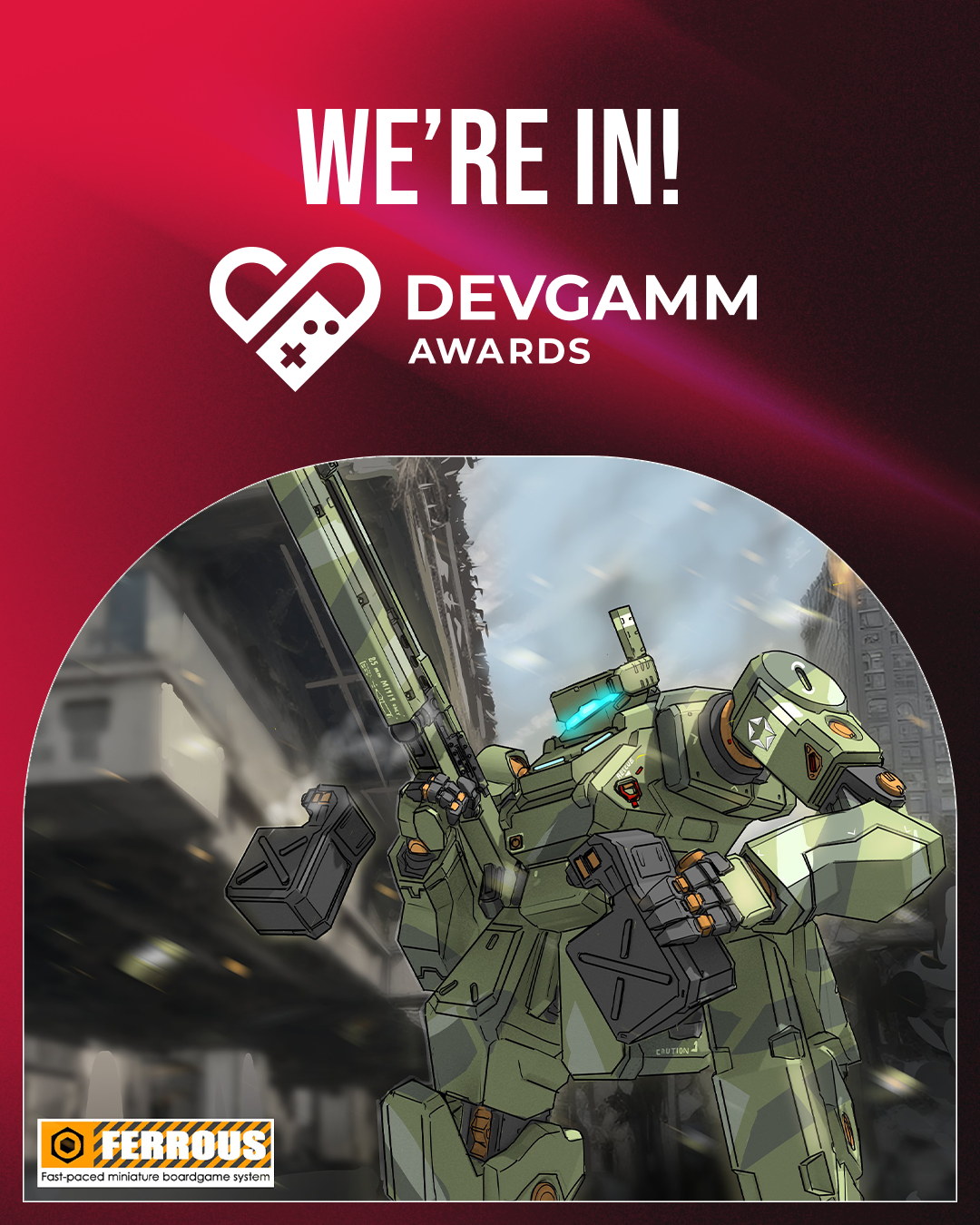
Ferrous is participating in DevGAMM Lisbon 2026! Our game has also reached another major development milestone coinciding with our latest patch release for Windows, Mac, and Linux versions of Ferrous: Digital Edition.
Multiplayer is now implemented, bringing player-vs-player battles into the core game alongside the existing single-player framework. With that foundation in place, a much broader range of battlefield content is now being integrated and supported.
New and expanded unit types now include:
• Gunwalkers
• Hardsuits
• Infantry
• Land Vehicles
• Air Vehicles
• The first Airships
• Installations & Buildings
The game now also supports multiple Game Types, allowing battles to use different objectives, deployment rules, and match structures rather than every scenario functioning as a standard engagement.
The presentation layer has taken a major step forward as well. VFX implementation is underway across combat and battlefield systems, while the transition toward fully animated units, as a player option, is ongoing. With that said customization is also expanding significantly:
Custom weapons are supported.
Unit skins are supported.
Hand-painted customization is on the way, allowing players to push their units beyond preset appearances and make them considerably more personal.
With these underlying systems coming together, development is increasingly shifting away from foundational feature work and toward the major content hurdles that will define the finished game and our path forward after DevGAMM, an event we also are releasing a new trailer for!
Ongoing Developments:
CAMPAIGNS
Campaign support is one of the largest remaining development milestones for Ferrous, and it is intended to go well beyond simply connecting a series of individual battles together.
The goal is to support both single-player and multiplayer campaigns, giving battles a larger strategic context and allowing the results of one engagement to influence what happens next. Campaigns will provide a framework for progression, force management, persistent units, mission selection, resource decisions, and the broader military situations surrounding individual tactical battles.
For single player, this means building structured campaign experiences around the factions, conflicts, locations, and history of the Ferrous setting. These campaigns will also provide a natural way to introduce mechanics gradually, establish the setting, and give individual units and commanders a greater sense of continuity across multiple missions.
Multiplayer campaign support is intended to take those same underlying systems and allow multiple players to participate in longer-running conflicts rather than isolated matches. The exact structure is still being developed, but the larger goal is to create a system where multiplayer battles can contribute to an ongoing war rather than simply ending when the match does.
Campaign development will therefore involve both new content and new supporting systems, and it represents one of the largest steps between the current battle-focused version of Ferrous and the broader game we ultimately intend to build.
GENERAL CONTENT INCLUSION
With many of the core gameplay systems now in place, one of the largest remaining tasks is simply filling Ferrous with the amount and variety of content those systems were built to support.
This includes additional units, weapons, equipment, pilots, maps, factions, environments, game types, installations, vehicles, aircraft, airships, visual effects, skins, and customization options.
The expanding unit framework now allows Ferrous to support a much wider battlefield than the original Gunwalker-focused implementation. Infantry, Hardsuits, conventional land vehicles, aircraft, airships, and static installations can all occupy different tactical roles, and future content will continue to build on those distinctions.
Weapons and equipment will receive similar expansion. The custom weapon system allows new armaments to be added without restricting units to a narrow set of predefined loadouts, while skins and upcoming hand-painted customization systems will provide additional visual variety.
Maps and environments are also a significant part of this work. Different terrain types, layouts, objectives, environmental conditions, and mission structures are important to making each battlefield feel meaningfully different rather than simply providing another arena for the same encounter.
At this stage, the challenge is increasingly less about proving that Ferrous can support these systems and more about producing, balancing, integrating, and polishing the volume of content needed to make full use of them.
DLC ROADMAP
Another major area of planning is the long-term content roadmap for Ferrous after the core game is established.
Because Ferrous is being built around modular factions, unit types, weapons, campaigns, maps, and game modes, the game is naturally suited to expansion. DLC can introduce substantial new content without requiring the underlying game to be redesigned each time.
Potential expansions may include new factions, additional military forces, campaign content, vehicles, Gunwalkers, aircraft, equipment, environments, maps, customization options, and other parts of the Ferrous setting that extend beyond the initial release.
An important part of this process will be deciding what belongs in the base game and what makes sense as future expansion content. The core release still needs to feel complete on its own, while later DLC should meaningfully expand the game rather than simply divide existing content into smaller pieces.
The roadmap will also need to account for how expansions interact with multiplayer. Compatibility between players, shared maps, faction availability, and ownership requirements all need to be considered carefully so that additional content expands the multiplayer ecosystem without unnecessarily fragmenting it.
This planning is still ongoing, but the intention is to establish a clear long-term structure for Ferrous rather than treating post-release content as an afterthought.
ADDITIONAL PLATFORMS
Ferrous is currently being developed primarily around its PC release, but additional platforms remain part of the longer-term plan.
That includes potential releases for mobile devices and consoles, each of which introduces its own technical and design requirements.
Console releases will require work around platform-specific input, user interfaces, certification requirements, performance targets, save systems, networking, and other platform services. Ferrous already supports controller-oriented gameplay concepts, but shipping on dedicated console hardware requires a much broader level of integration and testing.
Mobile presents a different set of challenges. Interface scaling, touch controls, performance optimization, memory usage, asset management, and the general pace of interaction all need to be reconsidered for smaller devices. The tactical structure of Ferrous can translate well to touch-based input, but the interface will need to be deliberately adapted rather than simply shrinking the PC version onto a smaller screen.
The broader goal is to make the underlying game as platform-independent as reasonably possible so that Ferrous is not permanently tied to one device or control scheme.
These versions will come after the core PC experience is sufficiently mature, but the architecture of the game is being developed with future platform expansion in mind.
There is still a substantial amount of work ahead, but the nature of that work is changing.
Many of the systems that once existed only as plans are now functional parts of the game. Multiplayer, expanded unit categories, game types, customization, visual effects, vehicles, aircraft, installations, and other supporting systems are creating a much larger foundation than the earlier versions of Ferrous had.
The next major phase is about turning that foundation into a complete game: building campaigns, expanding the playable content, refining presentation, establishing the long-term roadmap, and eventually bringing Ferrous to additional platforms.
Ferrous is steadily moving from a collection of individual systems into the broader tactical wargame those systems were created to support.
MOD SUPPORT
Mod support is also part of the longer-term direction for Ferrous.
A large portion of the game is already being built around data-driven systems for units, weapons, equipment, factions, maps, skins, and other content. That makes Ferrous a strong candidate for community-created additions once the underlying systems are stable enough to expose safely.
The long-term goal is to allow players to create and share their own content, potentially including custom units, weapons, skins, factions, scenarios, maps, balance changes, and other gameplay additions.
Exactly how deep mod support will go is still being determined. Some systems may be relatively easy to expose, while others will require additional tools, documentation, validation, and safeguards to keep custom content from breaking saves, multiplayer sessions, or core game systems. As development of the Mod Kit continues we will update you all.
Multiplayer compatibility is especially important. Modded content will need a clear way to determine whether players are using matching data, and the game will need to handle modded and unmodded sessions cleanly.
Steam Workshop integration is also being considered as part of this process, though the first priority is making sure the underlying modding framework is stable and practical before committing to a particular distribution system.
The intention is not simply to allow file replacement, but to build toward a modding environment where Ferrous can continue growing through community-created content after release.
MOVING FROM UNITY 2022 TO UNITY 6
Ferrous is also beginning the transition from Unity 2022 to Unity 6 as development moves forward.
Unity 2022 has served as the foundation for much of the game's current development, but moving to Unity 6 provides a more modern long-term base for continued development, optimization, platform support, and future engine updates.
This transition is not simply a version-number change. A project of this size relies on a large number of interconnected systems, including rendering, input, Addressables, multiplayer, animation, UI, asset loading, save systems, shaders, and platform-specific functionality. Each of these needs to be tested carefully as the project moves forward.
The migration will therefore happen with stability as the priority. Existing gameplay systems need to continue functioning correctly before new engine-specific features are relied upon.
Moving to Unity 6 also supports several of the longer-term goals for Ferrous, particularly continued performance work, broader platform support, improved development tooling, and maintaining the project on a current engine version as development continues.
The objective is to complete the transition without disrupting the existing game, while giving Ferrous a stronger technical foundation for the remaining development roadmap and eventual post-release support.
 Thank you for your ongoing support and thank you for playing! See you on the battlefield, pilots.