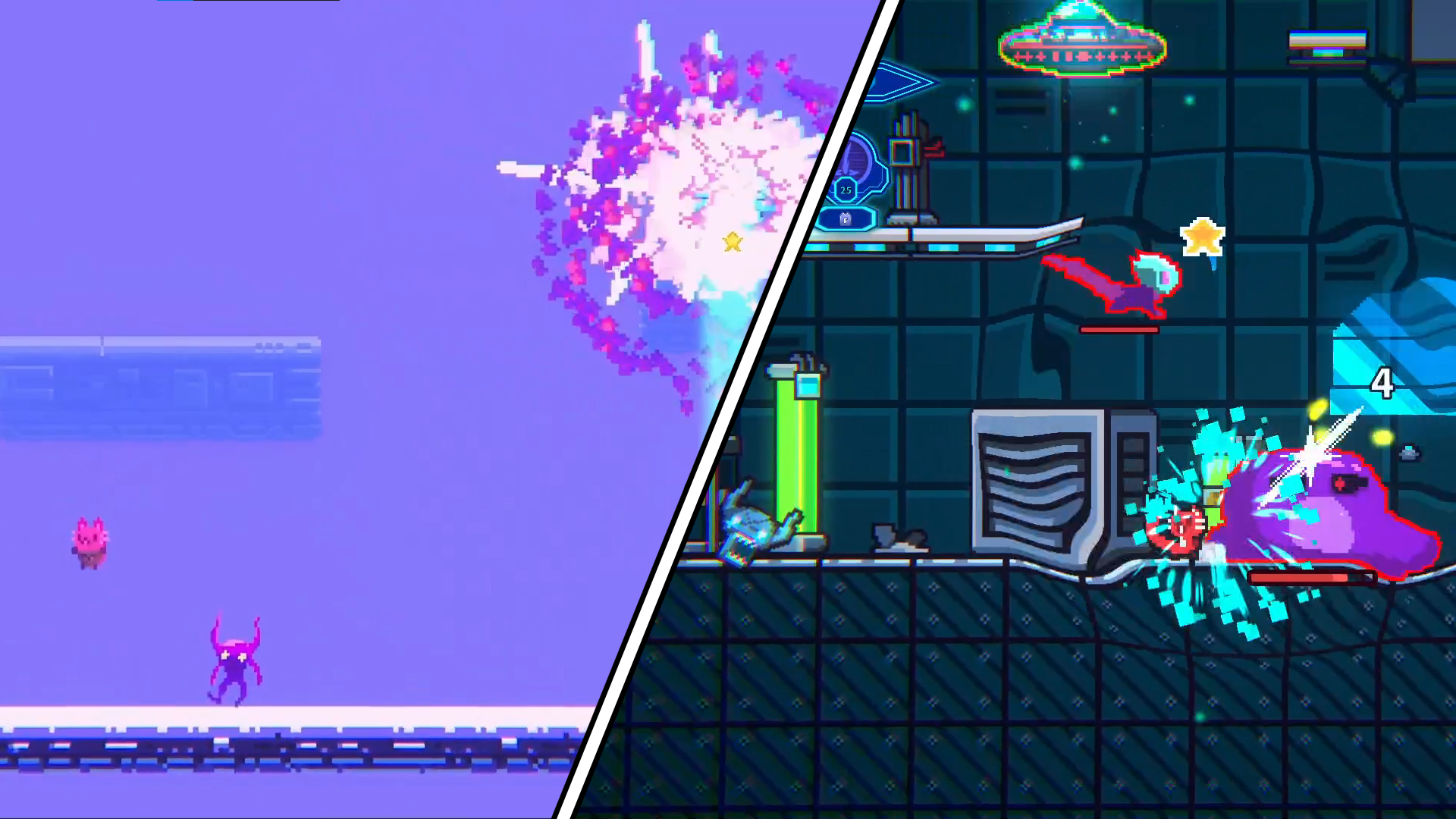
A space in Cat-Astrophy does not start with a beautiful background. It starts with a much more important question: What fun decision should Polo have to make here?
Before dressing every environment in pixels, we test what truly matters: movement, rhythm, enemies, platforms, distances, and possible routes. We want every space to have its own rhythm and combine different ways of playing, so moving through a planet never simply feels like going from one room to another.
⚔️ Combat: moments that test your reflexes, positioning, and mastery of the Cursor Estelar.
🪐 Exploration: optional paths, hidden corners, and small surprises for those who choose to look beyond the main route.
🧗 Platforming: sections where movement, timing, and precision matter just as much as combat.
✨ Discovery: secrets and rewards that turn curiosity into a real part of the experience.
We are not trying to fill every second with action. We want every second to present an interesting decision.
Good Spaces Tell Stories Through Gameplay
That is why, when we design a room, decoration is not where we start. First, we think about how Polo should move, where the player can land, which positions are safe, and where they might find an opportunity to attack.
We also ask questions such as: Can an enemy control a route? Is there an alternative path? Is it more worthwhile to move forward or stop for a few seconds to explore? These decisions shape the space long before the final art appears.
Because a room can look beautiful and still play badly. And that is precisely what we want to avoid.
From Functional Prototype to Full Planet
Our process starts very simply. First, we make it work. Then, we make it shine.
The first version of a room only needs the essentials: platforms, positions, enemies, distances, and routes. From there, constant iteration begins:
We adjust jump heights.
We move enemies and modify their positions.
We test alternative paths.
We shorten areas that feel too long.
We expand spaces that need more freedom of movement.
We remove elements that may look interesting but do not add anything meaningful to the gameplay.
We repeat the process until the room stops being merely functional and starts to feel good to play.
Only then can it become a real place within Polo’s universe.
When It Works, the Magic Arrives
Now the colors, shapes, backgrounds, effects, and all those little details that give each planet its own personality can finally appear.
A room that began as a functional test slowly becomes a real corner of Cat-Astrophy, integrated into a universe full of planets, dangers, secrets, and possibilities.
Gameplay first. Identity second.
Because to us, a good level is not simply a beautiful background with enemies placed on top. It is a space that supports movement, creates decisions, and rewards curiosity.
What Makes a Space Memorable?
Maybe it is an intense battle that forced you to react at the last second. Maybe it is a movement sequence that felt perfect. Maybe it is a hidden path you completely overlooked during your first playthrough.
Or maybe it is the combination of all three.
In Cat-Astrophy, we do not want our spaces to simply be different. We want them to be memorable. We want every space to have something to tell you, something to teach you, and, in some cases, something that makes you come back.
We want you to have a reason to move, a reason to pay attention, and a reason to wonder what might be behind the path you decided not to take.
Because before a space looks like part of a planet, it has to feel like part of Cat-Astrophy.
💬 What makes a level stick in your memory?
An intense fight, a particularly satisfying movement sequence, or a little secret that you discovered completely on your own?
We want to hear it. 👀