
Over the past days, we have been working on one of those systems that is rarely the first thing players notice – but makes an enormous difference to how believable a game world feels:
environmental audio.
Until now, sound sources in Dangerous Connections could sometimes be heard too clearly through walls, floors or even from several rooms away. A machine running behind a concrete wall could still feel as if it was standing almost next to the player.
For Level 1, we have now completely reworked this behaviour.
Before & After
The video below shows the difference directly.
The sound sources themselves are the same in both versions. In the first part, our new occlusion and reverb systems are disabled. In the second, the complete environmental audio system is running.
Suddenly, walls actually separate spaces acoustically. Machines behind concrete lose both high frequencies and volume, sounds around nearby corners remain partially audible, and different rooms develop their own character.
Dynamic Sound Occlusion
At the core of the new system is a real-time raycast-based occlusion manager.
For nearby 3D sound sources, the game continuously checks the acoustic path between the player and the source.
Depending on the geometry in between, a sound can be:
Open – there is a clear acoustic path.
Partially occluded – the source may be around a nearby corner or only partly obstructed.
Strongly occluded – walls, floors or other massive structures separate the player from the source.
The system does not simply switch effects on and off. Filtering and volume attenuation are smoothly blended, which helps avoid abrupt or artificial transitions.
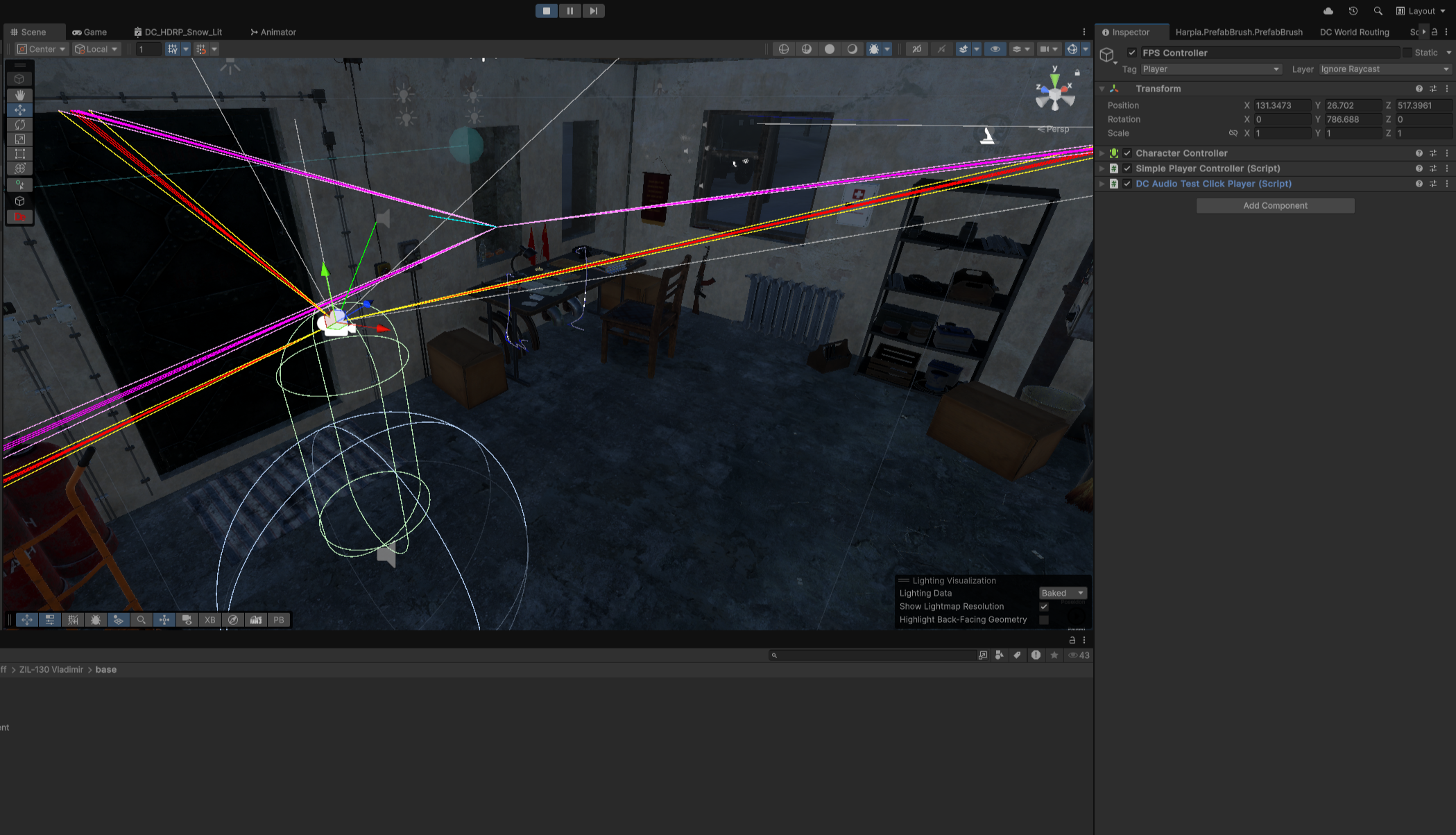
And yes – the debug view does look slightly like the Soviet Ministry of Sound has begun tracking every acoustic signal in the building. 😂
Sound Around Corners
One challenge was avoiding the opposite problem: making every sound disappear the instant a wall enters the direct line of sight.
Real environments do not behave like that.
A machine just around a corner should still be audible, while the same machine behind a long concrete wall should be much more strongly suppressed.
The new system therefore also checks additional paths around nearby geometry. This allows sounds to remain partially audible around corners instead of immediately being treated like they are behind a massive barrier.
The result feels much more natural while moving through corridors, bunkers and industrial spaces.
Doors Now Change the Acoustic Space
Moving geometry is also taken into account.
A good example is one of the sliding doors inside the production complex.
With the door closed, the machinery inside the room is strongly filtered and attenuated.
As the door opens, the acoustic path becomes available again and the original sound gradually returns.
When the door closes, the room becomes acoustically separated once more.
No separate fake sound source is required – the system reacts to the actual geometry of the moving door.
Room-Based Reverb
Occlusion was only one part of the overhaul.
Different indoor spaces now also use their own reverb characteristics.
A narrow corridor should not sound like a large production hall, and a bunker room should not sound like the snowy forest outside.
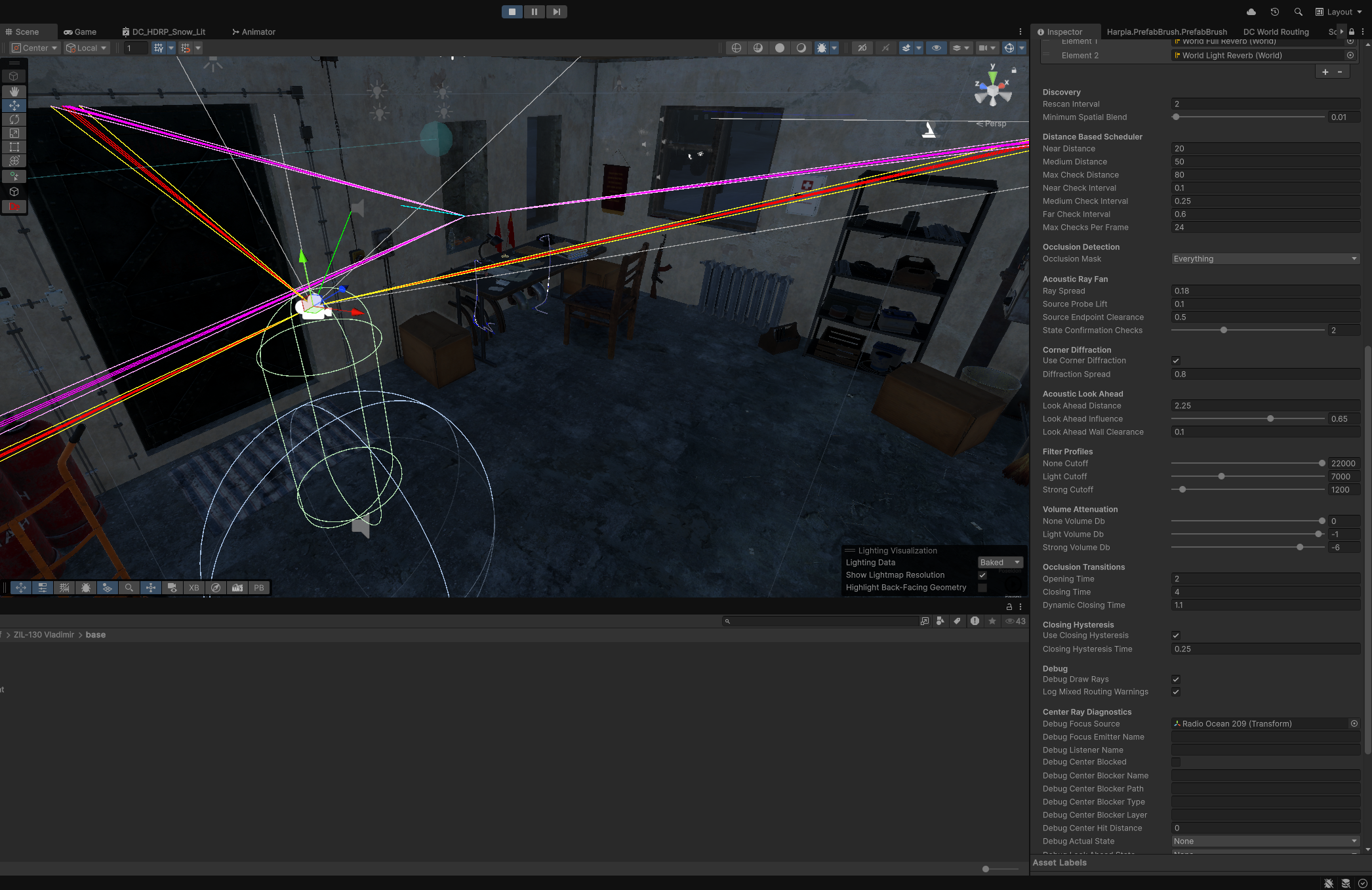
Our environmental audio manager now switches between different room profiles depending on where the player is located.
Large industrial spaces can produce much stronger reflections, while smaller rooms receive more restrained reverberation.
Interior and Exterior Ambience
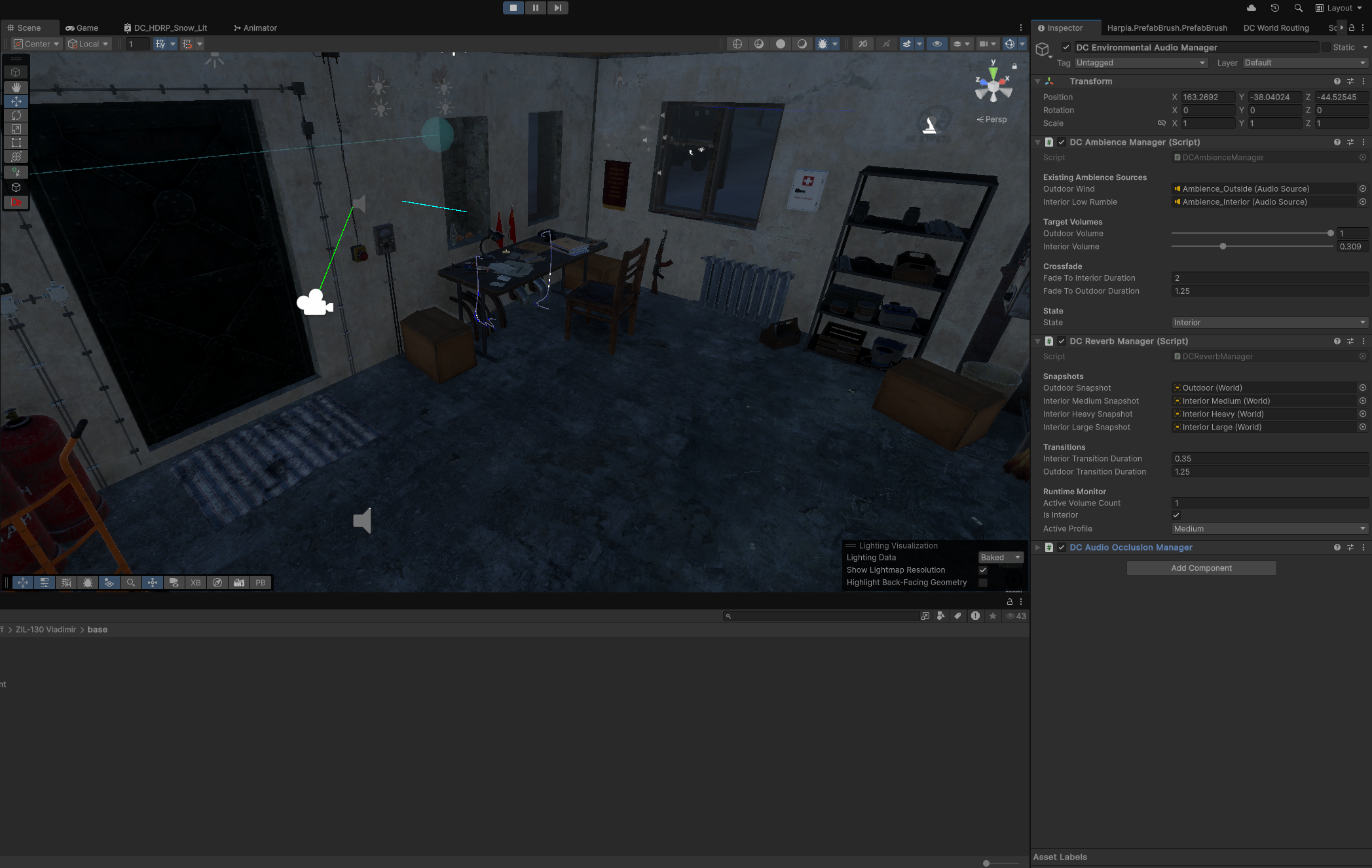
The background ambience itself also changes smoothly when moving between indoor and outdoor areas.
Outside, the snowy environment is dominated by wind.
Inside, the outdoor ambience fades away and is replaced by a much more subtle interior room tone.
This transition is intentionally gradual rather than instantaneous, helping the environment feel like one connected physical space.
A Small Detail With a Big Effect
None of this changes the mission design, weapons or story.
But together, these systems dramatically change how the environments feel.
A sound behind a wall now actually feels like it is behind a wall.
A machine in another room has distance and weight.
A large hall feels larger.
Opening a door suddenly connects two acoustic spaces.
It is one of those improvements that quickly becomes invisible once it works properly – because it simply feels like the world behaves the way it should.
With the environmental audio overhaul complete, another major part of Level 1 is now checked off. ✅
More development updates soon.
Dangerous Connections is a story-driven single-player FPS set during the final years of the Cold War.