Hello, Commanders!
This is I M GAME.
Change in periodical devlogs and previews
Starting this September, we’ll be sharing a monthly newsletter covering the development of Master of Piece throughout Early Access.
Until now, our update announcements have mostly focused on newly added features and content, as we assumed those were the updates players were most eager to see.
However, Early Access development isn’t always about creating something new.
We continue to receive a great deal of feedback from our players—and we can’t thank you enough for it. A lot of our development time goes into fixing, adjusting, and polishing systems that are already in the game.
These changes may not always look as significant as a brand-new feature, but they are just as important to making Master of Piece the best version of itself by 1.0.
With these monthly newsletters, we want to share more of that development process with you.
The newsletters may include the following development-related sections:
Work in Progress — Improvements and changes being made to existing parts of the game.
Deep Dive — A closer look at the game design and development behind existing systems and features.
Sneak Peek — A preview of upcoming features or content.
We’ll also occasionally include some lighter, non-development sections:
Master of Piece Statistics — Player data, analytics, and interesting insights from your journeys.
Synergy Spotlight — Useful Trait combinations you might want to try in your next run.
Not every newsletter will include every section, but we hope this gives us more ways to show you what’s happening behind the scenes.
Work in Progress: Endless Mode
The Twisted World
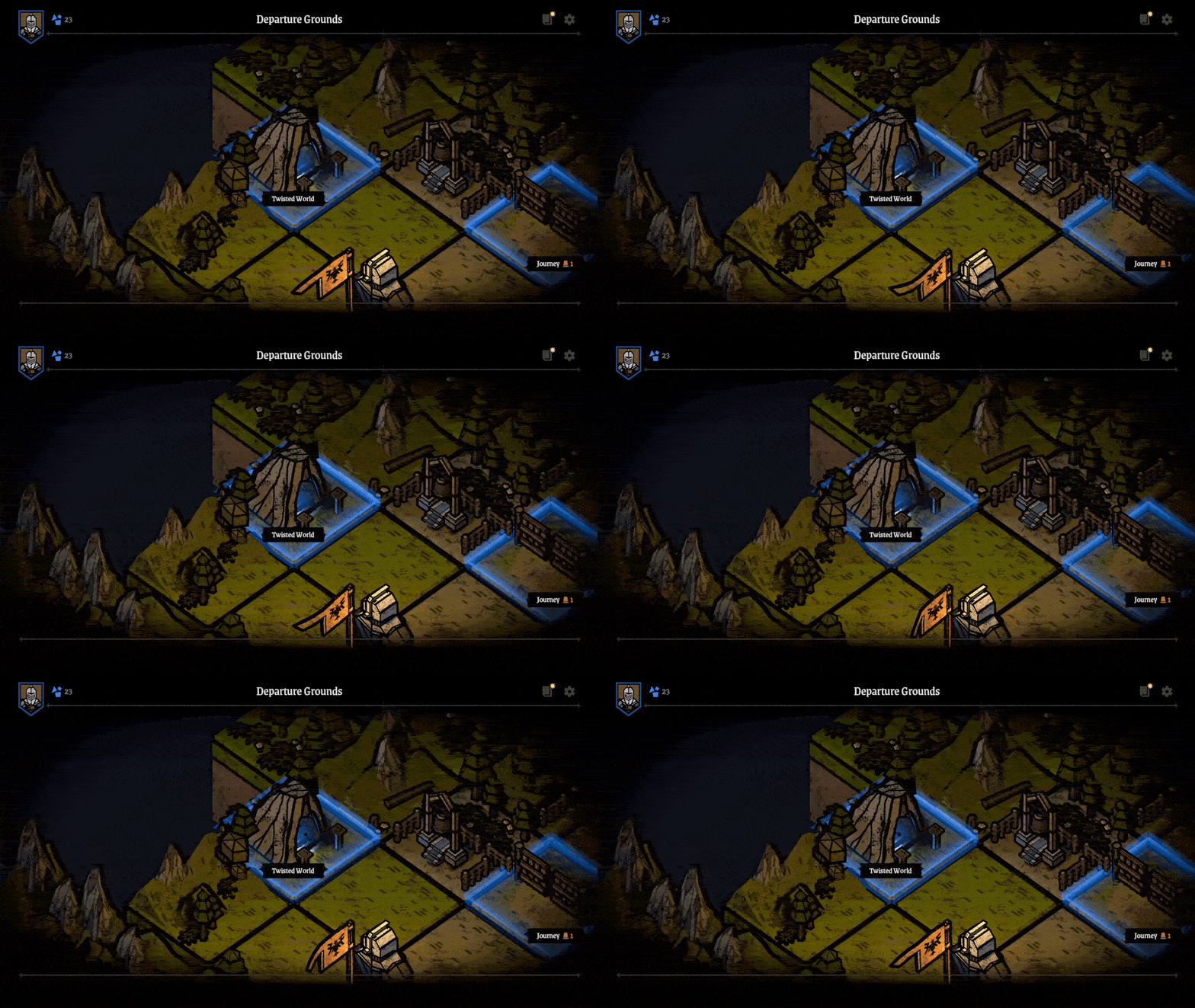
A strange cavern has appeared near the Departure Grounds.
Beneath the collapsed fissure lies a place untouched by light, opening into an unfamiliar landscape that somehow resembles our own world.
Everything there is distorted.
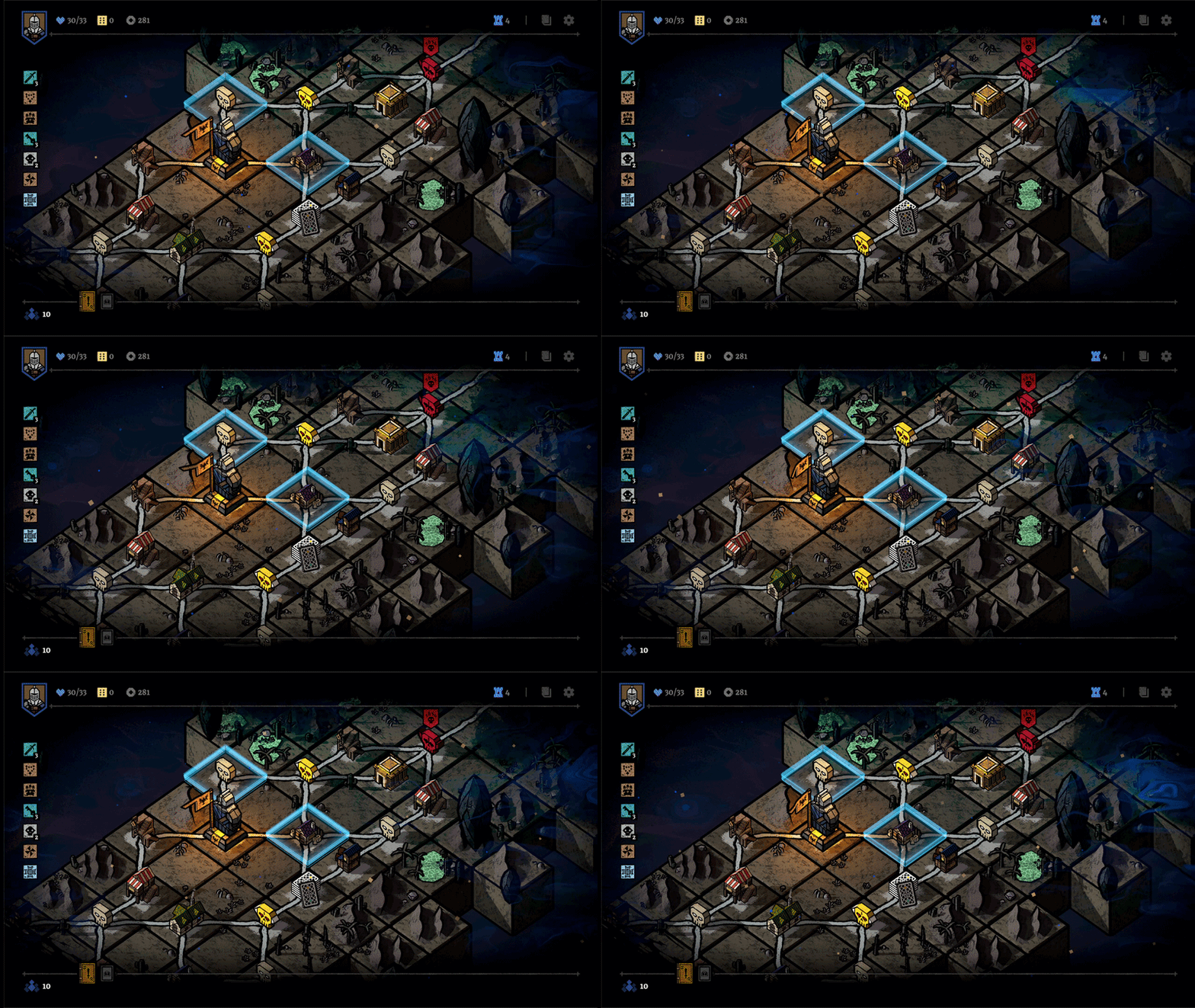
Regions are tangled together in an order that makes no sense. Roads already traveled may suddenly appear before you once more, while places yet unseen can emerge without warning.
Nor can the people found within be spoken to properly. They do little more than repeat words whose meaning cannot be understood. Though they wear the shape of men, it is difficult to say whether they are truly alive at all. Their voices drift between the same broken phrases and stretches of silence, as though caught in a sentence that can never be completed.
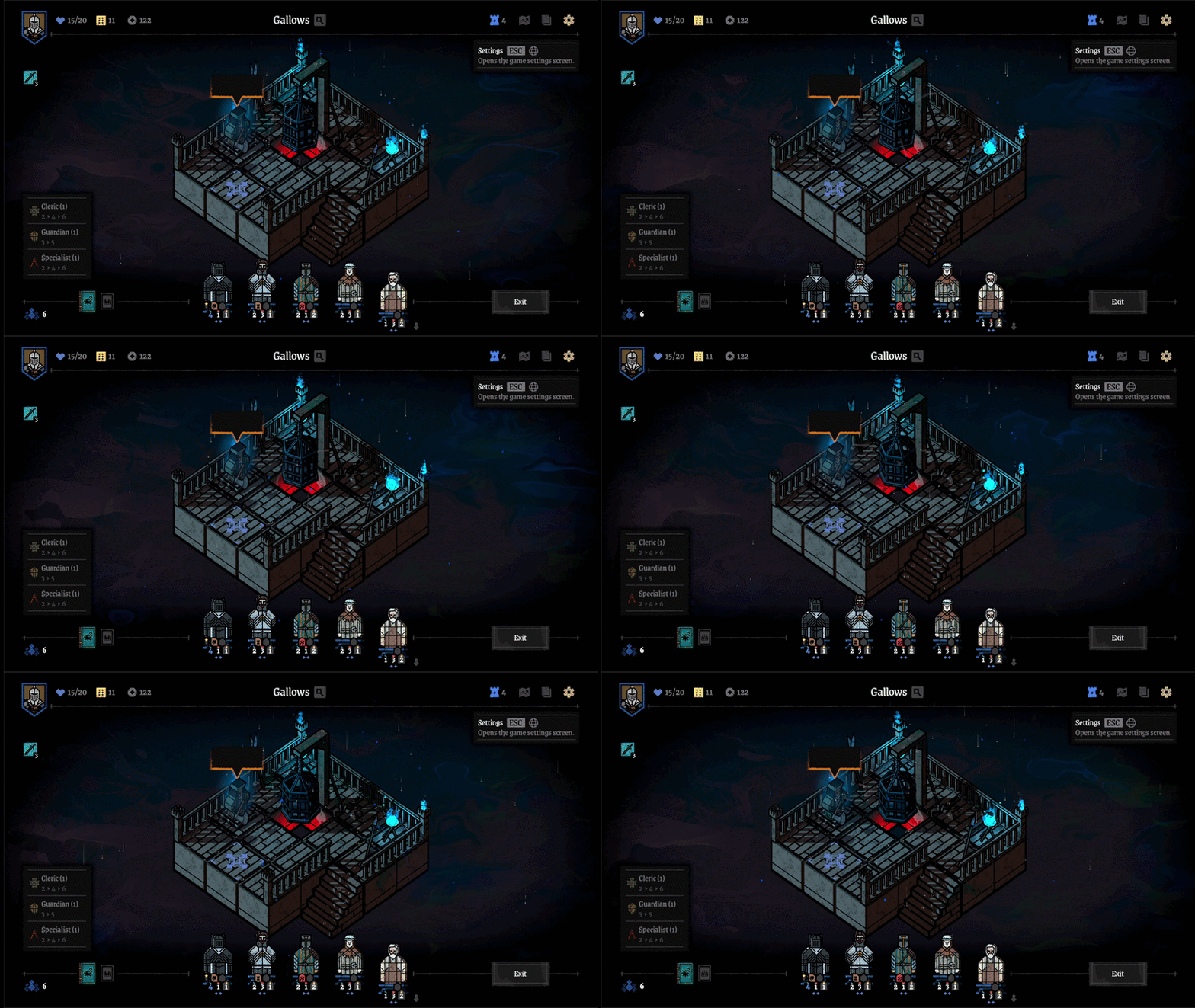
No one yet knows how far those roads extend, nor the nature of the strange force that fills the air.
Only one thing is certain.
The Twisted World continues onward, trapped within an endless cycle with no end in sight.

Ever since the release of the demo, we’ve seen many players ask for an Endless Mode—a place where they can continue fighting stronger and stronger enemies until they eventually reach something they can no longer overcome.
Maybe that happens in Region 20, 50, or somewhere around Region 86, where the enemies have become completely ridiculous.
We also felt that, as a roguelike deckbuilder, Master of Piece needed a mode like this.
One of the most satisfying parts of a deckbuilding game is reaching the point where everything comes together. You find the right Pieces, Traits, Relics, and synergies, and suddenly your build feels so powerful that it almost breaks the game.
And once you have a build like that, one question naturally follows:
“How far can I take this?”
The Twisted World is designed to answer that question.
Much like endless modes in other roguelikes, the Twisted World lets you continue testing and developing your build against enemies that become increasingly powerful as you progress.
How far do you think your deck can go?
Major Characteristics of the Twisted World
Regions appear in a randomized order.
Your first region could be the Ember Chasm, Duskwind Plains, or somewhere else entirely.
Enemy stats are adjusted through level scaling, so starting in a late-game region doesn’t mean your journey will immediately end in the first battle.
The world becomes increasingly dangerous as you progress.
Enemies, bosses, and obstacles will all grow stronger the farther you travel.
Winning battles rewards you with dice.
Endless Mode is about creating your ideal build and pushing it as far as possible.
To give players more opportunities to shape that build, each battle victory will reward you with an additional die.
A Key Design Decision
One of the first questions we discussed while designing Endless Mode was:
Should it continue directly from a normal journey, or should it be a completely separate mode?
There are obvious advantages to letting players continue from a regular journey.
You could take the powerful build you naturally developed during your run and immediately see how far it can go. That ultimate combination of Pieces, Traits, and Relics wouldn’t have to end just because the normal journey was over.
But there is also an important downside.
If Endless Mode directly follows a regular journey, players may begin building their decks specifically for Endless Mode from the very beginning.
A synergy that works well for completing a normal journey may not necessarily be the best choice for surviving dozens of additional regions. If players are constantly thinking about what they will need much later in Endless Mode, it could change how they approach the regular game itself.
In other words, Endless Mode could begin influencing the normal journey before players even reach it.
That wasn’t what we wanted.
So we want the two modes to serve different purposes.
Endless Mode
A place to test the power and limits of your builds.
The level scaling will work differently from a regular journey, meaning players may need different synergies and strategies to keep progressing.
And because the purpose is to see just how far a build can go, we want to leave room for clever combinations to become absurdly powerful—even to the point where they feel like they are “breaking” the game.
That is part of the fun.
Regular Mode
The regular journey remains the intended core experience of Master of Piece.
Its difficulty, pacing, Final Boss, and Ordeal system are designed around providing a complete journey with a clear beginning and end.
Rather than asking, “How long can this build survive?”, the regular mode is about whether you can overcome the challenges placed in front of you and successfully complete the journey.
Keeping the two experiences separate allows us to balance each around a different goal.
This is just one of the design questions we’ve been discussing while developing the Twisted World, and we’ll have more to share as development continues.
Master of Piece Statistics
Since the beginning of Early Access, we’ve been collecting gameplay data to help identify potential problems and areas where Master of Piece can be improved.
But some of that data is also simply fun to look at.
So from now on, we’ll be sharing a few statistics in each newsletter to give you a glimpse at how everyone else is playing.
See how your own journeys compare!
Who Did Players Choose for Their Journeys?
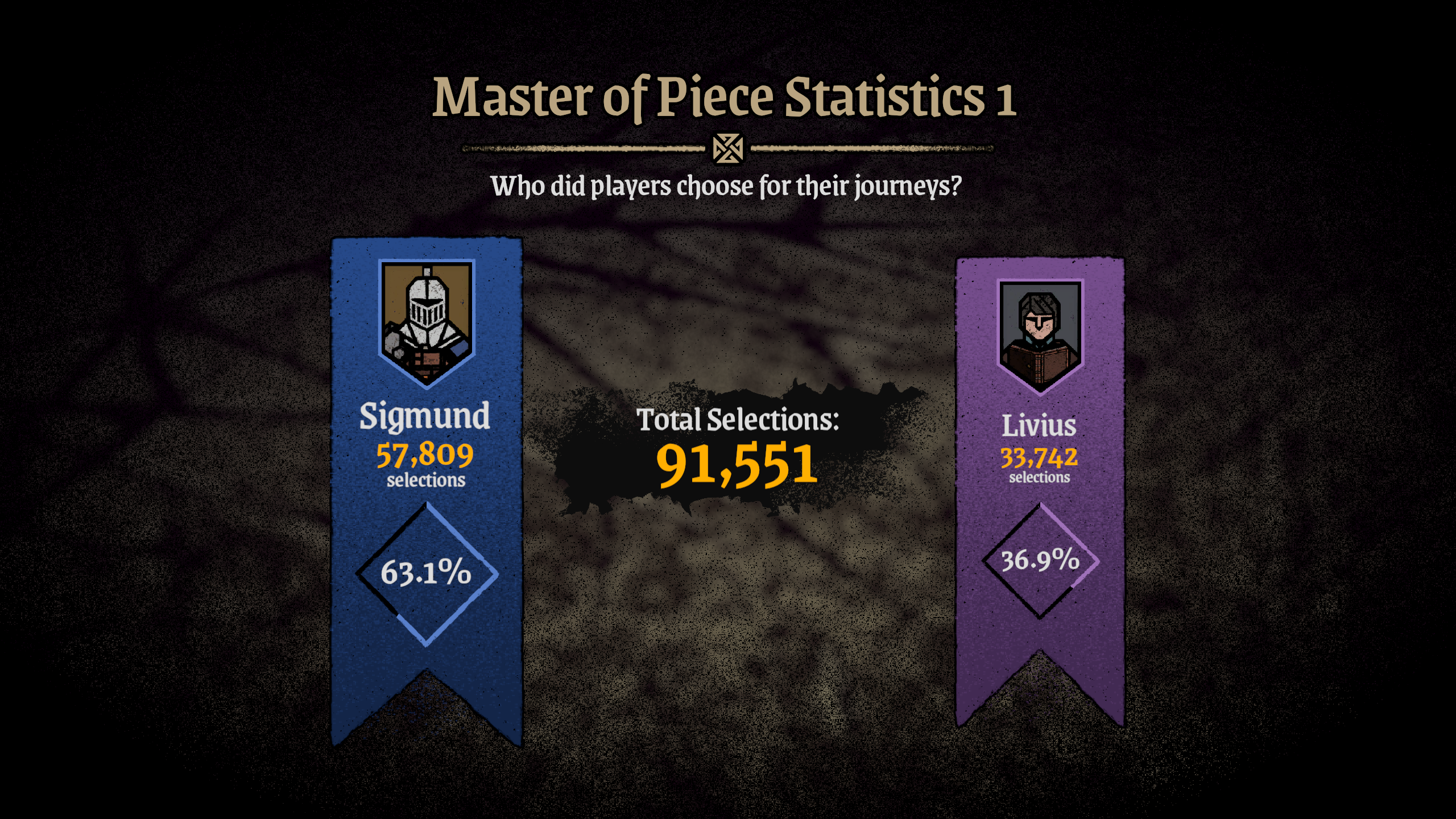
Sigmund: 57,809 selections — 63.1%
Livius: 33,742 selections — 36.9%
Sigmund takes first place as the most-selected Commander in Master of Piece.
Perhaps not the most surprising result, considering he is also the first Commander players get to play.
Still, Livius has claimed more than a third of all Commander selections.
Most-Visited Building Events
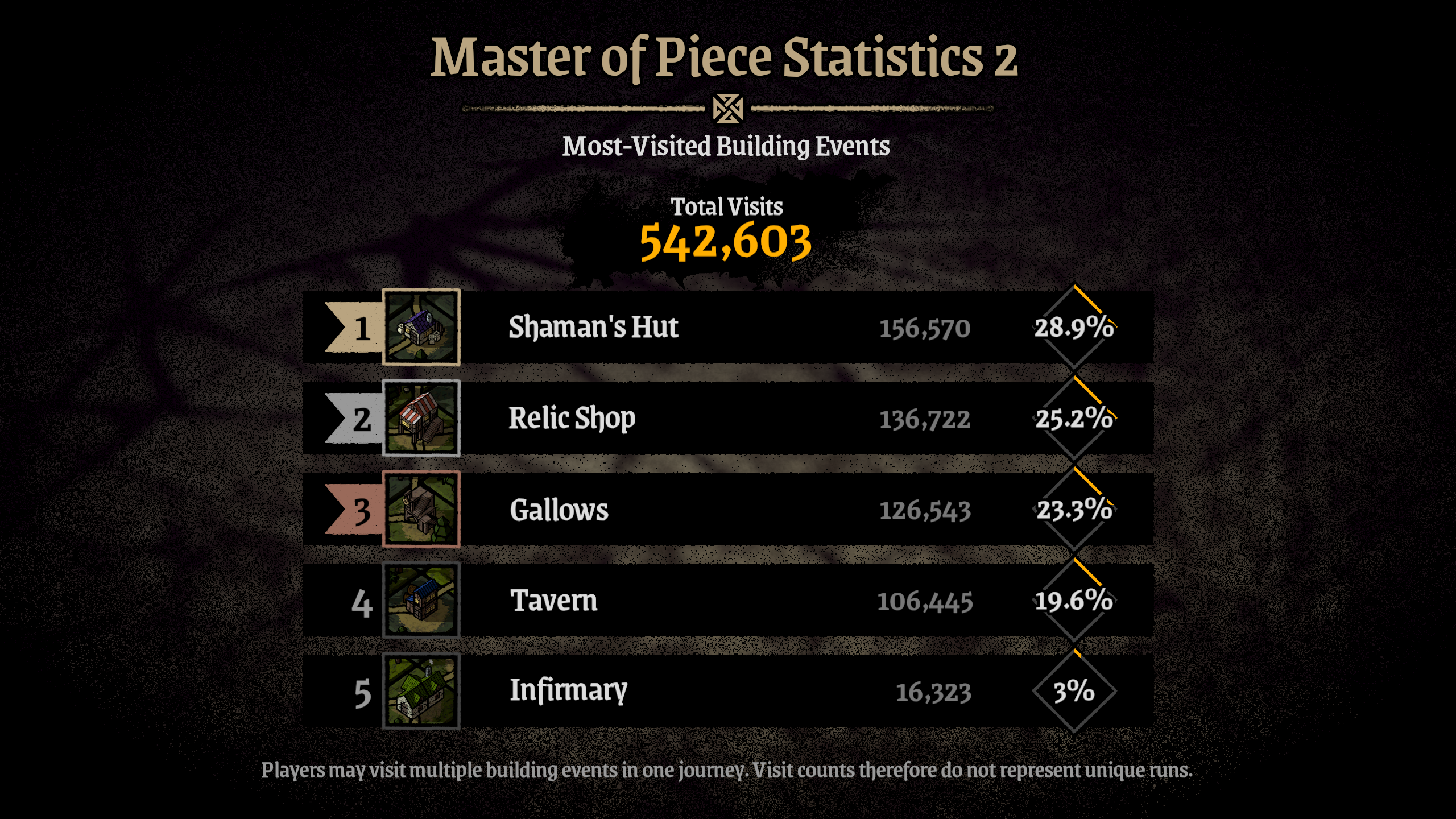
Shaman’s Hut: 156,570 visits — 28.9%
Relic Shop: 136,722 visits — 25.2%
Gallows: 126,543 visits — 23.3%
Alehouse: 106,445 visits — 19.6%
Infirmary: 16,323 visits — 3.0%
Note: Players can visit multiple building events during a single journey. These percentages represent each building’s share of total building-event visits, rather than the percentage of journeys in which the building was visited.
To our surprise, the Gallows was not the most frequently visited building.
Instead, the Shaman’s Hut took first place.
One possible reason is that its benefit is extremely intuitive:
Walk in. +1. Walk out.
The same may be true of the Relic Shop.
Walk in. Pick a Relic. Walk out.
Simple.
The Gallows is a little different.
From a design perspective, we consider it one of the most powerful ways to strengthen your Pieces. Combining two synergistic Traits onto a single Piece can create some extremely powerful combinations.
But at first glance, the Gallows may simply look like a place where you sacrifice one of your Pieces and lose it forever.
Which, admittedly, does not sound particularly appealing.
The Infirmary, meanwhile, stands out for the opposite reason.
At just 3.0% of total building-event visits, it is visited far less often than any of the other buildings.
One possible explanation is the way most players approach combat. Since Pieces usually stand between the enemy and the Commander, much of the game naturally revolves around protecting the Commander before they take damage in the first place.
If your Pieces are doing their job, increasing or restoring the Commander’s HP may simply feel less valuable than strengthening the Pieces that are protecting them.
In other words, why prepare to take more hits when you can try to stop those hits from reaching the Commander at all?
Sneak Peek
Last but not least, here’s a small sneak peek at something we are working on: