
Hello all!
The next update has been released - 0.9.0. This update largely focuses on the addition of the initial version of government mechanics, but also comes packed with a completely new UI, the addition of a bunch of new art and assets, and an initial foray into allowing moddability (which sets the groundwork for translations as well).
As before, here's the shortlist of the features that have been added, with more in-depth discussion below:
Laws and Acts - Pass laws (representing core values of a country) and acts (discretionary additional decisions)
Government types - Generated from the laws that have been passed in a country, some government types will need to pay more attention to faction power, influence, and favoribility, while others can act with through executive power with impunity
Factions - Aristocrats, Peasants, Zealots, Technocrats, Luddites, Industrialists, Workers, Financiers, Imperialists
Head of Government - Either elected or inherited based on laws
Leaders - Usually representing a faction and their candidates for the Head of Government
Various government mechanics and ways to interact with factions
UI overhaul with new visuals and colors
Buttons, notifications, many other assets improved
Dynamic effects for pictures
Added portraits representing leaders
Minimap represents real state of the game map
Initial mechanics for modding - Includes portraits, leader names, and leader lore occupations
New loading screen
Country lists are always sorted alphabetically
Improved map visuals, with a focus on oceans
Government Mechanics
For a while now, interacting with your own country has been somewhat limited mainly to economic and military development. Government and its related mechanics hopefully will help to add more peacetime activity, help players to mold their country more interactively, and let players see the changes to their country as time and technology progresses. The main facets of government have been designed to have an interplay between laws/acts, faction interest groups, and the head of government. To assist this, a new "resource" has been added in the form of "political power" which ticks up slowly and allows various political actions to be performed.
Head of Government
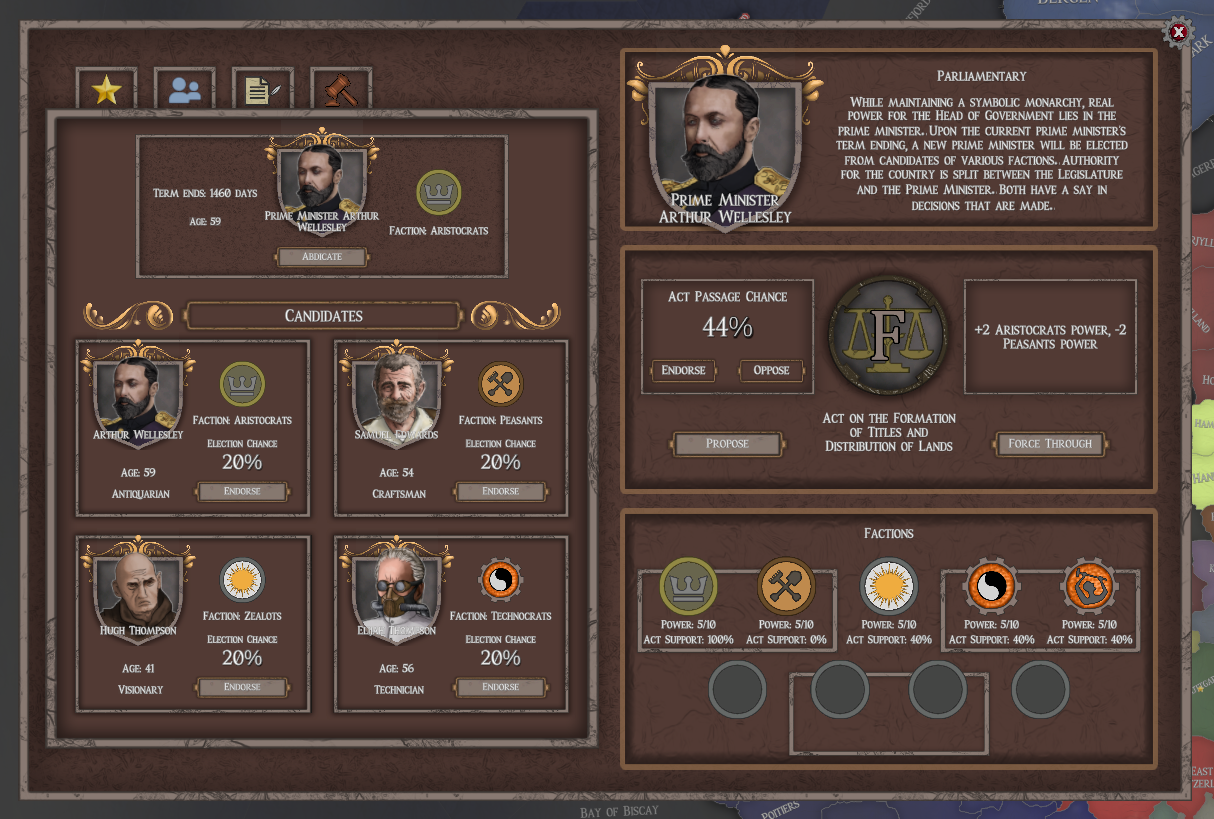
Each country now has a Head of Government that acts as the main executive of government power. If the legislature is abolished, the monarch can decree with little resistance, however factions will still react to those actions. If the legislature exists, passing acts or laws will require their support, or a state where factions have been reduced in power.
The type of Head of Government depends on the laws that have been passed, mainly the Inheritance laws and Legislature laws. For example, a country where inheritance is hereditary and the legislature is abolished will be determined to be an absolute monarchy where the king reigns until death or abdication. Likewise, A country where the inheritance law is "Elected" and the legislature exists will be a democracy with a president where a candidate is chosen from the pool of candidates every four years. The election chance of candidates is also determined by the power of the faction they represent and if they have been endorsed.
Initially, most countries start with some form of monarchy, but technology progress allows additional forms of government to be considered with different ramifications. Countries also start with (relatively) historical leaders and government types. Some countries that have their starting lore explored to some degree (Australian Commonwealth, British Empire, France) will have ahistorical leaders that take their place in the setting.
Also excitingly, I now have an artist that is working with me to help produce the portraits and some of the higher quality assets that are seen!
Factions
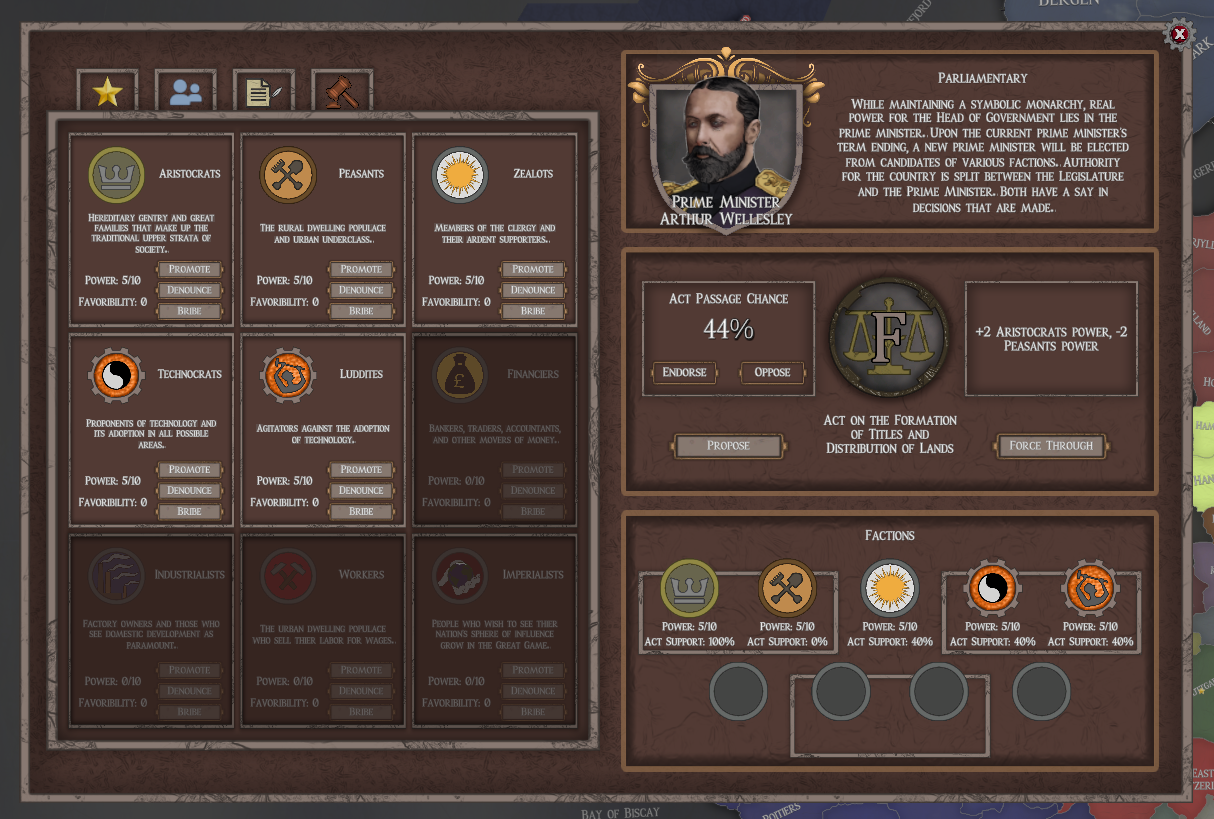
Factions are meant to portray some of the competing interest groups that exist. I found this approach to be more universal from country to country and shows the different interests of people beyond political parties. In universe, political parties may be mentioned or named in the future in events, etc. but in my mind they act as more of a facade for true interests that are portrayed as factions in this setting. Currently, the factions that exist are:
Aristocrats - Hereditary gentry and great families that make up the traditional upper strata of society
Peasants - The rural dwelling populace and urban underclass
Zealots - Members of the clergy and their ardent supporters
Technocrats - Proponents of technology and its adoption in all possible areas
Luddites - Agitators against the adoption of technology
Industrialists - Factory owners and those who see domestic development as paramount
Workers - The urban dwelling populace who sell their labor for wages
Financiers - Bankers, traders, accountants, and other movers of money
Imperialists - People who wish to see their nation's sphere of influence grow in the Great Game
Factions have two main values - power and favoribility. Power is simply how much influence they have in the nation's politics and favoribility is how much "good will" they have to the current ruling government. In the future, these values will fluctuate more often depending on actions taken and events, but currently they are relatively static except for player intervention.
Laws & Acts
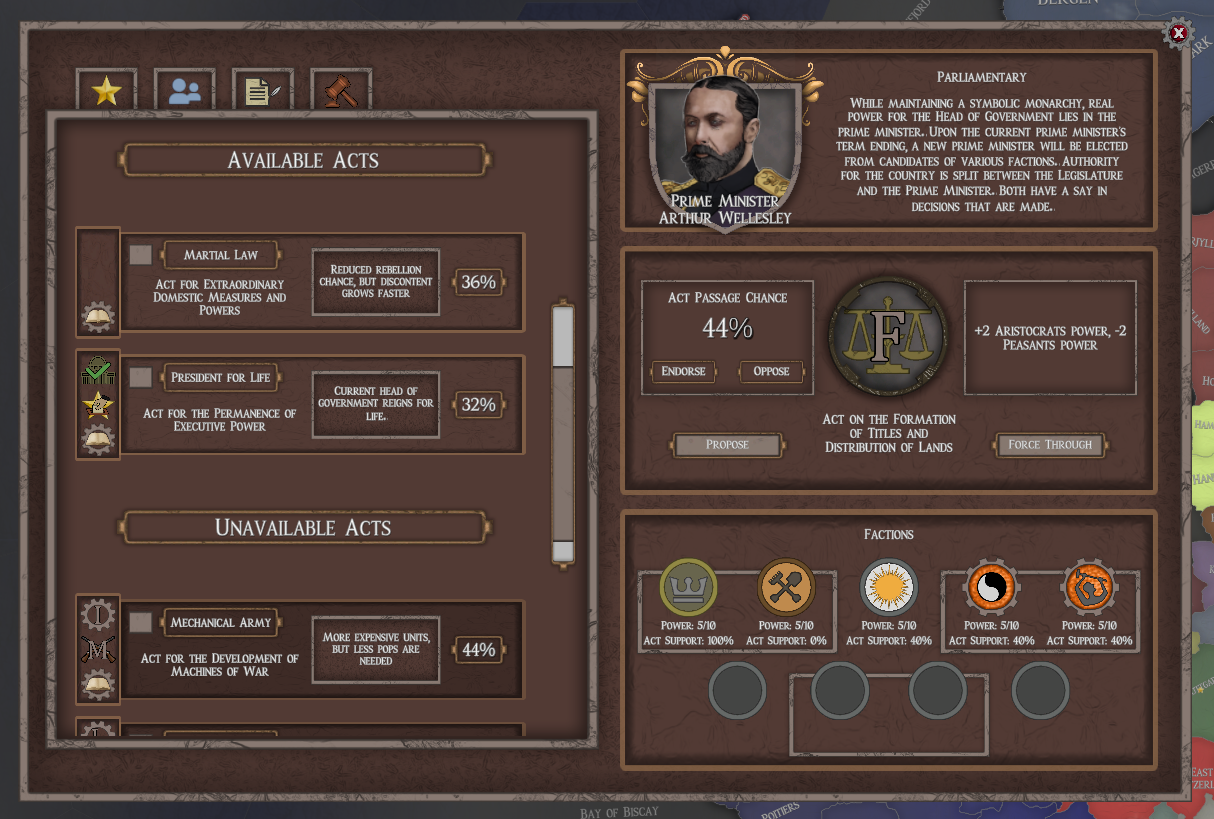
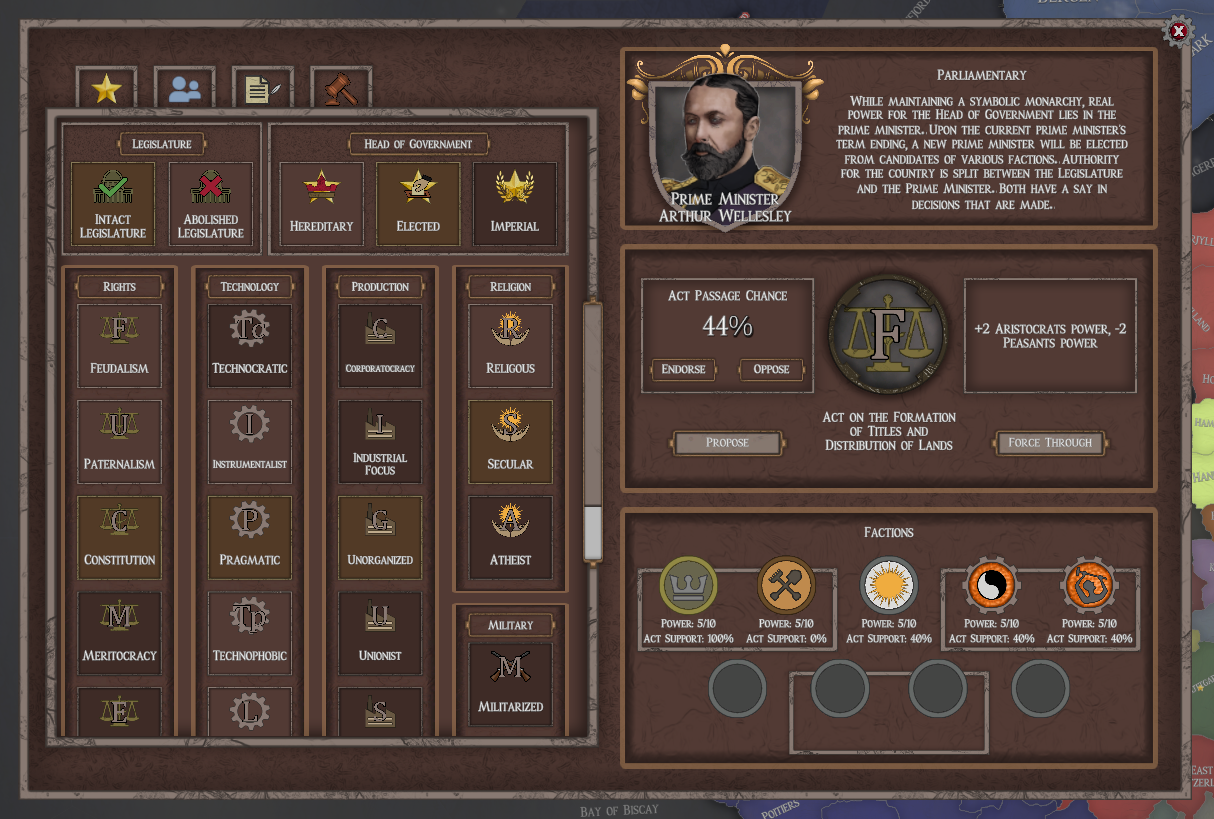
Laws and acts both consist of pieces of legislation that can be chosen and come with specific requirements and effects. Laws make up the "core" of the country and represent things such as if the country has a legislature, how the country approaches technology, civil rights, and more. Acts are more discretionary, but also come with usually a technology requirement and passed law requirement. So a country that has "Luddic" as a law can not pass the "Mechanized Army" act because they have an aversion to technology, but they will have access to the "Mass Mobilization" act. Currently, there are not many acts as the main focus was getting the mechanics in place, but this will also be changed in the future. Factions will also respond to the laws passed more actively in the future.
UI Overhaul
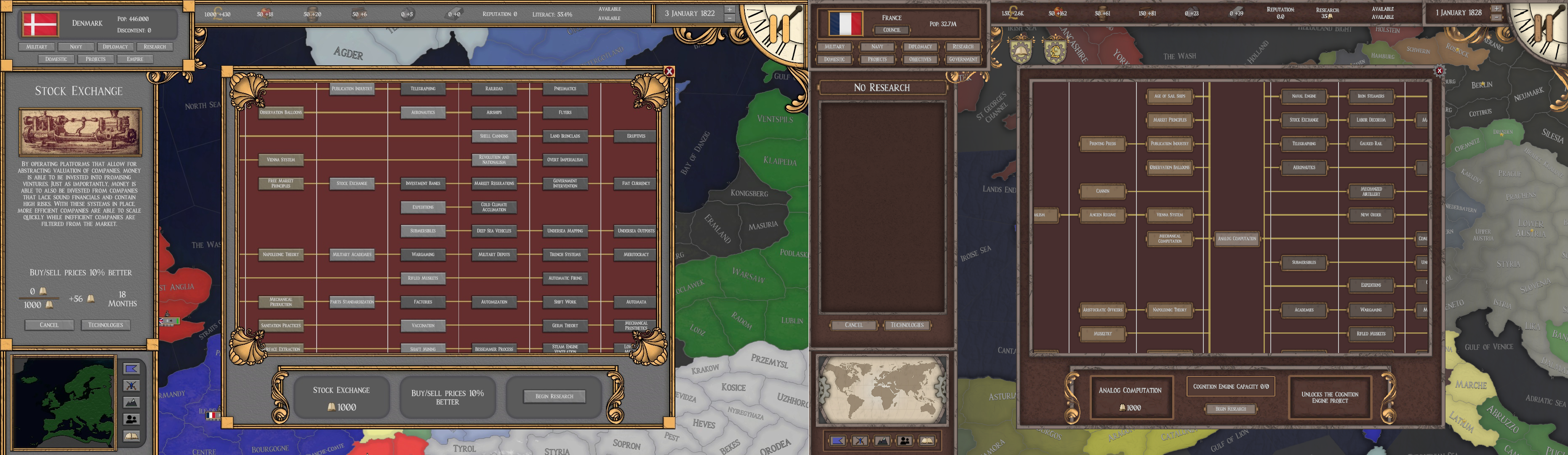
As you can probably tell in the above screenshots, the overall look has been drastically altered. This was done in order to have a more industrial look of leather and steel which I felt matched the Steampunk setting much better. Below is an example of the change, and every UI interface reflects this change now. Many more higher quality assets have been created to support the change including buttons, notifications, and most decorations. Overall, I'm very pleased with the changes. Some tweaking will most likely continue going forward as the UI feels like it can always be improved, but this was a huge change that I think fits the setting much better.
Moddability
The first efforts have been made to support easy modding by exposing parts of the game files to the user. With modding, there's lots to consider with how outside information is integrated into the game at runtime. Firstly the information needs to be exposed to the user in a way where they can change it and the game needs to know to look there first, and if it is formatted incorrectly, to use the default values instead because something like an update can obsolete a mod and break the game, not mention someone having multiple conflicting mods installed. The main pipelines have been created to support this now in the code, but it will be much work to de-hardcode many of the values in the future to support something like a translation - though this is definitely a goal.
Initially to test the modding pipeline, leader portraits, leader names, and leader lore occupations have been left exposed to the user in the "StreamingAssets" folder and should be able to be changed as long as the changes follow the formatting used in the exposed files.
Wrapping Up
The next update(s) I plan on being slightly smaller and filling out many of the government and other mechanics more fully without breaking save games like large updates like this sort of have to (sorry!). Thanks everyone for following along and hope to be back soon with more!