
Hi there!
Several of you have asked me about the choice of a hexagonal grid design for a real-time strategy game. I therefore felt it was important to dedicate a Devlog to clarifying this rather unusual design choice for the genre, on which I decided to build my game. TLTR is at the very end of the post. ⬇️
Foundation: History
In the past, I've had the desire to offer games rich in history. To design games that appeal to young schoolchildren or adults passionate about learning more about historical culture. I still hope to one day create educational games for future generations.
Building around history isn't always easy and can be complex. Just think of all the resources used to create the game maps for Assassin's Creed. That being said, a historically inspired map doesn't necessarily mean the game is historically accurate. The spectrum of historical accuracy can be very broad.

Being a game designer for a historical game is a highly complex challenge. Between my programmer's aspirations, the precision of historians, and the rigor of players, a fierce optimization battle is being waged. No one wants to give an inch. With this in mind, I rely on a fundamental design choice in my game: discretization (working in increments). Everything in my game is discretized: time (every 15 minutes), the number of soldiers (in increments of 5), the hexagonal grid, morale (in increments of 10%), fatigue (per level), ammunition (per level), and so on.
This gives me some leeway regarding the level of historical authenticity represented in the game. Mentioning that "ammunition level is low" avoids having to specify that there are exactly 82 bullets remaining, when the precise historical information is unknown. The hexagonal grid works the same way; it's there to indicate that the unit was approximately in that area of the battlefield at a given time, rather than at a precise, specific location. The same applies to biomes (rivers, forests, fields, mountains, etc.), for which it's often difficult to find accurate information.
As a developer, player, and history enthusiast, the irony of the game is that I desire high historical accuracy but can't present it without presumption: historical facts are therefore presented with imprecise accuracy. What a contradiction! Essentially, it's a design choice I made for the sake of communicating the accuracy of historical facts.
Board Game Style
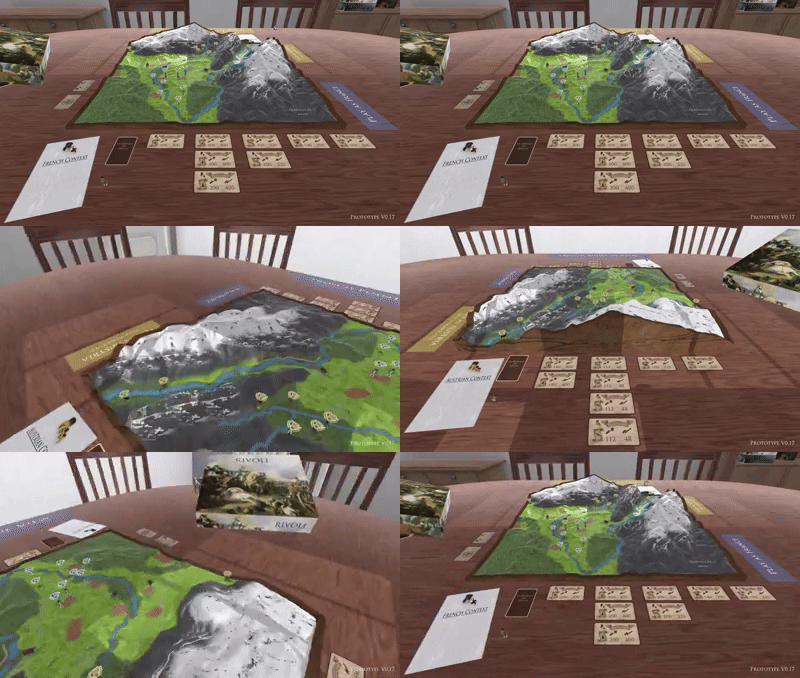
Another reason for the hexagonal grid's existence is its "board game" aesthetic. As a big fan of board games, I took the liberty of adding a personal touch and incorporating this design into the game. As you've noticed, the game is based on a distinct visual style, reminiscent of a board game like Catan Universe. This aesthetic element adds depth and relevant context to the gameplay. The hexagonal tiles, of course, emphasize this unique visual aspect of the game.
So, why real-time?
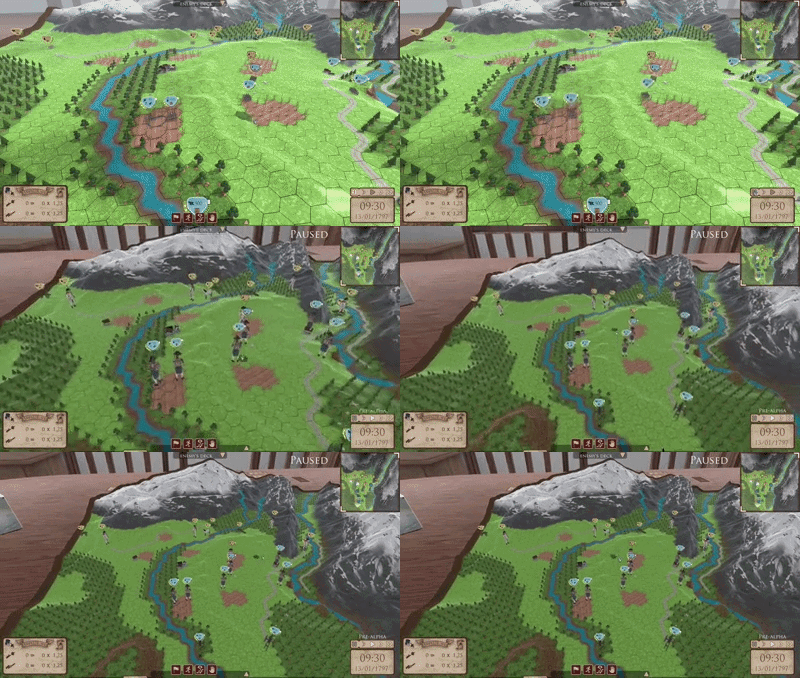
Why didn't I choose to make a turn-based game instead of real-time? My aim is for you to feel the pressure exerted by the enemy army's movement and to have to adapt and take responsibility for your own choices and mistakes. Once the battle begins, your choice isn't about planning what will happen each turn, but rather about reacting to events unfolding on the battlefield.
Contrary to my initial plan, I'm still allowing you to pause the game, because you made it clear during playtesting that this is a feature you value. Furthermore, it helps mitigate the drawbacks of the interactivity inherent in video games. This means that, in addition to having to manage absolutely everything, you also have to deal with the delays caused by the game's controls. This can rightly make you feel a sense of injustice, as you feel limited by the game and not by your own abilities. In short, allowing you to pause ensures that the game isn't the cause of your defeats nor your scapegoat.
Easy to Learn
My goal is to make Avant-Garde: Napoleonic Battles accessible to new players looking to get into the strategy genre. RTS games aren't always easy for beginners to grasp. To introduce RTS games and the story of my battles to a wider audience, I've decided to introduce simpler mechanics for the Padawans of our RTS universe.
By using a hexagonal grid, choosing destinations, movements, and formations becomes clearer and more intuitive. It's easy to understand the advantages and disadvantages of the terrain, as each cell has its own attributes. There's no room for interpretation. Unit orientation and attack range are easier to analyze, since they are clearly defined by the hexagons.
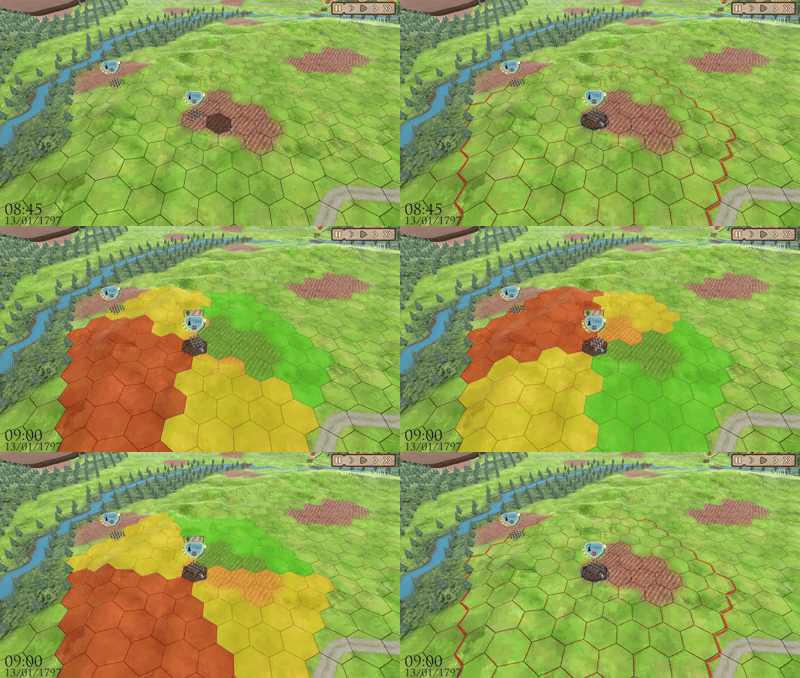
In fact, it's also to make the game easier to learn that I wanted to implement two types of attacks, which you can use at any time during combat.
One is for simplified orders, where a single click is all it takes for the unit to automatically maximize its movement and positioning.
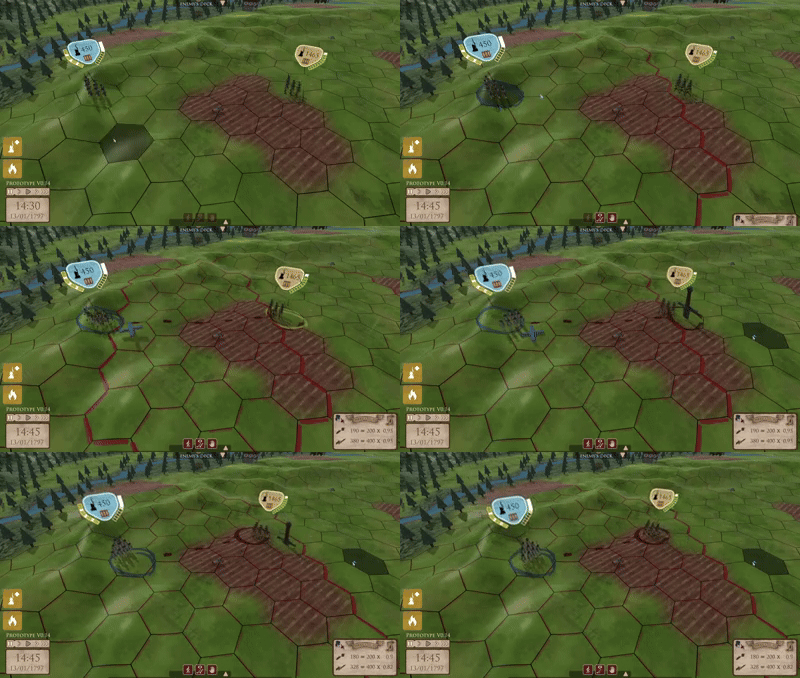
And one for precise orders, for more complete strategic command where you dictate precisely to your unit its actions to be executed.
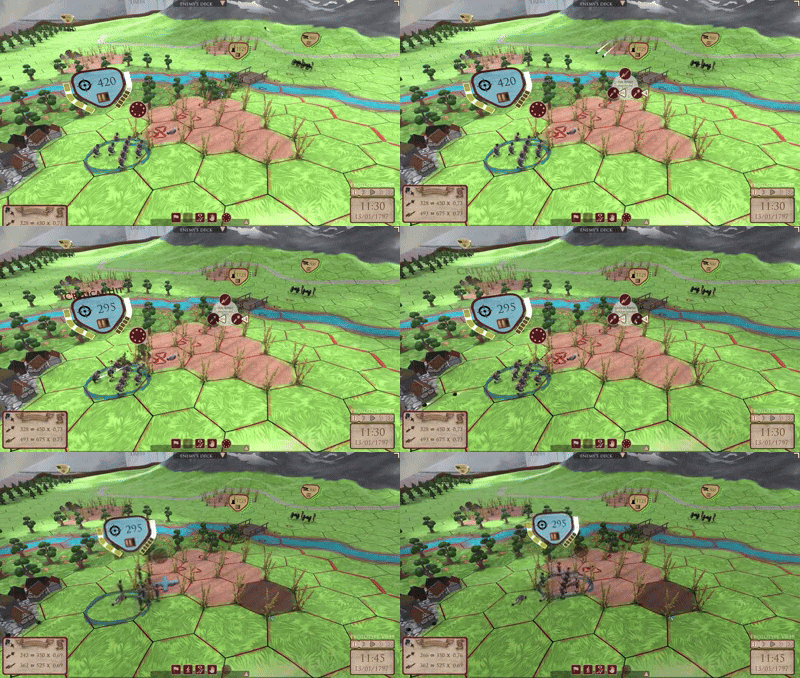
So whether you are a beginner or an expert in RTS, the field of glory is within your reach.
[TLTR]
In summary, developing a real-time strategy game based on a hexagonal grid is a unique design choice grounded in the game's main objectives:
Accurate and clear communication and transmission of historical facts
A distinctive "board game" visual style
Easy to learn and play
An experience where you must adapt and bear the consequences of your actions
Here's a short video summarizing the content of this Devlog for those who prefer visuals to complement the information.View game page
Feel free to share your opinion and give me feedback; it's always greatly appreciated!
Take care!
Thomas Crozet