
Greetings, scholars!
Last entry we finished with Qin; this entry we cross over from Ba Commandery, follow the river down, and look at Chu—then follow the coast north and look at Qi.
The two houses of the eastern half of the world walked different roads. Chu's land was too large—so large that one king could not hold it alone, and he could only enfeoff his clans to hold it for him; Qi's land was not rich, but what was rich was the sea and the roads, so it staked the state's fortune on buying and selling. Both houses propped up the state with clans, yet their methods were far apart. Chu divided the state among three families; Qi gripped the state in one.
This entry has two legs: first how Chu divided and how it held, then how Qi turned goods over and how it profited.
[I. The Land Too Large]
How large Chu was, a persuader once calculated for it. In the "Biographies of Su Qin" in the Records of the Grand Historian, Su Qin goes to persuade King Wei of Chu to join the vertical alliance, and opens by reciting its four boundaries:
To the west it has Qianzhong and Wu Commandery, to the east Xiazhou and Haiyang, to the south Dongting and Cangwu, to the north Xing Fortress and Xunyang—five thousand li across, a million men in armor, a thousand chariots, ten thousand horsemen, and grain to last ten years.
West to Qianzhong and Wu Commandery, south to Dongting and Cangwu, five thousand li across, a million men in armor, and grain to last ten years.
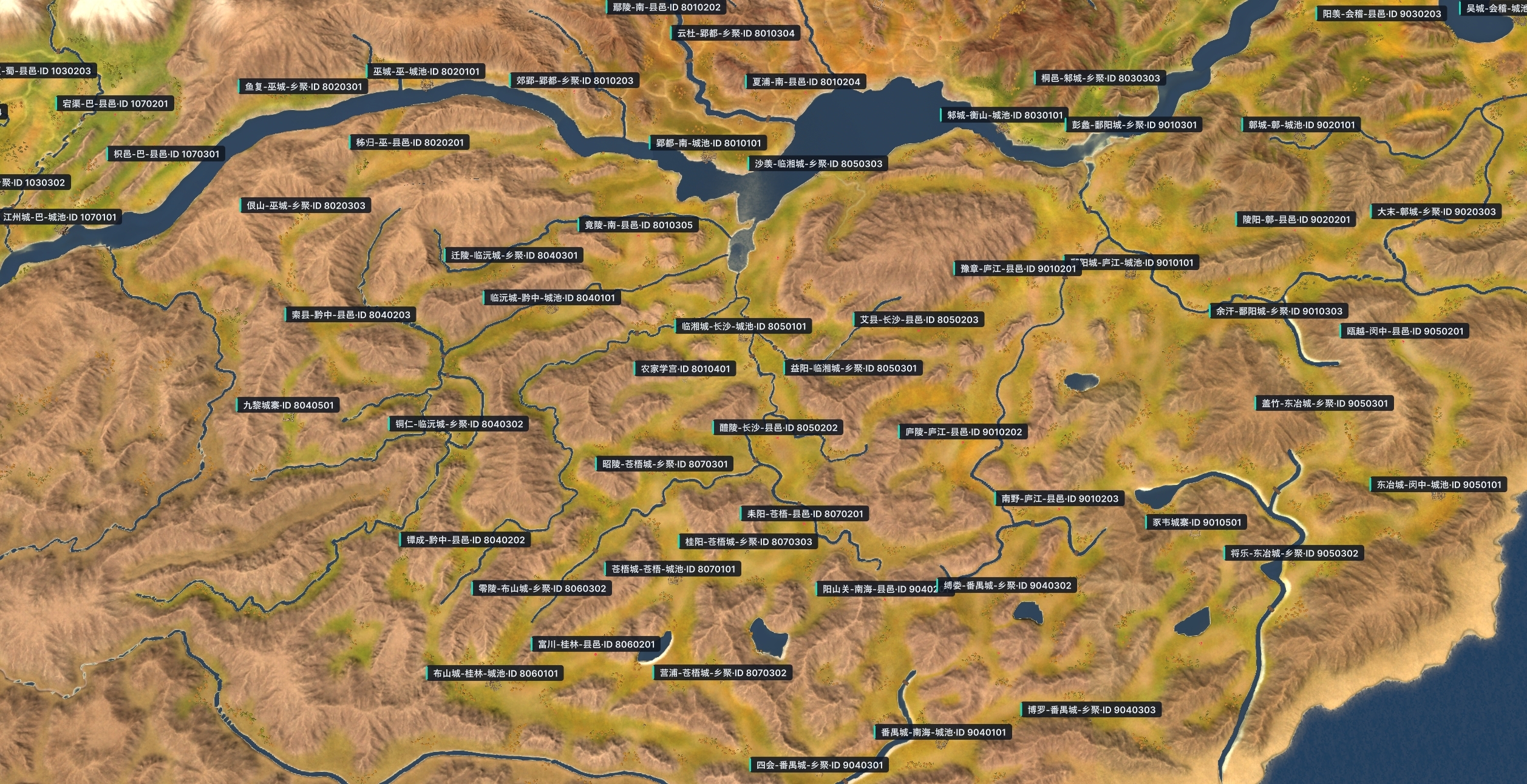
On our map Chu has fourteen commanderies and eighty places, holding all of Jingzhou and all of Yangzhou, plus Jiujiang Commandery in Yanzhou and Ba Commandery in Yongzhou. Of the map's nine provinces, this one house spans four; no other house spans more than two.
The "Biographies of the Money-makers" in the Records of the Grand Historian, on the goods of the south, opens with:
The land of Chu and Yue is broad and thinly peopled; people eat rice and soup of fish, and sometimes burn the brush and weed the water.
Broad land, thin people. Fourteen commanderies spread across eighty place names is under six places to a commandery; in Chu's southernmost commanderies there are only four or five to a commandery, and beyond them are only wild mountains and great marshes. One king, a piece of land that size, and not many people in the middle of it.
Many commanderies, but they are not equal in weight. What truly holds Chu up is the ring around Lake Dongting: Nan Commandery, where the capital Yingdu sits, Changsha, and Wu Commandery, which holds the mouth of the Three Gorges to the west. These commanderies crowd together, and taxes, grain, and soldiers all come out of them. The rest each spread four or five place names, and most have a single city flying a flag.

[II. The Three Ducal Clans]
The land was too large; one king could not hold it alone, so someone had to hold it for him. What Chu used was the clan.
The families that held power in Chu were always branches of the royal house itself. The "Biographies of Qu Yuan and Jia Sheng" in the Records of the Grand Historian opens with:
Qu Yuan, whose personal name was Ping, was of the same surname as the kings of Chu. He served King Huai of Chu as Left Councillor.
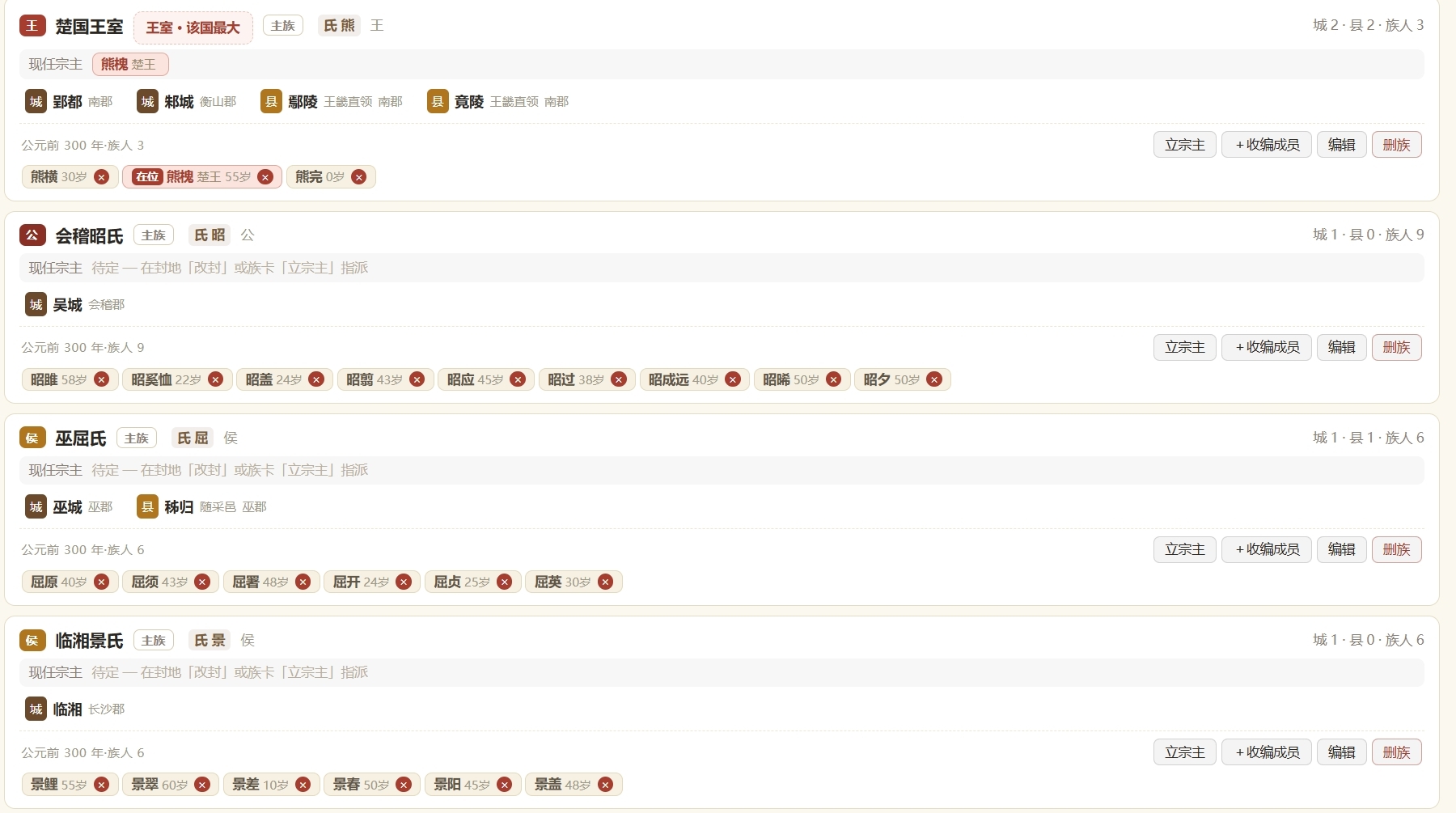
Qu Yuan's clan name was Qu, the same surname as the kings of Chu. The Qu clan came out of the descendants of King Wu of Chu and was enfeoffed for its support at a place called Qu, and only then took Qu as its clan name. Alongside the Qu were the Jing and the Zhao. Qu, Jing, and Zhao were the three great ducal clans of Chu from the Warring States onward.
These three each hold a piece of land on the map, placed so that together they ring Chu around. The Qu clan is enfeoffed in Wu Commandery in the west, holding the mouth of the Three Gorges; the Jing clan is enfeoffed at Changsha, called the Linxiang Jing clan, holding Lake Dongting and the Xiang River; the Zhao clan is enfeoffed at Kuaiji, called the Kuaiji Zhao clan—land newly gained after the destruction of Yue. Of the three pieces, the Changsha one matters most. Around Dongting lies Chu's grain region, and the waterways south and west all pass through this ring.
What the three held was not only land but office. Of Chu's generals who led troops and its chief ministers who ran the government, many came out of these three. In 312 BC Chu and Qin fought a battle at Danyang; the Chu commander was Qu Gai, the Chu army was crushed, and Qu Gai was taken prisoner. Counting further back, Zhao Xixu, Zhao Yang, and Jing She are all names of these three clans.
Below the ducal clans there is one more layer. On the map there is a group of enfeoffed lords who hold only a single county—Jinling, Luling, Luo County, Liling, one family fed by one county. Qin registers its people household by household, so one man of Qin is one soldier or one farmer, directly under his lord; Chu handed out land layer by layer and let the clans manage themselves. When the moment really comes, the king has to go and ask them one family at a time.
[III. One River, One Capital]
Chu's great stretch of land was strung together by a single river.
Yingdu, in Nan Commandery, is the capital of Chu. Nan Commandery's ten places make it the most completely laid out commandery Chu has. Westward, up the river and through the Three Gorges, it reaches Wu Commandery and Ba Commandery; eastward, down the river into Jiangdong, it reaches Yangzhou's five commanderies. Across several thousand li from west to east, the Yangtze is Chu's only trunk line. The "Biographies of the Money-makers" in the Records of the Grand Historian has a line that says exactly this:
Jiangling was the old capital Ying, reaching west to Wu and Ba, and holding the richness of Yunmeng to the east.
From Yingdu west it reaches Wu Commandery and Ba Commandery, and east it joins the great marsh of Yunmeng. When Chu moves troops or moves grain, it moves on this waterway.
Chu's expansion eastward also went by this river. Jiangdong was originally the land of Wu and Yue; Chu destroyed Yue around 306 BC and took this coastline under its own name. Wucheng in Kuaiji Commandery is Wu's old capital, and old Wu sites like Tiger Hill and Sword Pond and the remains of the Battle of Fujiao still stand in this stretch; Dongye in Minzhong Commandery and Ouyue to the south are the old lands of the Yue people. Both states' flags are gone, and their names stayed on Chu's table.
Water is fast, but there is only one of it. Yingdu is at the western end; Kuaiji in Jiangdong and Nanhai in Lingnan are at the eastern and southern ends, a thousand li apart. In 301 BC Qi, Wei, and Han attacked Chu together, and the "Hereditary House of Chu" records:
Qin then attacked Chu together with Qi, Han, and Wei, killed the Chu commander Tang Mie, and took our Chongqiu before withdrawing.
The Chu army was crushed and its commander Tang Mie died in the fighting. This battle was fought on Chu's northern border, still a thousand li from Yingdu. Each enfeoffed lord's troops obeyed only their own lord, and they could not gather in one place in time; Chu could not hold even its own front door.

[IV. The Land Is Not Rich]
North of Chu, across the Huai River and a stretch of sea, lies Qi.
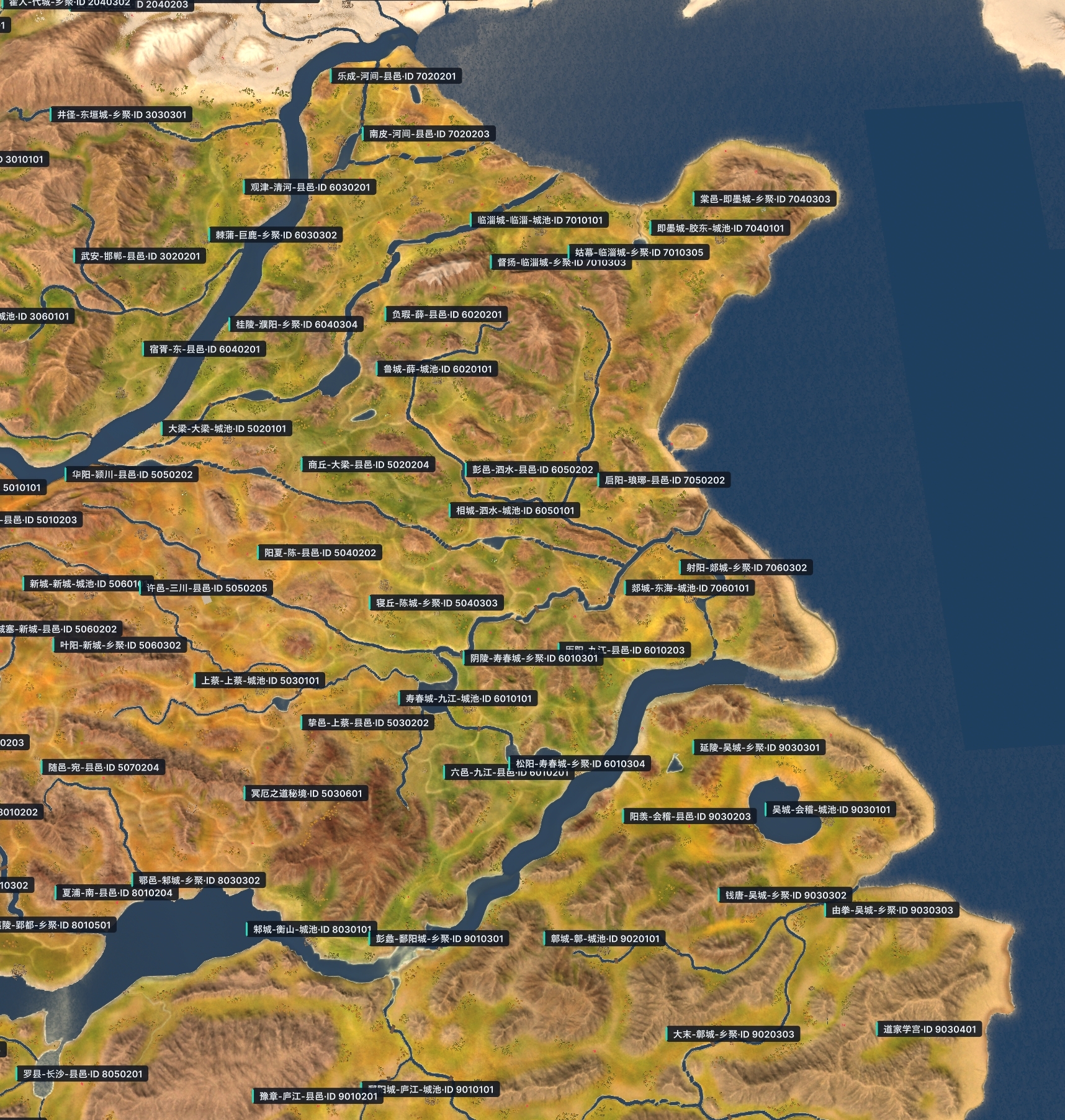
Chu's land is loose; Qi is the opposite. Qi has seven commanderies and forty-nine places; all six commanderies of Qingzhou belong to it, and in Yanzhou it has one Xue Commandery reaching to the edge of the Central Plains. Forty-nine places spread over seven commanderies is seven to a commandery, far denser than Chu. Chu spreads four or five place names to a commandery, Qi spreads seven, and the two maps can be told apart at a glance.
Qi's borders are tidy too. Qingzhou is one whole piece, six commanderies laid out from north to south with no other state's land cutting in; only Xue Commandery stands alone out in Yanzhou, a hand reaching into the Central Plains.
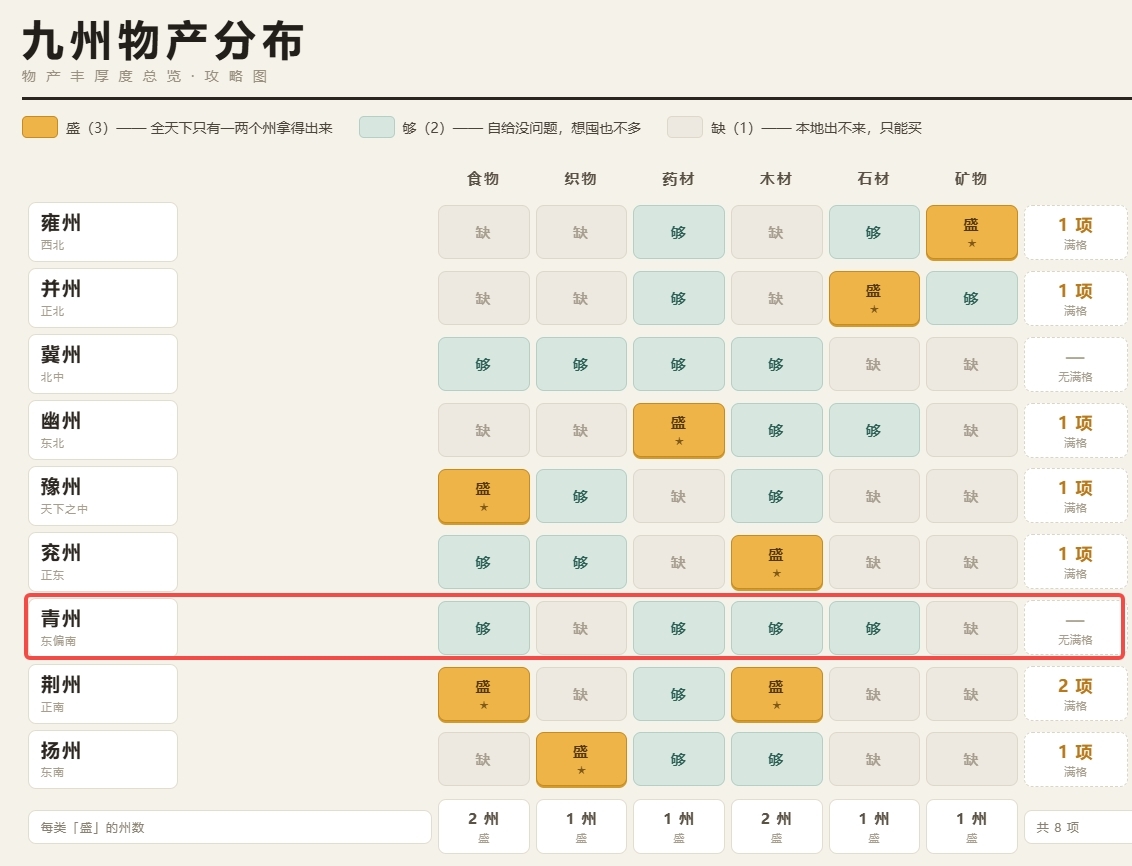
But as to goods, Qi is one flat plain. Qingzhou's six goods read: food 2, textiles 1, medicine 2, timber 2, stone 2, minerals 1—all six in the middle, not one at full marks. Chu's Jingzhou has grain and timber full, Yangzhou's cloth is full, and Qin's Yongzhou iron is full. Of Qi's six, not one can press down on anyone else's.
At Chu's feet lie Jingzhou, the richest in grain under heaven, and Yangzhou, the richest in cloth; whatever grows in its ground, it sells. Qi's ground has nothing of the kind.
Qi's position, though, is compact. To the east is the sea, to the north the old course of the Yellow River, to the west the Ji River, and to the south it presses against Song. Of its four sides, three are water and one is people.
[V. The Tian Clan]
Qi is the reverse: it grips the state in one family's hand.
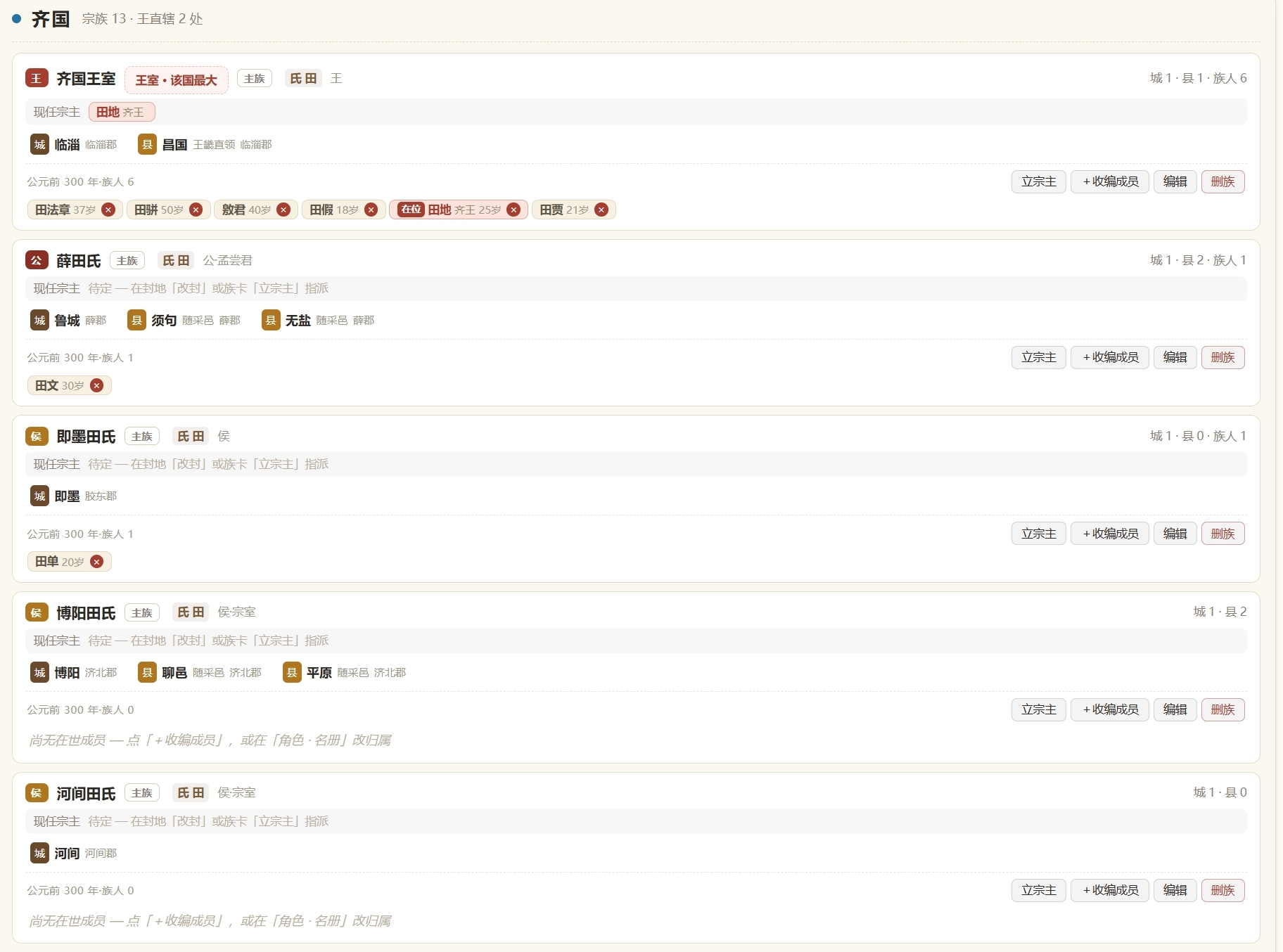
The map shows it most clearly: of Qi's seven commanderies, five are held by people named Tian. The royal house is Tian; the Boyang Tian clan of Jibei Commandery, the Jimo Tian clan of Jiaodong Commandery, and the Hejian Tian clan of Hejian Commandery are all royal branches split off from the Tian, and the most prominent family of all is enfeoffed in Xue Commandery, called the Xue Tian clan—that is the line of Lord Mengchang.
How this Tian family rose, the "Hereditary House of Tian Jingzhong" in the Records of the Grand Historian records one thing. Tian Qi, an ancestor of the Tian, served as a minister under Duke Jing of Qi and collected rent with a small measure while giving out grain with a large one:
In collecting taxes from the people he took with a small measure, and in giving grain to the people he gave with a large measure, doing hidden kindness among the people, and Duke Jing did not forbid it. From this the Tian clan won the hearts of Qi, its clan grew ever stronger, and the people thought of the Tian.
Taking in with a small measure and giving out with a large one—one pass each way, and the common people gained while the Tian gained their hearts. By the time everyone in Qi, high and low, spoke of the Tian's goodness, the Tian's seat was secure. In 386 BC Tian He was formally enfeoffed as a lord by the Zhou king, and Jiang's Qi became Tian's Qi.
Lord Mengchang keeping three thousand retainers is his most famous deed. What he kept them with was still that fief. Chu enfeoffed land to the Qu, Jing, and Zhao clans to have them guard the frontier; Qi enfeoffed land to the various Tian families to have them keep retainers and command troops.
[VI. One Road, One Linzi]
Qi's money comes from the sea. The "Hereditary House of Duke Tai of Qi" in the Records of the Grand Historian records the first thing Duke Tai did on reaching Qi:
When Duke Tai reached the state he put its government in order, followed its customs, simplified its rites, opened up the trades of commerce and craft, and made the most of the profits of fish and salt, so that many of the people came to Qi, and Qi became a great state.
Commerce and craft, fish and salt. Other states began by drawing fields and fixing taxes; what Qi fixed first was how to ship goods out and how to get people to settle. Later the "Biographies of the Money-makers" puts this more concretely:
Qi lies between mountains and sea, with a thousand li of rich soil, good for mulberry and hemp, and its people have plenty of figured silk, cloth and silk, fish and salt.
Mountains behind and sea in front, mulberry and hemp, cloth and silk, fish and salt. The sea gives Qi two things no one else can trade for: salt and fish. Salt is needed by every household every day, and it is produced on the coast, which the interior does not have. Qi's salt sold across the world, and with this one thing it was in business with everyone. The Guanzi, handed down from Qi, has a line on this arithmetic:
A state that reigns over the sea attends carefully to its salt policy.
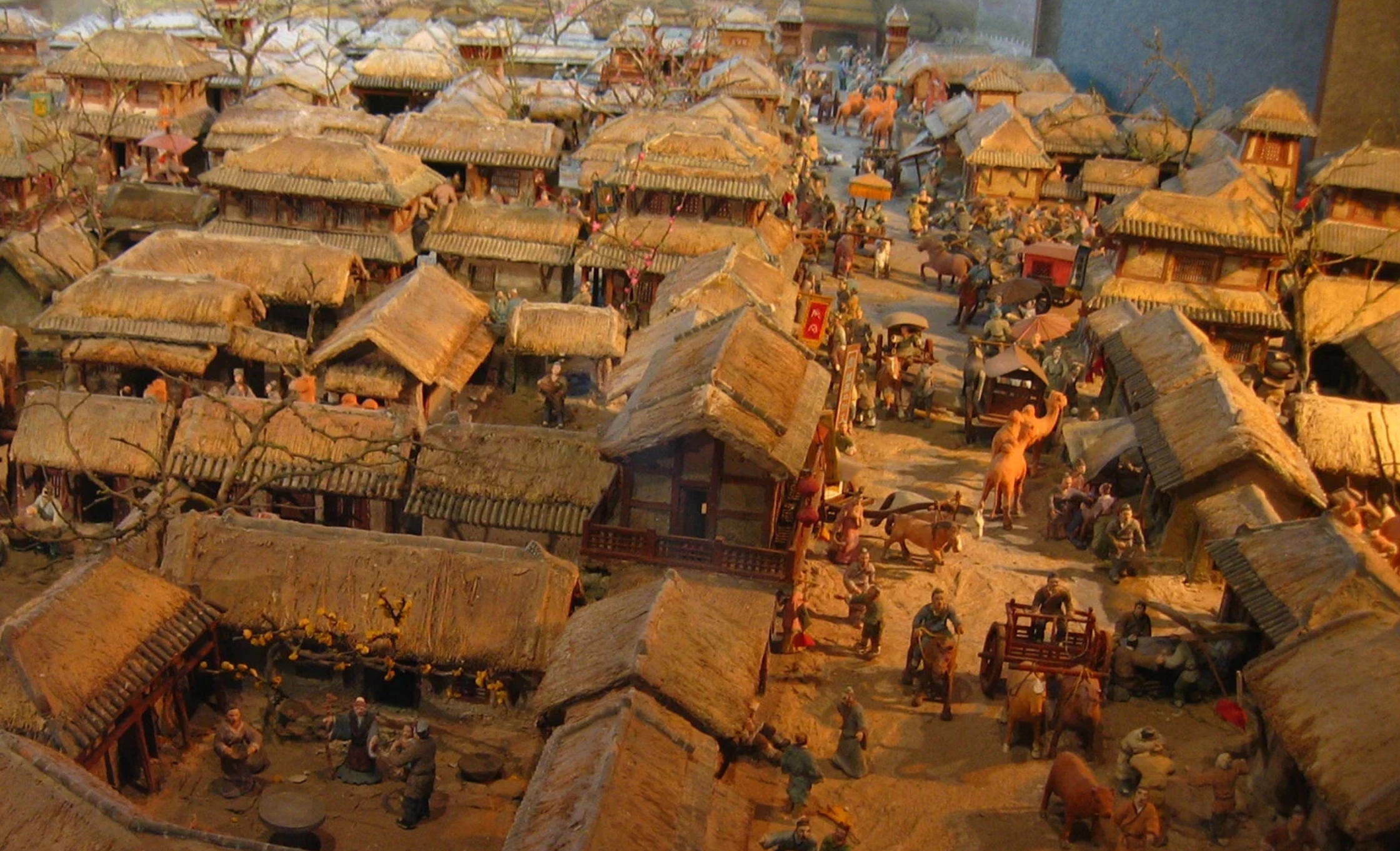
Trade needs a place, and Qi's place is Linzi. Linzi Commandery has ten places, with the capital Linzi in the middle. In the "Biographies of Su Qin" in the Records of the Grand Historian, Su Qin reckons up Linzi's traffic:
On the roads of Linzi the cart hubs strike, the people's shoulders rub; lining up their robes makes a curtain, raising their sleeves makes an awning, and shaking off their sweat makes rain.
Wheel strikes wheel, shoulder rubs shoulder, robes joined make a curtain, sleeves raised make an awning, and a shake of the hand scatters a rain of sweat. A persuader's words must always be discounted, but that Qi stood on commerce and craft is not false. Chu's people gathered beside the rice paddies along the river; Qi's people gathered at the crossroads.
[VII. Chu: Large but Scattered]
Chu has one strange thing about it: its grain is the most plentiful under heaven, and its iron the scarcest. On the goods table, minerals and stone both sit at the lowest grade, and the full marks in both are all to the west and north, in the hands of Qin, Zhao, and Yan. For Chu to make weapons, it must first buy from others.
But the quality of weapons does not rest on iron alone. Chu's equipment is not described badly in the books. The "On Military Affairs" in the Xunzi, discussing the troops of the various states, has this passage on Chu:
The men of Chu make armor of sharkskin and rhinoceros hide, hard as metal and stone; light, sharp, and swift, their soldiers move like a gust of wind. Yet their army was ruined at Chuisha, and Tang Mie died. Was it that they had no stout armor and sharp weapons? It was that the way they were commanded was not the right way.
Chu's armor was made of sharkskin and rhinoceros hide, hard as metal and stone; its soldiers ran light and swift as the wind. Yet at Chuisha its army was crushed and its commander Tang Mie died. Xunzi finishes the thought himself: the problem lay in how they were commanded.
Good equipment, good men, and still a defeat. Chu's problem lay elsewhere.
One place is terrain. Chu has the Three Gorges to the west, the Five Ridges to the south, and in between only one Yangtze. The land is hard to cross: hard for outsiders to come in, and hard for Chu to move out. Chu's soldiers and grain all travel this water, and across several thousand li there is only this one line; cut it in the middle and the two ends can no longer meet. What let Chu hold its own was these few mountains and rivers; and what cut Chu into three blocks—western, eastern, and southern Chu—each holding one end with a thousand li between them, was also these few mountains and rivers.
Between Chu and Qi there also lies a state that our map erases. Song has no place on the map; its land was divided among Qi, Chu, and Wei. In the real year it is still there, its capital at Suiyang, wedged right between the two houses—and it can fight. The "Hereditary House of Weizi of Song" in the Records of the Grand Historian records, after Lord Yan of Song took the title of king:
To the east it defeated Qi and took five cities; to the south it defeated Chu and took three hundred li of land; to the west it defeated the Wei army, and so became a rival state to Qi and Wei.
It had gnawed at the land on both sides. We erased it from the map so that these two eastern houses could stand facing each other.
Another place is enfeoffment. Chu's land was broad and thinly peopled, land was cheap, and enfeoffing it cost nothing. The ducal clans each took a side, and below them was a group of small enfeoffed lords holding a single county; land was divided layer by layer, and power with it. Qin's enfeoffed lords grew fewer and fewer; Chu's grew more and more.
The two together make the defeat at Chuisha. In 301 BC Qi, Wei, and Han came at Chu together; the field was on Chu's northern border, still a thousand li from Yingdu, and each enfeoffed lord's troops obeyed only their own lord and could not gather in one place in time.
Grain, land, stout armor—Chu lacked none of them. But these things could not be brought to one place.
[VIII. Qi: Rich, but It Cannot Stand]
Qi's strength is plain to see: forty-nine place names crowded onto seven commanderies, Linzi one of the greatest cities under heaven, and salt from the sea sold across the world. Its army can fight too—in 314 BC it broke Yan's capital in fifty days.
But what it took, it could not keep.
Take a piece of land and someone must hold it, and the one who holds it must be your own. Chu can do this because it has ducal clans like the Qu, Jing, and Zhao, passed down through several generations, and set out on a frontier they are a wall. Qi has no such layer. Qi's ruler is named Tian, and the Tian were only enfeoffed as lords by the Zhou king in 386 BC; the old clans of former Qi had long since been squeezed out by the Tian. All the Tian have left is their own house's royal branches: of the seven commanderies, five are held by enfeoffed lords named Tian, which looks tidy but is in fact thin.
Thin in having no second force. Let an enfeoffed lord like Lord Mengchang grow strong, and the power of the chancellor presses straight down on the royal power. Tian's Qi would rather not expand than raise up another set of men holding troops and land.
When the clans are thin, troops must be hired with money. The "On Military Affairs" in the Xunzi, on Qi's soldiers:
The men of Qi prize technical combat; by their rules, one who takes a head is granted a gold piece in redemption, with no base reward. When the matter is small and the enemy weak, this can be used for a while; when the matter is great and the enemy strong, they scatter and fall apart.
For one severed head, what Qi pays out is money; what Qin pays out is fields, houses, and rank. Money is a one-time transaction; fields and houses can tie a man and the state to one rope. Qi could break in, but it had no troops to hold the ground for it.
One more thing that cannot be changed is terrain. North of Qi is the old course of the Yellow River, and across the river is flat plain with no mountains. East is the sea, south is Song, and only the Ji River to the west just barely counts as a line. Yan is due north of it, and riding across flat plain you can reach the walls of Linzi in a few days.
Qi knows this itself. Its Jibei and Hejian commanderies are placed squarely against the Yellow River, yet across the whole of Qi there is not a single pass.
In the campaign of 314 BC Qi failed to hold its ground in Yan, and turned Yan into a mortal enemy. The "Hereditary House of Duke Zhao of Yan" in the Records of the Grand Historian records, two years later:
Two years later, the men of Yan together set up Crown Prince Ping, who was King Zhao of Yan.
After King Zhao of Yan came to the throne he called in worthy men, and the first he meant to deal with was Qi. Qi was the richest, but the door on its north side stayed open.
[IX. What's Next]
Chu and Qi are walked through, and the eastern half of the world is walked through with them.
The two sell different things: Chu sells what grows in its own ground, Qi sells what it buys from others. But what the two lack is the same thing: iron and stone. The map's full marks in iron and stone are all to the west and north, in the ground of Qin, Zhao, and Yan. The world's iron and stone are at one end, the world's grain and cloth at the other.
Next leg we go north, to look at Zhao and Yan.
Thank you, scholars, for reading.