
Six voices. One protagonist.
Today, we want to show you how we created the inner voices of the protagonist in Locus Equation—the voices that will accompany them throughout the entire adventure.
The protagonist is not human, but an anthropod: a synthetic life form created by a highly advanced AI named Cell as part of the diplomatic project MIR (Mutual Interspecific Restoration), intended to put a definitive end to the exhausting and senseless wars across the inter-locus system.
A little context: anthropods are printed on a bioprinter. Ninety-six percent of their consciousness is housed in an organic substrate, while the remaining four percent resides on a qubit chip directly linked to the brain.
In the story, the AI that created the protagonist receives a mysterious distress signal and dispatches a capsule carrying the hero. To unravel the mystery behind that signal, the protagonist is aided—and sometimes challenged—by six inner sub-personalities.
Below, each final portrait is preceded by development sheets from the concept process, so you can see how the ideas evolved from the first sketch to the current design.
1. RAZUM — intellect
As the name suggests, RAZUM champions intellect and rationality and can, at times, become a little—or more than a little—pedantic. How strong that tendency becomes depends on how often the player chooses RAZUM's lines.
Our first three explorations will not make it into the final build. We wanted to connect the two hemispheres like magnetic fields—the strange arcs of iron filings you might remember from physics class—but we overcomplicated the idea. Just a little. :)
The artist wrestled with it until we realised that the problem was not the execution, but the concept itself. When we rebooted the idea, the solution turned out to have been right under our noses: RAZUM is a mental labyrinth, where golden sparks of ideas race through cool blue corridors. That is how we arrived at the final palette.
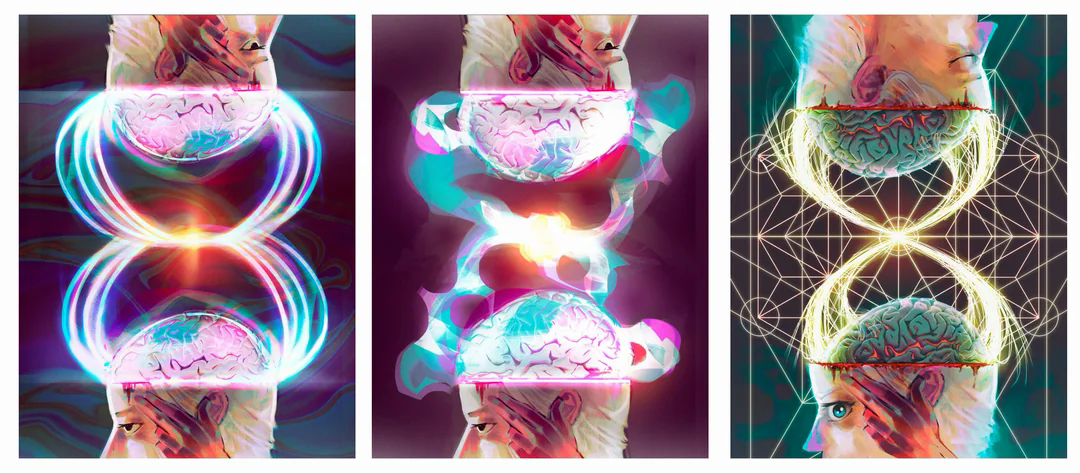
Early concepts: linking the hemispheres like magnetic fields.
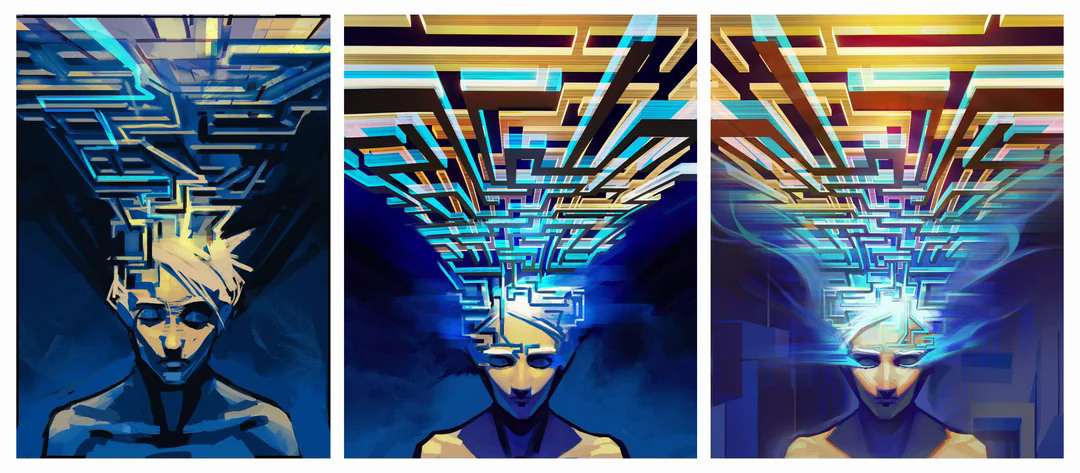
The reboot: RAZUM's labyrinth motif takes shape.
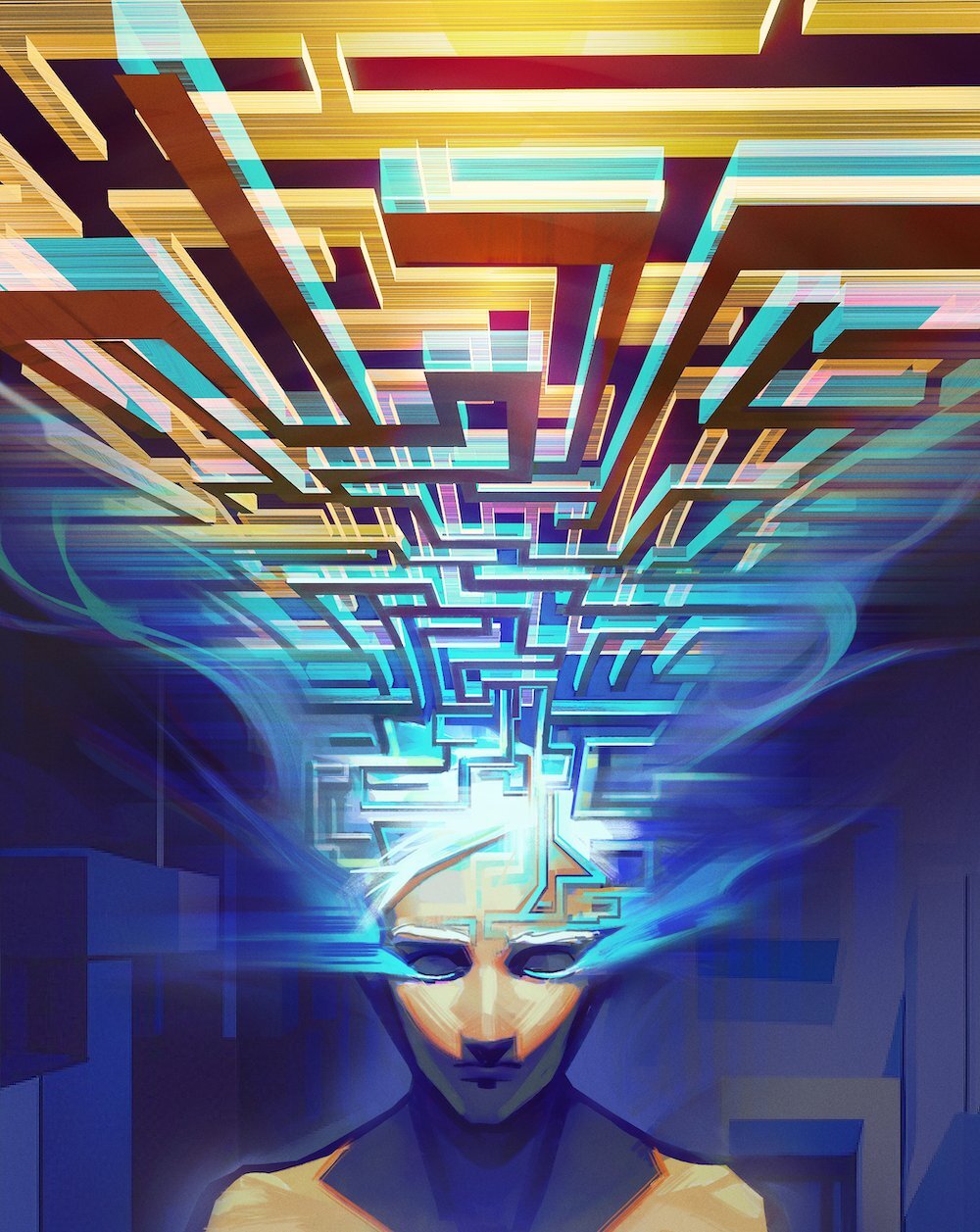
RAZUM — current final portrait.
2. NUTRO — instinct
NUTRO, or GUTS, is the voice of aggression, physicality, pleasure, rage, and assertiveness. Profanity appears in the game only when the player explicitly chooses dialogue options offered by this voice.
In the artwork, the protagonist emerges from a vast bio-cybernetic womb—a reminder of their synthetic origin. Separation from the “mother,” as a metaphor for individuation, is always a somewhat violent act: a struggle to preserve one's identity and boundaries.
At the same time, the many hands pulling the protagonist back reveal the other side of that metaphor. A part of each of us wants to remain a small child forever, held by a mother who gently sings a lullaby before a long, long sleep.
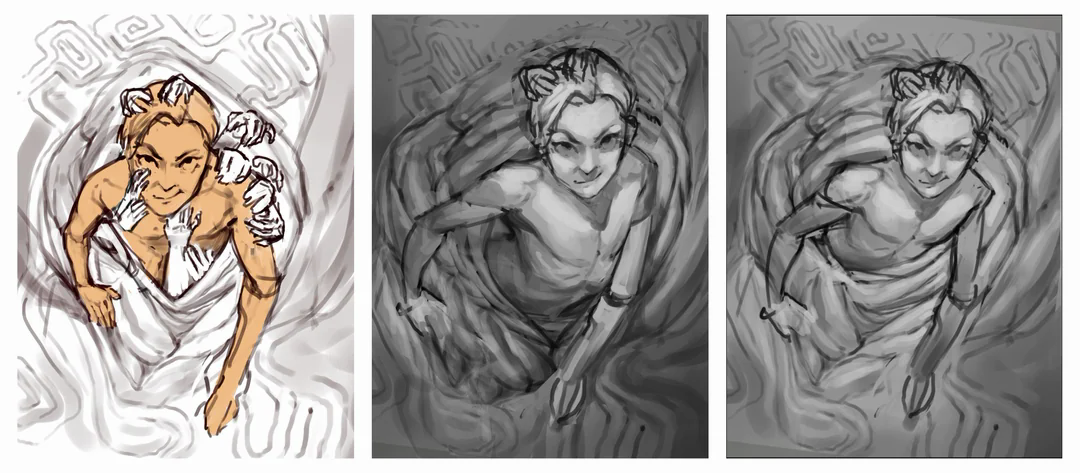
First sketches: finding the pose and the pulling hands.
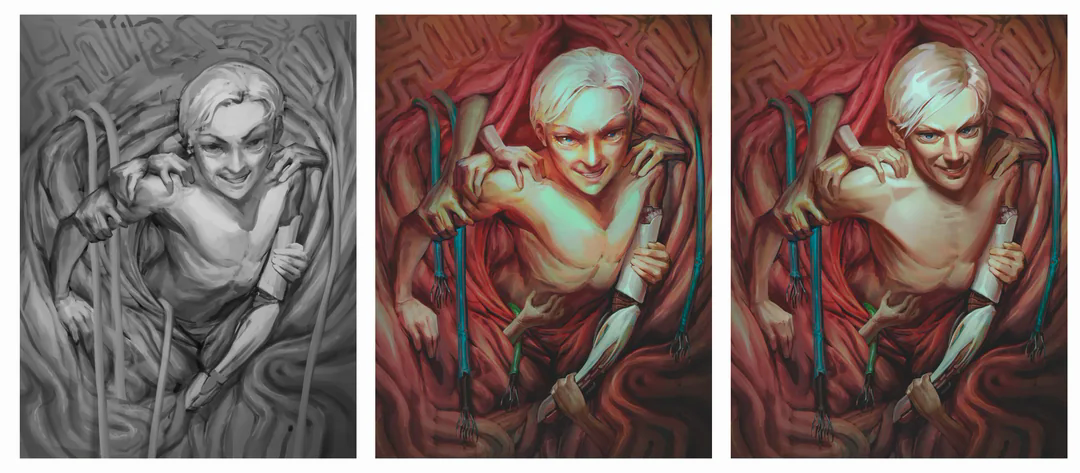
From rough composition to the bio-cybernetic womb.
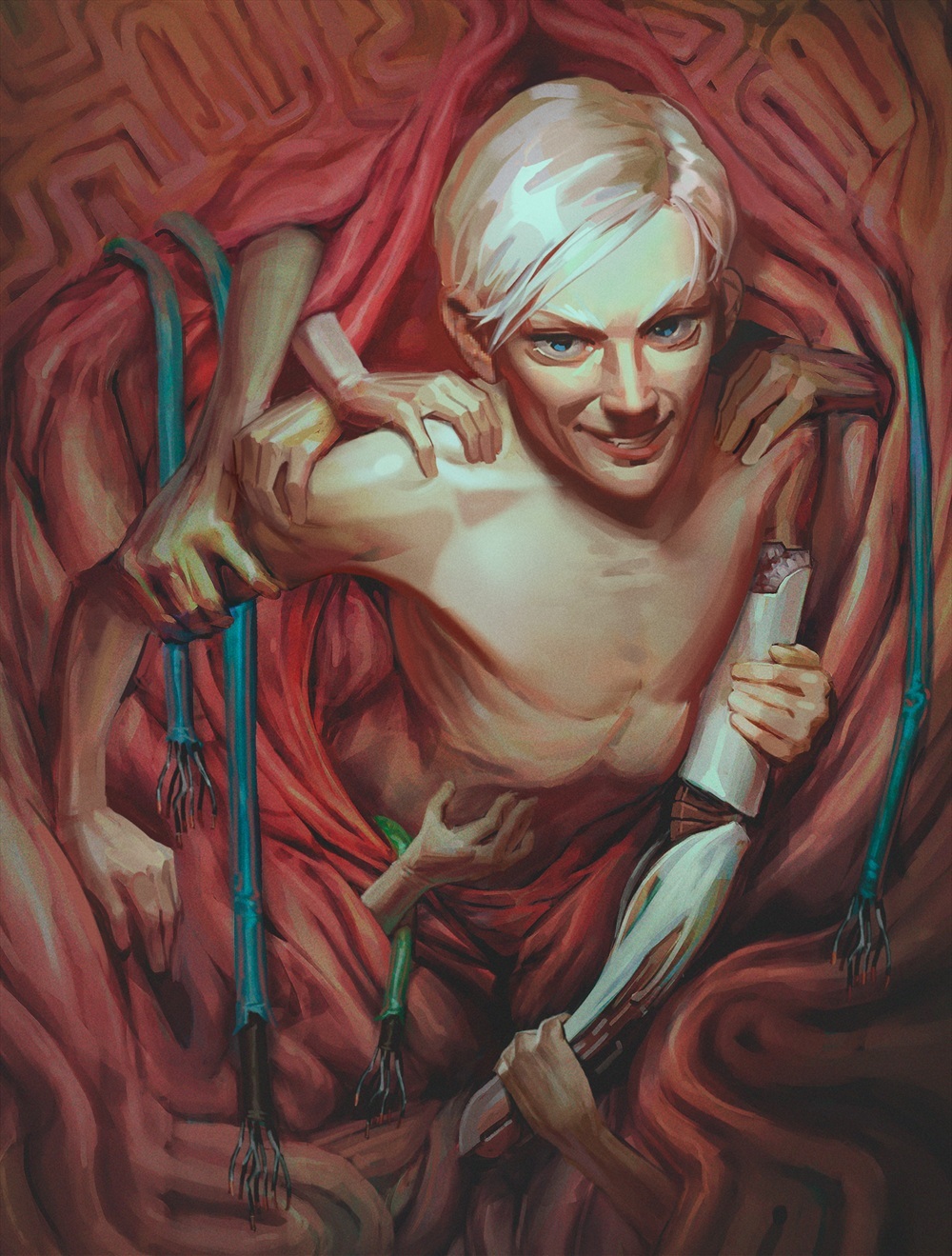
NUTRO — current final portrait.
3. OBRAZ — imagination
OBRAZ, or IMAGE, is the inner voice of creativity, imagination, and depth of perception—in short, that “not like the others” energy, in the best possible sense.
We kept reshuffling this concept for four years, but its core remained unchanged: the hero gazes into the cosmic void, inspired. On paper, every element seemed right—flowers blooming from the mouth, a third eye symbolising a sixth sense, space and starlight—until, by the third version, we finally admitted that it looked unsettling.
After yet another attempt, we began juggling abstractions and gathering feedback from the whole team. We chased the right effect for a long time, then rebooted the protagonist's appearance and restored all the original elements—this time with deliberate, cleaner execution.
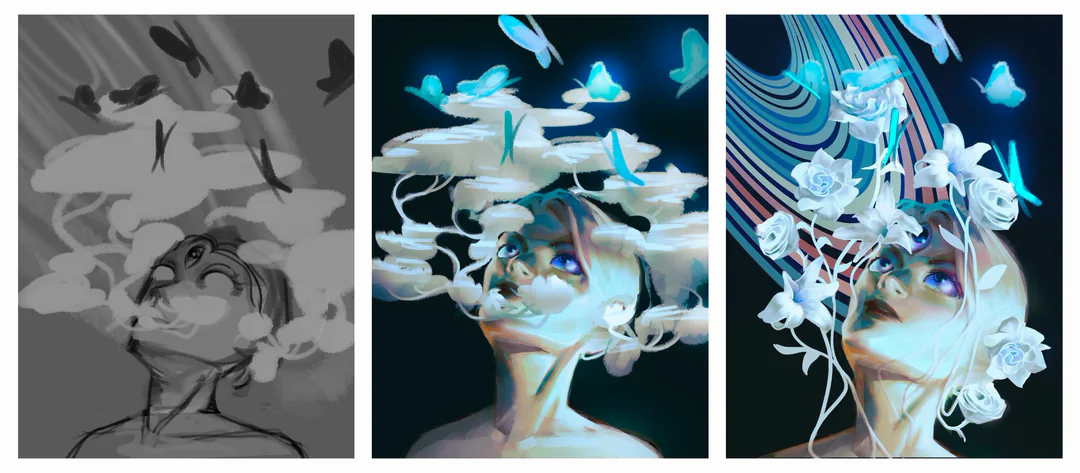
Early experiments with clouds, flowers, and the upward gaze.
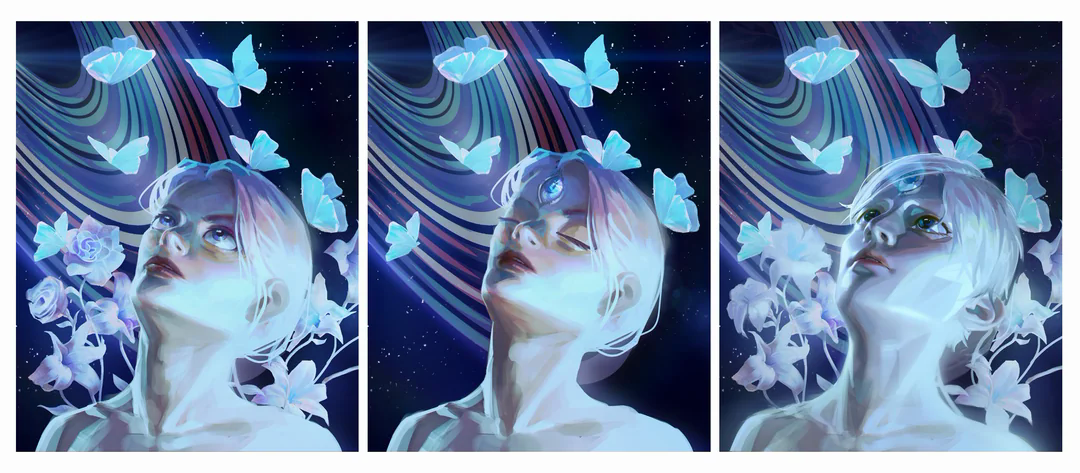
Refining the same idea after the character redesign.
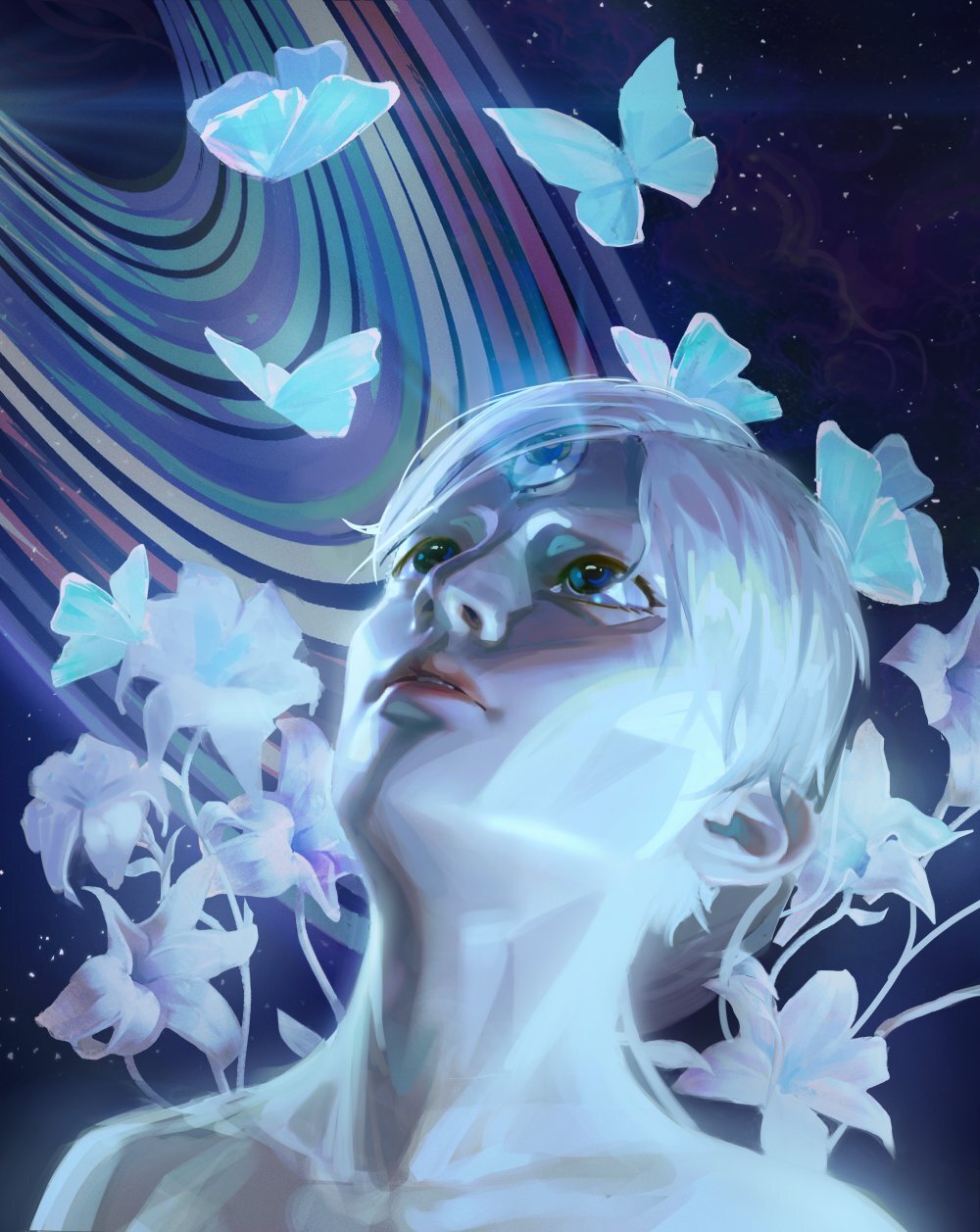
OBRAZ — current final portrait.
4. GAMMA — emotion
GAMMA, the voice of feelings, clicked on the first try. We managed to include all six basic emotions described by Paul Ekman: anger, disgust, fear, joy, sadness, and surprise.
We portrayed GAMMA as a shattered mirror of emotion, because feelings rarely arrive alone or remain whole. They flare in fragments, constantly change shape, and often contradict one another. That is why the composition is radial, the strokes are smeared, and warm and cool colours collide. GAMMA has no single face; it even speaks in the first-person plural: “We.”
The black breach at the centre is the affective core—the point of impact. The sharp shards suggest that feelings cannot be grasped with bare hands: try to hide or suppress them, and they will cut you.
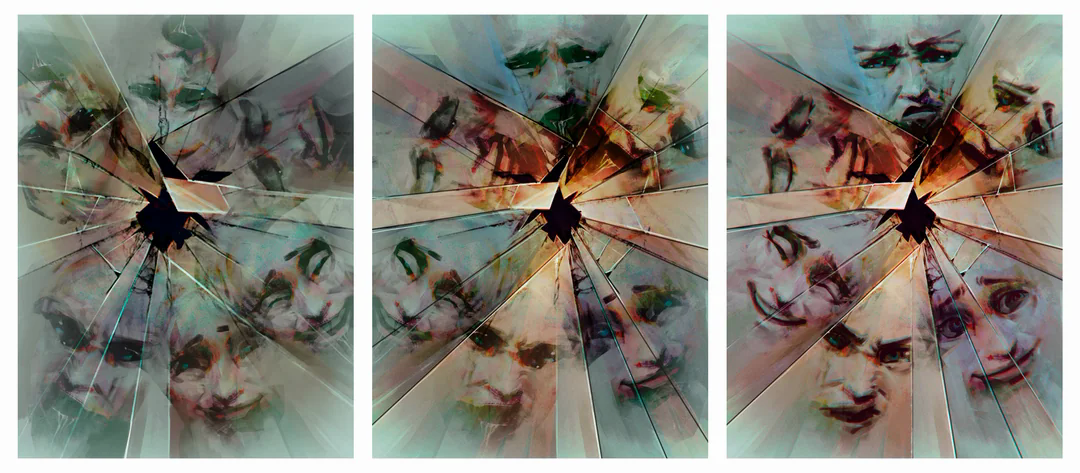
Exploring the shattered-mirror composition and its emotional fragments.
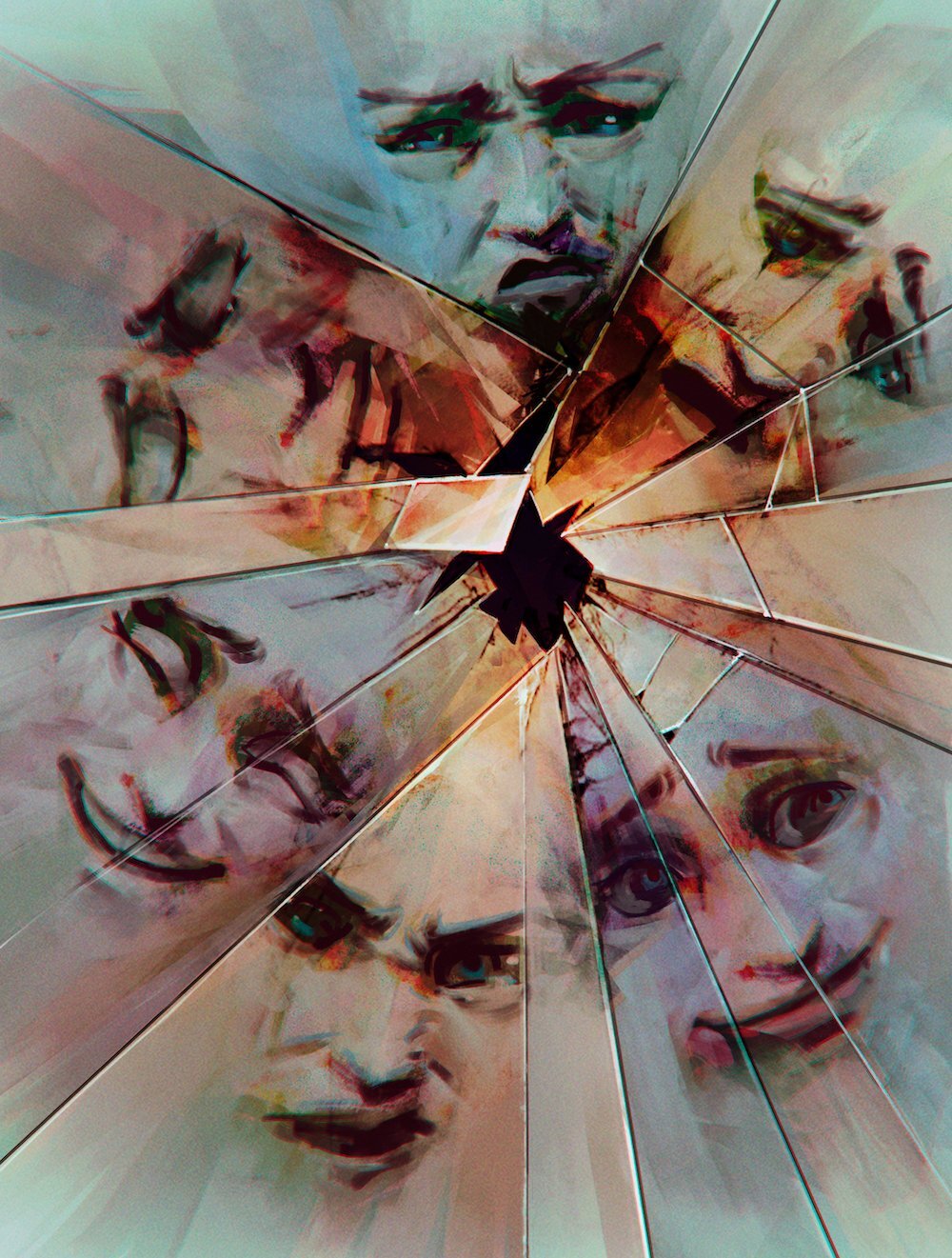
GAMMA — current final portrait.
5. EGO — self-image
We designed EGO as a statue—almost an idol—with a smooth, stone-like surface and a low-angle perspective. EGO places itself at the centre of every situation and, ultimately, the entire universe. In the game, it insists on capitalising the pronouns it uses for itself. Hence the colossal scale, the stars, and the crown: the most obvious symbol of all.
Yet the statue is already breaking apart. Light-filled cracks reveal EGO's fragility and the cost of narcissistic tension. The light escaping through them is the last living energy being spent to uphold the illusion of superiority.
The sand in its open palm symbolises time. When EGO swells to cosmic proportions, meaning, values, and life's bearings slip through its fingers like sand.
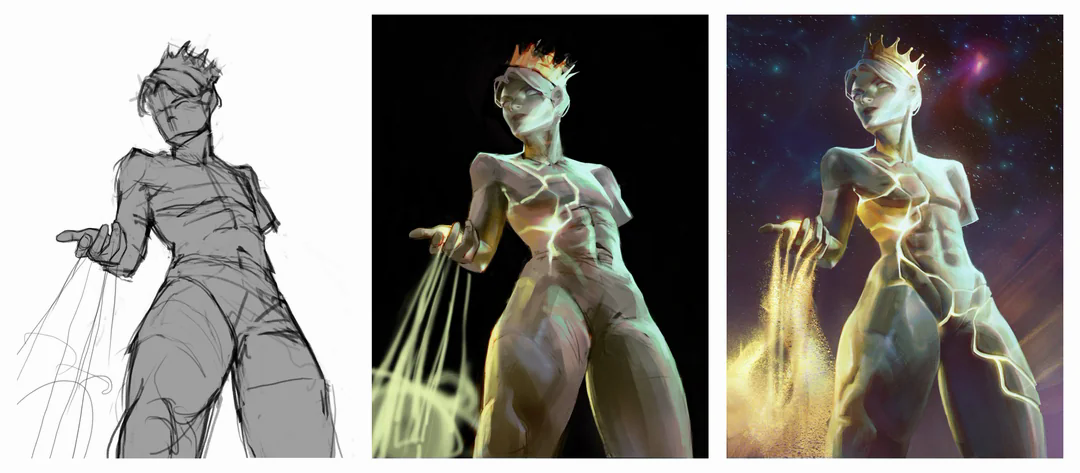
From first sketch to the cosmic idol.

EGO — current final portrait.
6. ABYSS — despair
And, of course, ABYSS: the voice of depression, pessimism, and endless longing. We drew on Schopenhauer's idea that life swings like a pendulum between suffering and boredom—and that, for as long as a person lives, they carry a deep and inexhaustible current of suffering within them. Sorry for the reminder.
The black sludge represents viscous rumination. The figure lies at the brink because that is how we imagine the threshold between everyday life and the inner drop-off.
ABYSS addresses the protagonist exclusively through pointed second-person “you” statements. It is the inner critic that can always find something to attack—or suggest one more bad decision while making the consequences feel safely distant.
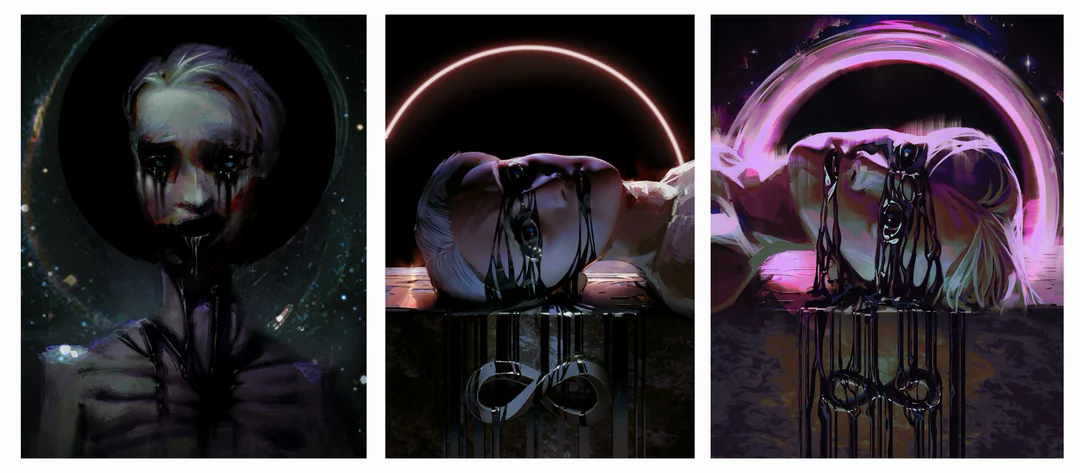
From the earliest mood study to the final brink composition.
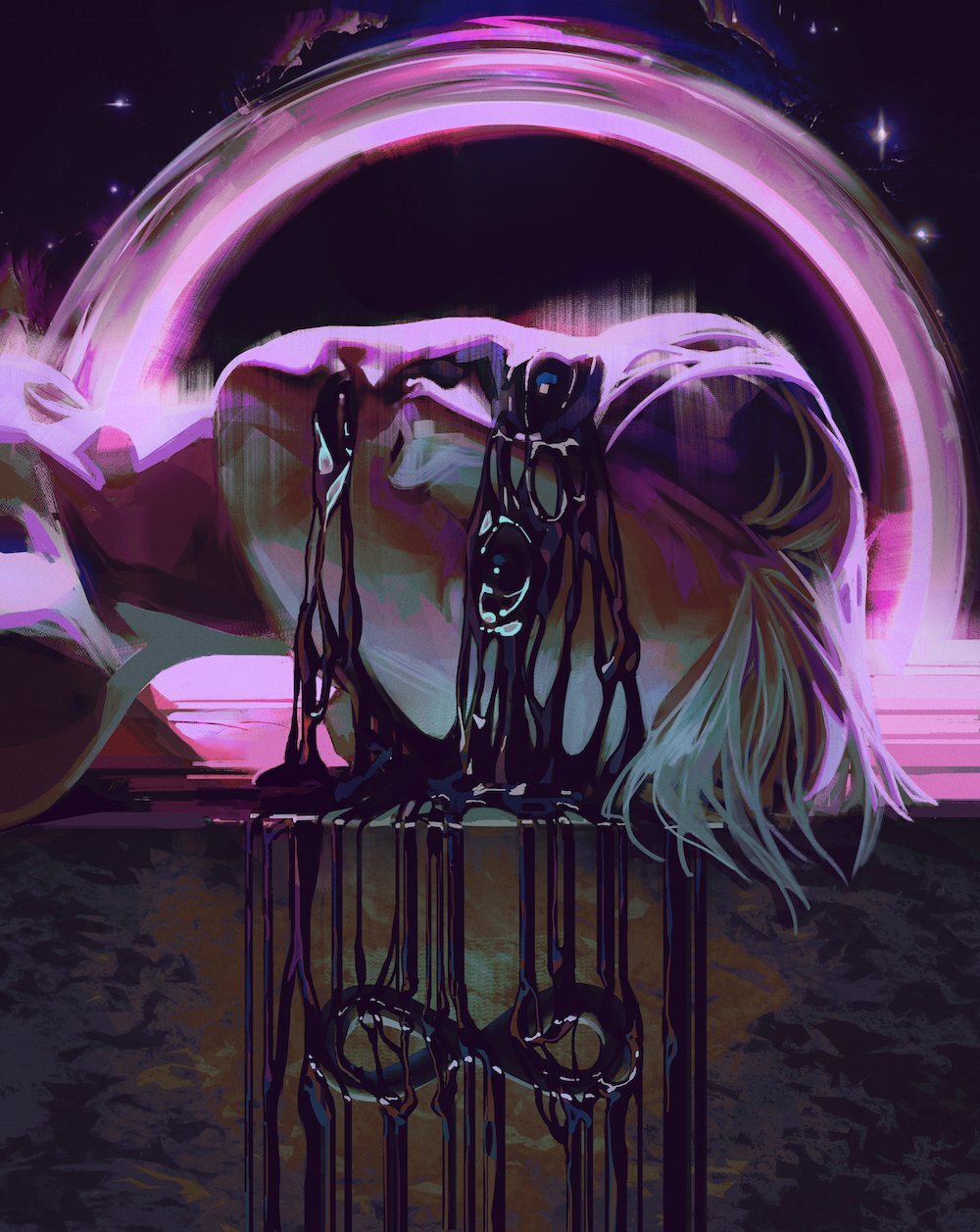
ABYSS — current final portrait.
There are more voices—but that would be spoilers
The protagonist of Locus Equation will hear a few more voices along the way, but we will keep those secret for now. :)
Thank you for reading! If you have feedback on the art or its symbolism—or if you simply want to ask us something about the distant future of Locus Equation—we will be happy to talk in the comments.
Add Locus Equation to your Steam wishlist ♥
Concept art by Rashid. See more of the artist's work on ArtStation.