
State of Development
Hey guys, it has been about 13 months since the last official update. Sorry for the relative silence, but I have been busy outside of developing the game. I just want to let you know that the game is still very much in development, and progress has been made since the last update. To start this post, I’ll talk about what I have been spending so much time working on. Recently, I have been prototyping and testing various world generation systems to achieve the look that I am going for. The current system was essentially designed as I built it, and that resulted in it having a lot of visual, technical, and performance pitfalls. It also had the issue of touching too many external systems directly. This made it much more difficult than it needed to be to refactor other systems and integrate them into the game quickly. For now, and likely for the next demo, an improved version of this system will take its place until I am done with the new one. In terms of what the new world generation system brings, it will:
Generate not only in the X and Y directions, but Z as well.,
Use a modular “building blocks” system, which will allow for drastically different parameters per biome.,
Get rid of the existing chunk system, and replace it with a more dynamic one that does not require every tile in a chunk to be accessible. This will also remove the obvious boundaries between biomes.
Allow for a more robust, multiplayer viable saving/loading system.,
Better, more realistic lighting. The current system relies almost entirely on Lumen emissive GI. If you are familiar with the system, you know that this is far from ideal. This is one of the greatest challenges, and a big reason why people don’t usually make fully indoor games.,
This will still take more time to complete, and I will not assign a release date to it. Aside from world generation, I have also dedicated an immense amount of time improving my understanding of multiplayer and replication. Because of the nature of the game and what I would like to do with it, there were some questions regarding efficient replication that I felt needed to be answered before I began implementing multiplayer into the game. As of right now, I feel much more confident in this area, which was one of my weakest, and have begun rewriting systems to allow for multiplayer. Lastly, I would like to address the pace at which I am developing the game. I have a job outside of developing LIMINAL and other responsibilities which greatly limit my ability to develop the game quickly. I obviously wish that this wasn’t the case, but I have to make money somehow. I do not want to charge money for this game during early access, my stance wont change on this. I would however, like to bring back the development streams that I did for a while previously on Twitch/Youtube. So if that is something that would interest you, look out for those soon.
To wrap this section up, I promise that LIMINAL is not only being worked on, but will be released.
Official Patreon
I have decided to create a Patreon for LIMINAL with the goal of allowing me to spend more time on the game's development to release it quicker. Since I have a full time job and other obligations in my life, I do not have as much free time as I would like to work on the game.
Your support will help me dedicate even more time to development, but joining is completely optional. Just being here, following the project, and sharing your excitement is already enough and a big part of what keeps me motivated.
As of right now, there is a free tier, and a single paid tier for $5 per month. All of the money that I receive from this Patreon will be used towards LIMINAL, and will help give me more free time to work on the game. That being said, I will develop and release LIMINAL regardless of the game’s support on Patreon.
On Patreon, you’ll get:
Weekly Patreon update posts. These will typically be behind-the-scenes development posts and system breakdowns.
Exclusive development content such as videos and images of the game in its current state.,
A matching Discord role to show that you are a Patreon supporter.,
Access to Patreon-exclusive Discord channels.,
A mention in the game’s credits.,
Early access to test builds and prototypes.,
Access to new YouTube videos two days before they release.,
Polls to help shape certain aspects of the game.
You can visit the Patreon at: https://www.patreon.com/c/LIMINAL_Game
Post-Processing Update
It has been a while since I have messed with the visual appearance of LIMINAL. I want the game to have a unique (although arguably common nowadays) look similar to early digital cameras. The previous post-processing effect that I used to achieve this got the point across, but the quality was lower than I would have liked, and I felt that it was really only 70-80% of what I was looking for. That's why recently, I have been messing with shaders again, and I have come up with a new post-process that I believe is a much better starting point than the previous one. It's also a lot more simple!
I have attached some images of the post process below so that you can visualize the various layers of filters and see what they do to the image. I'll also explain each step along the way to make it easier to understand what everything is doing.
1.) Scene Texture
 This is the scene without any post-processing applied. As you can see, it is pretty boring, overly smooth, and generally uninteresting.
2.) Applying DoG
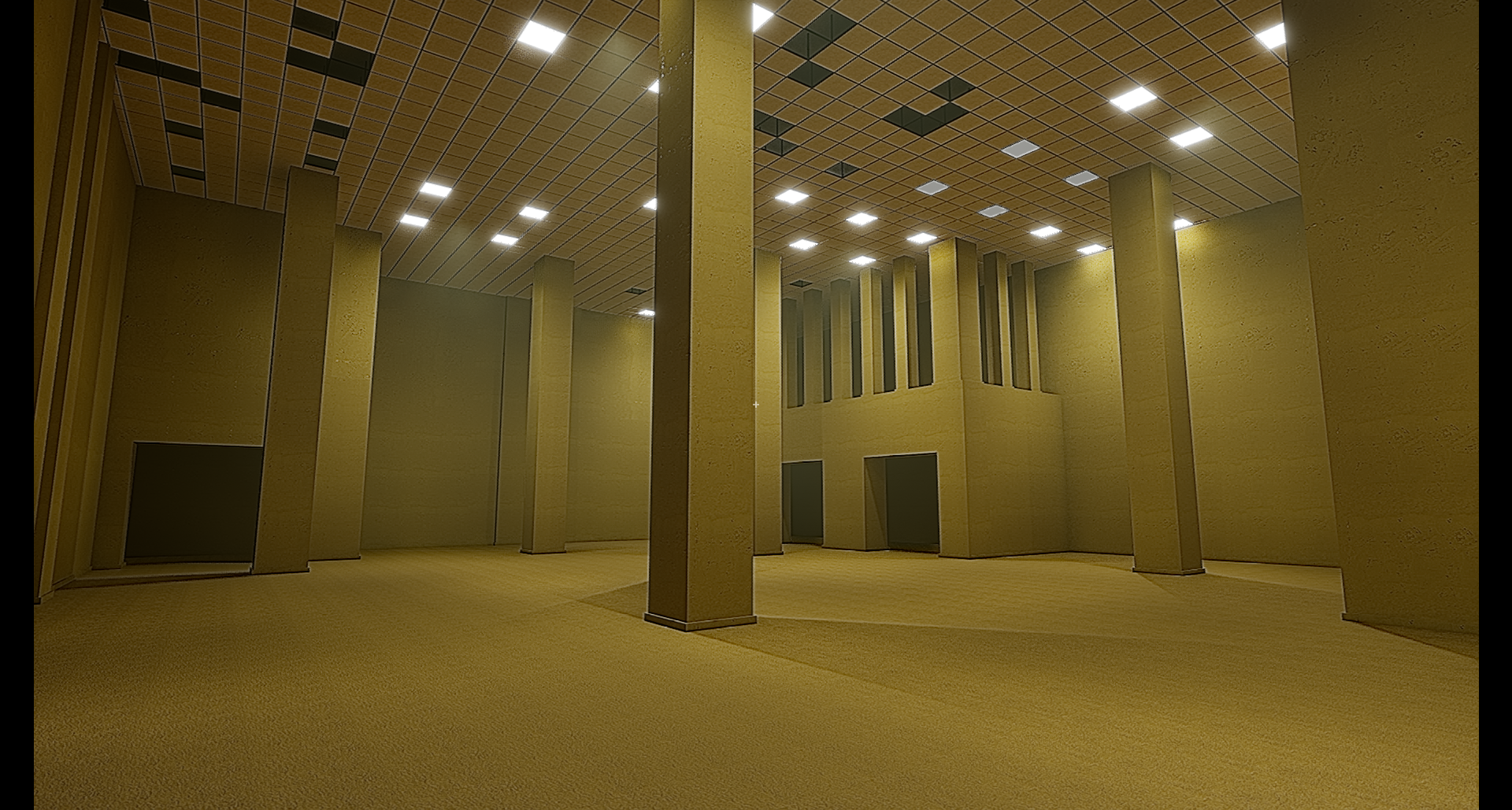 Here is that same scene with a filter added to the scene color which is known as "Difference of Gaussians". This filter involves sampling the scene two extra times and blurring each of those samples different amounts. Then, you greyscale both of the samples and subtract the color of less blurry one from the more blurry one. Here is what that looks like with no scene texture being added:
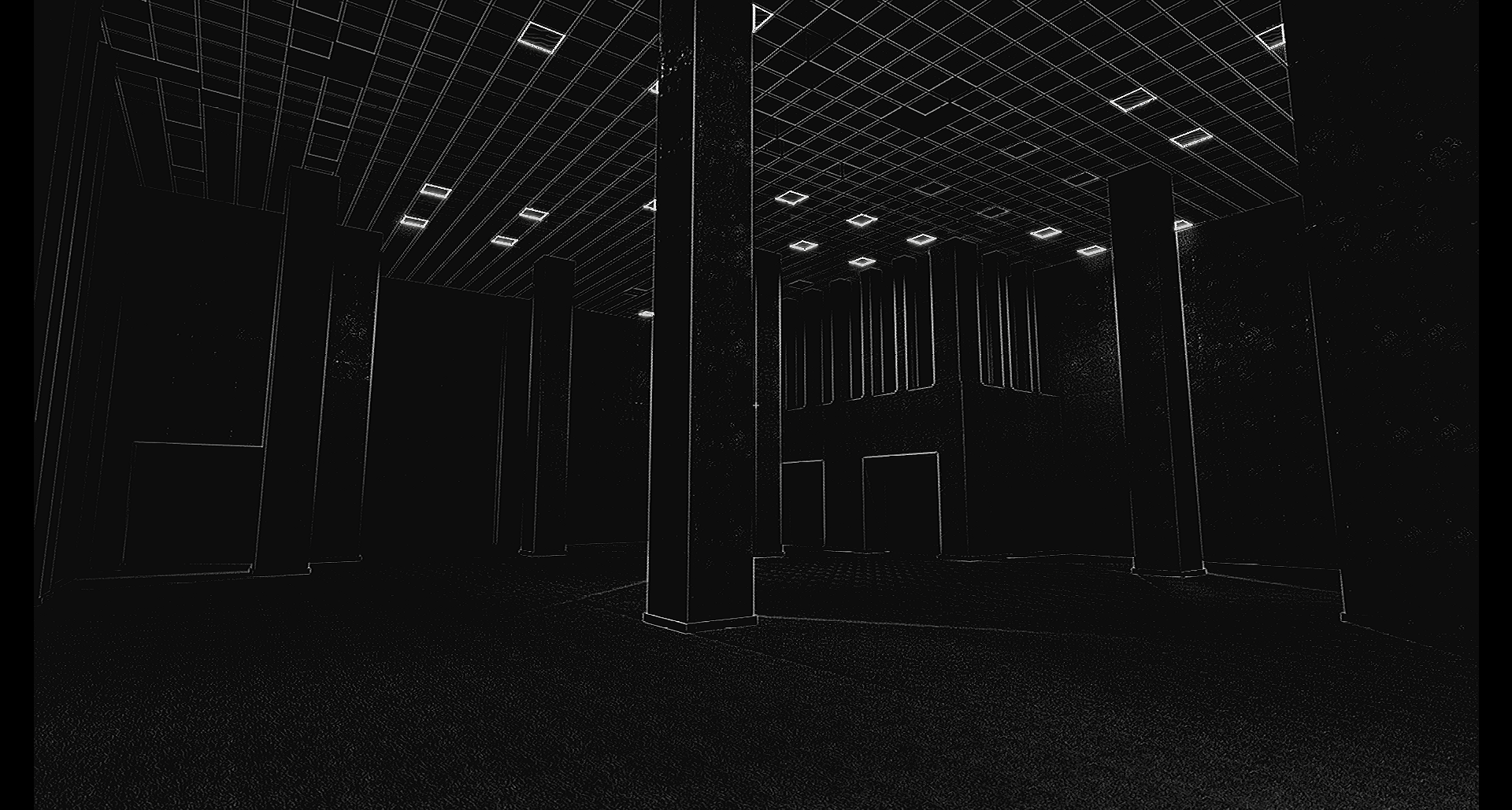
3.) Color Grading
 Now it's time to adjust the colors of the image to more closely resemble a poor quality camera. This means getting rid of the darkest blacks, and the brightest whites.
4.) Bloom!
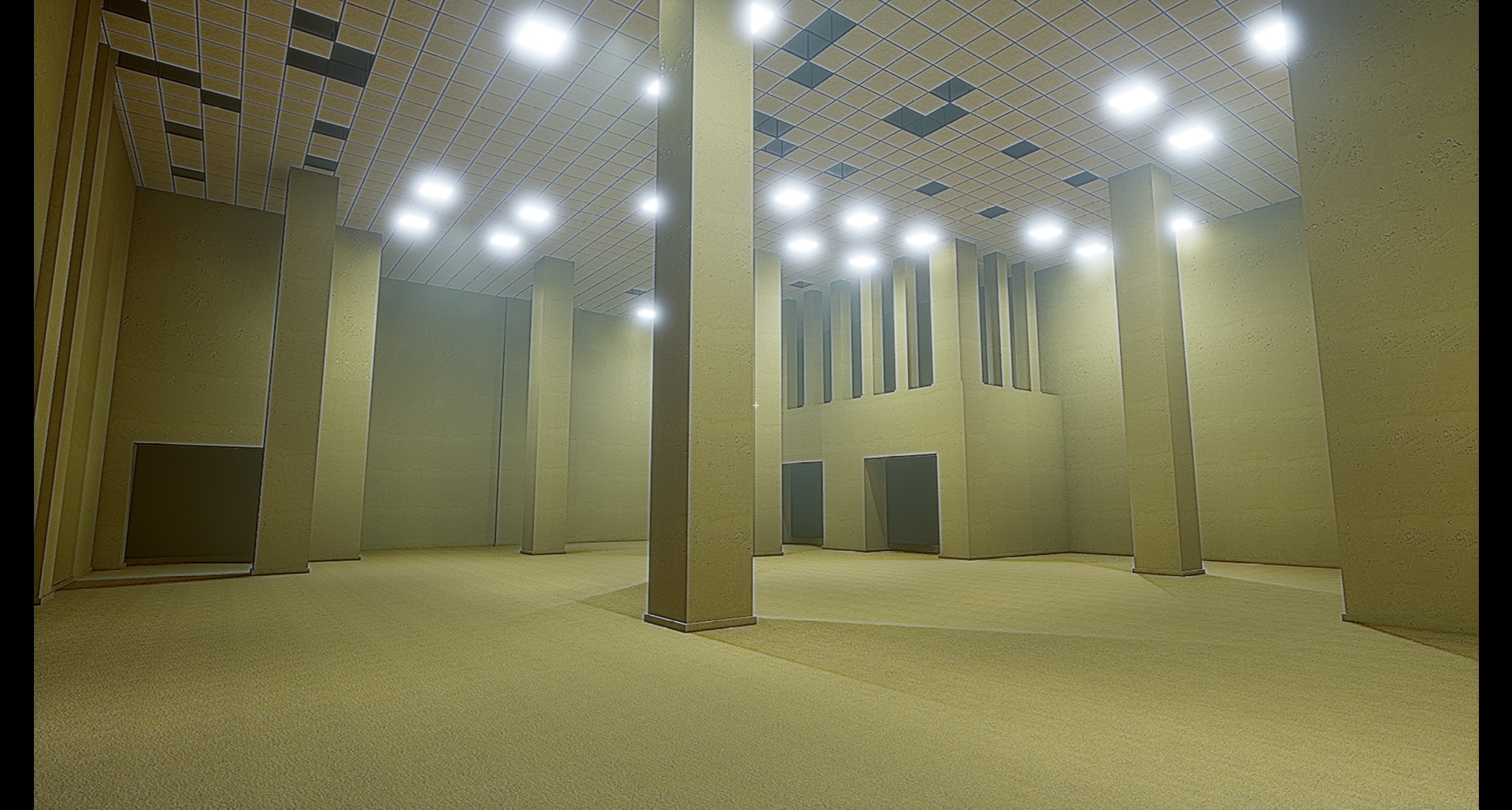 To simulate the low quality sensor of one of these cameras, the next step is to crank up the bloom for the scene. This effect is most obvious when looking at the lights before and after applying the effect.
5.) Chromatic Aberration/Film Grain/Sharpening
 I have combined these effects into one image because they are subtle and would be hard to notice on their own.
Chromatic Aberration: This is a subtle effect, so you might have to look at the image in full-screen to see what it's actually doing. On a technical level, it is separating the colors channels of the image (Red, Green, and Blue) and offsetting each one slightly.
Film Grain: This is another subtle effect, but is essential to achieve this look. It helps add imperfections to the image that would otherwise appear to smooth and clean. But it can be easy to overdo!
Sharpening: The last effect to add is a sharpening filter. This helps give the image that overly sharp, somewhat grainy appearance that old digital cameras produce.
Conclusion
That is all for this development update, stay tuned for the next one which will talk about the new world generation system! If you would like to stay even more update-to-date, join the Discord where I frequently post about development. You can also check out my Twitch channel where I stream development on the game live!