
Hello,
in this update want to finally show progress in Localization. I will also talk about the release plan and for a bit of fun I want to include my first experience with AI coding (yay).
As you may have guessed already I am a 'late adopter' of cutting edge tech (Microcivilization still runs in .net 5!). So it is only now that I look intyo this agentic coding trend everyone seems so excited about ...
Since the localization requires plenty of throwaway helper scripts (as will be shown later) and also includes a lot of tedious work, I figured it could be a good exercise to test the latest coding AI without letting it touch too much of my precious code. So I will share my pains and gains in dedicated ✨AI notes.
Gazillion of texts
Perhaps the most frightening issue was not knowing how much there will be to translate. In my last update in September I could only guess. Mainly because of the many texts in game code, that never show up.
You see it isn't so simple as to look at a single piece of code and see a list of all user-visible texts. There are hero traits which only drop for saves imported from 2023 versions and no longer drop. There are Heroes that only drop in old playtest demo. There is a lot of semi-dead code on various places (things that are turned off by configuration feature toggles, but technically could be turned on if I wanted to).
But now I know. It is around 3,400 texts. I know that, because I asked mighty AI to count them.
✨ AI experiment Note: The first response was around 5,000. Over time with more hints I got about 10 different numbers, and ~3,400 seems to be a more stable number now. I quickly found out that detecting dead code with AI is highly unreliable. To confirm my suspicion I asked for the list of all droppable heroes (same semi-dead-code problem but one for which I know the correct answer). Unfortunately not even the most obscene models could get it right without repeated clues.
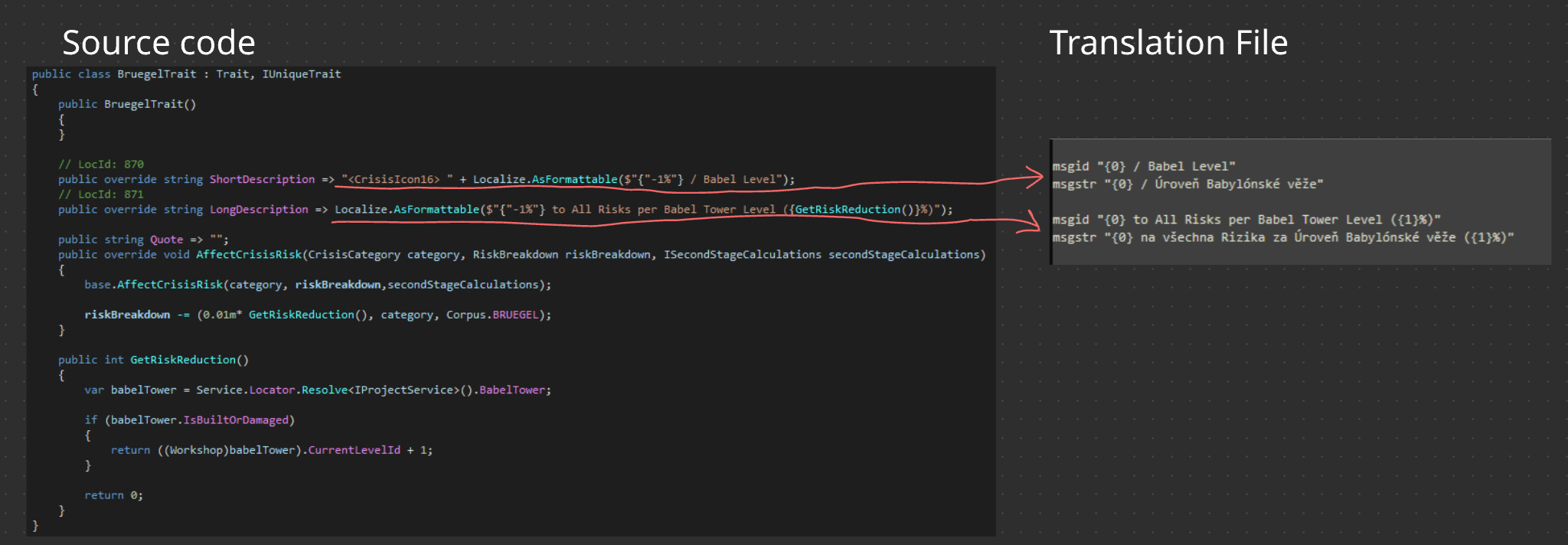 The two parts where I spend most of the work now. The string definition in a code file and its translation file record. In here you can see an example of a translated trait text from Breugel class (one of the hero definitions). The work with brackets, parameters and inline icon texts had to be done correctly, otherwise we would have ended up with bugs. This one was formated using a bunch of scripts generated by AI. It works correctly, but it is done on a hero that never drops . Identifying these dead strings is one of the big issues.
Test semi-automation
Texts of translations are stored in plain text files. There's always a text's key and the text's translated value in the given language. There's one file per language, so the file is technically a table with two columns. For 3,400 texts times say 10 languages gives me 34,000 texts someone would have to check on screen.
Since I am a solo developer, my approach (as for everything) is to be single-handedly able to provide translation and verify it in the game. I don't want to rely on third parties. Yes I don't speak 10 languages, I barely speak two. But in principle I still will have to provide fast bug fixes when things break. So I decided to make the translations semi-auto-testable.
Trivial test approach would be to let a player run through the entire game while taking notes of any translation that is off. Logging that kind of evidence against a set of 3,400 tests isnt something you would want to do every week however. So the more tester-friendly approach is to provide for each translation key an automatic method of displaying it on screen.
A simple cheat code for just displaying text randomly on the screen however might hide overlap defects and color/font-specific issues. So the approach I chose was instead to automatically provide a way to show the REAL text on the screen, doing all the legwork (like generating heroes, changing screens and faking mouse hover) behind the scenes.
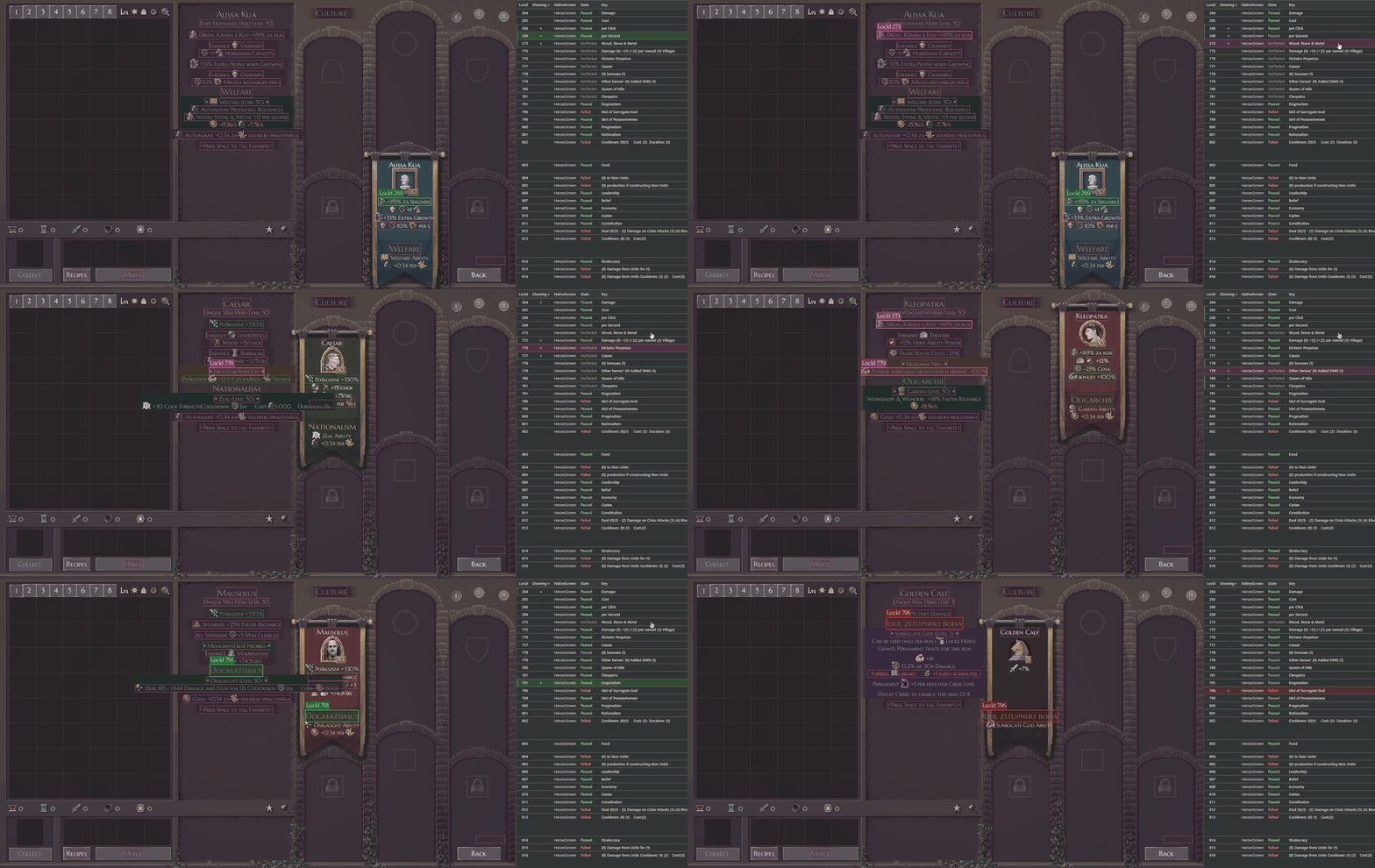 An example of a semi-automated test. In here tester checks a handful of strings just by pressing arrow keys. The automation code does the arrangement of the text on the screen (generates a hero and simulates a mouse hover). The manual part is the actual decision whether the text is OK or not.
The idea is simple. On the window to the right the tester sees the entire texts table with 3,400 rows (filtered by screen groups).
Tester can then step through them by pressing a down arrow key on the controller window only, nothing needs to be clicked in the game. The game will establish context for the next string automatically.
If the text is ok, tester presses right, if it is wrong, presses left. If it needs bug text description, press left again and type it down. Testing a single text can easily take 1 second. That's a little bit over one hour to positively test the entire language. (ofc more time per each bug found, but you get the picture)
There are some 'fun parts' in this obviously:
The fun part 1 is that all texts need to be highlighted on the screen - so the code needs to know what it is doing (which in our programmer world almost never happens).
Fun part 2 is that pressing down arrow key will actually change the game state to when a string is visible. This is simple for button labels you see on the screen all the time (nothing needs to be done). But it is more difficult for hero-traits that only display when the hero is equipped and you hover on him. You need to actually know what kind of hero to make and this may be different for every text.
Fun part 3 is that you need to be able to add translation in your language while you're running this test and the game picks it up on-the-fly. This means that you can translate simultaneously while you're testing it.
✨ AI experiment Note: The text web page was generated by LLM based coding agent. The communication flow worked perfectly on first attempt and I mereley had to rewrite/refactor the backend and data code layers manually. AI does seem to have eager-junior developer habits of passing data via static classes, misusing dependency injection and overly defensive programming. But overall the web+API was one of the more positive experiences in this experiment.
For the fun part 2 - the part I call Arrangement - AI help turned out to be more on the negative side and unfortunately its code was either too complex or simply took too long to make+refactor. I tried to fiddle with the approach for two days, but I realized no flow doesnt save time as 4 out of 5 prompts end up with 50%+ code removed manually by me afterwards.
There are many things I still have to think about regarding AI coding behavior but I think one real problem was reusing code which isn't perfectly matching what it needs. It almost always silently wrote a duplicate code instead of suggesting a change. So after some time I gave up and decided that coding arrangements manually will be more effort but probably faster and less risky.
How much is done?
Most Hero Screen texts (about 81%) is covered by test arrangements. That doesnt mean it is working - just that the tests can be executed within a few minutes time (once a translation exists). Now there are some bugs to fix but overall this covers 9% readiness for translation.
The biggest progress was in the automation though. Having the test strategy with an actual working test app verified on the whole game page means the difficult problems are solved. Now I just have to replicate all the work I did already across the rest of the game (turning the 9% coverage into something like 80%).
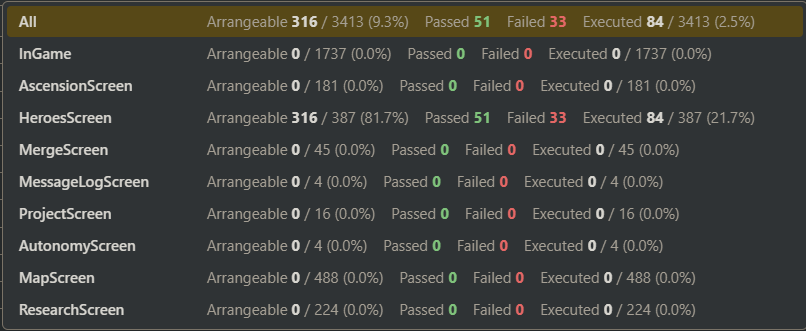
To make myself sleep at nights I generated a little metrics overview (My inner Project Manager Gollum personality forced my Smeagol Developer to do it). You can see the numbers of texts here and their 'coverage' by arrangements - the automated 'scripts' that enables quick on-screen testing.
For no-AI approach my estimate was between 60 to 120 hours to curate all the 3,400 texts manually for the entire game - so roughly 2-4 weeks of work (plus 1-2 weeks of time to prepare scripts, the website and doing some research).
We'll see how things go with AI help - a lot of time I spend experimenting, so at the moment seems to likely take longer, but some benefits hopefully pop out as the work becomes more 'script-heavy' later on.
✨AI experiment Note:
When I naively asked AI to do all the heavy lifting it helped me extract and curate strings into a sample translation text file and ran out of its 5h token budget in 20 minutes. Then another two of those budgets overnight. Then I realized it only did half the work and spent most of my weekly budget, messed up the codebase and would have to be run again, all because I was not explicit enough about some steps.
So the wise thing was to upgrade my subscription (obviously) roll back and run a more idiot-proof prompts over two days. Frustrating experience but Pay-to-Win came to the rescue.
In the end it took over two weeks of mixed AI and manual work to get a single string translated and testable on the screen. I'm currently in week 3 and certain that AI assisted approach will in fact cost extra time, not save it. On the other hand the quality of the results might end up far better (plus it is an important exercise).
When will v1.2 be released?
Bad news is that the 3,400 texts is larger than I hoped for and so the translation costs will quickly climb when I start adding languages. So for that reason I will probably do it in two steps.
I will pick one or two major languages (based on current and potential playerbase) and release a version with those translations (by professional translators).
In addition to these two languages I will also add machine-translated languages done using a mix of tools (My current preference is POEdit Pro which uses DeepL, Google Translate and GPT for their machine translations, but ofc I am open to any suggestions and will be doing more research as well). The version will probably contain also my own Czech language translation (which I will have to do anyway to make sure all keys are working well).
After 1.2 is out and stable I will evaluate how much pain (and money) it was to really pull off and then decide what order to do the other languages in and also what translation method to choose.
In terms of timeline, I am still aiming for Q1 2027 for the 1.2. release. In my last update I mentioned March and I think this is quite realistic.
✨My assessment of the AI experiment
I have shared the anecdotic experiences so you know how far I am with my rookie AI exposure.
While I am generally against usage of LLMs in any public facing professional work (especially Artwork), I am keeping more open mind towards some areas of coding. E.g. there's a difference between generating your own UI library (and treating as you would treat a fork of an existing free library) and AI-decompiling another game's backend and claiming you 'made it with a tool' to sell it online).
At this phase I am still figuring out how much long-term agentic coding would be even useful for my work. After spending almost a month I am mostly concerned how to avoid losing my ability to maintain that same code manually.
First because of the complexity of generated code - making it hard to read and full of tech debt (you can refactor generated code with AI when you give it precise instructions correctly, but in my experience manual refactoring using IDE tools was always faster and more predictable)
Second by becoming a kind of addictive procrastination tool.
After month with AI when I have a problem doable in 10 to 20 minutes I already feel a strong tendency to do it with a ~30min prompt anyway and go make a coffee or go to social media in the meantime. I think this is subconscious - because it will allow me to drift off to other things.
So while on paper the AI's performance looks good, for the time being I am a bit skeptical about the actual time savings in the long term. For the duration of Localization work I'll keep the experiment going and we'll see if I change my opinion.
So in case you're also an indie-dev experimenting with AI, I hope my notes were a bit helpful.
That's all for this update, have a Good Day and I'll see you again around Christmas time.
Cheers,
Ondrej