What's happening / TLDR: Developer diaries introduce details of Espiocracy - Cold War strategy game in which you play as an intelligence agency. You can catch up with the most important dev diary (The Vision) and find out more on Steam page.

Change of Planned Release Date: Q3 2027
We are moving the tentative release date of Espiocracy to the third quarter of 2027. While the core game is satisfying, its production (stability, quality, content, learning curve, interface) requires more work. Along the way, we are going to expand playtests, we plan to release a demo, and we'll carefully act on feedback from both, so that the release version of the game is as epic as you deserve it to be.
Dev Diary #76
Espiocracy covers a very complex period of history, full of multilayered conflicts and tense brinkmanship. In the previous dev diary, we explored how the game handles this complexity on the level of individual events through "plausible points of divergence". Today, we'll zoom out, and tackle it from the big-picture perspective: NATO vs Warsaw Pact, capitalists vs communists, Reds vs Blues.
For all the complexity, further multiplied by deep espionage, the Cold War is ultimately a contest between two superpowers. This brings great clarity (to the point where some people today are nostalgic exactly for this feature of the Cold War!) which the game fully exploits. However, instead of using it for simplification -- as nearly all other video game takes on the Cold War do -- we try to use it to deepen and further enrich gameplay. This diary explores some of the related mechanics.
Blue vs Red
The mechanical foundation has existed in the game since the earliest builds. Any two entities in the game world can be compared by a function that calculates alignment from -100 to +100. This calculation, while it's most precise for entities of the same kind (eg. alignment between two countries), also works also for different kinds of entities (eg. alignment between an actor and a country). It extends even to transient entities, such as actions, so that the game can for instance easily define logically optimal actions available to state actors.
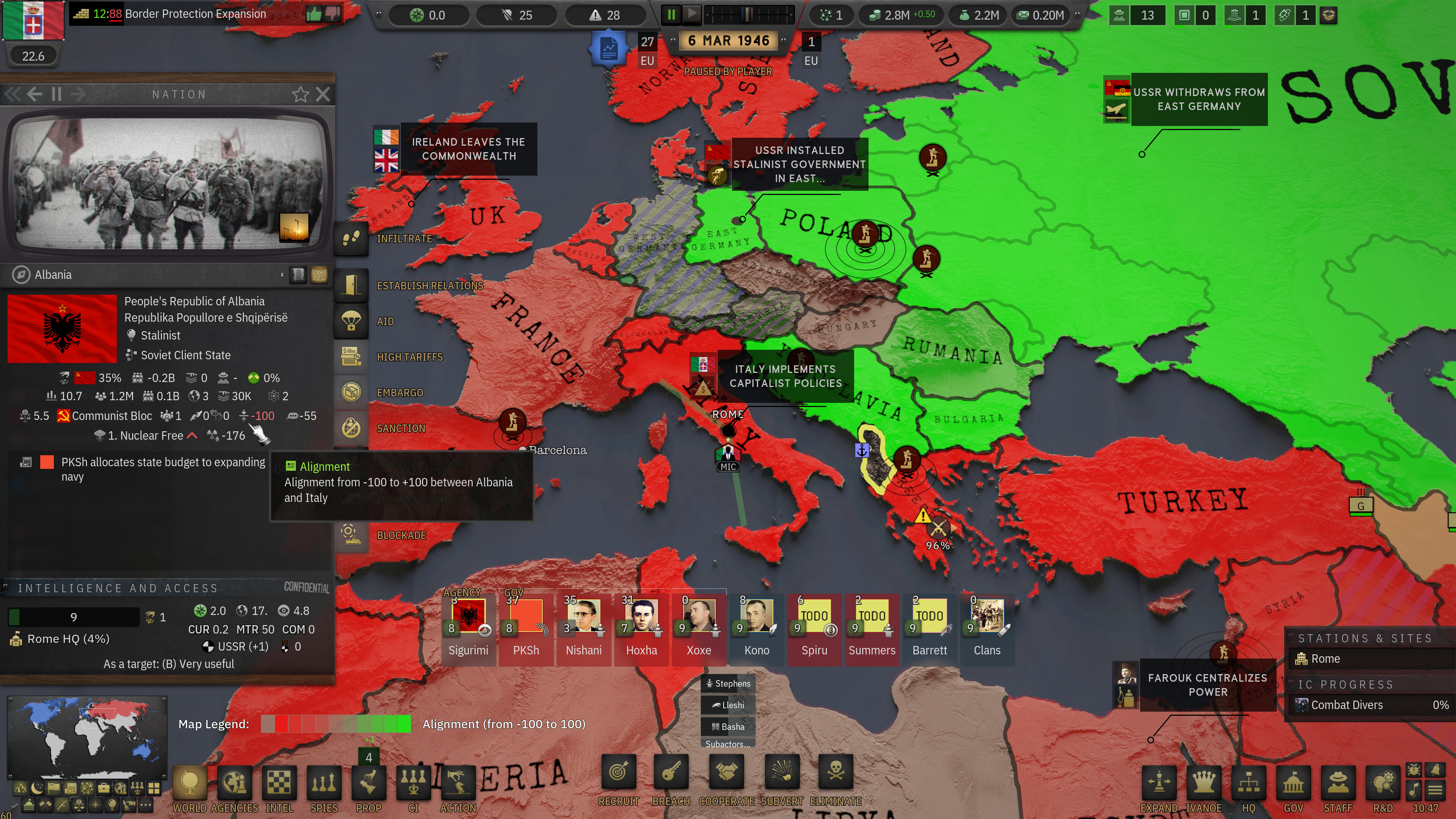
This universality is precisely the strength of this algorithm. You can sense it from its summary for country-actor comparison:
- if an actor believes in an ideology and a country has a governmental ideology, calculation is mainly defined by alignment between the two ideologies (which in turn compares alignments between the views inside, which in turn compares alignment between the subjects of those views, eg. pro-Soviet vs anti-Soviet gives -100), weighted by 0.5 for standard ideologies and by 1.0 for extreme ideologies
- if an actor is not in opposition to the current government, calculation is further supplemented by alignment between actor's homeland and compared country (which in turn compares governmental ideologies, alliances, top actors, government type, international control, diplomatic interactions, populations, religion, propaganda campaigns, and more...), weighted by 0.2
- as a base comparison, the calculation also always includes alignment between the views of the actor, the country (so that anti-capitalist actor is obviously poorly aligned with the USA), and the views of the local population (weighted by their popularity), weighted by 0.3
(Naturally, from a programming perspective we are talking here about frequent recursion which has to be managed through depth handling, proper ordering, and extensive use of caching.)
After seeing this feature in action, a further implementation idea almost falls out of the screen and yells "implement me!": regularly calculate, store, show, and use alignment of every entity with the USA and with the USSR. Organic Blues vs Reds. And so we did implement it.
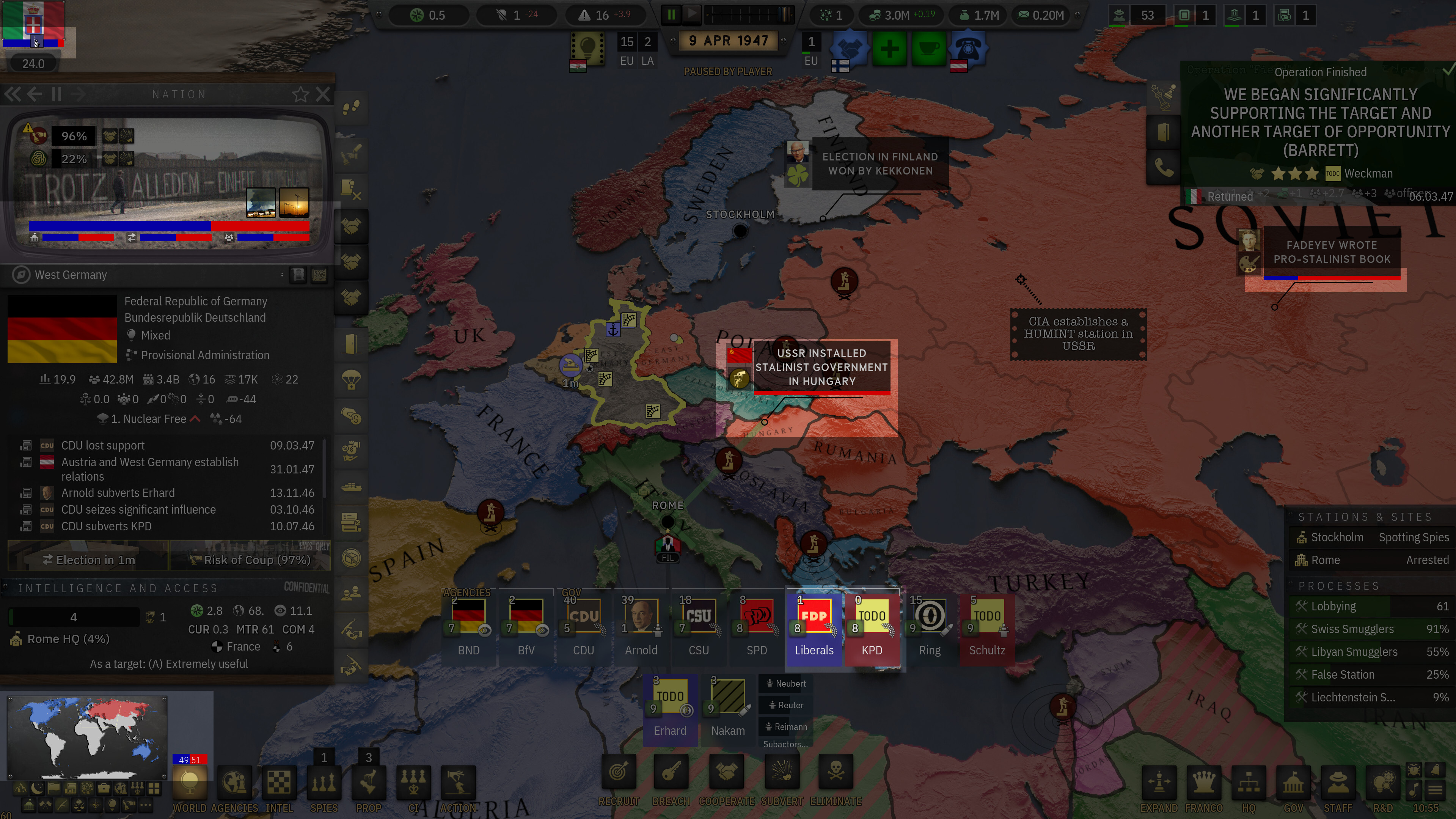
To make it more comprehensible, we translate the two -100 to +100 parameters into a single A:B ratio (eg. 75 Blue : 25 Red means a country mostly aligned with capitalist bloc). To make it more interesting, country-superpower alignment received one more level of calculation: stateful history.
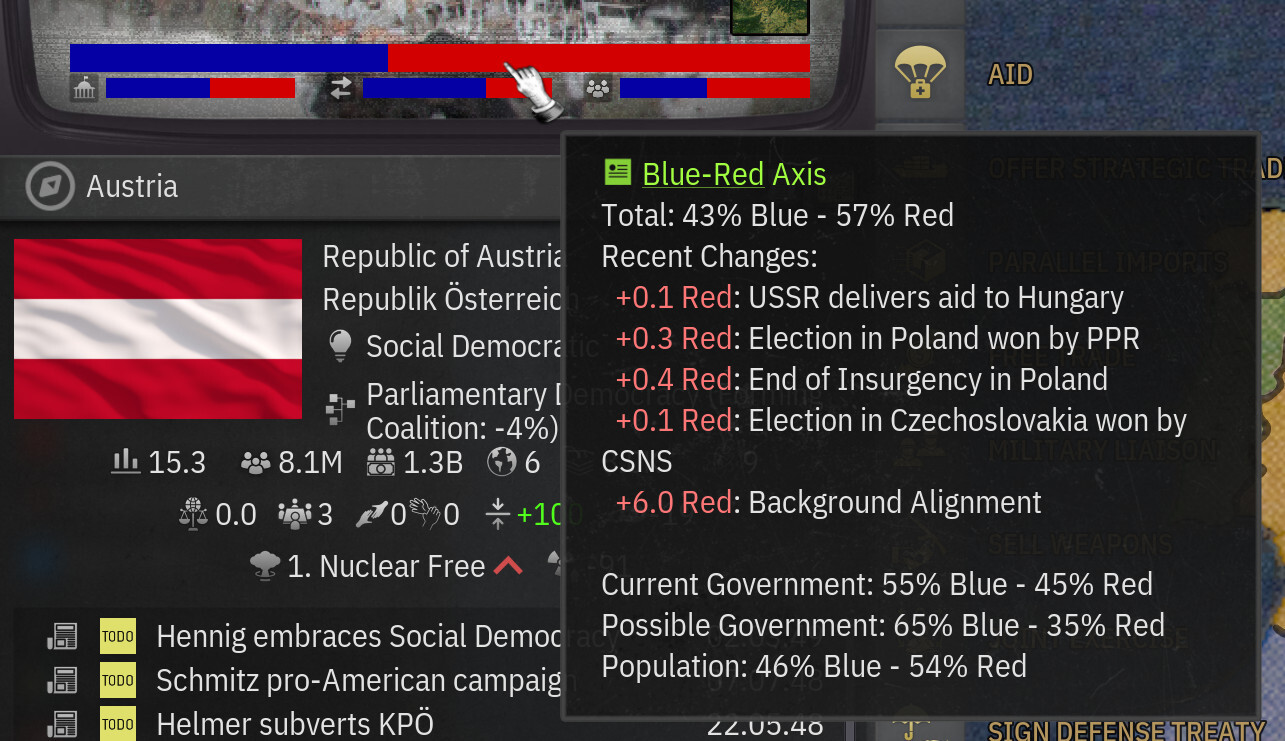
Standard alignment calculation is stateless (pure), which means that given the same input it always gives the same output. In contrast, a stateful approach depends also on previous states, allowing for instance tending towards X over time (implemented here to dampen sudden changes) or single modifier events.
Small Events Go Big
This is where the game implements one of the most fascinating facets of the Cold War. Every little event may matter. A hockey game, chess match, jazz concert, trade fair -- events that we dismiss today with one tap, in the Cold War were capable of distilling whole American-Soviet conflict into one place and time. Many were so important and iconic that we still remember them today, like The Kitchen Debate.
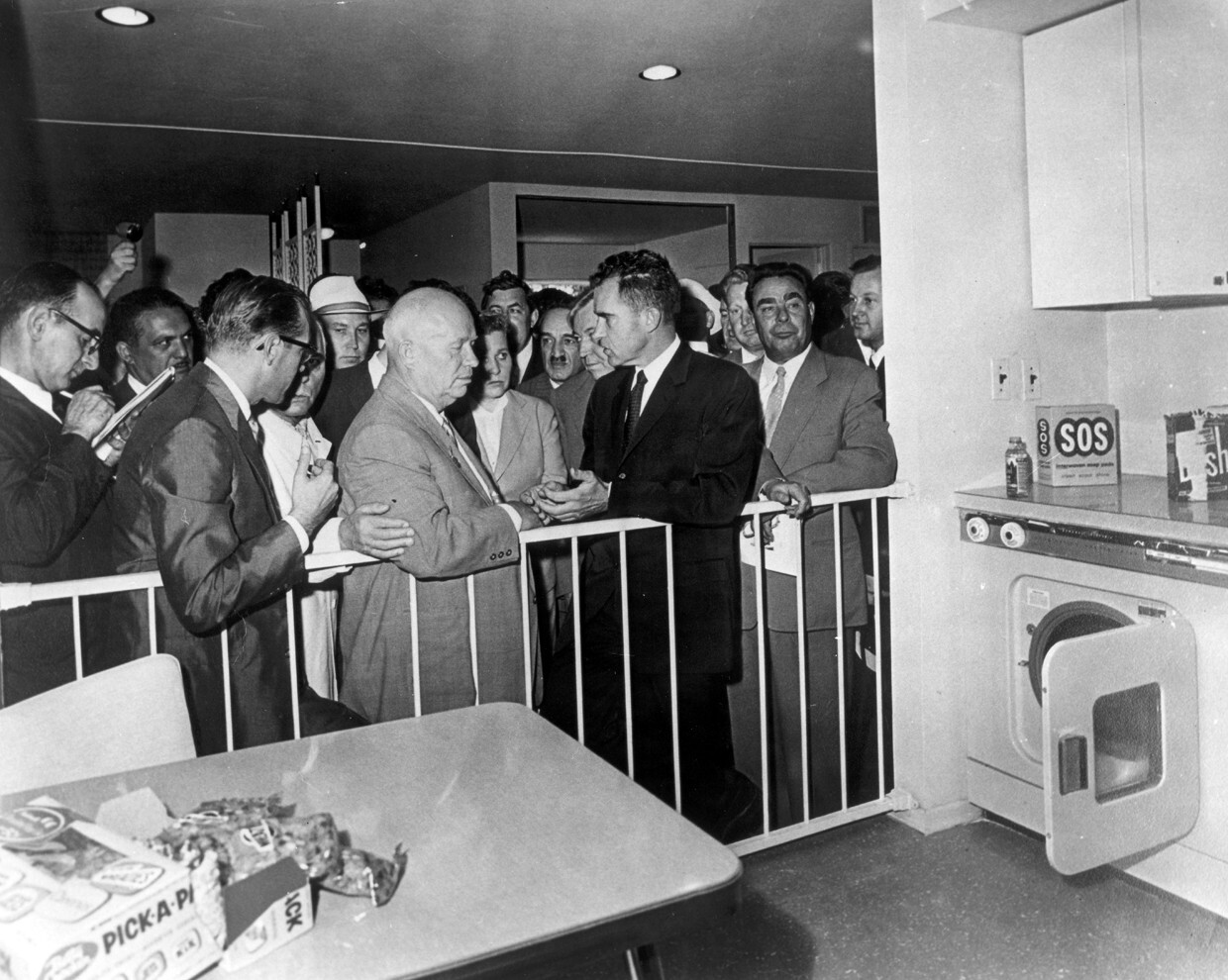
Espiocracy features a rich database of such possible events. And, true to history, they influence the whole Cold War (sometimes to an absurd extent, from modern perspective) by modifying blue-red alignment.
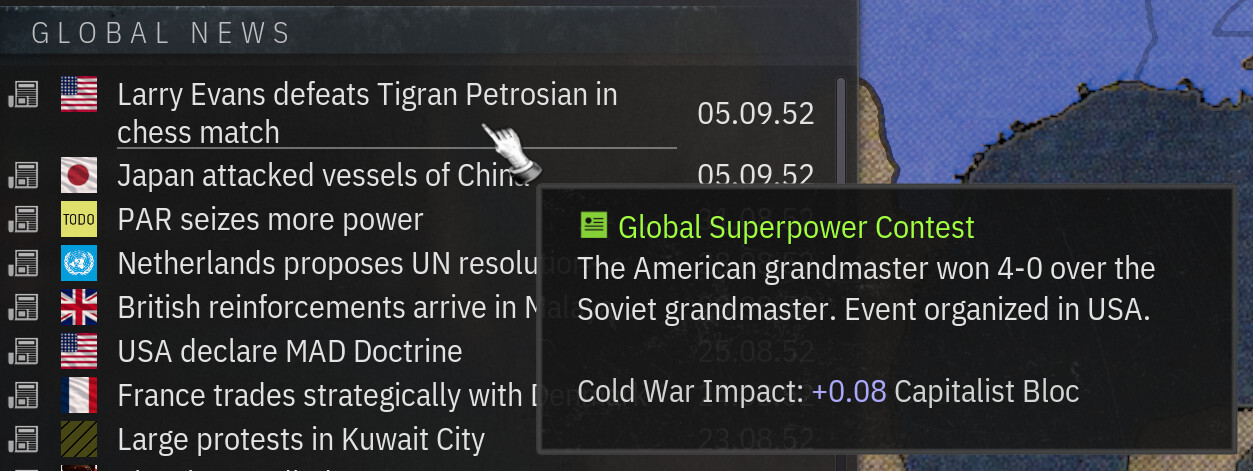
These events influence not only the country in which they occur but also the relevant audience - for instance, a Soviet ice hockey victory over Canada influences the superpowers, Canada, and countries where this sport is popular, such as Czechoslovakia or Finland. We were not joking in the introduction that this Red-Blue perspective is used to further deepen the game instead of simplifying it!
Naturally, this mechanic has been expanded to all the other events, which stem from actions of countries, actors, and players. Joining the UN, winning a battle, defecting agent -- all of these, and many more, can also modify alignment with superpowers ("can" is important here, majority of events do not meet threshold of importance).
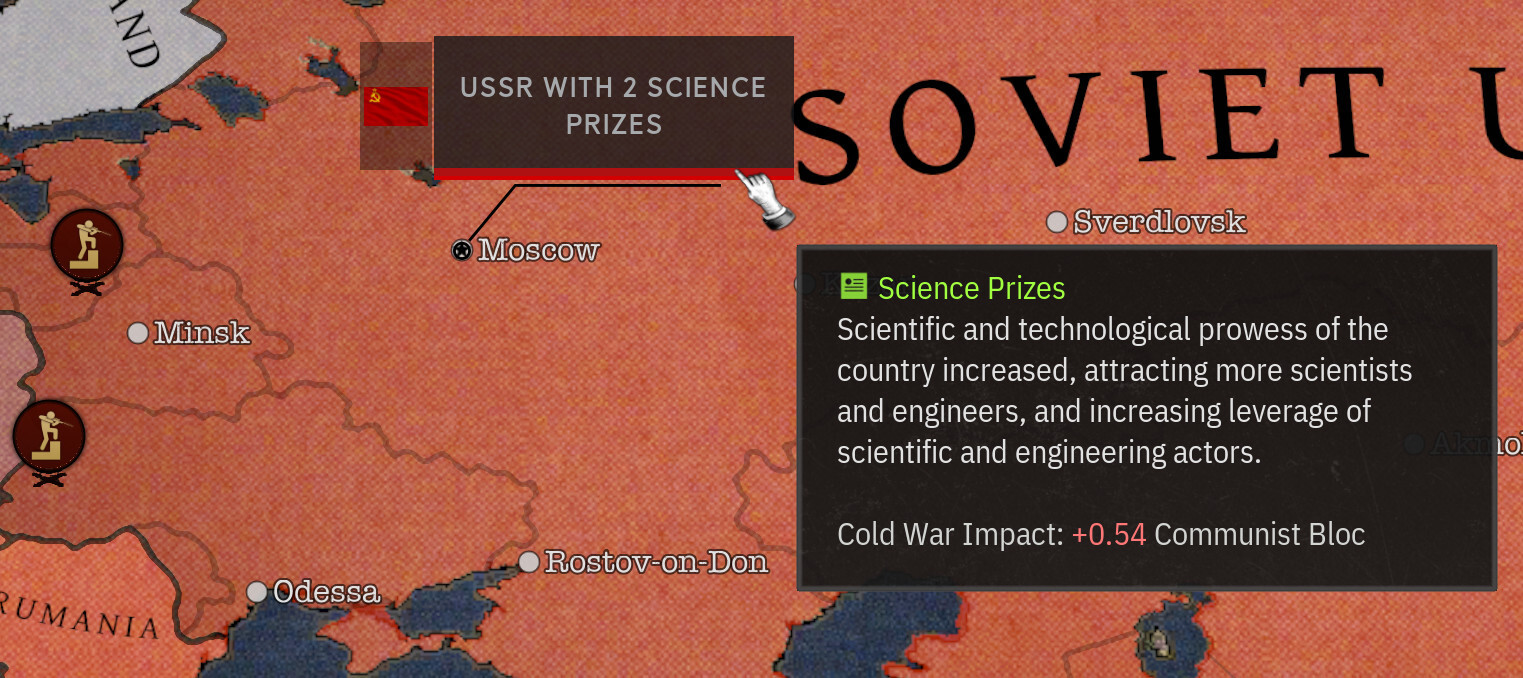
Most important events escalate beyond the relevant audience: they influence the global state of the Cold War.
Who is winning the Cold War?
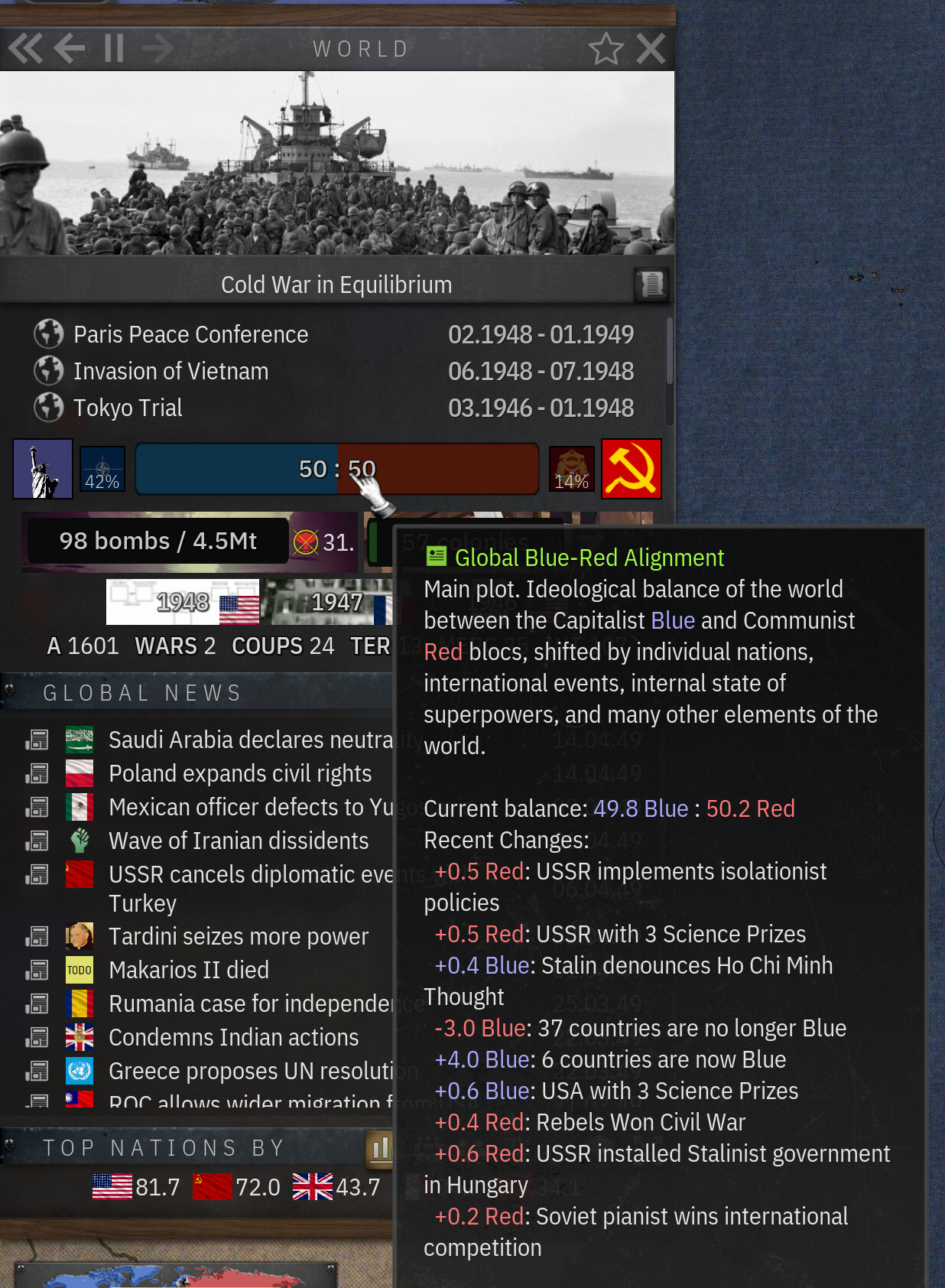
All of the previously described calculations contribute to one global score that is both the thermometer and the thermostat of the Cold War.
On the most basic level, it is modified by changes in country alignments (the Cold War begins with global 50:50 Blue-Red ratio based on initial set of alignments, so only converting countries from one bloc to another matters), important enough events, and the internal state of the superpowers. As the ratio inevitably evolves, it becomes the answer to the question: Who is winning the Cold War? And, as countries and actors are aware that this is indeed The Answer, it also starts driving further events in the game world. For instance, losing the Cold War for the Blues may drive the American election (as it did in 1960), while for the Reds it may drive Politburo tensions (as it did when Khrushchev was ousted).
To avoid snowballing here (a classic issue in strategy games where doing actions A-B-C brings gains D-E-F, which enable doing more A-B-C, which bring more D-E-F, which enable doing more A-B-C, and so on), the Cold War is divided into phases with different mathematical dynamics.
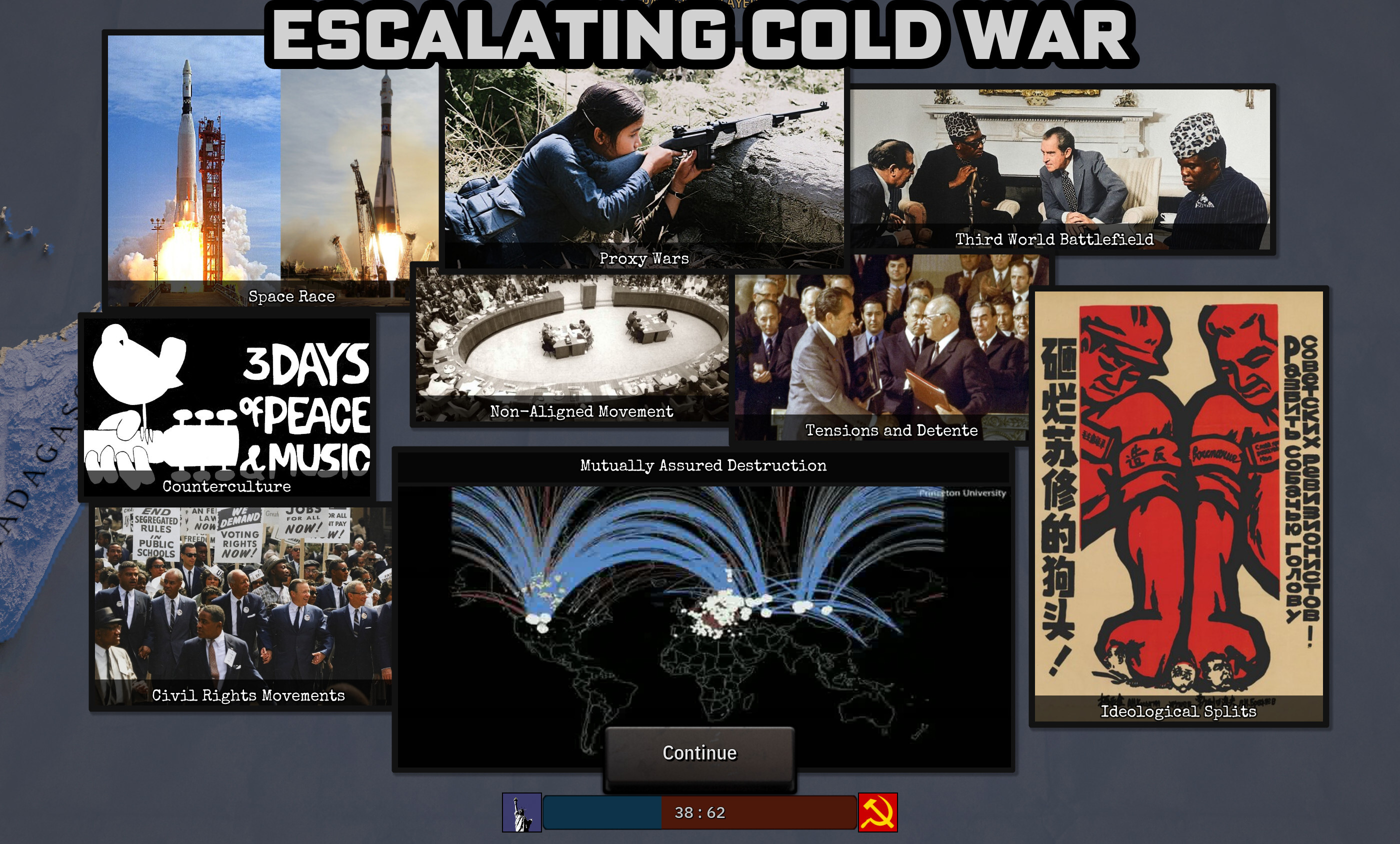
The phases:
- Cold War Equilibrium -> ratio between 60:40 and 40:60, slow changes, high importance threshold for events, internal dynamics of superpowers generally not affected
- Escalating Cold War -> ratio 60-80 for one side, high frequency of "little events", low importance threshold for events (many actions are now more impactful), easy for the (skilled) losing side to get back to equilibrium
- Late Cold War -> ratio 81-99 for one side, slow changes again, "little events" mostly don't matter anymore, neutral countries start tending towards the winner (only until the ratio reaches 90), while the losing side gets more aggressive tools (such as easier nuclear escalation or a deep reform), and both sides are subjected to specific changes (more in the next section)
- End of History -> ratio 100:0, the losing side collapses
Collapse
When the game world progresses towards a decisive victory by The Reds or The Blues, both sides advance towards their ends through sets of unique events. Examples include:
- winning USA: including more countries in the free dollar-based market, stronger NATO, peace dividend, taking over OPEC
- winning USSR: convincing Third World countries to communism, Sino-Soviet reconciliation, reversing American brain drain
- losing USA: racial riots, weakening the POTUS office, random assassination attempts, anti-communist witch hunts, progressing towards the separation of southern states, increased risk of civil war and coup plots, fiscal crisis, countries leaving NATO
- losing USSR: gerontocracy, resignations, high coup risk, a new party competing with CPSU, guerrilla separatists, increasing international isolation, food shortages, losing satellite countries, tearing down the Iron Curtain, death of communism and its popularity
Sooner or later, one of these (and other natural actions in the game) breaks the camel's back and causes the collapse of the superpower: partial dissolution, fall of the government, and takeover by a new provisional ideology-less administration. After the collapse, blue-red language is no more. The legible world of the Cold War disappears from the game, replaced by unilateral dominance of the winning superpower, which then enters an ambiguous era of the war on terror...
Final Remarks
Next dev diary will be published on September 4th.
If you're not already wishlisting Espiocracy, consider doing it
https://store.steampowered.com/app/1670650/Espiocracy/
There is also a small community around Espiocracy:

---
"What does the Ambassador do? He raises holy hell. He yells at the office chief, ‘You CIA cowboys are out there upsetting Soviet-U.S. relations! We have enough trouble with the Soviets without you jackasses going out and doing something on the street with a guy you know nothing about.’" - CIA officer on the intersection of diplomacy and espionage