What's happening / TLDR: Developer diaries introduce details of Espiocracy - Cold War strategy game in which you play as an intelligence agency. You can catch up with the most important dev diary (The Vision) and find out more on Steam page.

This short holiday-time dev diary introduces a new mechanic: a moddable implementation of "points of divergence", a term known from alternate history circles, which denotes significant history-rewriting events.
In this case, it's a distant iteration of large international crises (hinted at in DD#51) where two players, turn by turn, engage in a war of nerves over a high-stakes issue from history or plausible alternate history.
We use it to implement unique events which shouldn't really be generalized into a repeatable mechanic. A prime example of such an event in the game is the Berlin Blockade:
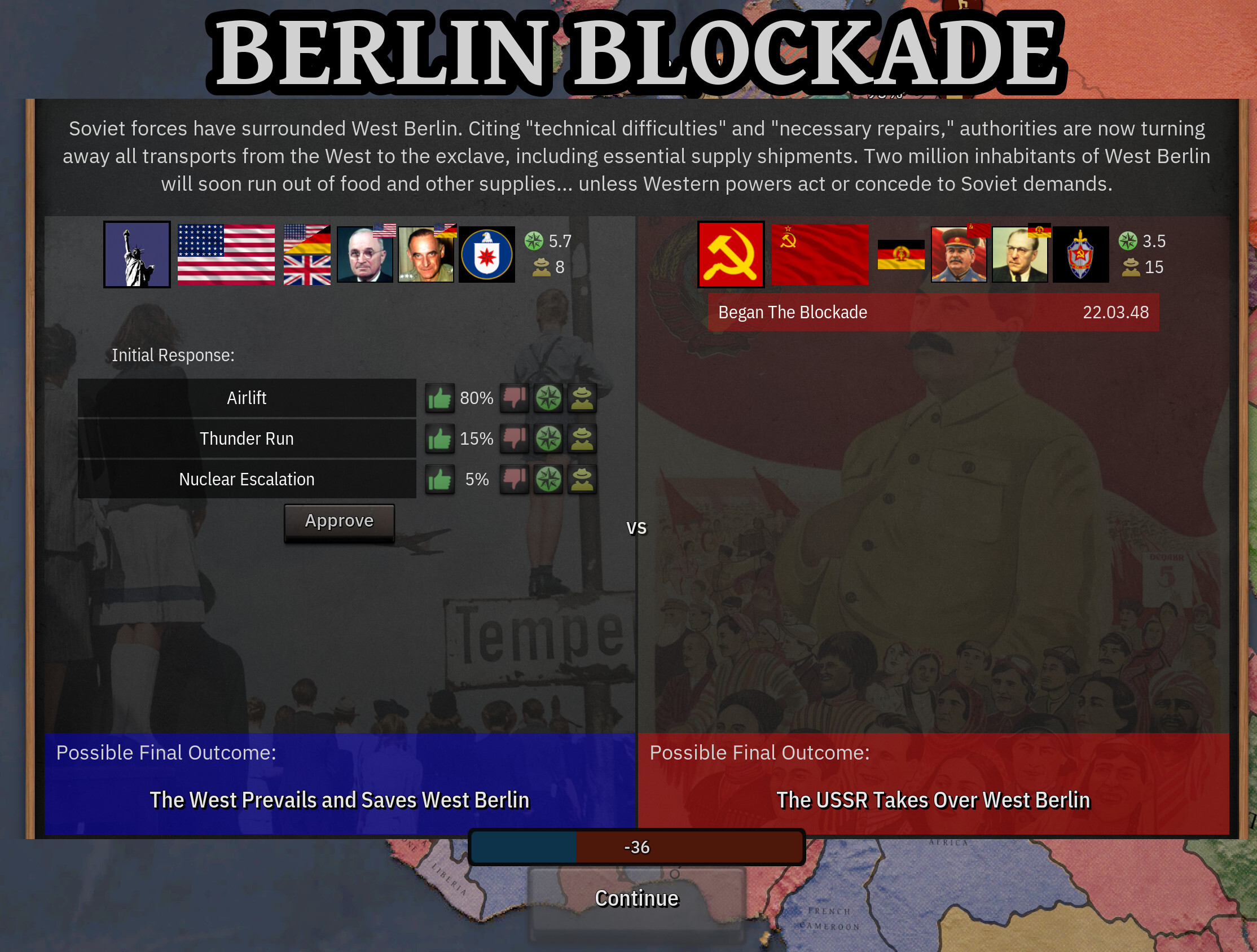
Technically, it's a kind of advanced event chain, so it has all the usual features of event popups known from other strategy games -- trigger conditions, flavor text, clickable decisions, and effects on the game world. The caveat is that they are never triggered automatically; they are launched through a conscious governmental decision (so the Soviets may decide to never launch the blockade).
Inside, what makes it "advanced" is that the event has a decision tree (a'la dialogue tree) which is traversed in turns by two opposing parties.
Every decision has defined availability and costs (in terms of state budget, strategic intelligence, military deployment, etc). Once chosen, a decision:
- directly influences the game world; for instance, "nuclear escalation" means actual progress up the escalation ladder, which may lead all the way to WW3;
- modifies the event's -100 to +100 score (similar to a "war score");
- grants a new set of decisions to the other side.
The point of divergence is won by either side once the score reaches -100/+100, or when the end of the decision tree is reached (in which case the side with no responses left loses the confrontation), or when external circumstances derail the event (eg. the aforementioned WW3). The final outcome implements a wide range of bespoke history-rewriting consequences. For instance, a Soviet victory in West Berlin will cause further Western retreats, delay the establishment of NATO (or significantly weaken NATO if it is already established), damage the image of the current American administration, turn the German population against the West, and so on.
From the perspective of the player, as an intelligence community, gameplay around decisions can get slightly complicated. The ultimate decision belongs to the top actor of the side (eg. Truman or Stalin). It is taken probabilistically, with each option given an initial probability of choice based on circumstances and actor preferences, and then the player can influence the probabilities (including investing strategic intelligence and burning agents to get the point across). This system is, admittedly, somewhat shaky, so it will probably evolve in the future.
And that's all there is to this mechanic. Fundamentally, it's a simple feature but it significantly improves "historicity" of the game (which can be easily lost in an overly simulationist game world), gives us a space to capture many details that would be otherwise missed (take a look the wiki page about the Berlin Blockade to see how many interesting steps, alternate scenarios, and great little decisions contributed to the event!), and becomes an interesting tool for modders.
Final Remarks
Next dev diary will be published on August 7th.
If you're not already wishlisting Espiocracy, consider doing it
https://store.steampowered.com/app/1670650/Espiocracy/
There is also a small community around Espiocracy:

---
"What happens to Berlin, happens to Germany; what happens to Germany, happens to Europe" - Vyacheslav Molotov