
Dear nobles,
We are finally back with Dev Diary!
It doesn't mean that we had such a long Christmas break; quite the contrary, we started working on Noble's Life with renewed energy and January flew by in a blink of an eye.
Today we are going to talk about character creation. Since we want to allow each player to find their own ruling style. we will also give you the tools to achieve it.
Therefore, we will tell you what sending the player's character to become a devoted to the Church can affect, what the cult classic "Inferno" by Dante Alighieri has to do with the protagonist's past at the university and whether using hedgehog, squirrel and chicken symbols as heraldic figures is a good idea.
Personalities and Coats of Arms
The player will be able to choose the name of his noble, but also the name of his demesne, which is the same as that of the family and something like a surname. You can also choose the name of your main city. Of course, each of these can also be drawn from a pool of historically accurate proposals.
The matter of identifying your character will be closed by the coat of arms. Here, as in many other games, you will be able to modify the shield and choose the charge. Among the available symbols, there will be only those figures which were historically present, but that does not mean that the choice will be small. Lions and eagles in various configurations were fairly common, as were towers and crosses, but there were also flowers (especially lilies) and other plants, unicorns, wild boars, hedgehogs, squirrels and chickens (roosters to be precise).
Why would anyone put such an animal on a coat of arms? Nowadays this may be unusual, but all of these animals were once used to represent certain virtues. Squirrels symbolized patience and perseverance, hedgehogs symbolized perseverance and cunning, and the roosters symbolized vigilance, manliness, and courage.
How will the chosen coat of arms translate into the game? Well, visually quite a lot. We are already planning many places where we will present the player character symbol.
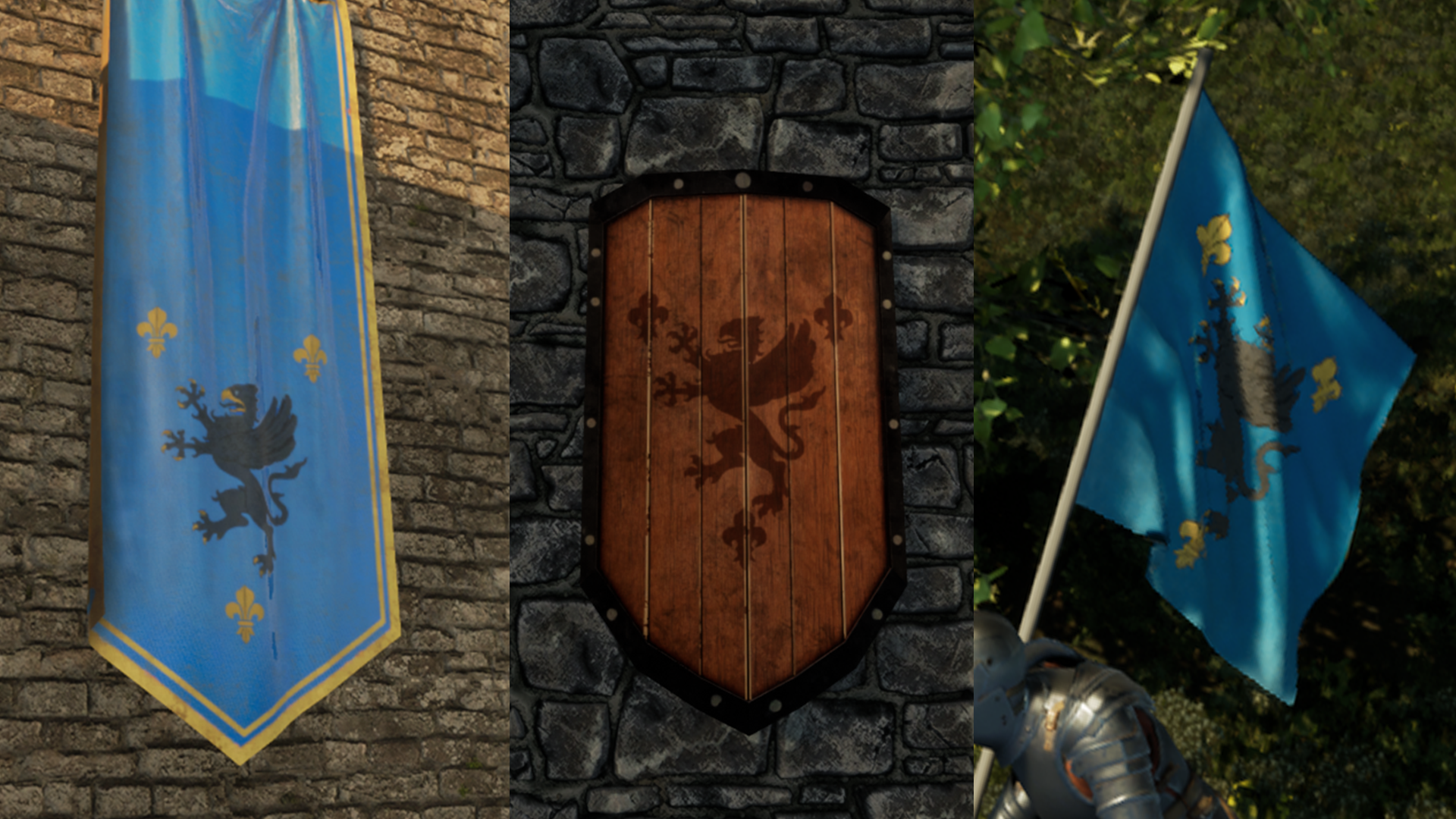
These are just some examples of the different ways a player-created coat of arms can be presented.
Origins
The biggest influence on the gameplay itself will be the origin - defining the player character's past. We are initially planning four options, which will be further divided into two groups. The first one defines our character as the first son, the heir, who has known for years that he will be the one to rule after the death of his father. The second - the second son, who became heir only after the recent death of his older brother.
Each group will affect many story events, differentiating the gameplay and making it, in simple terms, a little easier for the first son. In his case, the player will be able to choose between The Overseer and the Knightly Traditions.
The Overseer is an origin recommended for those wanting an easier start of the game and focusing on economics. The player's character is liked and respected by the inhabitants of his domain, who over many years have gotten used to thinking of him as their future ruler. The protagonist with this past was also prepared for the role of a steward of his demesne. This includes gaining access to unique decisions when interacting with the peasantry.
The Knightly Traditions, on the other hand, reflect the focus of the character's education on military issues, as well as his youthful fascination with legends of the Knights of the Round Table. Hence, by choosing this background, the player will strengthen their initial military capabilities, as well as gain at least some additional opportunities while dealing with knights and soldiers.
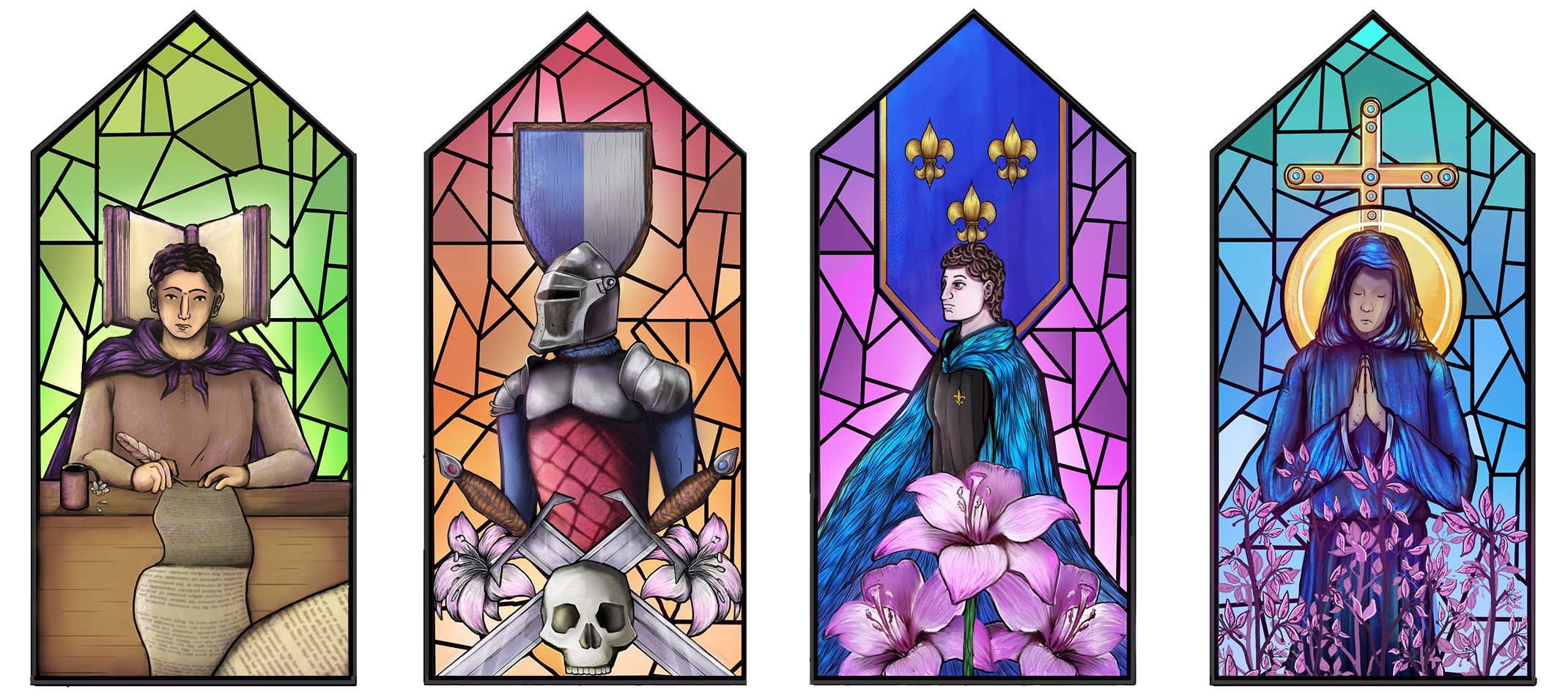
This is the first version of the graphical representation of origins in the form of stained glass windows.
The other two available choices tied to being the second son, are Church Education and University Contacts.
Church Education establishes that the protagonist's father decided that his second child would make a career in the church. Hence, the player character with this background was trained for several years as a clergyman and even managed to take minor orders. Although the death of his brother forced a change of plans, such a past will still facilitate relations with church dignitaries or increase piety in his domain.
University Contacts, on the other hand, mean that the character has been sent to obtain higher education. We are tentatively planning for it to be the recently founded university in Cahors. The city itself is very interesting, and is mentioned in Dante Alighieri's famous "Inferno". And it's not in just any company, because it's next to the biblical Sodom. It is used there as a synonym for the sin of usury. It is said that even in the period prior to the Hundred Years' War, rich merchants-usurers living in Cahors were granting loans throughout Europe.
In such an environment, a player character with this background had the opportunity to learn a little bit about trade and finance, and on top of that has met some rich people. The latter will open up options for unique investments and loans. On the other hand, it may earn the lord a not-so-honorable reputation of a friend to the usurers.
That's all for today. In the next Dev Diary, which will be in March, we'll tell you more about the beginnning of the game’s story and explain why Kingdom Reborn is the game's second title.
What origin story do you like the most? Or maybe you would like to suggest another one?
Let us know! Be it on our Steam forum or on the Noble's Life Discord ( https://discord.gg/CwUvBu3d8q ).
We also invite everyone interested in the Hundred Years' War to our Twitter account ( https://twitter.com/Nobles_Life ), where as part of the On this day series we describe events of interest from the perspective of this great conflict.