
Dear nobles,
Merry Christmas and Happy New Year!
Thank you for this entire year. Your interest in Noble's Life continues to impress us.
There wasn't supposed to be any more Dev Diaries this year, but we decided that we would prepare one more post. However, first we have to pass on sad information. Unfortunately, we will not be able to start playtests this year. We did as much as we could, up until the last minute, but some things just don't work very well. We've also come across some nasty blockers and we would feel bad sending the game with such big bugs that we are aware of.
We immediately inform you that this does not mean that you will have to wait long. Playtests will probably start in January 2023, rather in the second half of it.
We will recuperate over Christmas, fix the last major problems and share the beginning of the game.
We know it's been taking a while, but we're a small team that wants to make the best possible impression, so we're asking for a little bit more patience.
Christmas in the Middle Ages
On the occasion of Christmas, we would also like to write something about how this special time was experienced in the Middle Ages. There were so many differences that we have had materials for years.
It was widely accepted for men to dress up as women and wear animal masks in order to tell jokes for money, children-bishops or huge football matches, with several dozen to as much as several hundred people, where even deaths occurred. And to top it off a several-day feast and fortune-telling.
From more modern customs, the relative novelty (being roughly 100 years old) were Christmas nativity scenes.
Today, however, we will write about the first two, i.e. mummings. The name is probably associated with the Middle English word mum (silence), German mumme (mask) or Greek mommo (frightening mask). The word mummer (disguised person) from the Early New High German language also had to influence the creation or spread of the term.
Mummers
Putting aside the term in itself. It is not certain how and when the custom began. Some historians suggest that this form of entertainment is the result of these huge feasts in which hectoliters of alcohol were drunk. Many others perceive in this play, which seems quite correct, the remnants of the pagan customs associated with the winter solstice.
The history of mummers in Europe dates back at least to Ireland in 1172. Already then it connects them with Christmas. We also have confirmations of the existence of the custom from England of the thirteenth century. More recent sources mention this game also in continental Europe, so we recognize that mumming could probably have been cultivated also in France, and especially as close to Gascony as the place of action of Noble’s Life. Yes, this is also our inspiration for in-game events.
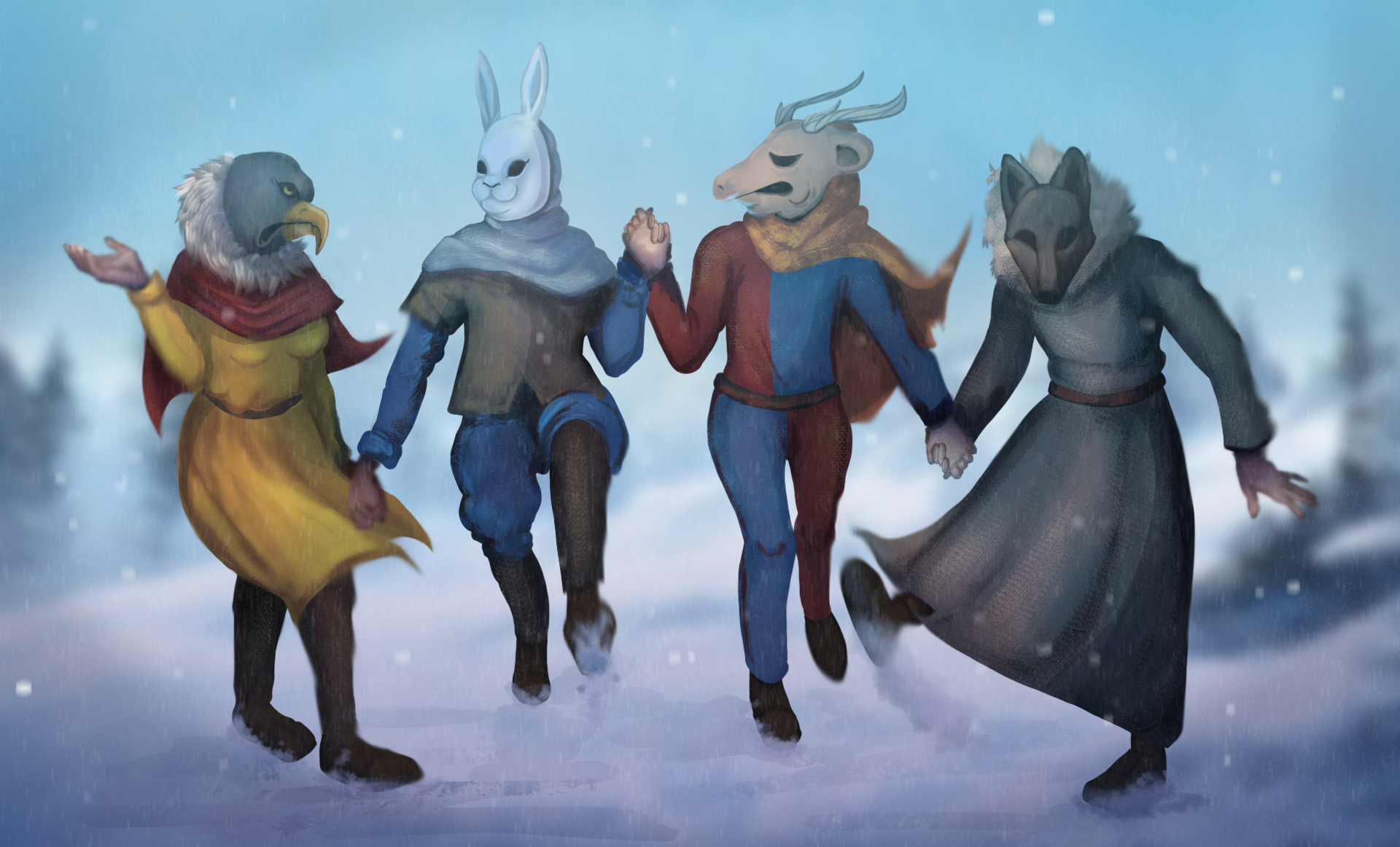
There are not many representations of mummers from the era, but based on those from illustrated manuscripts, we have prepared a graphic showing how it could look like.
What exactly was that?
As we wrote earlier, the basis was disguise. It was popular for medieval men to either cross-dress as women or wear various animal masks such as: rabbit, donkey, wolf, bird, deer, in one word, of those animals that the locals knew. At the same time, different regions could have their own unique ideas for disguises.
Once the peasants had dressed properly, the games began, of which there was also some variety. Common dances in silence or singing folk songs are most often mentioned, but also going door to door. The mummers then sang in front of the household or told jokes. Some did it for pure fun, others expected some coins or other gifts. Those who know the custom of Koledari practiced today may have certain associations.
Mummers also organized amateur performances. Unfortunately, we do not have too many medieval sources here (although the tradition continues to this day). It was very likely that they would play, above all, the story of Saint George and his battle with the dragon.
It also happened that games of dice were played with the host of the house, after which he got to join the rest in a group dance. Although it was folk entertainment, there are indications that crowned heads were also involved.
Mummers survived in many traditions, it was also the basis for more famous Italian Masquerade balls.
It seems that it was great fun, but also a form of letting out some steam and fooling around in order to forget about the painful parts of life.
Or were we really just dealing with antics after a lot of alcohol? Our ancestors were not so different from us after all.
So, ending once again - Merry Christmas and Happy New Year to all!
Peace for those who need it, or crazy fun similar to the one had by our ancestors described today.