
Greetings, Captain!
As promised, here's our mid-cycle reboot of the Developer's Diary, now denoted by the index R1 as you may have noticed to tell that it's the first of the reboot series. Today, we'll be talking in detail about the Supply System in the Campaign, show off some of our progress with the map itself, and of course introduce the revised, version-based Roadmap, which will also be edited into the Early Access launch announcement "Roadmap and Buyer's Notice".
That was the summary, now let's take a deeper dive!
Roadmap:
(*) : We are here
Gathering Storm - Pre-Campaign Work (*)
- Tutorial
- Challenges
- Fleet Endurance and Basic Customization
v1.4 | Campaign Preview v1
Features:
- Campaign game mode
- Permadeath of boats and characters in Fleet Endurance and Campaign
- Crew enlistment management
- Crew traits
- Crew gear customization
- Crew skill rebalance
- Crew animation additions
- Steam cloud save
v1.4.1 | Fire Support
- Focus on Call-ins and Call-in customization
v1.4.2 | Home Improvement
- Focus on Tech Tree fundamentals for usage on all sorts of upgrades and unlocks.
v1.4.3 | Thunder
- Rework and expansion of artillery based weapons
- Weather mechanics on world map
- Weather visual improvements in gameplay
- Wind effect on crafts
v1.4.4 | Armory
- Implementation of variant and improvement systems for existing arms
v1.4.5 | Fleet Endurance Preview v2
- PC-461 playable
- Fleet Endurance map selection
- Fleet Endurance friendly positioning management
v1.5.0 | Campaign Preview v2
- Campaign extension to New Britain and Eastern Papua New Guinea
- Improved area presets for engagements to better resemble the world map
- Squadron management
- Replay system
- Special Missions
v1.5.1 | Coordinated
- New AI features for units
- Public level editor support
- Workshop Integration
v1.6.x | Vast Distances
- Possible sidegrade to custom ocean from Crest
- Public craft creation tools
- Various reworks on unsatisfactory implementations
v1.7.x | Classified
- Classified
As you can see, the upcoming version has the longest to-do list of all the other versions, owing to our desire to have the Campaign be "mostly done" before being released for preview. Still, progress has been coming along nicely, and we're glad to be able to talk about at least some of it.
The Map:
Let's begin with the modernized map, replacing the original we talked about way back in March.
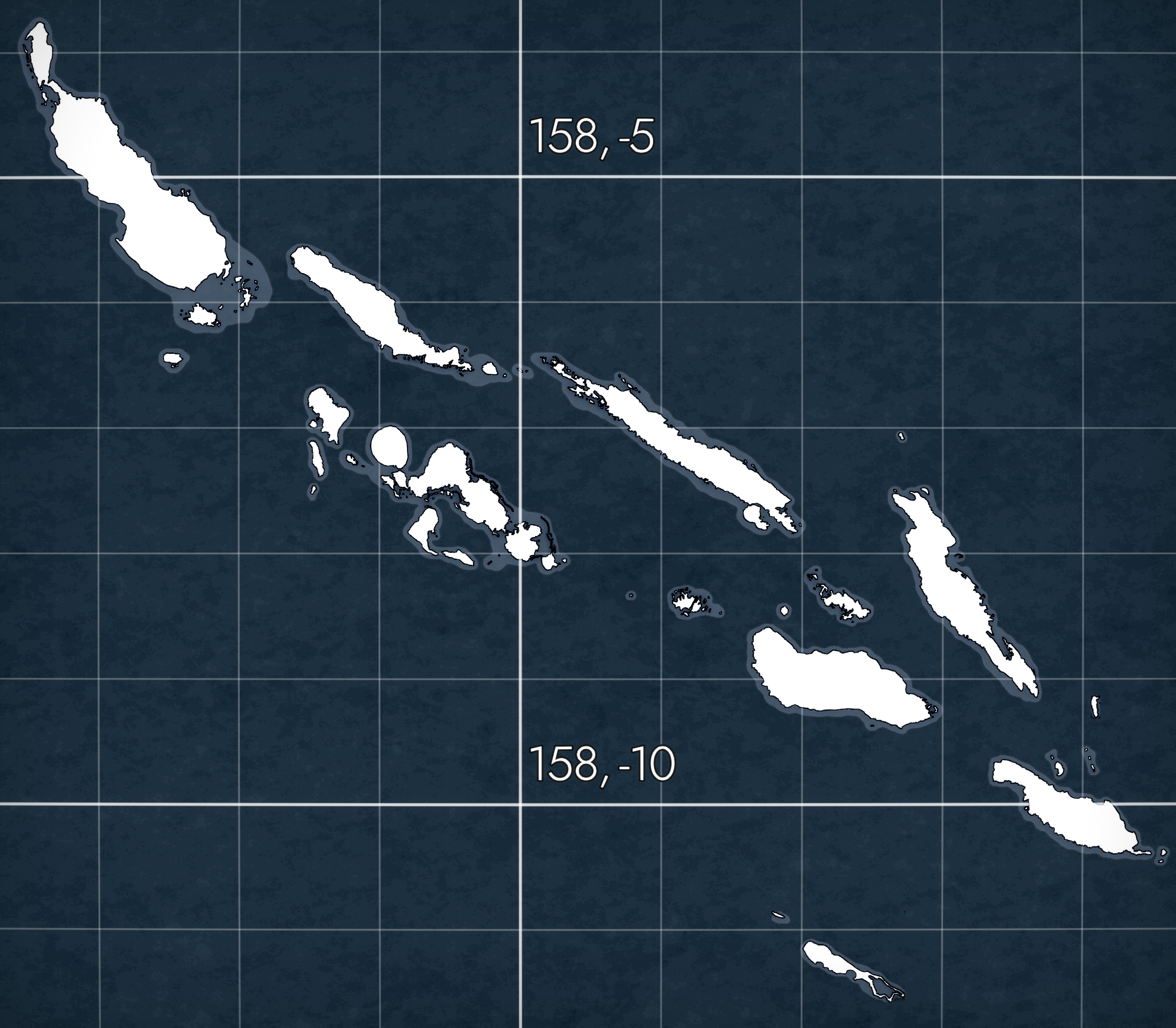
Our crisp new high quality map is complete, replacing the older one you currently have access to in Campaign Spectator, which is a downsampled version of a high resolution heightmap. The base heightmap was causing a few visual glitches along with very messy and unrealistic representations of the coastlines of the locations. Which, as you'll agree, is quite unacceptable for a map we expect you to be staring at for quite some time.
On a more subjective note, we also felt that the old style felt a bit disjointed with the rest of our UI design and thus acted as a creative block, and having an actual high quality map in place solves both of these problems, making it easier to visualize gameplay on top of just being pretty and nice to look at.
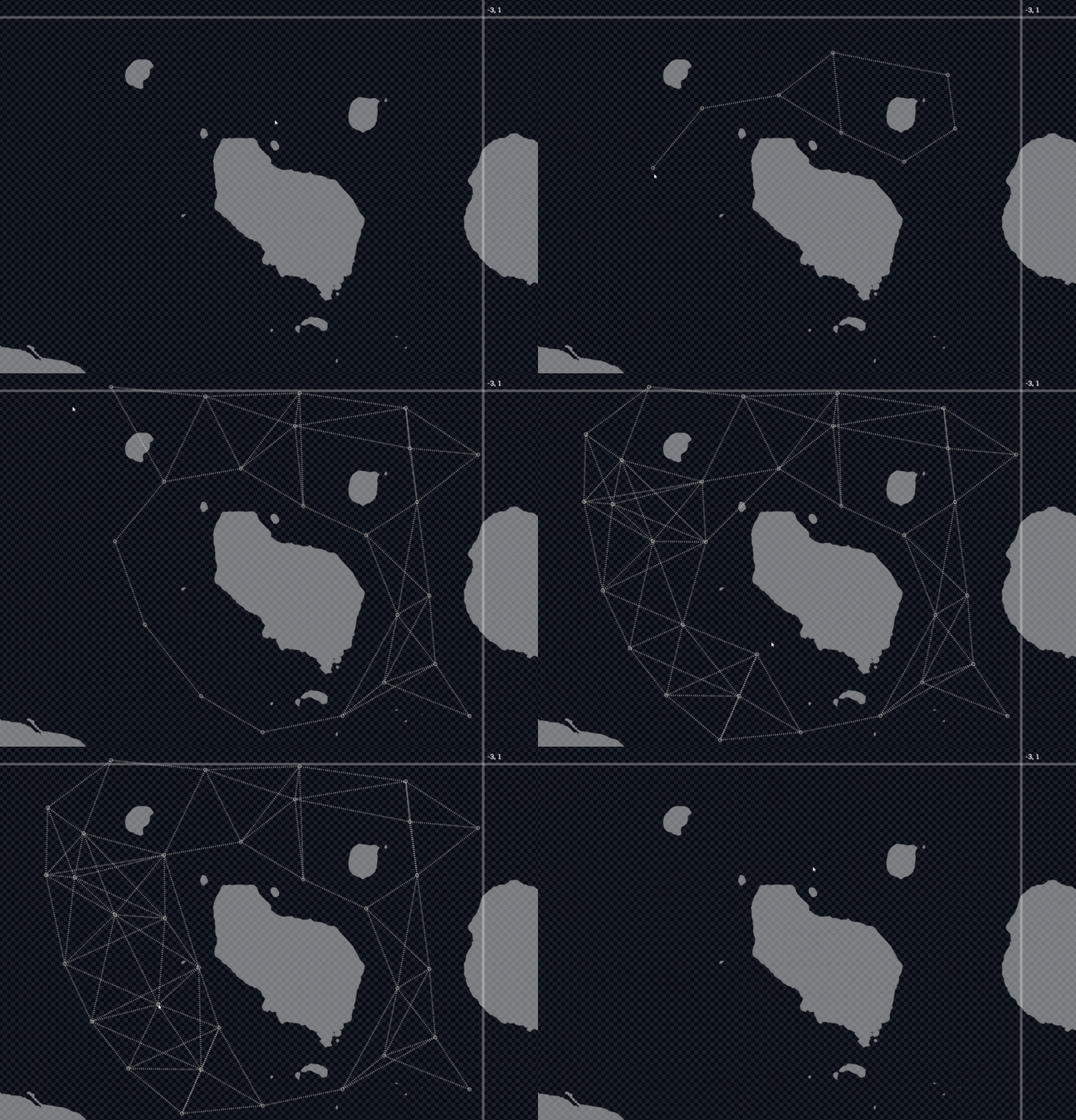
Here you can see the Patrol Nodes being placed by hand to create a Patrol Network. We already use a similar system for Challenges and Fleet Endurance to tell the AI the routes along which it will patrol, and the Campaign map counterpart will of the Patrol Network will be used for, you guessed it, patrols that spawn regularly from bases.
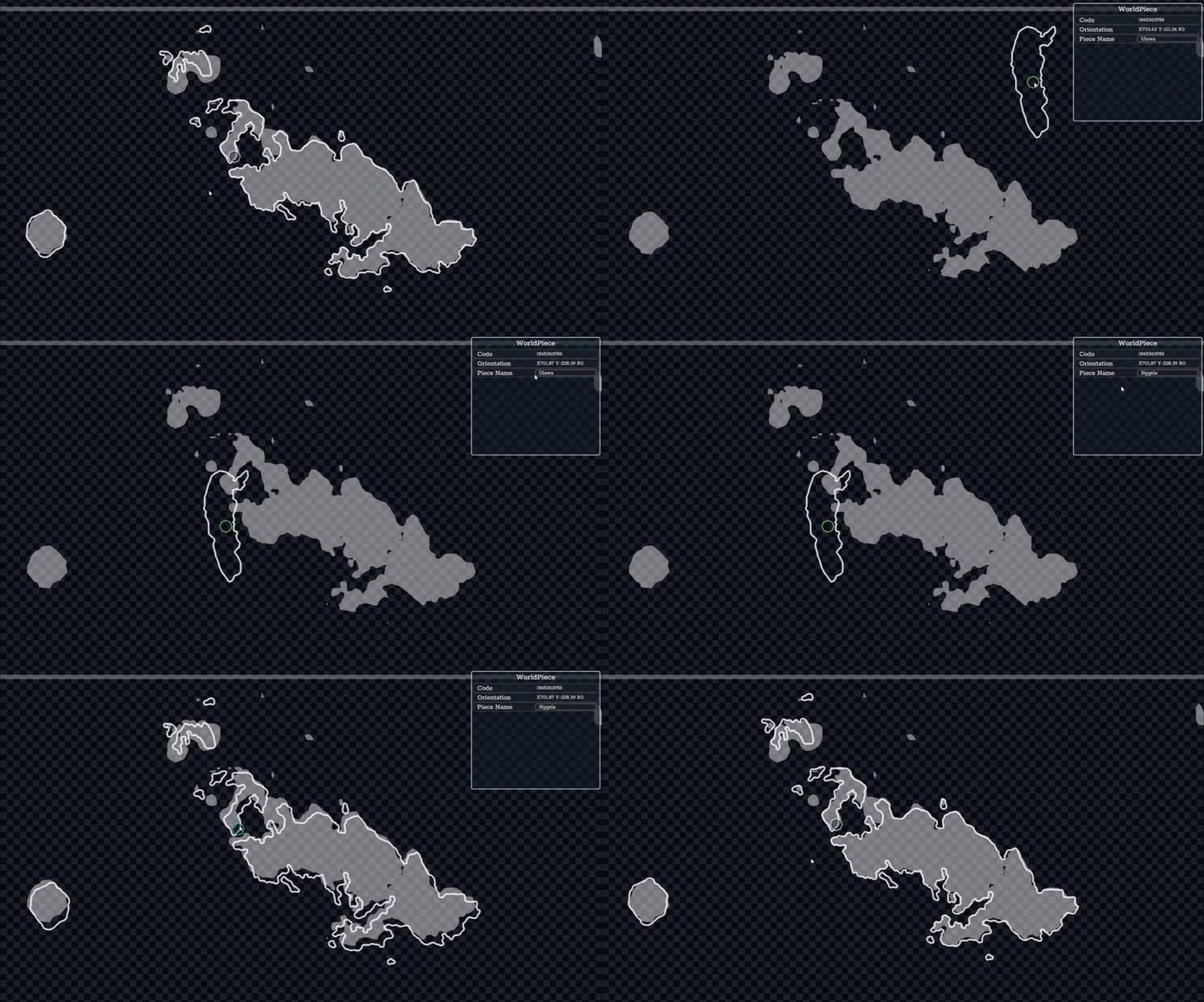
And finally, here's a sample of our map integration. The directory is pinged for Nggela and one of the many source .pngs with the related label, the coastline, is retrieved. The node is calibrated by hand, using the heightmap as a reference, so that the game can load all the high resolution pieces at the right places.
The result is the seamless fusion of the visible map and the gameplay element map behind the scenes. Now, of course, you may have noticed that our drawn map does not exactly match the heightmap, and that's because the heightmap is rather less than perfect, creating islands that aren't there in reality and removing those that are, which is why we enlisted the help of an artisan to draw the region true to life.
Supply System:
Next up, we wanted to talk about the Supply System, which will form the backbone of all operations in the Solomon Islands region for either side of the conflict. Bear in mind that the supply system is currently not implemented and is slated for this week, so this section will be lacking in pictures as all we have right now are our crudely hand drawn internal document diagrams. We hope to have a visual aid for this later on, but for now, enjoy the description of the design as it is fairly final.
Overview:
As we hinted earlier on, Supply is the abstracted flow of resources from one point to the next, discretized into periodically spawned Supply Convoys of varying size and cargo value. Supply is used for several things; it can be stockpiled, it can be consumed to spawn patrols, it can be used to develop bases, and will in fact be doing all of these simultaneously and automatically, according to game rules the player will have limited but meaningful ways of interacting with. It flows in from outside the map and chains between bases, forming a supply line, along which convoys will be automatically spawned and will have to be defended or raided. Multiple, unique supply lines can exist as the amount of supply lines is determined through gameplay.
Flow Rules:
Supply lines are automatically generated, and they are guided by a list of 10 rules:
1. Each node can have at most 1 input and 1 output.
2. Route connections may not overlap, meaning a supply line cannot cross over itself.
3. Maximum number of supply nodes, that is, bases, served is the priority.
4. Second priority is to minimize the total distance travelled.
5. All routes are curved and are never closer to a coastline than a given distance except when debarking and embarking in a port.
6. The number of supply routes are determined through Campaign parameters and through gameplay.
7. Supply routes may not be changed for up to two weeks once they are decided, or until their last supply convoy reaches its destination; whichever is later.
8. Convoys will stop for at minimum a day, scaling with the base supply value of the convoy.
9. Supply flow is discretized as convoys are spawned and sent underway; the player is given a daily average estimation and losses are reflected there.
10. Individual connections in a supply line may be blocked after sustaining heavy losses for a period of time.
To go briefly over the implications of these rules, the game will automatically always decide on the best supply route for you (and your enemy), and will even do limited damage mitigation on its own. Your direct involvement in the way supply lines are structured will be limited mostly to raiding and defending convoys, and later on assigning squadrons to do that. What's under the hood may be a relatively complicated system, but the part that concerns a PT Boat Captain is quite simple; sink the bad guys, and keep them from sinking the good guys.
Nevertheless, the sustained flow of supply is crucial to the operations in the area, so it's useful to know for what and in what manner they will be used, so let's move on to Bases.
Bases, Development and Outflow:
Bases are what we call each node on the supply network, which are pre-determined spots on the map deemed suitable for base construction. When the Campaign begins, most of these spots will be barely developed and/or under control of the enemy, so they don't necessarily represent full fledged bases, but each of them have the potential to be just that.
This on-going status of a base is called Development, and has several effects. Firstly and perhaps most interestingly, each base on the Allied side will pay a fraction of their development to you as RPs, the main currency of the Campaign. Development increases the supply consumption rate of a base as well as the strength and frequency of generated patrols.
Development is built and maintained with supply; bases will atrophy if the stockpiles run dry and the supply situation is still not fixed. Whenever a larger base consumes supply, it will generate a percentage of that in backflow in the opposite direction of a supply route.
A base will always first collect just enough supply to maintain its supply status plus a minimum reserve that will be adjustable through gameplay (say, lowered during an Assault as the rear bases are stripped for resources to fuel the main attack) and the base will again take a cut depending on its rules to use for development and/or further stockpiling, again in proportion depending on its rules. Then finally the remaining supply will be pushed forward, with a pushing bonus that depends on, you guessed it, the base's rules, and a distance based logarithmic decay modifier to simulate the additional fuel and escorts required to travel longer distances. Logarithmic decay means that small differences in shorter distances won't matter that much, while longer distances will give increasingly larger penalties.
To further help visualize, as an example, and assuming no stockpiling:
If 100 supply enters node with no storage and the rules: collect 10%, develop 40%, push bonus 10%, they take the 10, develop 4 with it and put the remaining 6 on the push pile to have a base of 96. Then, with the push bonus, this becomes 105.6 supply pushed to the next node.
Now finally, let's talk about the base types based on development that change the flow rules for that particular base. The base types we have are: Outposts, Supply Depots and Forward Bases, in increasing order of development.
Outposts are small emplacements with very limited amenities, and so can only spawn light patrols. They do not have any stockpiling whatsoever; whatever they collect, they will use for development. They take a smaller cut than larger bases from the supply line, and will pass the remaining supply onward with a boost scaling depending on their development. Outposts generate no backflow, and if they somehow receive some backflow, which generally shouldn't happen as bases upstream will generally be more developed, they will use all of it to further their development rapidly build up.
A sufficiently developed Outpost evolves into a Supply Depot, which is a medium tier facility that gives with one hand and takes with the other. Light and Medium patrols will be spawned from Supply Depots, while they will stockpile half of their cut and use the remainder to develop themselves further. They have limited stockpile that scales with development, meaning they will have occasional bursts of would-be stockpile getting used for development from the leftovers of arriving cargo. They will take a larger cut than outposts, and have the same push bonus as a maximum development Outpost.
Supply Depots will generate half to all of their consumption as backflow, scaling with their development. Given their position as mid-sized bases, they will also only consume 50% of the backflow that they receive, and will push the rest upstream (or downstream from the backflow's point of view).
Finally, a fully developed Supply Depot becomes a Forward Base, which is the final evolution of all bases capable of spawning Light, Medium and Heavy patrols. They will stockpile almost all of their collected supply, using very little for development. They also do not collect any backflow but instead pass it onward (backward?) to lesser bases in greater need, and will generate all of their collection as backflow themselves.
And finally, perhaps most importantly, Forward Bases are the only base type that can muster an Assault, which are the primary way of attacking and taking over new territory that we will be talking about in detail in a future Developer's Diary.
Overall, the system is designed to be self-balancing by distributing development everywhere while simultaneously encouraging the rapid buildup up bases furthest down the chain and therefore closest to the frontline. We'll be experimenting with it thoroughly after it is implemented and these experiments will be the topic of a future Developer's Diary, but for now, this is the detailed plan going forward.
Goals for the Next Cycle:
At the very least, we want to have implemented and tested the supply system. Associated gameplay modifiers will come after we have verified that the system is working as intended and producing the intended behavior. Beyond that, there are multiple things we can work on towards the Campaign goal, and so we will have to see where the natural flow of development takes our priorities by then.
Either way, our full focus will be on the Campaign and so adjustments to other modes are unlikely for the next two weeks unless pressing issues arise somehow.
Closing Remarks:
We hope this scratches the itch for Campaign details, especially if you feel particularly interested in the technical, under the hood aspects. That said, for the next diary, we hope to go back to having more visual stimulation, so to speak, and will be focusing on in-game demonstrations next time around.
That will be all, Captain!
T.T.