![Armored Battle Crew [World War 1] - Tank Warfare and Crew Management Simulator cover art](/_next/image?url=https%3A%2F%2Fshared.akamai.steamstatic.com%2Fstore_item_assets%2Fsteam%2Fapps%2F814740%2Fheader.jpg%3Ft%3D1585154027&w=3840&q=80)
Hey Tankers!
Today, we will go into detail about the difference between ammo types and how the armor works in Armored Battle Crew.
Try aiming at a flat surface!
Ammo
Each weapon has the ability to fire a maximum of 4 types of Ammo. For example, the 57mm 6 Pounder 6 cwt cannons can fire Armor Piercing, High Explosive, Canister and Shrapnel rounds. The ammo type can be change during combat in the Weapons Panel, so be sure to use the right ammo for the right target!
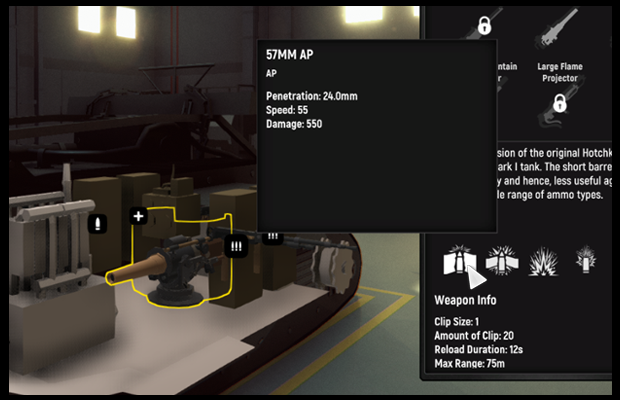
You can view each available Ammo Type when customizing the weapon in the Garage.
Armor Piercing (AP)

AP Shells will deal damage to any target in its path but as their name suggests, are best used against armored targets. However, they take into account of armor sloping and can be completely stopped if the armor is thick enough.
High Explosive (HE)

HE Shells will explode on impact against any surface (eg. fence, wall). This explosion causes splash damage with it's effective damage dropping drastically over distance. HE Shells have a low armor penetration value which means armor thickness can greatly reduce the damage caused. The HE Shells rely on chemical energy for its destructive power, which allows it to keep its penetration and damage effectiveness over distance. This makes it useful for engaging both armored and infantry targets at distance.
Canister

Canister Shells functions like a giant shotgun, releasing a volley of bullets from the muzzle of the gun in a forward arc. It has short range but absolutely devastating against exposed infantry.
Shrapnel

Shrapnel Shells function similarly to the Canister Shell, but detonate at a fixed distance before the target. On detonation, the round releases a volley of bullets in a forward arc. It is not as powerful as the Canister shell but is useful when engaging infantry at long-range.
Firing Canister against enemy infantry!

Armor and Shell Mechanic
Now you're clear about the types of Shells we have in Armored Battle Crew, lets find out how the different types of rounds interact with Armored targets.
Learn how the armor works so that you won’t go ballistic when your shots keep bouncing off enemy armor.
Armor Piercing (AP) Shell Mechanic
When an AP Shell hits an enemy vehicle, the game will calculate the contact point and Impact Angle to figure out the effective thickness at the collision point. If there is enough Penetration Value, the shell will punch through the armor and do damage.
Shell Penetration Value
All AP Shells have a Penetration Value that will drop over distance traveled and when striking armor.
Impact Angle
The angle at which a shell strikes the armor. The ideal impact angle is at 0 degree (also called the normal) and is perpendicular to the armor. The real Impact Angle is then calculated based off the deviation from the normal.
Effective Armour Thickness
All tanks are armored with metal plates of different thickness. Generally speaking, a tank's armor is thickest at the front and gets progressively thinner as you go toward the rear, with the top and bottom being the most thinly armored.
That said, the real thickness of a piece of armor is based on the Impact Angle of a shell. A shell that strikes at an angle away from the normal will decrease it's Penetration Value, making the armor harder to penetrate.

The effective armor thickness is calculated by dividing the real armor thickness with the cosine of the impact angle. #Math
- At 0 degree, Effective Armour Thickness is at 100%.
- At 30 degree, Effective Armour Thickness is at 115%.
- At 45 degree, Effective Armour Thickness is at 141%.
- At 60 degree, Effective Armour Thickness is at 200%.
As the Impact Angle increases, so does the Effective Armour Thickness. So, it's advised to target the side or rear of enemy armor and avoid firing at a highly sloped surface.
Last but not least, this mechanic applies to enemy shells as well. Angle your armor to maximize its effective thickness and watch incoming rounds bounce off like they're nothing!
High Explosive (HE) Shell Mechanic
As mentioned, HE Shells explode on contact, so keep a lookout for potential obstacles such as trees, fences, sandbags or walls to avoid friendly fire damage.
Do note that anything within the splash radius will get damaged and the best way to negate splash damage is to create distance and make sure there is armor between the point of impact.
That’s all for now. Stay tuned for more insights and be sure to WISHLIST the game and don't go AWOL when the enlistment begins!
As always, join us on Discord to chat about the game and tanks!
And drop a like and comment below to let us know what you are thinking!
Armored Battle Crew Team