
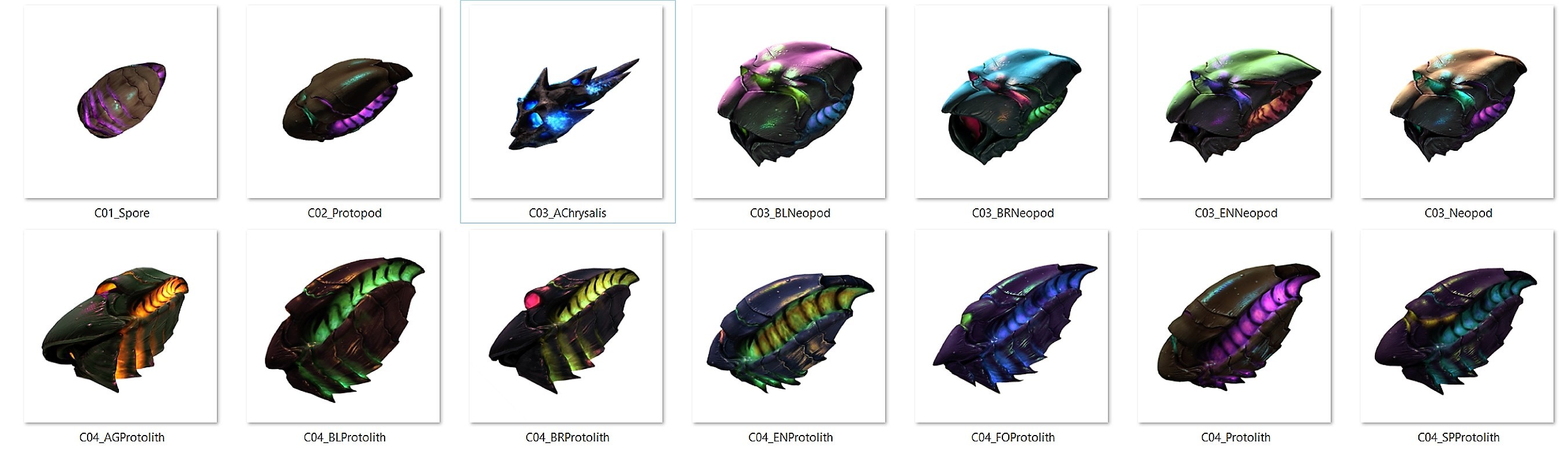
The Perseus Hive are very different than the three other warring factions, as they are living spacefaring creatures, and not actual warships.
Protopods & Neopods
What seemed to be harmless creatures floating in space, soon turned aggressive when the Genari started exterminating them in large numbers. Over the first year of Genari Clan Moshtigh's campaigns into Hive space, some of these spores began gestating into Neopods with offensive capabilities. They began to fire back; energy beams similar to lasers were relatively weak -- but the sheer numbers of these creatures tilted the balance. In addition, what looked to be their feeding mechanism -- their proboscis -- ended up becoming something more dangerous when in proximity to Genari ships. The proboscis would penetrate the hull, and absorb any organic lifeform it encountered: Namely the crew. This was just the first step in the Hive's counteroffensive.
Protoliths
Surviving Neopods eventually absorb enough organic matter to grow larger, and more 'experienced', to become a Frigate-sized organism. These Neopods get classified as Protoliths, ie. the precursor to the Lith stage of the Perseus Hive evolutionary process. Everything within this creature tends to improve, such as its sensiculum, energy beams, propulsive and regenerative properties. Far more durable than their smaller cousins, they can survive extended conflict with hostile Genari Frigates.
Chrysalis
These smaller masses are essentially undifferentiated Neopod cocoons, that will never molt into Protoliths. Scientists have not figured out why some Hive organisms never leave the cocoon, but these that are still alive generate a lot of organic energy. Somehow they can still communicate with other Hive organisms, and travel, albeit very slowly. They have been seen staying stationary in battle, as injured hive feed off the Chrysalis itself and increase their regeneration rates.
Variants
Spore
Essentially considered to be the 'infant' stage of this organism, where it has not differentiated into a truly functioning and independent unit of the Hive. Found often trapped in orbit of planetary systems, or gestating to the protopod stage with the help of a nearby stars' solar radiation. Completely harmless.
Protopod
Once a spore develops into a truly functional and self-sufficient organism, it differentiates itself with actual sensory and motor functions. These new hyper-reactive protopods have adapted to have defensive capabilities with a unique energy weapon.
Bloated Neopod
A little larger and thicker than the common Neopod, these bloated varieties tend to be slower and less reactive, but far more durable. Their regenerative properties and organic carapace are significantly more advanced than a standard Neopod. It seems to consume the same amounts of organic material as creatures of its class however.
Bursting Neopod
This unique neopod looks like it has a larger 'mouth', but it has developed a plasma wave weapon instead of its siblings' energy beams. The plasma wave delivers more damage, but has very limited range; so these organisms need to get within 2000km of an enemy ship .
Energized Neopod
Usually differentiated from other Neopods as a little more greenish in color, this more slender hive organism tends to be more 'energized' and moves a lot faster than creatures of its class. Whether it can be classified as 'smarter', it tends to hit and run invading warships, escaping retaliatory fire.
Bloated Protolith
When a 'bloated' Neopod advances far enough to its next growth stage, it commonly becomes a bloated version of the Protolith. It tends to be bigger and slower than a common protolith, with faster regenerative rates. Even though they are a lot less mobile than their siblings, they do tend to stay close to Chrysalis in a synergistic relationship that keeps them surviving protracted battles.
Bursting Protolith
The 'bursting' Neopods were the first to develop that unique plasma wave energy weapon, and this organism is the next step in its evolution. The original single-fire weapon has been split into two, doubling its effectiveness, though each with the same energy level as the original Neolith variant. Quite dangerous up close, these creatures are close combat brawlers as opposed to their hit & run energized cousins.
Energized Protolith
Those energized Neopods that do survive long enough and grow larger eventually develop into this class of organism. Like its smaller relative, it has a hyperactive propulsion unit at the expense of its carapace and regenerative properties. Also like its smaller sibling, it tends to be smarter, faster, and more inclined to hit and run enemy invaders.
Focused Protolith
It is uncertain how these small frigate-sized organisms managed to develop such powerful energy beams, but they are near-identical to Hive Entities' energy beams. Some proposed that the Hive Entities somehow spawned a part of themselves into a protolith, others suggest that the protolith itself acquired these more powerful offensive appendages from a Hive Entity. Either way, it can only support two of them, and it seems to have taxed their propulsion units similarily to the Spiral variant of the Protolith. It may be something to do with the energy required to maintain a high level of offensive appendages.
Spiral Protolith
On the surface, this looks very similar to a common Protolith, until you see that the 'eyes' have multiplied; those are not eyes of course, but appendages for energy weapons. The beams have split into two separate units on both port and starboard sides, though slightly weaker in overall strength. This increases this organism's beams from four to six. Energy signatures coming from the propulsion unit seems to be slightly lower however. It is not really understood why this specific kind of Protolith has modified itself this way, but it continues to thrive, perhaps even more successfully than the common Protolith.
NeoChrysalis
When a neochrysalis expires, whether by constant drainage from other hive organisms, or other trauma, it hardens into a dead variant. Its core still seems to have some minor energy signature, but it is too faint to produce any regenerative properties. Still though, these are seen brought into defensive positions, as the Hive organisms have learned they can be useful to absorb weapons fire. With such hardening into an asteroid-like structure, it is capable of taking a lot of damage before being destroyed.