
Hello again, Captains!
It has been a while since our first proper Steam devlog.
Last time, we showed you the rather large list of things we wanted to change as Warfleet Captains evolved beyond the original demo: new Operations, ship customization, better movement, a complete UI overhaul, graphical improvements and a lot more.
Since then, we have been quietly turning a lot of those plans into actual game systems.
And somewhere along the way, the version of Warfleet Captains we are currently building started feeling very different from the demo you can play today.
So take a seat, Captains.
Let us show you what we have been cooking.
🪖 Operations Are Now Actually Operational
In our previous devlog, we introduced the idea of calling Warfleet Captains' game modes Operations.
At the time, that was mostly a plan.
Now we have rebuilt the underlying game mode system around it.
The Team Deathmatch experience from the demo has been migrated into the new system as the Skirmish Operation, and we used that new foundation to build our first proper objective-based Operation:
Domination.
Instead of simply destroying the opposing fleet, teams now fight to capture and hold sectors across the battlefield.
The system has also been expanded so different Operations can define their own scoring rules. In Domination, for example, actions such as capturing and defending sectors can contribute toward your score.
We also had to rethink how spawning works.
The demo uses fixed spawn points, which becomes problematic once objectives and battle lines can shift around the map. Our new dynamic spawn system evaluates what is happening around available spawn locations before deciding where to deploy you.
It can avoid enemy-controlled areas, overcrowded friendly positions and locations that have already been assigned to another player.
Which should make appearing directly in front of an angry Battleship considerably less common.
Hopefully.
🚀 Entering and Leaving the Battle Got More Dramatic
The demo reuses the mini-jump effect when a player spawns.
It did the job.
But we wanted something that felt a little more appropriate for a massive warship arriving on the battlefield.
So we created a completely new spawn sequence built around a jump gate opening ahead of the ship and launching the player into the Operation.
The system has already been integrated into real multiplayer matches, and we have since upgraded the gate so the battlefield itself can be visible through the opening.
There is still plenty of VFX polish to come, but the foundation is there.
The player should not just spawn.
They should arrive.
And we have been giving the other end of an Operation some attention too.
Instead of simply ending the match and immediately throwing a results screen at you, we have been experimenting with cinematic end-game scenarios showing the outcome of the battle.
These sequences now account for victories, defeats and even a newly supported draw state, along with different combinations of which team produced the match's MVP and Dread Captain.
That currently gives us twelve major variations of the sequence.
They still need more explosions, damage, audio and general space-battle chaos, but they are already integrated into the normal Operation flow.
Bots have also joined the MVP and Dread Captain calculations.
So yes.
You can now play alone against bots and discover that you were, in fact, not the most impressive Captain in the match.
Character building.
✈️ We Are Experimenting With Much Bigger Battles
One completely new experiment since our previous Steam update is something we have simply been calling the Battle Simulation.
The idea is to make the space around your capital ships feel like part of a much larger conflict.
Our earliest test already had 400 fighters battling simultaneously while running at over 400 FPS on a laptop GTX 1650.
Since then, the prototype has become considerably more interesting.
Fighters can begin organizing themselves into formations, react to environmental objects, attempt to avoid ships and terrain, and even crash when those attempts go badly.
Because apparently fighter pilots also make questionable decisions under pressure.
We have also replaced the temporary laser-style combat visualization with actual moving projectiles.
The system is still experimental, and we are not making any promises about exactly what form it will ultimately take, but we really like what it could add to the scale of Warfleet Captains.
Your ship should feel like one piece of a much larger battle happening around you.
🔫 Combat Is Getting a Lot of Smaller Improvements Too
A lot of work has gone into making the moment-to-moment combat experience feel better.
One major complaint from the demo was the lack of clear hit feedback.
Our first solution was the usual large damage counter.
We did not like it.
Warfleet Captains already has a lot happening on screen, and we want the HUD to stay out of your way whenever possible.
So instead, damage feedback now appears directly alongside the target you are attacking, giving you useful information without placing another giant number in the middle of the screen.
We have also rebuilt the automatic turret targeting system with better projectile-leading calculations to cope with the full 6DoF movement we introduced previously.
Turrets now do a much better job predicting where moving ships will actually be when their projectile arrives—even when those ships decide that upside-down is a perfectly acceptable orientation.
Directional audio has been corrected as well, so sounds now correspond properly to the player's camera instead of the orientation of the ship.
The orbit camera has received some subtle inertia to help sell the feeling that your viewpoint is following a gigantic warship rather than being rigidly bolted to it.
And underneath all of this, we have been doing a fair amount of optimization.
Turret projectiles were becoming surprisingly expensive during large engagements, so we rebuilt how their effects are handled. Nearby shots can use the nicer particle effects, distant shots switch to cheaper visuals, unnecessary impact effects are skipped at extreme distances, and effects are only activated when they are actually needed.
In one of our internal test scenarios, that improved the heavy-combat performance range from roughly the high-200s to around 340–360 FPS on the same machine.
The exact numbers will obviously vary wildly depending on hardware and the final graphical workload.
What matters to us is that the system now scales much better when the battlefield gets violent.
And Warfleet battlefields have an unfortunate tendency to do that.
🧩 Ship Customization Is Becoming a Real Progression System
In the first Steam devlog, we explained our philosophy for modular ships:
The ship is a platform.
You customize that platform into something that suits your playstyle.
A lot has happened since then.
Engines, shields, hull modules, turrets and the other major module categories are now properly connected to the real ship systems rather than existing as isolated prototypes.
More importantly, we made a major change to how modules affect ships.
The ship itself now defines its natural characteristics, while modules modify those characteristics.
That distinction matters.
An Excalibur that is naturally fast should remain recognizably an Excalibur even if another Frigate equips the exact same engine.
Modules can exaggerate a ship's strengths, compensate for weaknesses or push it toward a different role—but they should not erase the personality of the hull underneath them.
That philosophy now extends into progression.
Each ship earns its own Module Research Points, or MRP, by being played.
Those points can then be invested into research paths for different module categories.
The important part is that progression belongs to the individual ship.
Mastering and upgrading the Excalibur does not automatically mean you have mastered another Frigate.
And the modules themselves are being designed primarily as side grades and specializations, rather than a ladder where every new unlock simply makes the previous one obsolete.
More shield capacity may mean slower recharge.
More speed may come at another cost.
Progression should give you more ways to build your ship, not simply bigger numbers.
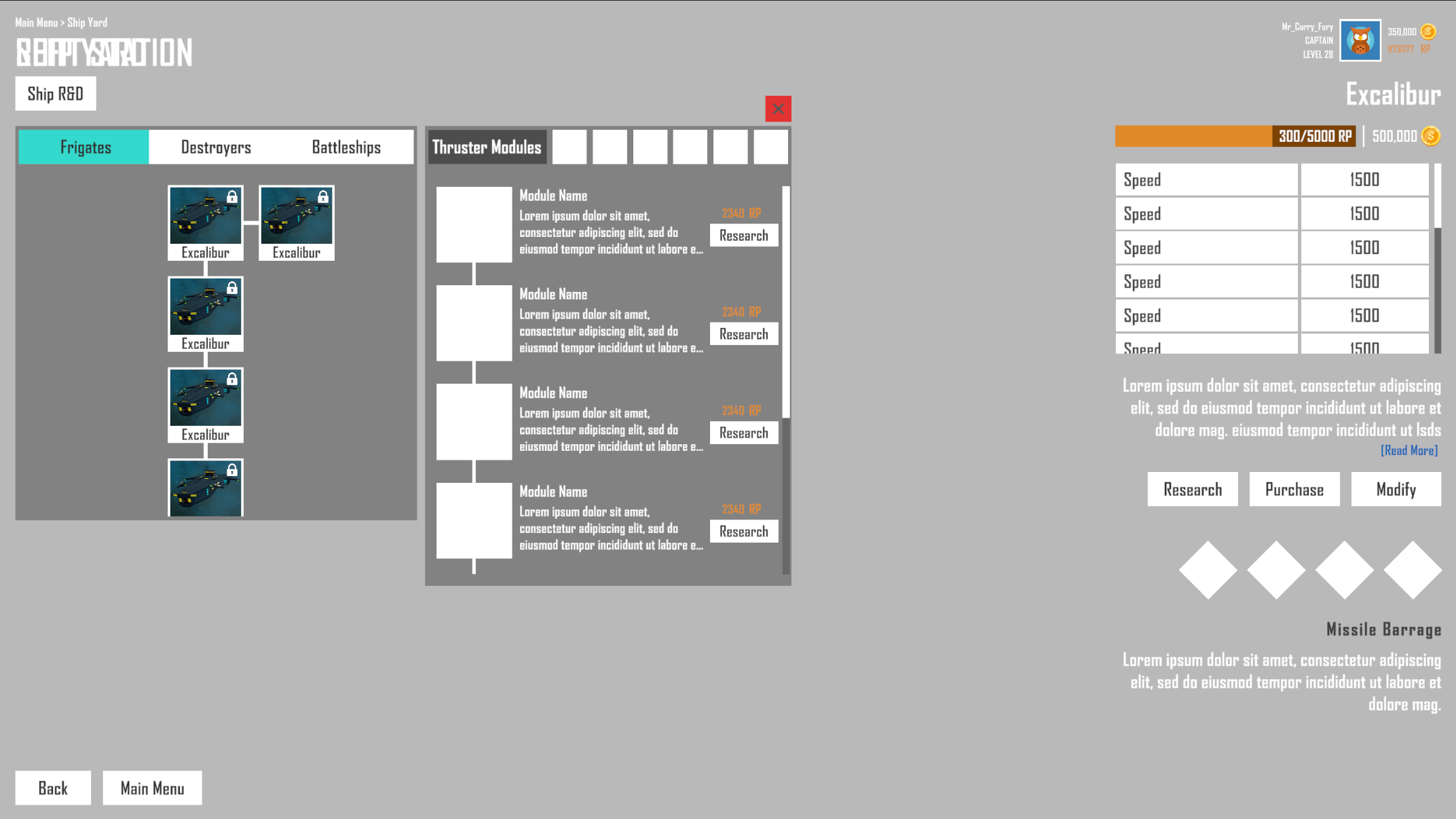
Turrets have received the same treatment.
Different turret modules can now have genuinely different firing behaviors rather than mostly swapping models and statistics.
We currently have four major behaviors working:
Repeater — fast burst-fire weapon.
Cannon — slower, heavy-hitting explosive weapon.
MultiCannon — sustained high-rate-of-fire weapon.
Beam — continuous energy weapon.
So swapping your turrets is now starting to change how your ship actually fights.
And there is one more addition to the loadout system.
Each ship can now bring three separate loadouts into an Operation.
You might prepare one aggressive build, one defensive build and one utility-focused setup, then choose the version that makes the most sense when deploying or respawning.
The goal is to add another layer of preparation without forcing you to predict everything that could happen before the match begins.
💾 We Rebuilt the Boring Stuff That Makes All of This Possible
There is another massive change that you probably will not notice while firing several hundred explosive rounds at someone.
We rebuilt the player data layer.
This is the system underneath progression, ship unlocks, purchases, module research, loadouts, match results, statistics and saved player data.
The demo's implementation was built for a much smaller version of Warfleet Captains, and the game is now rapidly outgrowing it.
The new architecture gives us proper support for migrating older player data as the game evolves, better validation of important account actions, and a cleaner separation between Warfleet Captains itself and whichever process stores that information.
In other words, we are trying to make sure the systems responsible for remembering everything you have unlocked do not become the systems responsible for making us cry during Early Access.
The new layer is already being integrated with ship research, purchases, module progression, module purchases and player loadouts.
Not glamorous.
Very important.
📟 Warfleet Captains Finally Has Its UI Identity
Now for something considerably easier to look at.
We have finally settled on the visual direction for the new Warfleet Captains interface.
The new style is a retro-futuristic CRT-inspired interface built around clean lines, simple geometry and a focused palette of green, yellow and red.
We wanted something that feels like it belongs on a command terminal aboard a warship rather than a generic game menu.
And once we settled on that direction, we committed pretty hard.
Instead of designing every screen individually, we built a reusable UI component library containing the buttons, fields, sliders, toggles, panels, progress bars, status indicators and text styles that will form the foundation of the interface.
The first major screen we used to test the style was something we teased in our previous Steam devlog:
The job board.
It now has a proper identity.
Meet the Contract Board.
Public multiplayer lobbies are presented as contracts available to mercenary Captains. You browse the available jobs, inspect their Operation and map, and choose which contract you want to accept.
Hosting a public match works in the opposite direction: post your own contract and make it available for other Captains to join.
Mechanically?
Yes.
It is a server browser.
But "mercenary Contract Board" sounds considerably cooler.
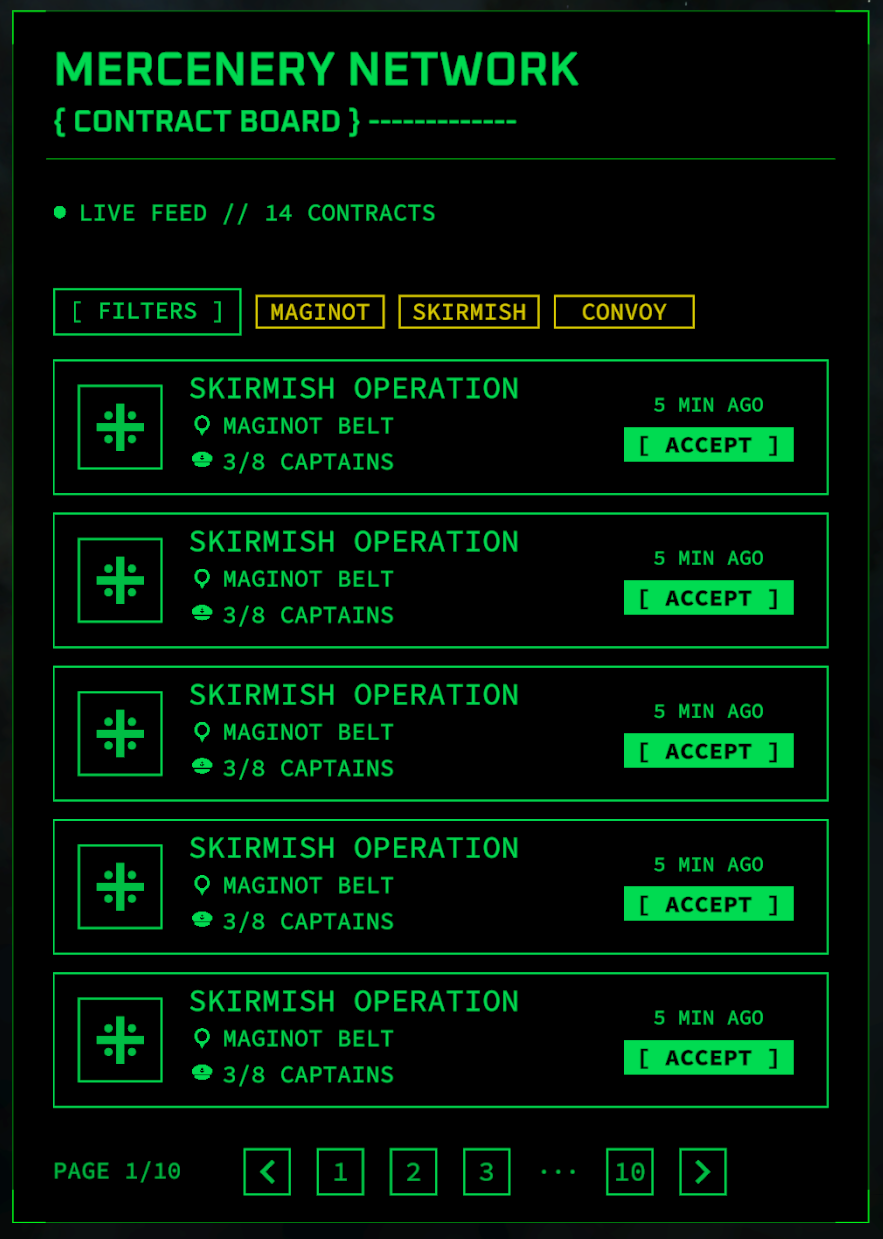
That design language has now expanded into the rest of the main menu.
While building it, we also created a reusable state system so every component can consistently react to being hovered, pressed, selected, disabled and so on.
Then we built a centralized theme system capable of changing interface colours globally.
One of the most useful applications for that foundation is future accessibility support, particularly colour-blind friendly palettes.
And because apparently building one UI system was not enough suffering, we also rebuilt the layout foundation to properly support different resolutions and aspect ratios.
The demo effectively expects a 16:9 display.
We do not want the new UI doing that.
The new layouts are being built to preserve their structure across wider and taller displays instead of simply stretching or breaking.
We have also completed the first version of the new Captain Profile, which gives us another major screen built entirely on top of this new framework.
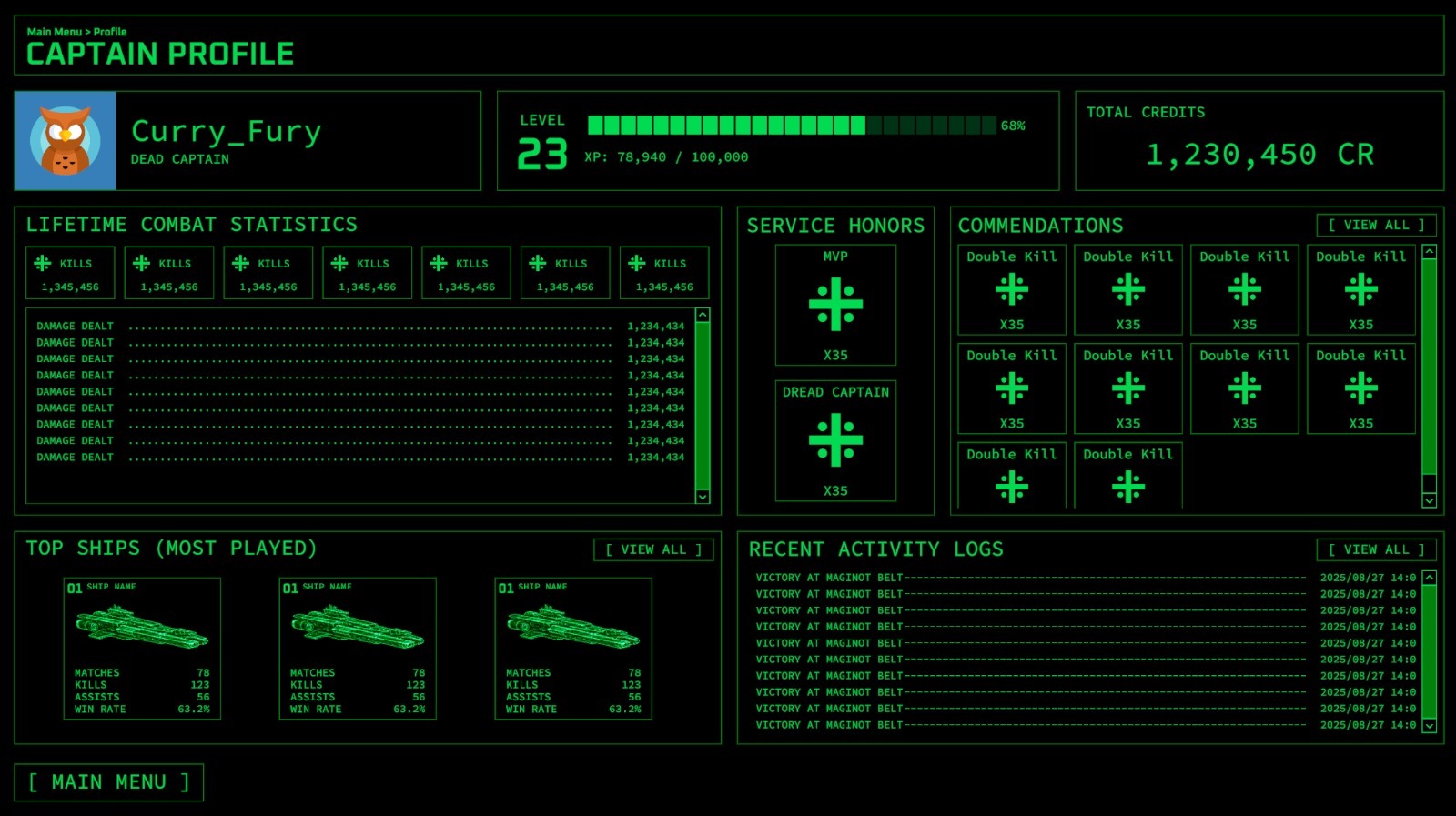
There is still more visual polish to come—especially the CRT treatment itself—but we finally have an interface foundation we can consistently build the rest of the game around.
🛠️ The Excalibur Has Been Rebuilt
The graphical overhaul we talked about in our first Steam post has also started making its way into the ships themselves.
And the first major example is the Excalibur.
We completely rebuilt the Frigate at its proper scale of roughly 300 metres, which gave us a much better reference for how much physical detail the hull actually needs.
The new model has far more panel work, greebling and identifiable details such as hatches and railings to better communicate just how large these ships are supposed to be.
We even decided to physically model its point-defence guns, which were originally going to remain purely visual effects.
The goal here is bigger than one Frigate.
The Excalibur is helping us establish the detail benchmark that we can carry forward into our Destroyers, Battleships and future ships.
And, more recently, the rebuilt model finally made it into the game engine.
It is still awaiting its final texturing, but seeing this thing inside Warfleet Captains for the first time was a pretty satisfying milestone.
So... Where Are We Now?
When we published our first Steam devlog, much of what you saw was still a collection of prototypes, plans and systems that had only just started being rebuilt.
Since then:
Operations have become a functioning framework.
Domination exists.
Dynamic spawning exists.
New spawn and end-game sequences exist.
Ship modules are connected to the real ships.
Module progression exists.
Turrets have distinct firing behaviors.
A new player-data foundation is being integrated.
The Battle Simulation is alive and firing increasingly concerning quantities of ammunition.
The Excalibur has been rebuilt.
And Warfleet Captains finally has a UI identity we are happy to build the rest of the game around.
There is still an enormous amount left to do.
A lot of what you have seen here still needs art, VFX, audio, balancing and general polish before we would call it finished.
But the foundations we have spent the last several months rebuilding are finally starting to turn into the actual game we have been wanting to make.
And that feels pretty damn good.
We will have plenty more to show as development continues.
Until then, keep an eye on the Steam page, and if you have not already, come join the community and tell us what you think about the direction Warfleet Captains is heading.
Thank you for sticking with us, Captains.
We'll catch you on the next devlog.
Over and out. 🫡