
A video game is made by a team of people. Each person brings their own influences into the game simply because those are their main touchstones of a genre. There may be an official list of influences tucked away in a folder somewhere from when original concept discussions and prototyping happened, but each team member is human and humans each have their own favourites.
For this dev diary, we spoke with six team members about their sci-fi influences and how they’ve been incorporated into the game (or in one case, not).
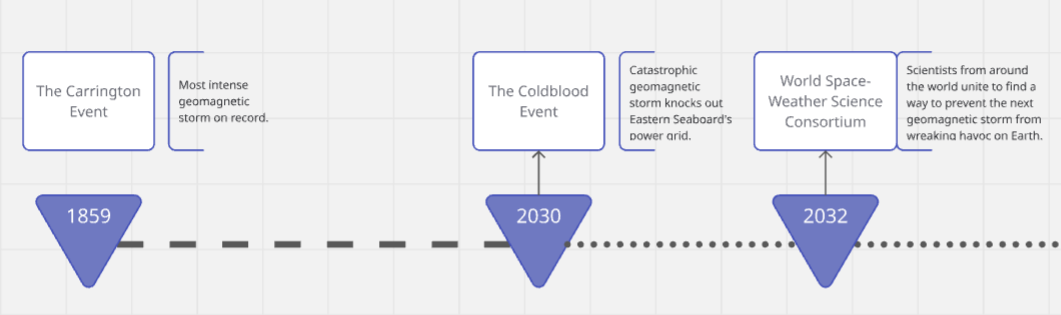 Timeline of events leading up to First Moon of Mercury.
What are some non-games sci-fi media that has influenced or inspired your work in First Moon of Mercury?
Heather Jackson (Narrative): Firefly -- The secrets the crew is keeping from each other is what fascinated me in this show. We have the same thing in First Moon of Mercury.
Jeffrey Flores (Art): For the original organic, non-traditional style, the art made for Jodorowsky's Dune was a big inspiration. We wanted to try a look that was unconventional and looked unlike most of what people would think of as spacecrafts. The curves and the arrangements [in [i]Dune] were almost biomechanical, and we wanted to explore forms like that.
The other film that influenced me is the recent Transformers One movie. The overall forms are complex but made up of simpler geometric forms. The world and characters are big, bulky, and industrial, yet maintain flexibility and hint at the underlying mechanics which are characteristics that reflect in our modules.
Evan Sawatsky (Art): Sunshine focused on a spacecraft designed to protect Earth from the sun, a very familiar narrative beat to First Moon. The craft that the cast travels on (The Icarus II) blends realistic space station construction (cylindrical capsules, asymmetry, heavy, industrial design) with near-future elements like a massive city block-sized solar shield that protects the craft from the Sun's radiation. The ship's design followed some of what exists in reality but with added over the top sci-fi flair, which inspired some of my additions to the newest iteration of the First Moon of Mercury station.
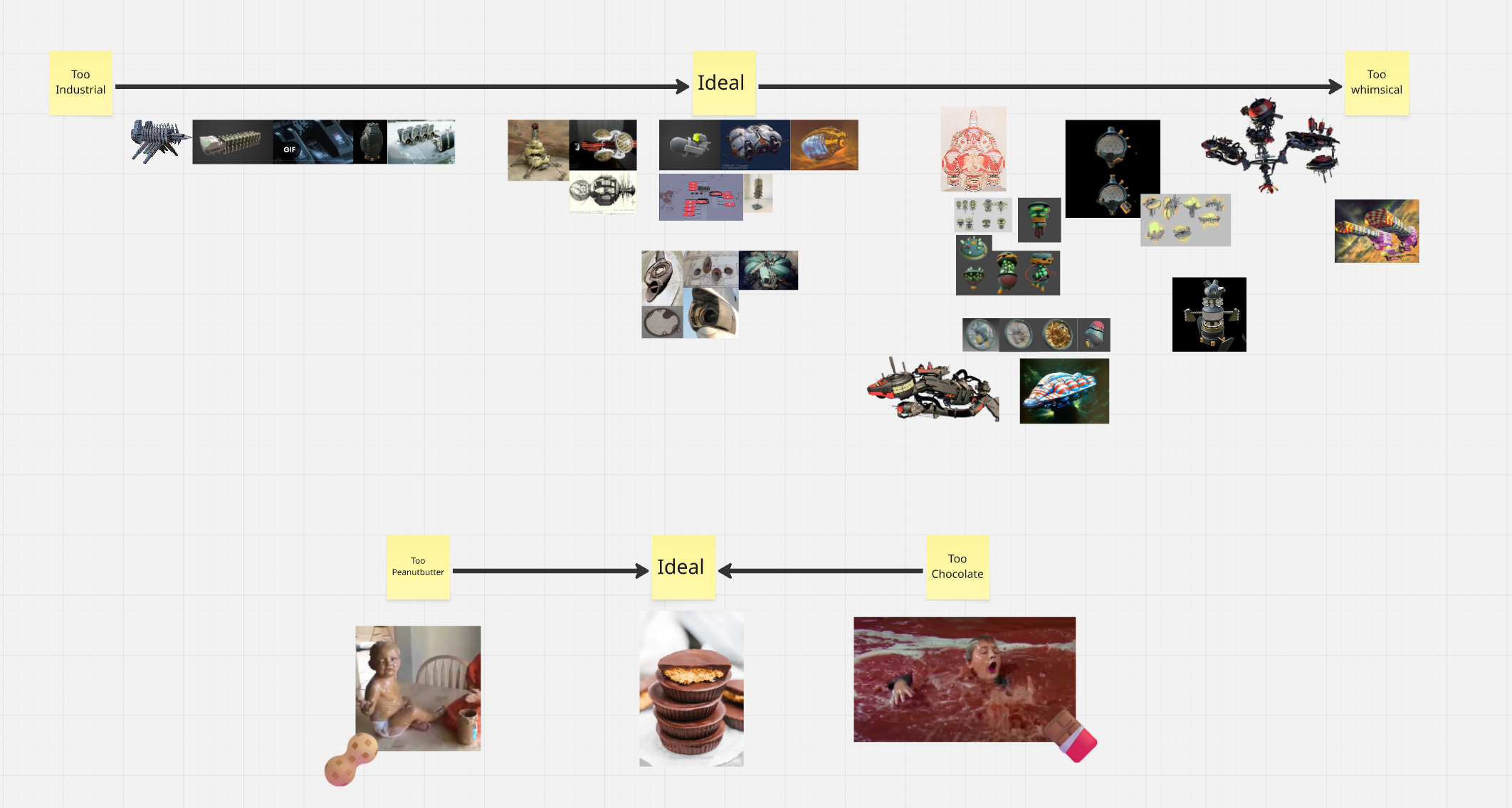 A silly inspiration Miro board from the art team during the initial design phase of First Moon of Mercury.
Janal Bechthold (Music): For musical inspiration I listened to soundtracks like Interstellar, Gravity, Ad Astra, The Expanse, Arrival, and Dune along with music of electro artists such as Daniel Deluxe.
Before I started writing the score for First Moon of Mercury, I did a lot of music listening to really immerse myself in sci-fi cannon. I was digging into what makes music specifically evoke the feelings of space and technology and what would players come to expect from the genre.
I love that musically we've stepped away from just the huge Star Wars / Star Trek orchestra, and that the genre has opened up to a lot more really interesting sounds and textures. I'm all for atmospheric moody scores. But! I do miss the classic use of melodies and melodic themes and leitmotifs. I hope we'll experience a return or a hybridization of these types of soundtracks!
Kirsten (Programming): I love Star Trek, Doctor Who, Sisyphus: The Myth, and Warehouse 13, but I am [not bringing them] into the programming side of things.
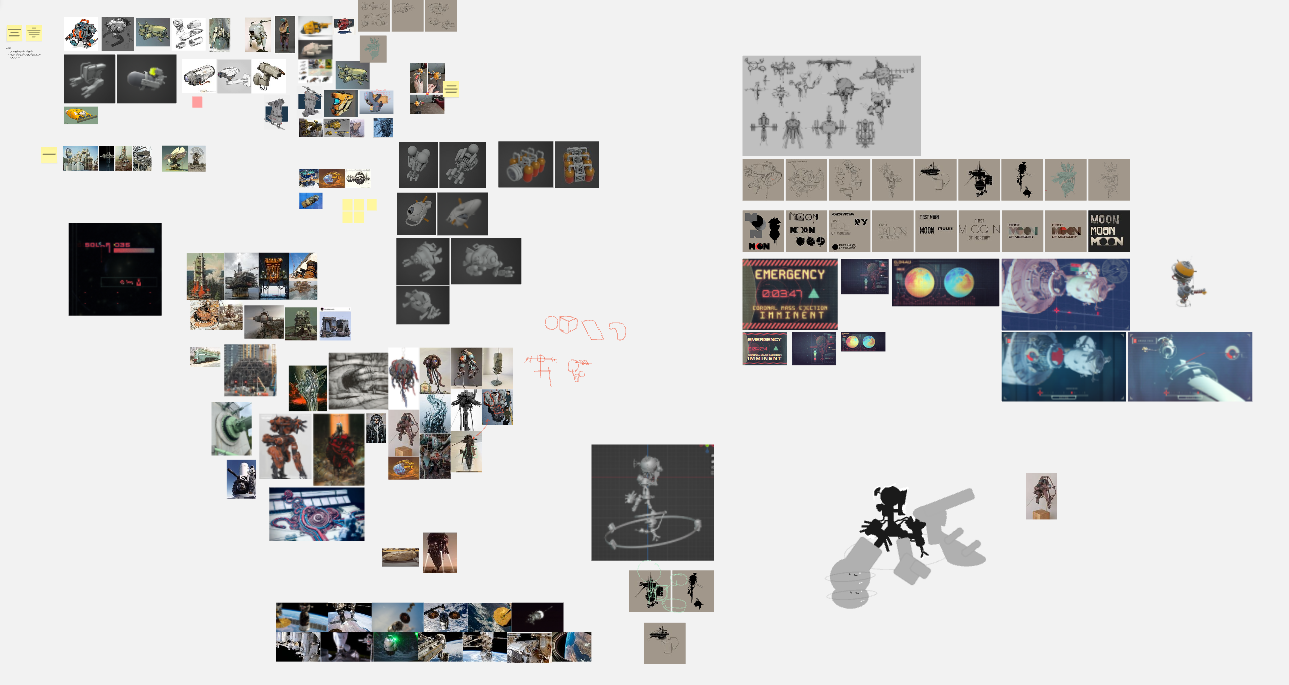 A portion of the Look Dev Miro board.
Victoria Rogers (Marketing & Community): I'm on the marketing side of things, so my work is very much informed by what the rest of the team decides. But for me, personally, I'm looking at a lot of books. Books use words! Most of what I work on requires writing words. Ursula K. Le Guin's Hainish Cycle has helped me really think about the in-universe political stuff, along with a lot of Sheri S. Tepper. Pretty much everything she has written is political in nature. Most sci-fi is.
The world coming together after suffering a major geomagnetic storm like what happens in First Moon of Mercury is going to cause social and political shenanigans. It’s important to me that our messaging conveys that in a meaningful way. I think Le Guin, Tepper, and authors like Lois McMaster Bujold, CJ Cherryh, and Elizabeth Moon do that really well.
Heather: The world is such a dumpster fire right now that I'm yearning to see sci-fi that proposes solutions and provides realistic hope for the future. First Moon of Mercury isn't totally scientifically accurate (at least not yet), but it's not so far off that it's out of the realm of possibility. I hope.
Victoria: I think that comes through. It was what I latched onto when I read through all of your documentation, at least!
We’ve talked about non-games media. What about games?
Victoria: No one? [Game designers] Thomas and Raphael aren’t here. They’d have loads to say!
Alright, for me there’s all three Mass Effect games. Outer Worlds 1 and 2, as well. There is a lot of faction narrative in those ones. Both franchises really demonstrate how you can use in-universe narrative and art and then translate it into the real-world, like the flight patches we had Jeffrey design.
I have ideas for souvenir-style post cards that you'd find at a space museum or tourist spot in-universe.
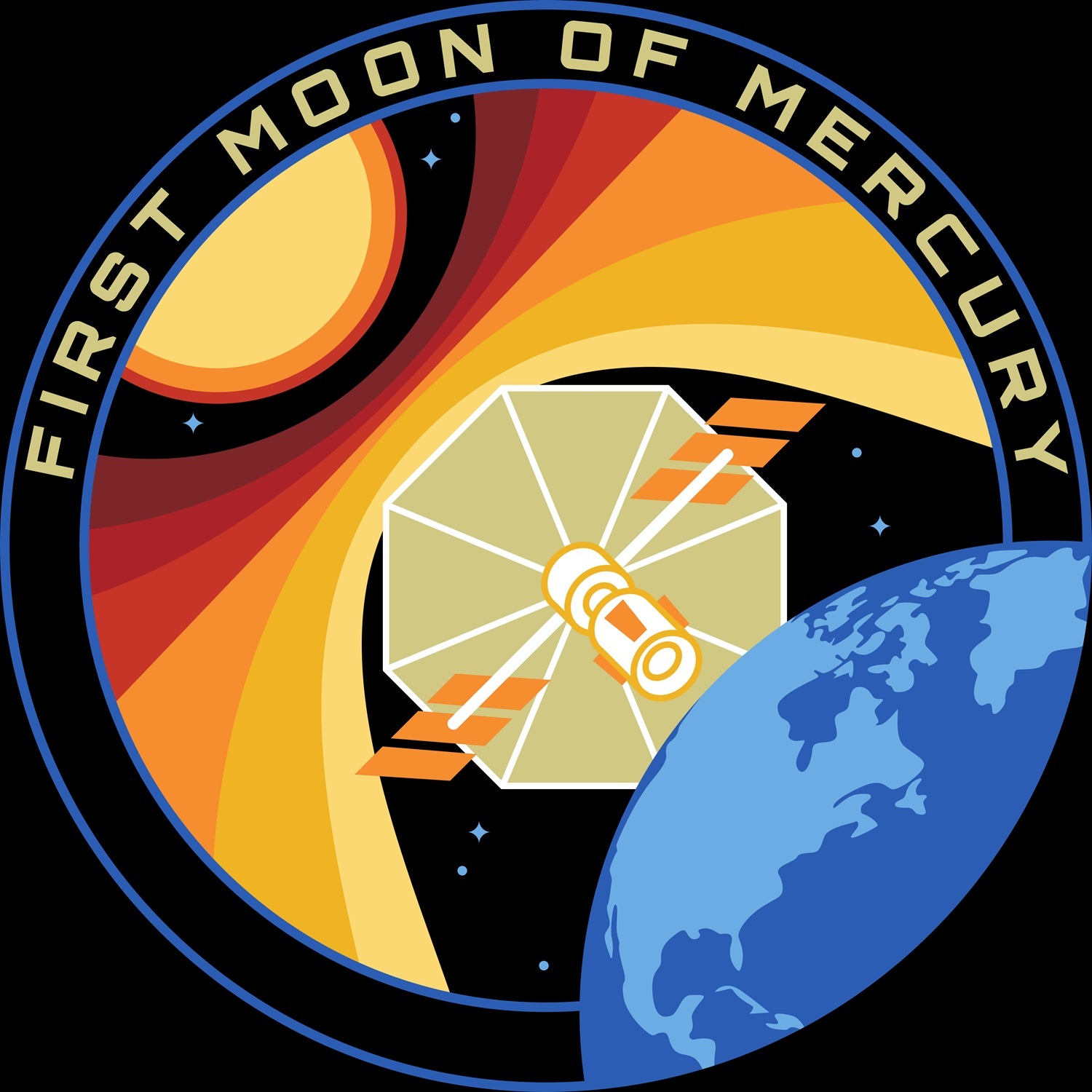 An illustration of the flight patch that was given to the astronauts of First Moon of Mercury.
Evan: Games like Hardspace Shipbreaker - from the amazing Blackbird Interactive, a fellow Canadian studio - and No Man's Sky were probably the biggest source of inspiration for myself. Sci-fi needs more bright colours and less grey greebles!
Victoria: [Laughs] But after feedback from players, we added more grey and intentionally designed greebles so they wouldn’t be confused with interactive puzzle elements.
This one is for the artists. Who are some visual artists that inspired you for First Moon of Mercury? Fine artists, comics, illustrators, whatever!
Jeffrey: Chris Foss! I wanted to lean into the unconventional forms of what a spacecraft can be while maintaining the feeling of heavy engineering, industrial forms, and hinting at a mix of scientific and corporate allegiances.
Evan: Thomas Puggelli's illustrations (specifically his fan art of the game Highfleet) shows a sense of scale and readability at a glance that I found very inspiring. He uses distinct silhouettes and high contrast as opposed to hyper-detailed mechanical surfaces to accentuate the gritty, lived-in appearance of the flying warships from the game.
Jeffrey: I think I have a strong preference for retro aesthetics and that there's always going to be some sort of hint of that in my art and concepts that bleed through, even for designs for futuristic machinery.