
In Parsector, you can move between planetary systems by using your Warp fuel. Since the solar system maps of Parsector are dynamic, the distance between any two planets is always changing. Before you select a mission, you must first select a planet by using the solar system map.
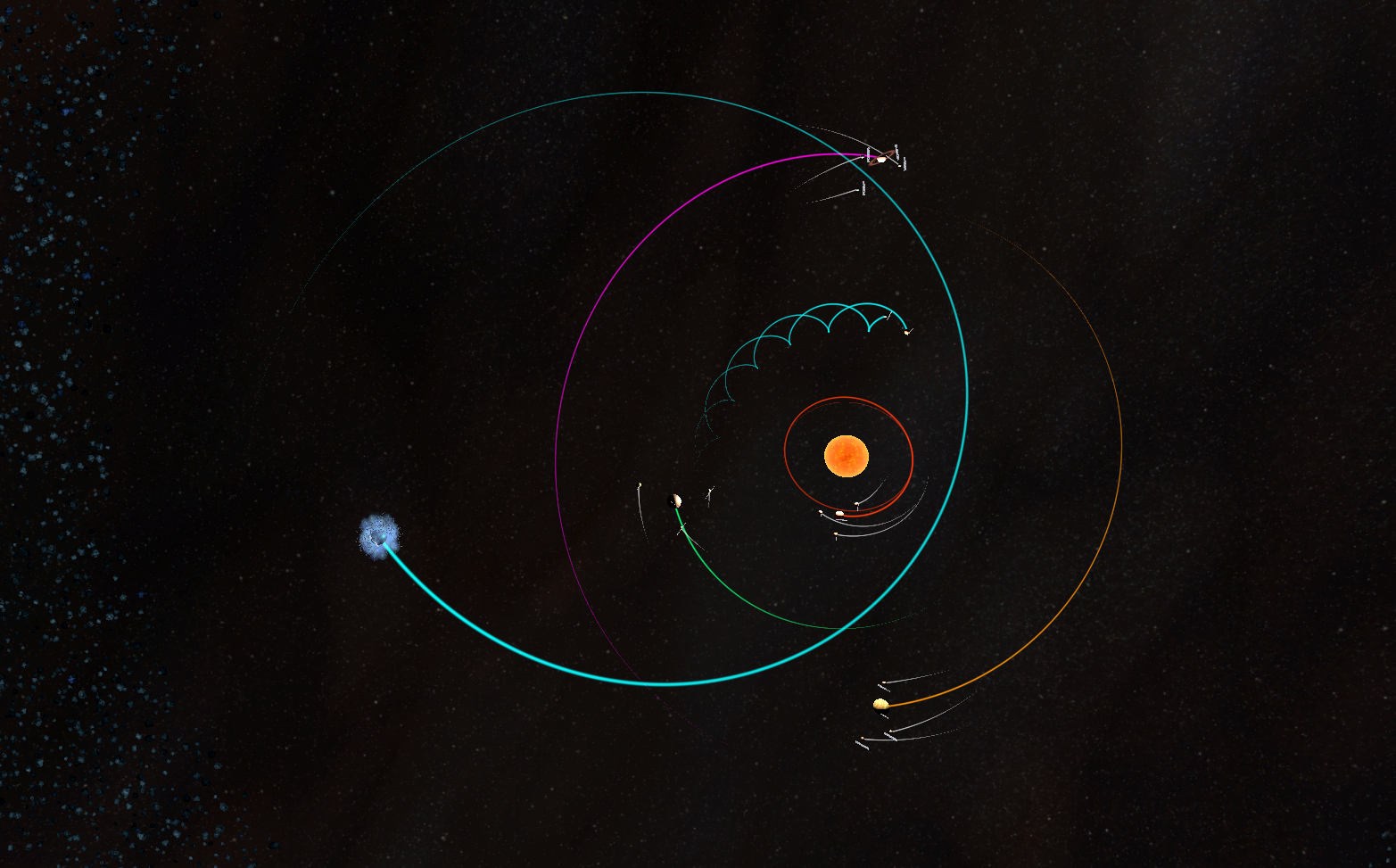
In the diagram below you can see that most planets are heliocentric in orbit, meaning their orbit is centered around the sun. Each planet orbits at a different speed, meaning that the distance between the planets is constantly being reconfigured.
However, you'll also notice that one planet, Taranis, has an orbit that takes it into and out of the solar system! This is meant to represent how a comet might behave, although in reality most comet orbits are elliptical, we've chosen to simplify our orbits to circular in order to make it easier to understand and more consistent.
An example of planet orbits as detailed in our previous update:
In real space travel, it is commonplace to design missions based on ideal timing windows, such as when Mars and Earth are nearby each other, it becomes much more cost-effective and expedient to make the transfer. When they are far apart, it is a clear waste of resources and time to make the transfer.
You begin the game in low planetary orbit of Shala, the green orbit in the diagram above. At certain times, the orbit of Fornax ( shown in red nearest the sun ) will bring it within a quick warp-jump of Shala. At other times, Fornax and Shala will be on opposite sides of the sun, requiring an expensive multi-jump.
The above diagram shows a top-down view of the solar system, however to fully understand the mechanics of moving around the solar system and eventually, galaxy, you have to also look at it from the side; it starts to become clear that various conjunctions of planets will form obvious opportunities to make "cheap jumps"...just don't get stranded at the edge with no warp fuel or you'll have to call roadside assistance.
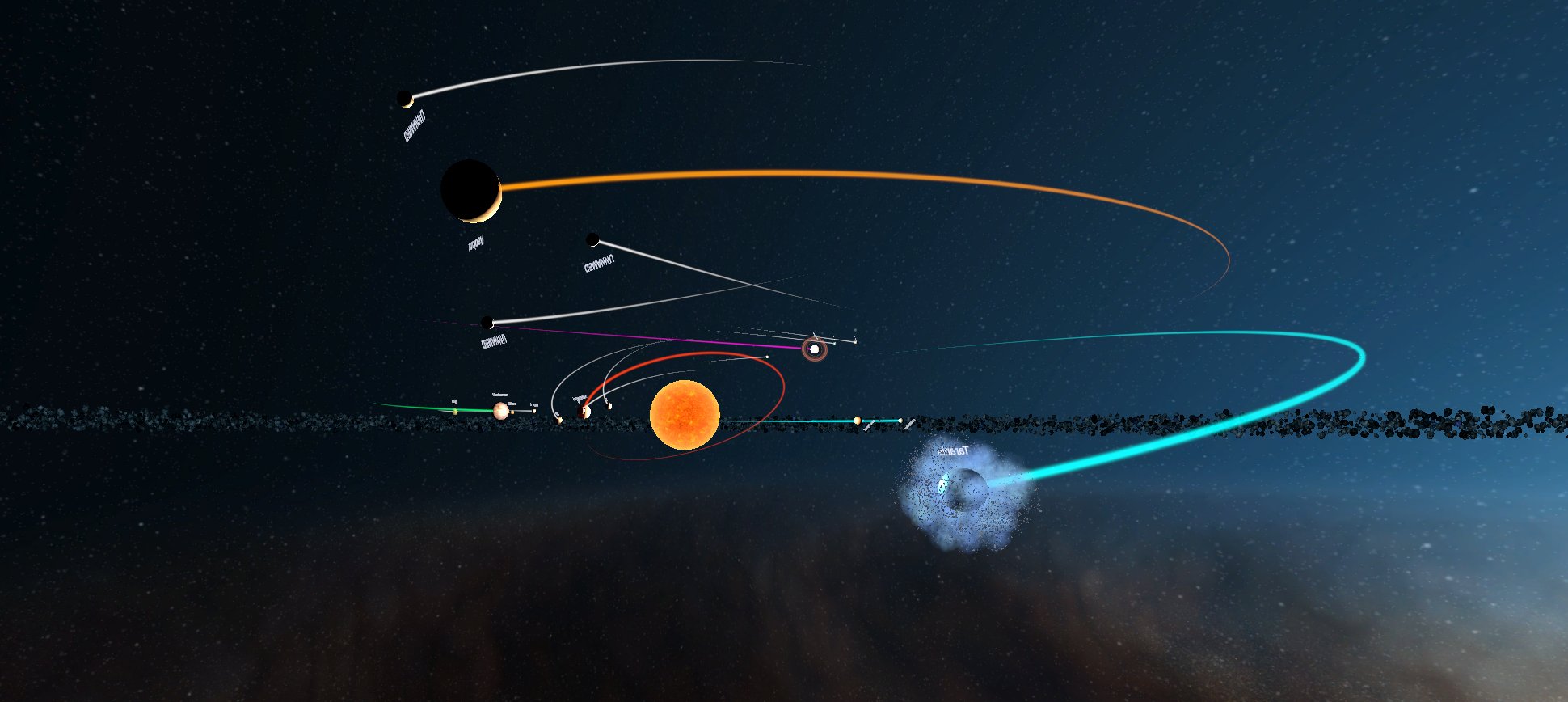
So, with all of that laid out, explaining the inter-planetary and (eventually) interstellar travel becomes very simple. Your "warp fuel" cost is calculated by the realtime distance between your origin and destination. If you really need to go mine a methane blizzard on Taranis, you'll still want to wait until it's not at the actual literal edge of the heliosphere.
Unfortunately, the resource-gathering on Taranis is best when it's coldest. The leeward side of Taranis at the maximum extent of its orbit is the coldest spot reachable by any ship, so a particularly greedy gatherer has two choices.
The easier method unfortunately requires a top-end capital ship and a colossal amount of warp fuel. The benefit is you can time your warp-in as Taranis reaches aphelion ( the furthest it will ever be from the sun in that cycle of orbit ). Then you can warp out again after Taranis begins to warm up and the resource quality begins to drop.
The other method involves jumping to Taranis when it wanders through the inner planets towards perihelion ( nearest point to sun in the orbit ), and riding it for one full cycle out of the solar system and back in again. This is what one might call a "low probability of survival" endeavor, and certainly not popular among those who appreciate having more birthdays in the future.
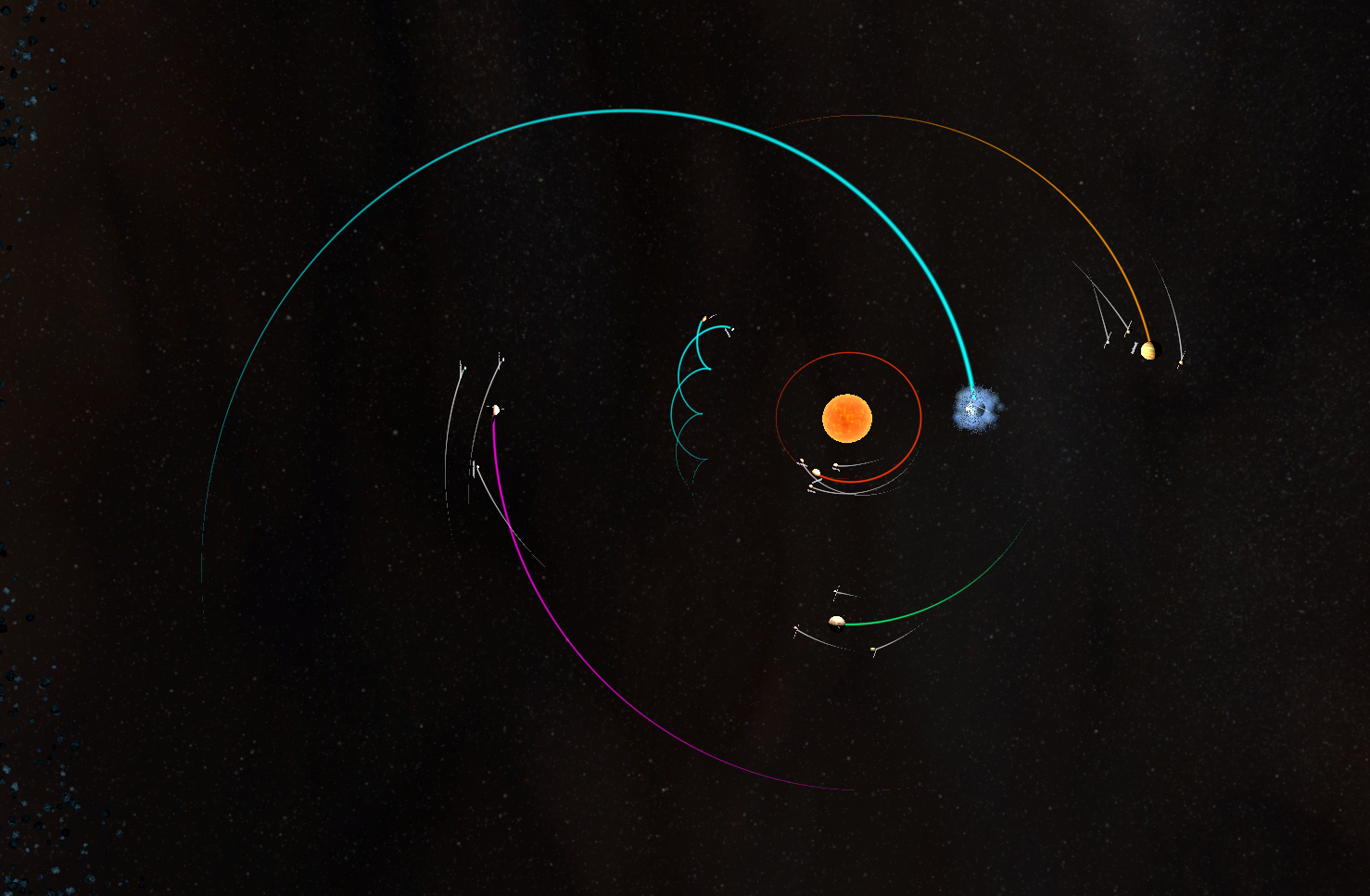
In the diagram above, Taranis has reached its nearest point to the sun. In this configuration, warp jumping to Taranis from Shala, Fornax, or Aeolius is inexpensive due to the momentary configuration of planets.
For comparison's sake, the above scenario represents an ideal time to warp between Shala and Fornax, as they are also adjacent. Jumping between Aeolius (yellow) and Iris (purple) requires traversing the entire diameter of the solar system and multi-jumping around the sun, prohibitively expensive.
This simple mechanic for moving around the "game map" consistently provides the player with interesting and meaningful choices, with a dose of semi-randomness to keep things spicy. It also serves a very important purpose; minimizing "travel time" in a game that's mostly about action and strategy. We give the players "Warp Fuel" as a resource that, true to scifi, makes spacetime irrelevant for a little while; long enough to go somewhere very far away, and hopefully, back again safely.
Editor's Note: We fully admit to leaving the "map" screen up on our PCs as a screensaver, much to the dismay of our GPUs that are wondering why humans love staring at pretty circles.