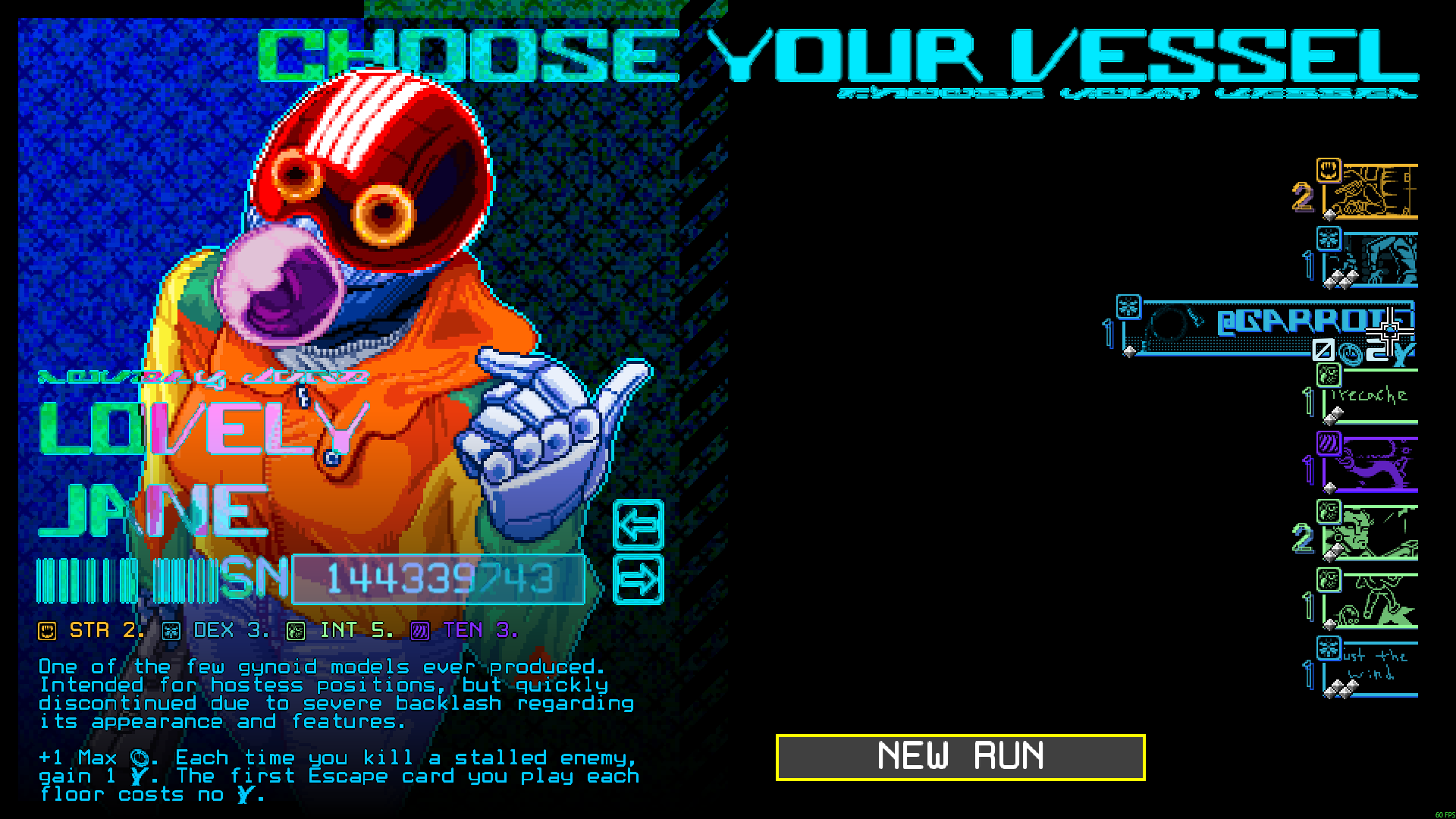
Beta Beta Beta

I'm Danny Judas. If you have been poking around on Collect Call's store page, you may have noticed that the playtest registration button has reappeared. This is no mistake: the playtest will be returning on September 21st, 2026. This test will be something more akin to a public beta test, where substantially more systems have been implemented and will be available.
With Precognition, back in July, I had tentatively promised a demo to come out in the Summer. While I have not been able to operate quickly enough to get the game polished for a demo, I have made considerable progress and feel reasonably comfortable offering up a new playtest for those willing to put up with some jank. The 21st happens to be the last day of Summer.
Playtest Goals
The test back in spring was always meant to be more of a 'proof-of-life' kind of deal. I wanted to show people that I was in fact working on a game and it could in fact be played. It was very messy, unintuitive, and awkward in more than a few ways. This new release is also going to be unpolished, and again I want to show people the progress I have been making. However, this time players will be able to experiment with something more like a full vertical slice than before.
With this new version, every core system has been implemented and will be 'playable.' This means that players will be able to access Wandering, Dilemmas, Dialogue, and Skill Checks. They will even be able to get a tiny taste of how the game's meta-progression will work. Runs no longer go on infinitely and there is a fair bit more content. "Everything" is here.
Also present will be a substantial number of gameplay and balance tweaks and overhauls that should make the game feel more complete, more coherent, and most importantly, more fun. After playing this test, players should come away with a more clear idea of what it is I'm trying to do and maybe even why I'm trying to do it.
That being said: it is by no means perfect. My previous warnings about being finicky still apply.
With that out of the way, let's go ahead and discuss some of the changes.

What to Expect
Combat
For starters, the core combat has not changed. There have been some balance adjustments, and depending on when the last time a player tried the game, they might find it to feel substantially different. But, combat has not been the core focus since the end of the alpha. I felt that the combat I presented then was almost exactly what I wanted the game to be like, and besides clarity issues and difficulty, I was not interested in making changes to the fundamental rules of the grid, enemies, or player.
As an extension of this lack of combat-focus, do not expect new enemy types, new factions, or very many new cards. The alpha test closed out with around 99 player cards, and the beta test will start with around 112. Several cards have undergone revisions both big and small, and I've taken some care to attack some particularly under and over performing cards and either make them more balanced or give them new personalities. To some, it might feel like a very different card pool in aggregate, but the actual number of changes and additions is quite small.
Balance
Broadly, the goal of balance changes going into the beta test was to continue pulling the difficulty of combat back, and increasing both the difficulty and especially agency in the interludes. Following the alpha, the Syndicate were identified as a pretty harsh speed bump and have been the subject of multiple small tweaks to try and pull them back in line with the Lowriders.
The game's various economies have been substantially rebalanced, pulling back sharply on the amount of currency given to the player. Contracts no longer give Insight, bounty no longer scales on its own, and performing poorly in combat will sharply curtail the player's ability to make and spend money.
On the other hand, it is now easier and more forgiving to reroll shops, and booster pack prices no longer rise. Feng Shui items can now be sold for much more money and generating more Yomi than is needed to beat a contract is now handsomely rewarded.
All-in-all, it should feel possible to do more with less.
Interludes
Interlude content has been expanded significantly. That's in relative terms, of course: the alpha had only 18 total Feng Shui items, no alt shops, and no roleplaying of any kind. Purely mathematically the growth in this part of the game is infinite. More practically, I have added 3 alt shops, 6 dilemmas, 10 disguises, 20 trinkets, and a handful of secrets. This is a fairly small amount of content and is very much meant to be a proof of concept for what's to come.
Feng Shui
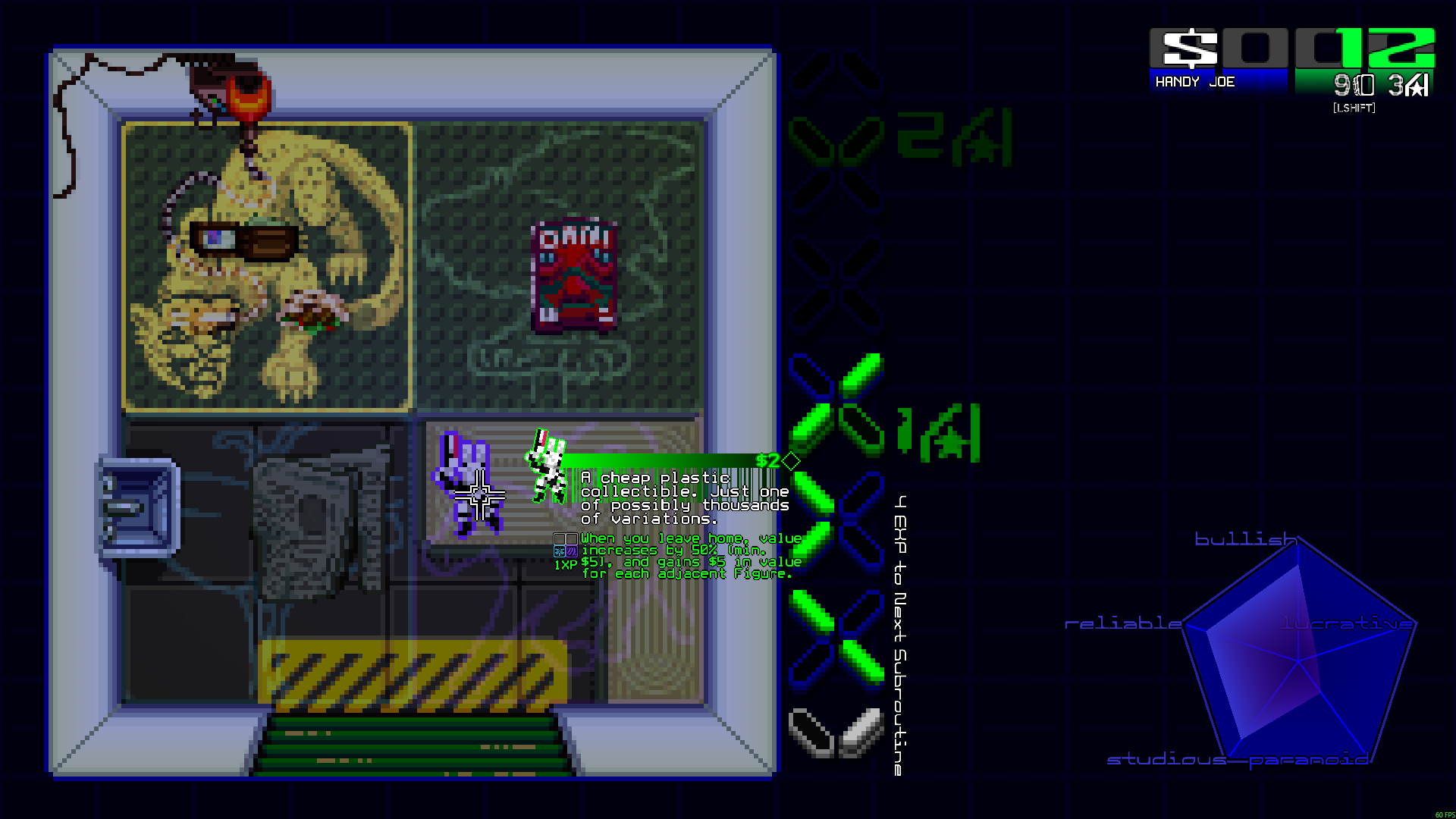 Once Every Seven Years.
Feng Shui was by far the most disappointing and under baked system in the alpha. For the beta, I have taken an aggressive approach, sharply expanding the amount of items available (mostly in the Common and Trophy pools), and completely demystifying the system. There is no longer guesswork involved in Feng Shui: items tell you exactly what they do, what quadrant they need to be placed in, how much XP they give, and whether or not they need to be rotated.
Originally I was very focused on the idea of keeping the effects of these items small and mysterious, but as I continued to test the game by myself and with others, I decided that the mystery simply wasn't compelling. Even I would forget what exactly the abilities were, how they were supposed to work, and why I was expected to engage with them. It made the system difficult to debug, hard to explain, and impossible to genuinely enjoy. Also, I quickly grew to hate writing the cryptic mood hints.
Beyond the items themselves, I also felt that selling and trashing items wasn't risky enough. And, moreover, forcing players to add items to their arrangement at the expense of Insight would eventually lead to a softlock. What happens when you have neither space to place an item, nor the Insight to sell it? Scary stuff.
Instead of forcing the player to spend currency to ditch items, they are instead forced to add malware to their deck instead, and earn no money from doing so. Now the most direct way to make money from trinkets is the pawn shop.
Pawn Shop
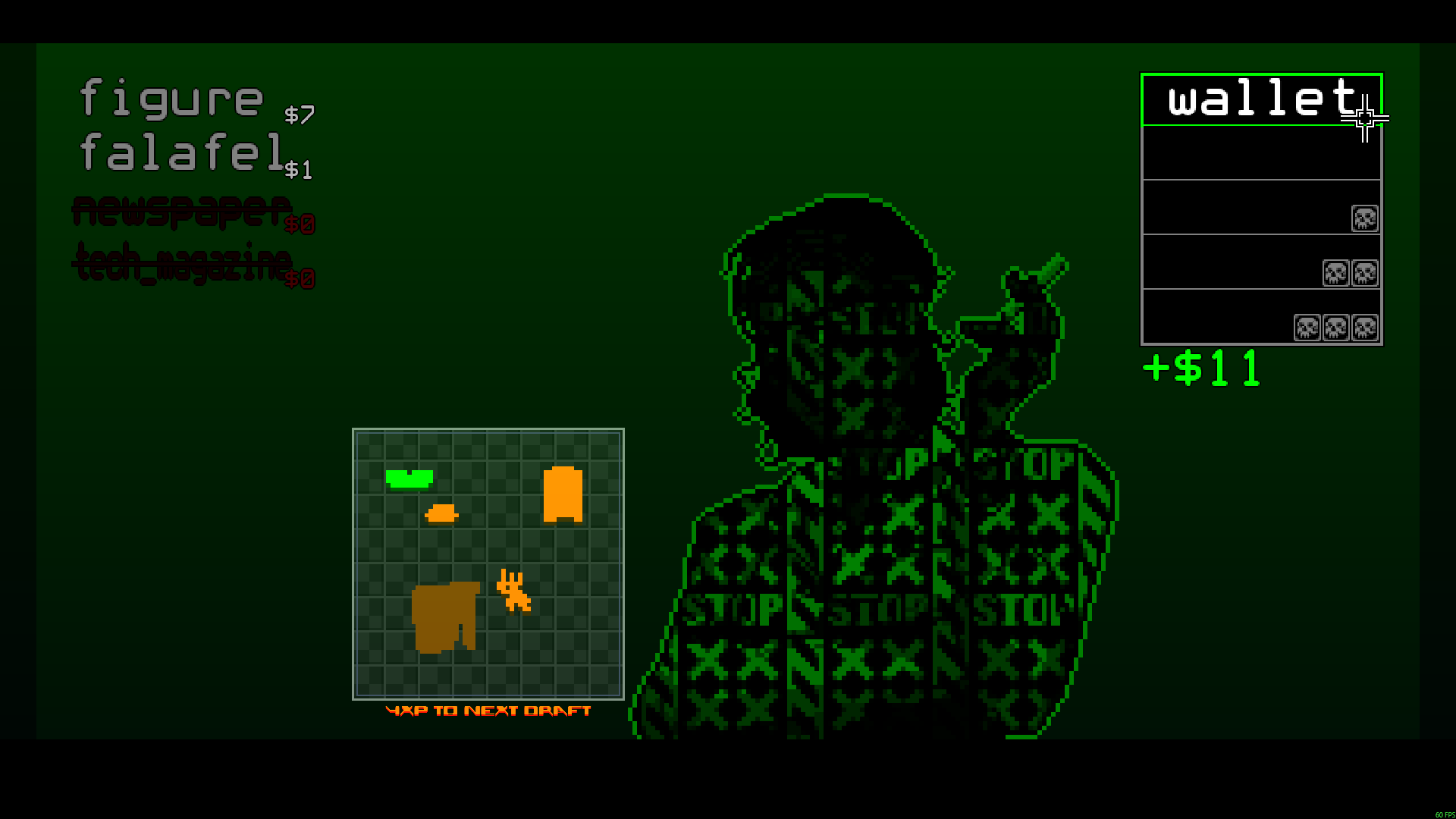 A brand new, extremely early screen to procrastinate on finishing.
The Pawn Shop is how players sell their items. Accessible only by successfully wandering to it, here players will be able to exchange their trinkets for cash. Unlike at home, selling one or two items has no negative consequence. Selling 3 or more though, and Joe and Janes start to suffer Buyer's Remorse. Just like how only five items can be bought at a time at the Thrift Store, it's only possible to sell five items in each visit to the Pawn shop.
New in both shops is a simple overview of the storage unit. This shows how much space is still available, and whereabouts an item is located.
The goal of this shop is to make builds revolving around buying and selling merch require more thought, and to give players more reason to wander. The other shops require that the player have some amount of money to interact with them, the Pawn shop is the first to give the player the opportunity to make money instead.
Nevertheless, before anything can be sold at the Pawn Shop, players need to get there.
Wandering
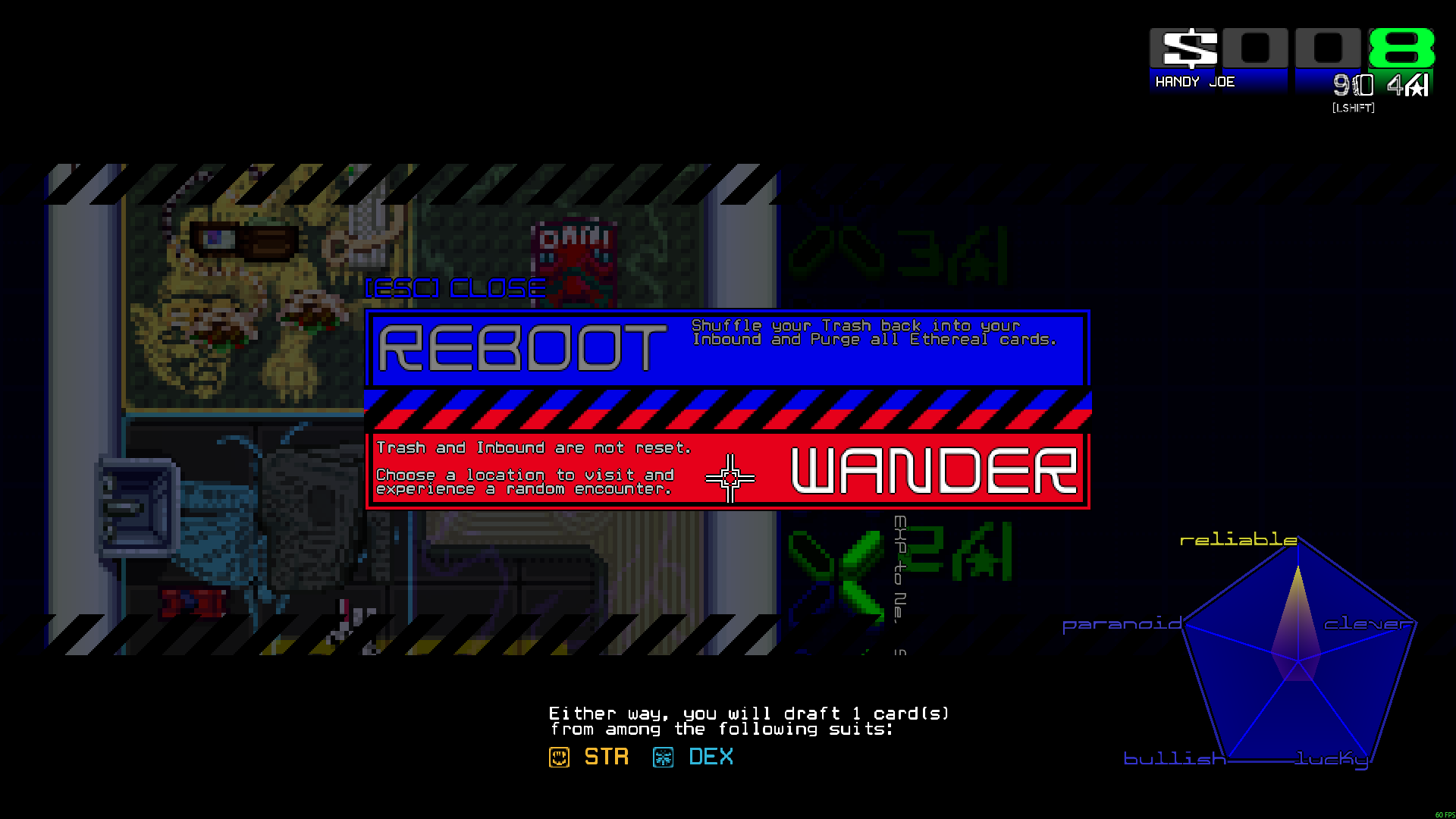
Once players are done fooling around with their storage unit, they'll be given the opportunity to do something with their down time. Maybe they'll play it safe and Reboot, purging most malware they would have picked up scrapping in the NAE's underbelly, and restoring cards trashed during a fight (such as the trusty Powder Driver). But, if that's too safe, and Joe's pockets feel nice and full, players can forgo the standard R&R procedures and go out on the town.
First they'd choose whether to visit the Disguise, Arms, or Pawn shops. After selecting, they'll be faced with a Dilemma - a random event where they might have to make a choice, talk to a stranger, or test their skills. If all goes well, the player will arrive at their chosen location and be able to engage in commerce. If not, they might end up heading out to their next contract empty handed - or worse.
Dilemmas
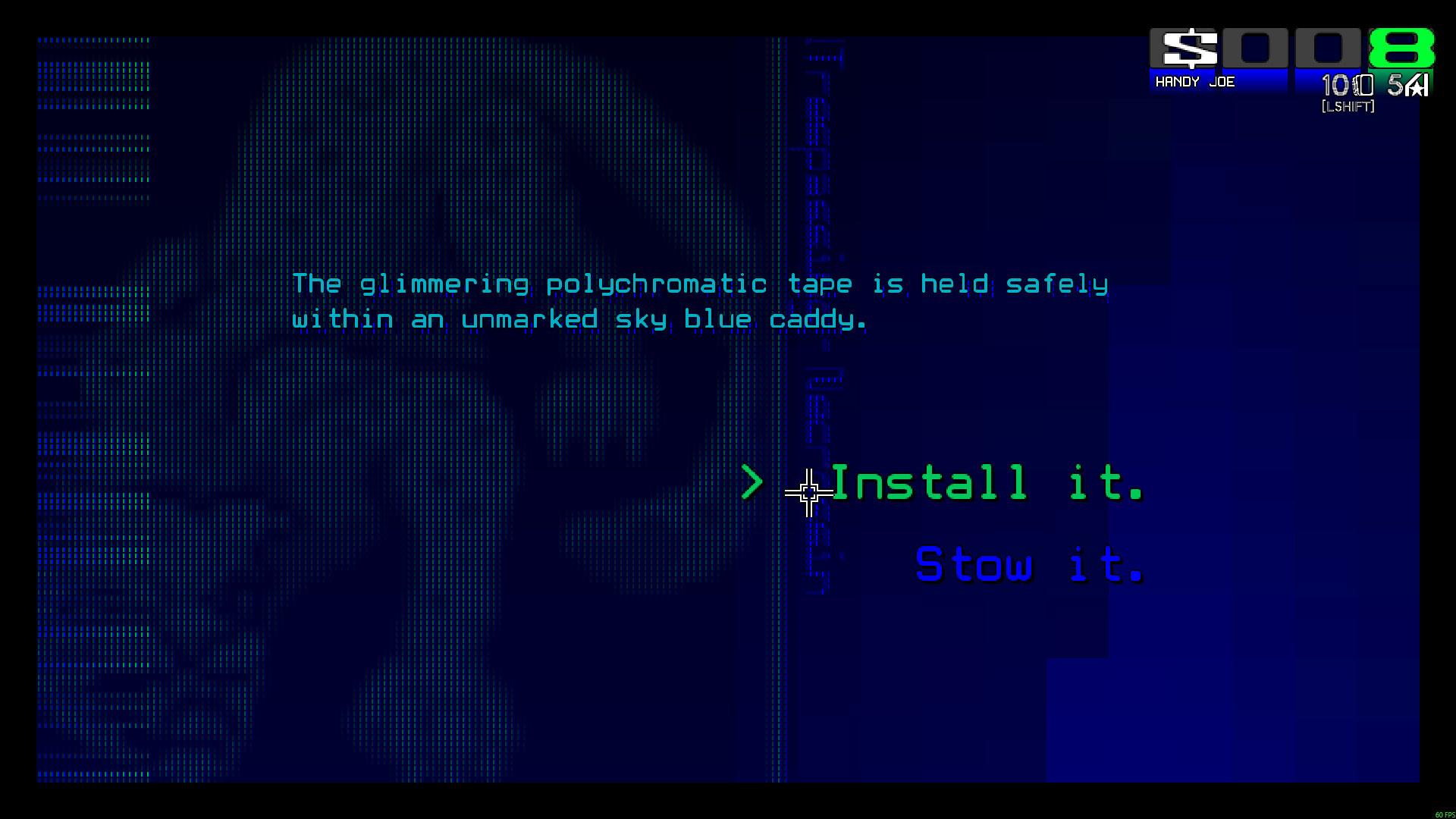
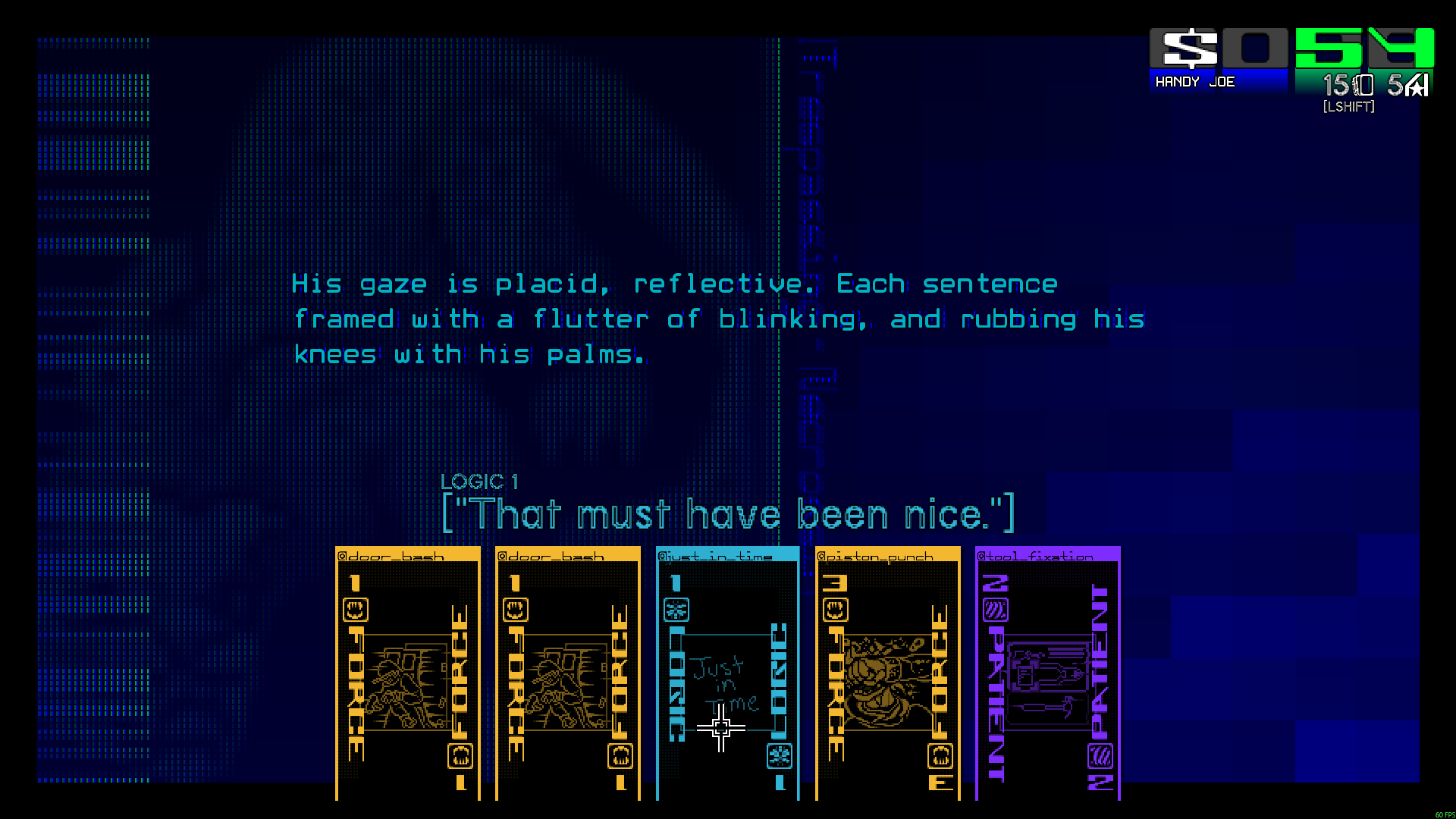
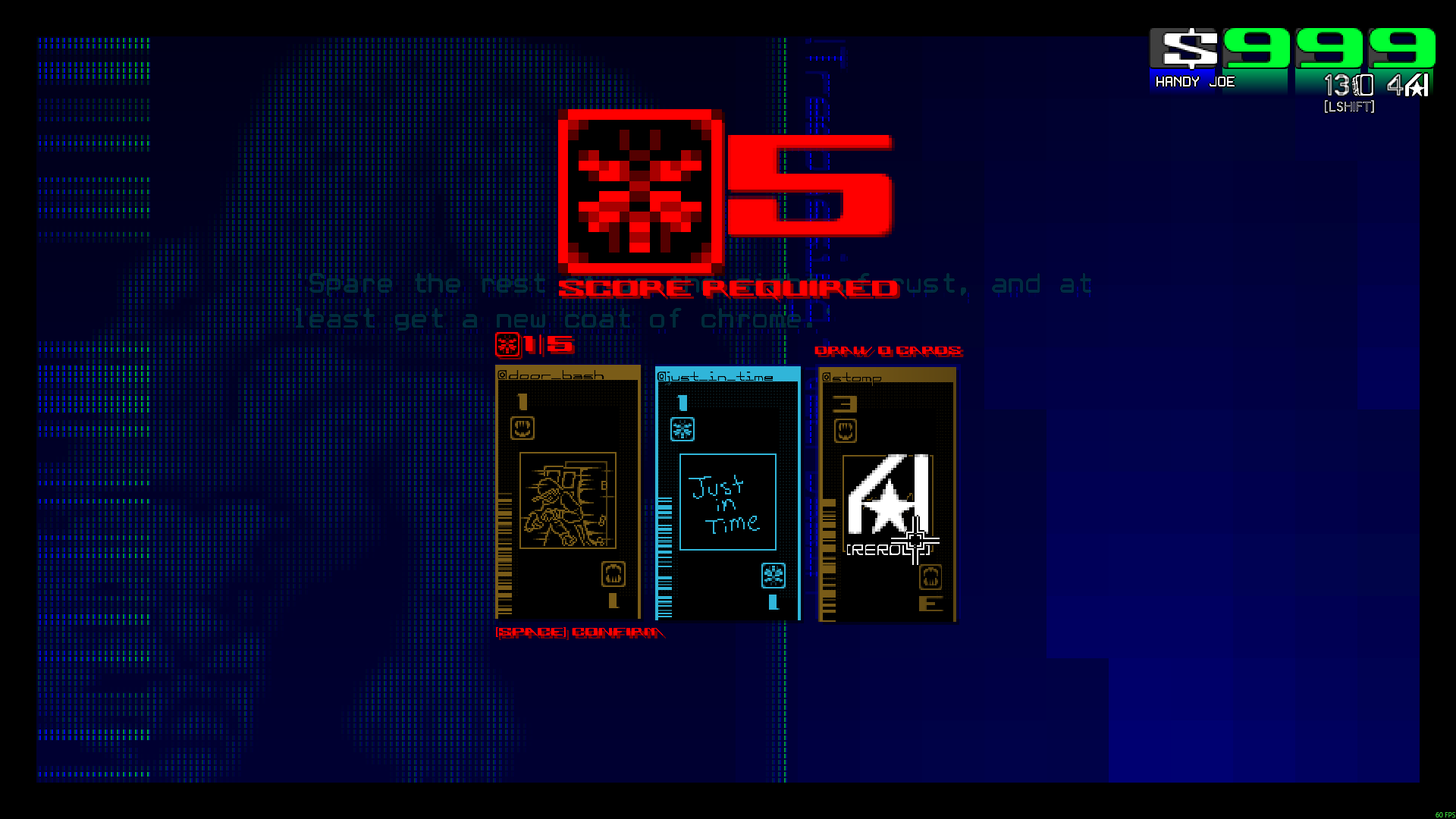
While some Dilemmas only ask for a decision to be made, a few will require Joe to talk or perform some abstract task. In these cases, the player is not in full direct control of what their vessel says or can do. Rather, it is the player's deck that ultimately makes these decisions. What a player can say, what kind of tests they can be successful at, and just what kind of android they are at their core is determined primarily by what cards they choose to include in their deck. If a player builds a Strength deck, they might only be able to communicate through force and intimidation. If they focus heavily on their Intellect or Dexterity, they might be too weak or too impatient to succeed in tests of Strength or Tenacity.
This gives the roleplaying systems some rogue-ish flavor. Sometimes outcomes will be essentially random, sometimes the player might choose to put their finger on the scale to embody the character or get the results that they want - but there will always be a barrier between the player and the vessel. Something just beyond control.
Combat
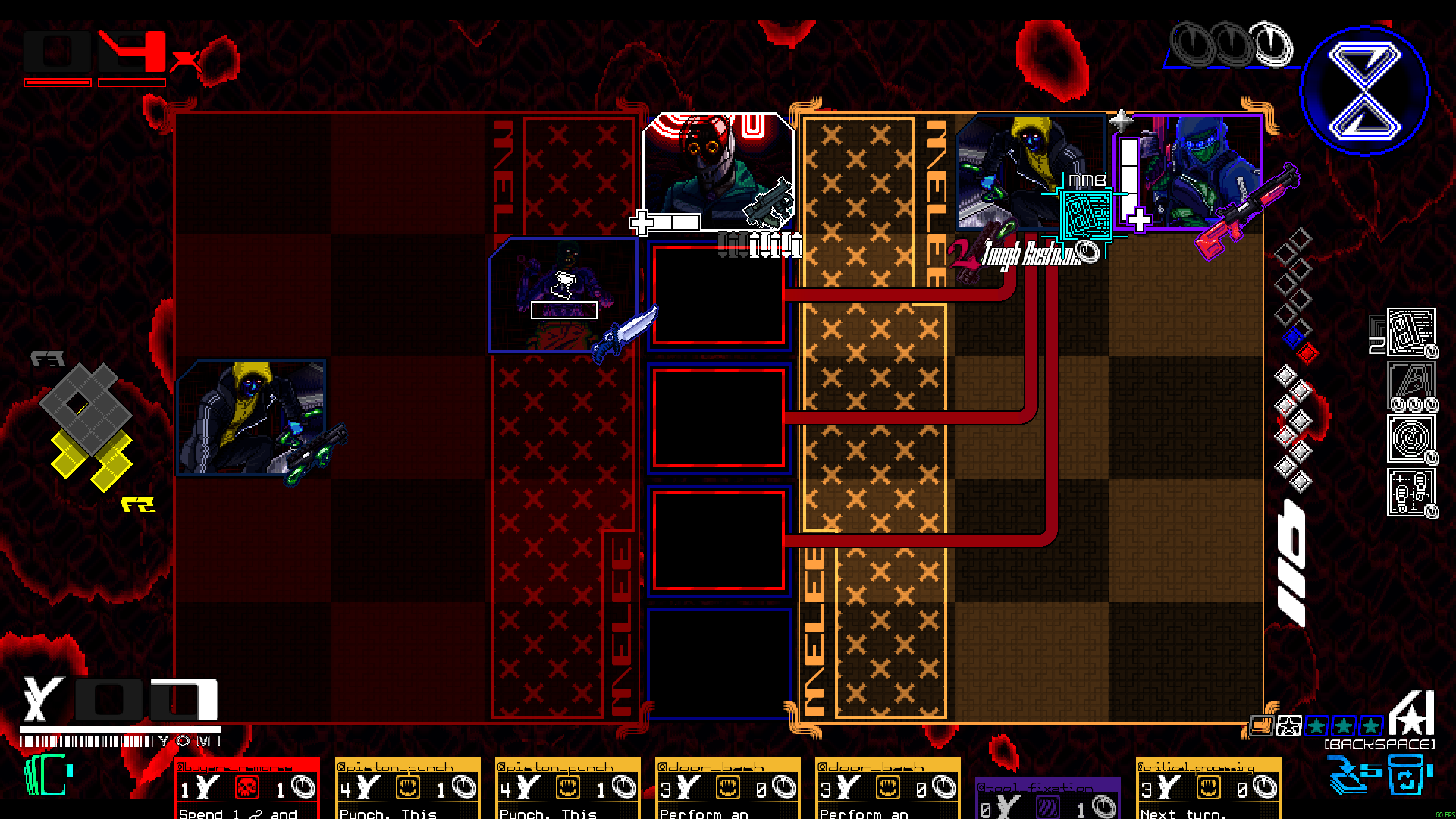
As already stated, the core of the combat system has not changed substantially. Players will still need to manage their distance to melee enemies, dodge the aim of ranged enemies, and carefully consider the effects and behaviors of their foes. Most of the difference in feeling will come from external pressures on battles, whether it be the greater effect that Feng Shui has, the new cards and deck building, or the leftovers from the last fight carrying into the next from Wandering. There are, however, two significant changes that feel worth specifically mentioning.
AStar
Undos were something I talked about being awkward to balance in Reconstitution, and I have taken another crack at them. During the course of the Alpha, Undos were changed to something that was free and impossible to fully expend. This of course was great for eliminating friction and allowing players to experiment, but it had one big downside. The game had lost an element of "gambling." It had been a system by which the player could bet on themselves making less mistakes in order to get more out of shops and other external systems. That was gone.
With Insight getting a substantial rehaul, I felt it was worth revisiting this system and trying to strike a middleground between the original, absurdly convoluted Undo system, and the new entirely frictionless system.
When the playtest releases on the 21st, players will find that Insight and AStar have once again become the same resource, with a couple key differences.
1.) Players now start with as much AStar as their chosen vessel's Tenacity
2.) Players get as many Undos per turn as they have AStar, capped by their Tenacity
3.) Spending Undos does not spend AStar
In practice this means that Handy Joe starts with 5 AStar and can hold up to five Undos per turn. Any time he spends down to below 5 AStar, he will have less Undos to work and therefore can afford to make less mistakes.
In practice, this means that Undos are essentially non-finite inside of battles, but players need to be careful with how they're spending them outside of battles. Its generally a bad idea to have 0 AStar in the bank.
Police
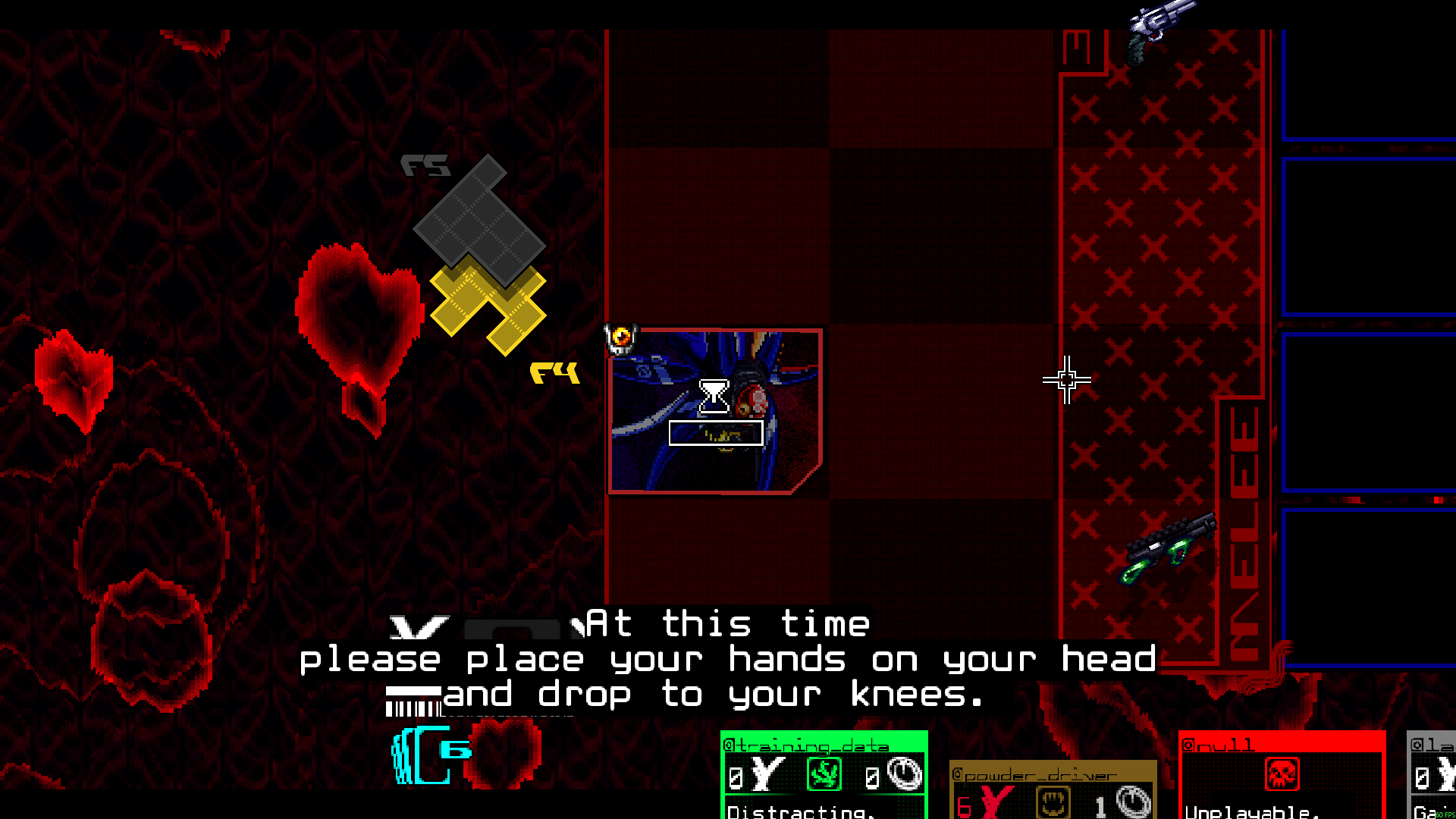 The jig is up.
According to some polling I did in the Discord, as well as observing playtests among the QA team, it became very clear to me that First Responders were not putting enough pressure on players. With the state the game was in at the end of the first playtest, it was entirely possible for the player to completely stall out the game and farm resources in battles. The police response system was neither sensitive nor constraining enough to prevent this, and contracts had essentially no hard time limit.
The current version of this system has the police response meter split into two distinct phases. The first five turns of every contract are the Quiet Time. During this time, if a gun is fired by either the enemies or the player, these turns will be skipped and police response will begin. Once police response starts, the player has 12 turns before the First Responder arrives.
All in all, this gives every mission a hard time limit of 17 turns before the police arrive.
I know time limits are somewhat contentious among roguelike fans and other games have gotten into a lot of trouble for having them, but on some level I do think its necessary to prevent the player from dragging their feet for their own sake. In practice, the 20 or so turns it takes before the First Responder can become a real threat is more than enough to clear all but one very specific mission in the current version of the game.
Hacking
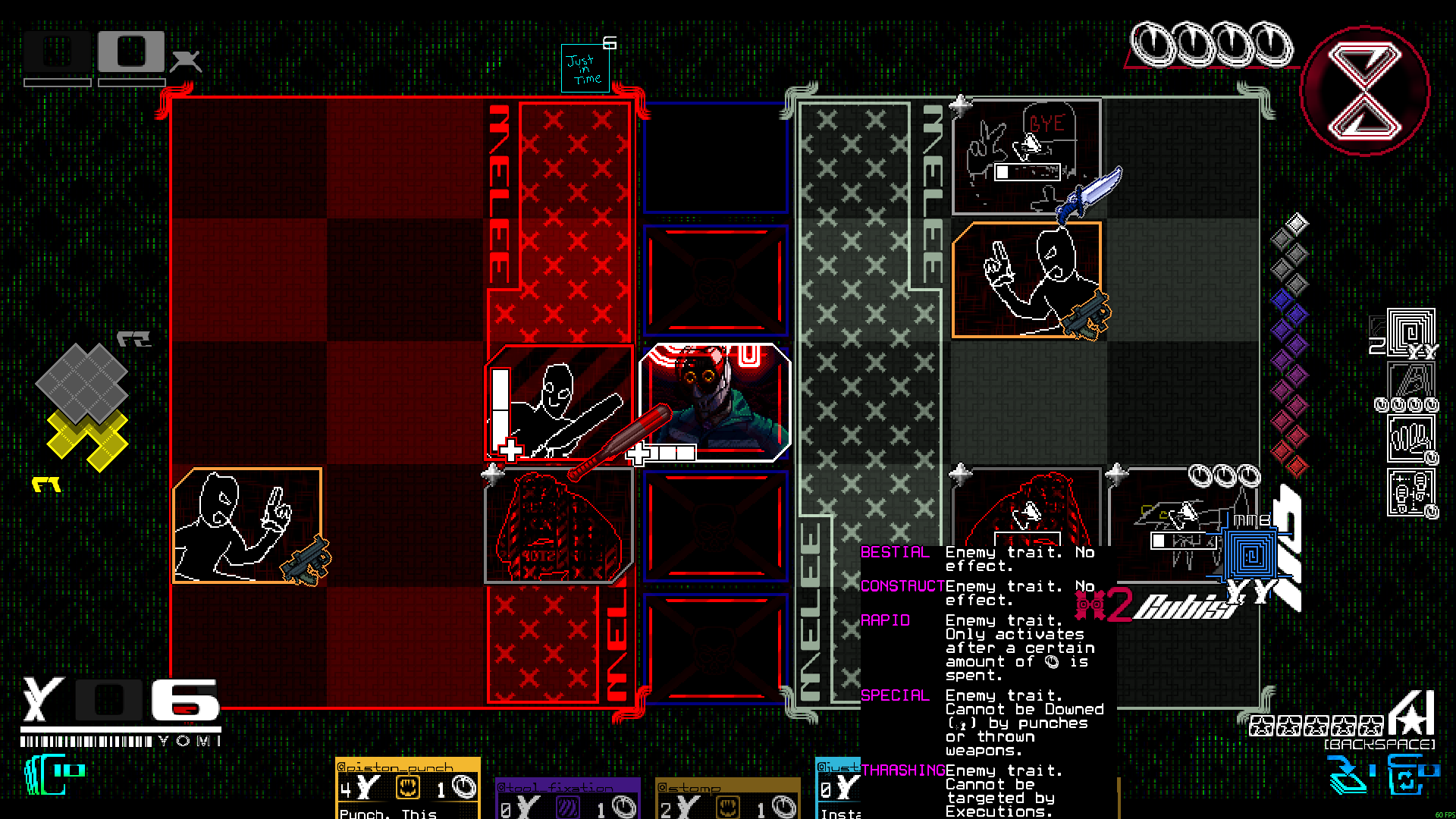 Dancing Digital Delusion
Did players even know they could hack Construct enemies to Stall them as long as they (the player) was standing next to a Net Spike, the Construct wasn't already Stalled for more turns then the player's Intellect, and they had a spare clock to spend and a hankering to press the B key?
Hacking was obviously insane when written on paper. An action that had a ton of requirements and not a lot of impact. Very exceptionally weak and understandably completely forgotten about.
The Hack action has gotten a full overhaul. For starters, it is now partially integrated into the visceral controls scheme. Press Z to swap between Throwing/Grabbing and Hacking, then mouse over a Construct enemy and press MMB. Maybe not as simple as pressing B and clicking, but nevertheless more in line with other interactions and now easily accessible on a controller.
Beyond simply making it a little more convenient to use, all its requirements have been completely stripped away. It no longer requires a Net Spike, and no longer costs Clock. Instead players can trigger it from anywhere by spending Yomi. Enemies targeted by a Hack will be stalled for a number of turns equal to the players Intellect, and hacking an enemy standing on a Net Spike will also Hack every other Construct standing on that Net Spike.
This is a fairly last minute change that might have significant implications that are not yet understood. But frankly, anything to make this useless action a little more fun to engage with.
Disguises
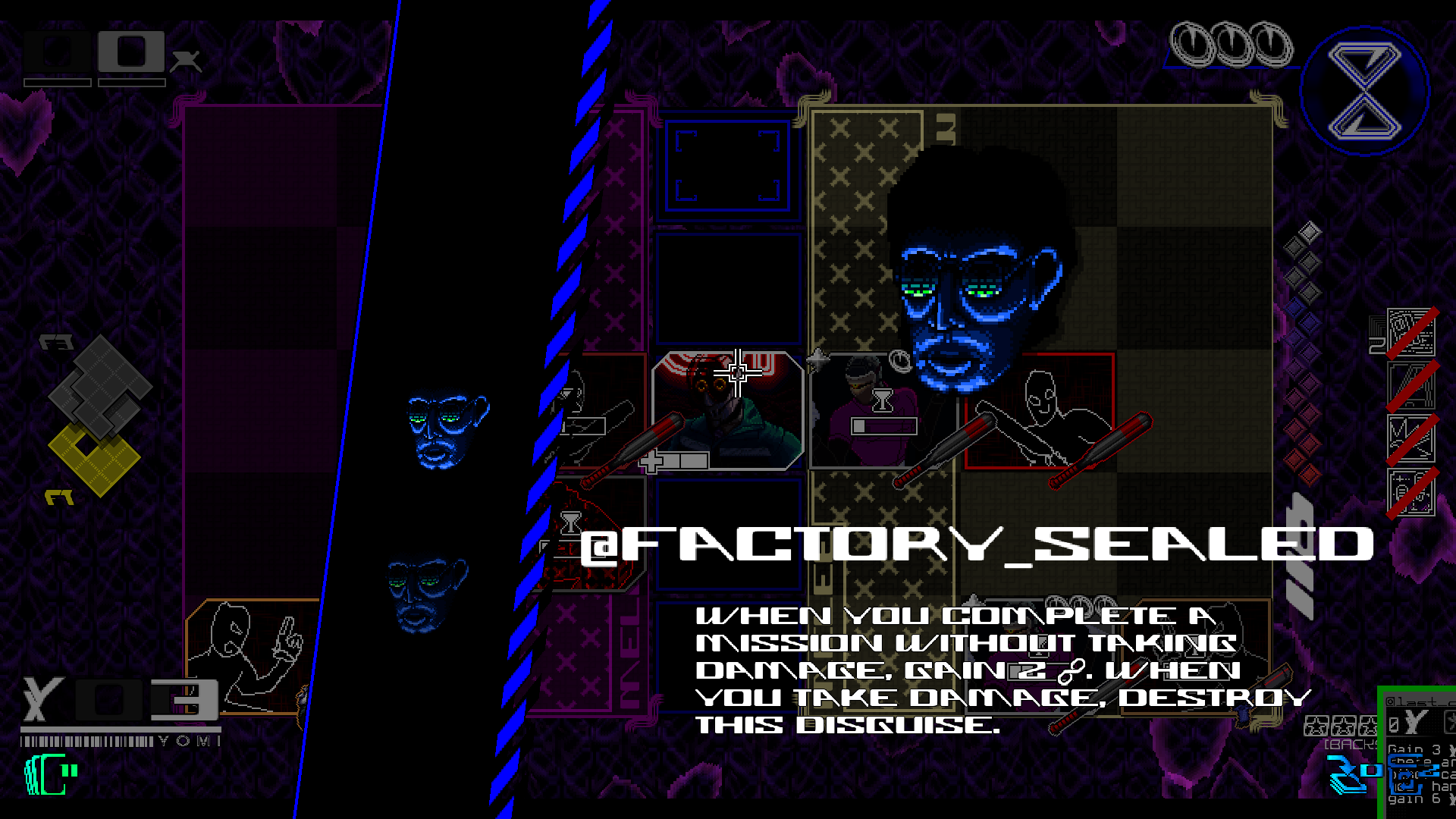 Deja Vu
The final(?) notable addition to the beta test is the Disguise system. When you wander to the Disguise shop, you have an opportunity to buy these. Some are literal rubber masks and faces, others are makeshift, and still fewer are specialized liveries designed by Joe's manufacturers. Don't let the identical placeholder sprite for each and every one of them fool you.
Disguises grant powerful passive effects for the duration of a Contract. These can be things that give you a stronger AStar or Yomi economy, or open up new mechanics, tactics, and strategies to play with. They're fairly self-explanatory, but I do think they're worth shouting out as they are an important part of Collect Call's identity. Something cold, calculated, and unfeeling wearing the skin of some other, more relatable, thing.
There are 10 masks disguises available in the playtest, with hopefully more to come.
Going Forward
Last time it was very difficult for me to keep up with the alpha. I struggled to add new features and content at a comfortable pace. I hope that it will be a little easier this time around as everything is in place and just needs... more. More polish, more balance, more stuff.
I intend to try and keep this one going until the actual full demo is ready. If that happens, then you'll get to watch this build steadily grow and morph and become more like what's in my head. With the big stuff out of the way, the first priorities will be in expanding the number and variety of dilemmas and disguises, then in the steady layering of art, animations, and assets into the game. I don't know how much time it will take to go from what I have now, to something that will feel safe stepping out from behind the shield of 'beta.' Hopefully not much longer.
February will be the next big Steam Next Fest I can attend and I would like to be there. It's already a couple weeks too late to sign up for October, and that's okay with me.
If any of the above sounds exciting to you, go ahead and sign up for the playtest and tell your friends.
As always, thank you for reading. More very soon.