
When a project has been running for years, one question eventually becomes unavoidable:
What changed and why?
As 2025 comes to an end, I want to put this into words. First and foremost for myself, but also for everyone who’s been following the project along the way.
2022–2023: The Engineering Phase
In the early years, I treated the script like a system—quite literally. Flowcharts, branching paths, decision points, event logic, diagrams. I was trying to think at scale from the very beginning, designing the story as an interactive structure with as much freedom and variability as possible. What I really wanted was to understand how a large nonlinear narrative actually works: where it holds together, and where it breaks.
That phase gave me several essential things:
The world and its internal logic;
The core themes;
The characters;
An understanding of the visual novel as a medium—not as a consumer, but as an author and developer.
But over time, one thing became obvious: a logically sound branching structure doesn’t automatically create drama. It can be clean, elegant—and completely hollow.
I was building the body of the script, but I didn’t yet know how to work with its soul: the characters and the story’s emotional core.
That limitation forced me to rethink the entire way I approached writing.
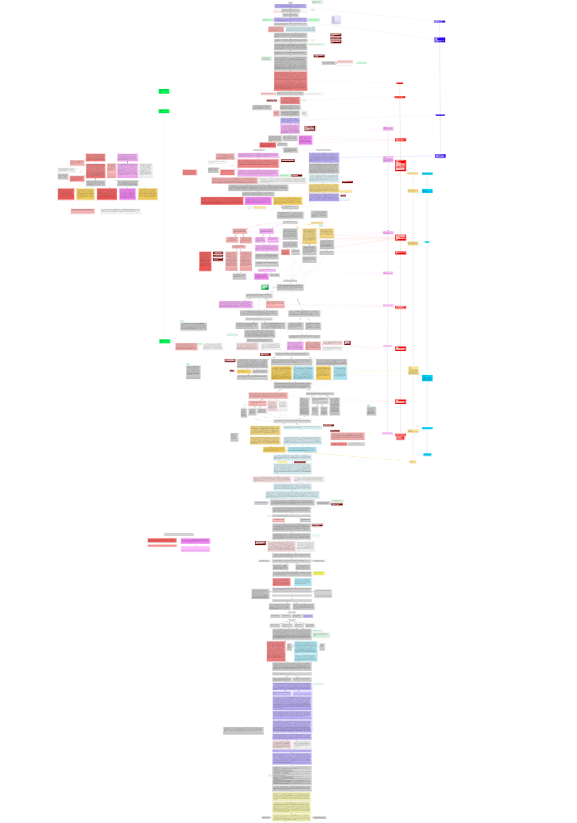
2024: Breaking Things Down and Rebuilding
2024 became the riskiest phase of development. I deliberately walked away from the comfortable structures I’d spent more than a year refining and started rewriting the script from scratch—this time not from plot logic, but from character states and thematic intent. I had to dismantle the “engineer” mindset in myself and force the story to unfold not according to a predefined plan, but according to how specific characters would actually act under specific circumstances.
It was a year of messy, uneven, contradictory, and often embarrassing drafts—drafts that will remain private, for my eyes only. Scenes began to appear not because the structure demanded them, but because without them the story felt incomplete—or worse, dishonest.
The focus shifted:
from listing what happens
to how those events bear down on the characters
to their choices, reactions, and inner conflict
The project lost its formal neatness, but for the first time it started to breathe. Unevenly, awkwardly—but already speaking the language of drama rather than documentation.
That was also when a key realization fully settled in for me: a character’s behavior in a scene can say far more than any amount of explanation ever could.
Around the same time, my understanding of the visual novel crystallized—not as “a book with pictures and music,” but as its own medium. Text remains the core carrier of meaning, but the storytelling follows a cinematic rhythm and editing logic: pauses, shifts in focus, pacing, and the way scenes collide with one another.
2025: Form, Discipline, and the Demo
In 2025, the chaos started to solidify into form.
The first demo released in April.
The writing was awkward in places, slightly rough, sometimes overwritten—but already confident enough to engage an interested reader.
In August, an updated demo followed, with substantial revisions to the text.
At that point, the work was no longer about what the story was telling, but about how it was experienced:
The prose became more concise and economical;
Detailed descriptions remained only where they truly mattered;
The prologue was reworked, moving away from abstraction toward concrete events.
This wasn’t content development anymore—it was a fight for form, rhythm, and delivery.
By December 2025, Act One was finished as a complete, self-contained piece. Not a draft. Not an experiment. A locked milestone in the project’s evolution. What remains is polishing the visuals and sound design. The text of Act One is finalized and will not be revised further.
Where the Project Stands Now
This process never felt like flailing or abandoning earlier ideas. It was a continuous progression—through clashes between opposing approaches, through mistakes, reversals, and returns at a higher level.
Structural thinking and expression, logic and intuition, form and content didn’t cancel each other out. Over time, they found a balance. Many decisions were initially discarded as unworkable, only to be revisited later—and ultimately reintroduced in a more mature form.
In short: dialectics, in its purest sense.
Every stage proved necessary. And each one shaped the script into what it is today.
Right now, the project is at a point where:
The foundation is in place;
The story structure of Act One has been playtested;
What comes next is expansion and growth—not endless rebuilding of the base.
The release of Act One is scheduled for February 5.
For me, that date isn’t just a milestone—it’s the logical conclusion of a multi-year chapter.
Thank you to everyone who’s been part of this journey. From here on out, it only gets harder—and more interesting.
See you in 2026!