Hey DJs,
Future Vibe Check has been a little bit quiet this month. However, that doesn’t mean the developer isn’t hard at work on the automation music game! I talked with Unwise on what they have been working on this month!
Hey DJs—Unwise here. We’ve been hinting at it for a while, and now it’s time to pull back the curtain: Future Vibe Check is adding full MIDI support with Soundfonts in the next major iteration of the game (dropping soon in Discord for our playtesters and soon after in our Steam Demo). This post kicks off a short series covering what MIDI is, why it matters, and how it unlocks more expressive music-building inside the game.
A Brief History of MIDI: Making the Sound of the Future, Universal
Back in the early 1980s, electronic music was exploding with synthesizers from companies like Roland, Sequential Circuits, and Yamaha. The problem? These instruments couldn't "talk" to each other. Each instrument had its own proprietary system for triggering sounds. No one spoke the same “language” when trying to jam together!
Enter Dave Smith (of Sequential Circuits) and Ikutaro Kakehashi (of Roland), who rallied manufacturers at the 1981 Audio Engineering Society (AES) convention to create a unified protocol. By 1983, MIDI 1.0 was born: the Musical Instrument Digital Interface. It debuted connecting a Prophet-600 synth to a Jupiter-6, proving instruments could sync notes, tempos, and controls seamlessly.
(THE BIRTH OF MIDI: At the NAMM Show in 1983 )
Fast-forward to today, and MIDI (2.0 introduced in 2020) is the backbone of all studio productions and live performances. Almost all modern music includes some form of MIDI!
Ok, so what is MIDI exactly?
Audio File = a recording in some format like MP3 or WAV.
MIDI File = a set of machine readable instructions telling instruments what to play, how loud, and for how long. Think of it as super-lightweight sheet music that any instrument can read in real time.
Pitch (0 -127, which note to play)
Velocity (0 - 127, how hard you hit it ≈ loud/bright)
Duration (how long to hold it)
Channel (who’s playing—piano on 1, strings on 2, drums on 10, etc.)
CC (Control Changes) for real-time expression (mod wheel, filter cutoff, reverb send, pan, volume…)
The standard stuck because it’s tiny compared to audio files, universal, and flexible.
** Fun Fact: Why are many MIDI values (like velocity) always on a 0-127 scale? It ties back to the protocol's design in the 1980s. MIDI messages use 8-bit bytes, but the most significant bit (the 8th bit) is reserved to distinguish between "status" bytes (commands like Note On) and "data" bytes (parameters like velocity). This leaves 7 bits for actual data values, and 2^7 = 128 possible steps (0 through 127). This efficient design allowed for reliable, low-bandwidth communication over serial connections, ensuring compatibility across early hardware. It's a clever bit of engineering that balances simplicity and functionality. Even today, it provides enough resolution for expressive control without overwhelming limited systems.
Leveling up the sound in Future Vibe Check
In FVC, we're soon moving to MIDI for all playback. Here's why this is hype!
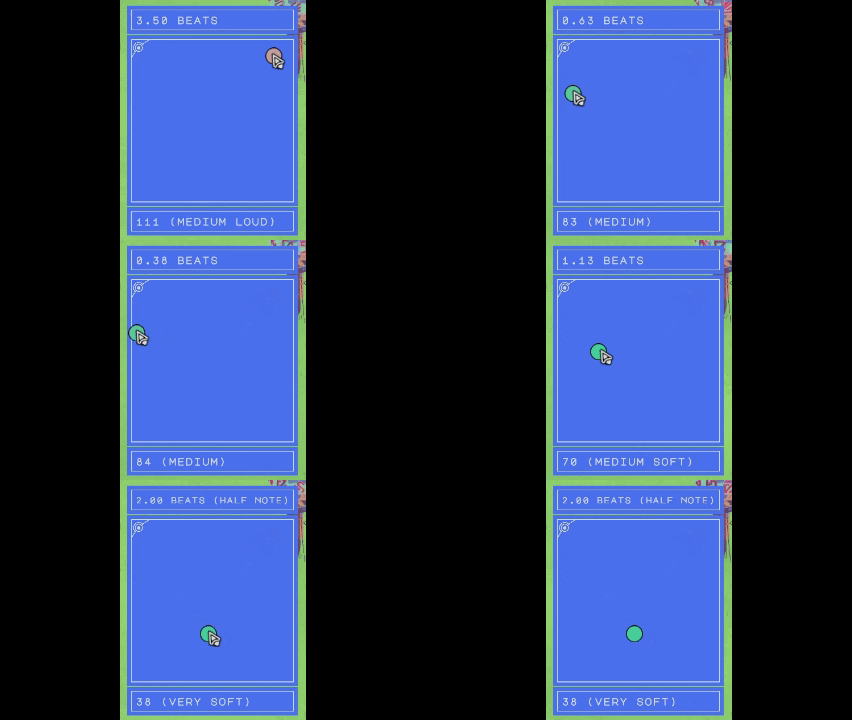
Better Expression on Each Node: Building a high-energy beat? Ramp up velocity for punchy impacts. Chill vibes? Lower velocity for softer touches on each note played. You can set different note playback lengths and even custom travel durations on signals. Need some legato sustains? Maybe the 4-on-the-floor needs a bit of humanization? Imagine automating a pitch bend on a lead synth as your factory expands….crazy possibilities 🙂
Better Instruments: With this change, we are also supporting soundfonts (collection of pre-recorded audio samples that are packaged with instructions for a MIDI synthesizer to play them). For testing, we will be using one key soundfont asset but we expect to support multiple in the future and the ability to bring your own soundfont. This means more instrument variety and realistic timbres per instrument.
Composition and Export: These systems all connect to our procedural music and grid-based composition system. So, you can make a vibe in FVC using our visually engaging toolset and export it to MIDI if you want to work on it in a DAW!
Next, we will be taking deeper dives to improvements to our logistic systems and some improvements to our procedural generation system to support more exotic scales. Join the Playtest Crew in Discord to try MIDI support early. Much love✌️🎶 — Unwise & the FVC Team