
Here's Part 2 of our writer's article. Enjoy!
This time, we'll start with Clara and Henrik. Their personalities are heavily tied to the Firm Lock quest. So if you haven't completed it, beware – spoilers ahead!
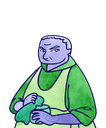
Henrik was initially designed as a functional character: a source of news about the outside world (yes, that’s another aspect that didn’t make it into the demo ːsteamsadː) and a pickup point for deliveries from merchants. But when our programmer suggested a grim side quest about a married couple, Henrik’s personality changed. After all, how do we usually see tavern keepers? As active, talkative, perhaps stingy, but harmless characters. I thought it’d be interesting to add a darker side to this type. Thus, Henrik is energetic but also prone to aggression; a life-of-the-party guy who is never willing to stay out of the spotlight. At the same time, I tried not to make Henrik too disgusting – merely weak and broken by unfortunate circumstances. This way, the choice at the end of this side quest would be more ambiguous.
From Henrik, we move on to Clara.
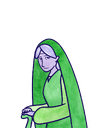
When I began working on her character, two questions arose immediately. First, what does she do aside from housework? Second, what compelled her to remain silent about her husband's abuse?
The answer to both came simultaneously. Clara became a talented healer, an expert in herbs and history. Hence her pride and faith in her own intelligence and strength. Hence her shame at her weakness: she is a healer who can’t cure herself, and a wife who can't cope with her husband.
From that starting point, fleshing out the character was easy. Before her illness, Clara was proud, stubborn, resourceful, considerate, and sarcastic. Now she is still stubborn and proud, but also desperate and tired, clinging to every opportunity to show off her intelligence, to remind others that she's still worth something.
And the last pair from Primrose are Arno and Renna. They could have actually been a couple, but our team, the evil plot twisters, kept them apart ːsteammockingː.
Let's start with Renna.
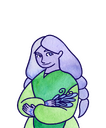
In the first drafts, she was just a kind and patient healer. Then it occurred to me that in the past she should have been Clara’s apprentice. Not to mention that most of her life was spent in the harsh conditions of a northern village surrounded by the Mist.
And so Renna transformed. She retained her patient and caring nature. But from Clara, she inherited a love of study and a sense of humor – though Renna's is less caustic. Curiosity became Renna's defining trait. Her passion for knowledge made her choose a life of freedom over marriage. Besides, nothing angers Renna more than people's ignorance (those who completed the Shadow in the Ruins quest may have noticed this trait).
As for her relationship with Arno... The full version of the game will give you a small chance to bring them together. At least, I really want to make it happen ːsteamhappyː.
And finally, Arno.
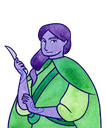
It's ironic that I discuss him last, because his concept was 'the top guy of the village'.
Arno is exactly that: open, good-natured, and sociable. I was tempted to make him boastful, sort of like Gaston from Disney’s Beauty and the Beast. But the desire to keep Arno a positive character prevailed. That’s why I decided that along with the villagers’ adoration, Arno would receive a lot – a whole awful lot – of work. So he understands perfectly well that his status entails duties and responsibility, not a village-wide party. There's no time for fun – he has to wax the longbow, drag the carriage to the village, and make sure that those terrifying beasts with blue fur live only in Cari’s imagination.
Incidentally, it's Arno's down-to-earth nature that becomes an obstacle between him and the knowledge-seeking Renna. At least in their youth. Who knows how their story will unfold now that the protagonist has taken up the cause?
If you thought I'd forgotten about Oscar, you're wrong. Though he is yet to show his colors once the game plot moves to Avesh.
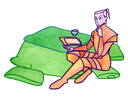
And that is the main difference between Oscar and the villagers, who needed bright personalities because there would be no other chance for the player to get to know them. It is also a challenge: to create a character who doesn't reveal all his cards at once but also doesn't get lost among the more defined NPCs.
Thus, Oscar's trademark is ambiguity: every action or phrase he utters can be interpreted in multiple ways. He might be mocking the Heliots, or trying to be friendly in an awkward manner. He might not notice that Gustav’s sympathy is fake, or he might see through it but prefer to remain silent. Combined with his consistently polite and verbose manner, the result is a character who both highlights the differences between the Akhets and the Heliots and keeps the player guessing about what else to expect.
That's all for now. We'll be sharing more insights from the team from time to time, so stay tuned!
And if you want to follow the development process more actively, we invite you to our social media (X).