
Welcome to the first devblog for Metrogether.
We have been very busy behind the scenes and our work on signaling is now in a presentable state. Let's dive into the different kinds of signals you may encounter:
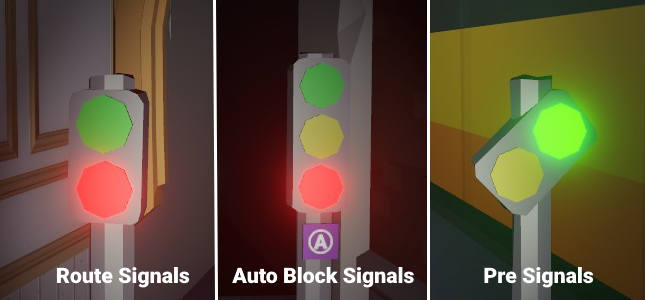
Route Signals
Route Signals are the simplest of signals. You can spot them easily due to them not having any extra signage that specifies what type of signal it is.
They default to stop and only show proceed when a route has been set. They are mostly found when switches are involved. The entire section of switches is one block, but multiple trains may occupy that block at the same time. To ensure that no trains crash into each other, switches are interlocked when routes are set.
If you are ready to depart from a station and a route signal is showing stop in front of you, you can request a route from the dispatcher using the button on your dashboard.
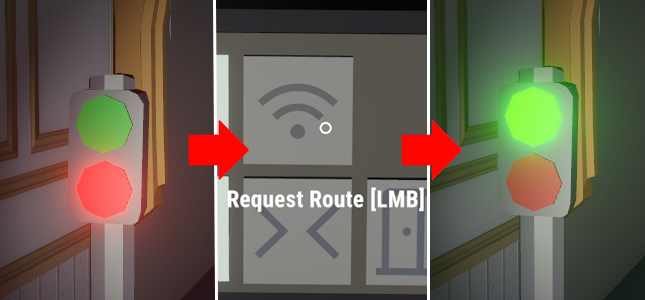
Once the track is clear and all switches are set, the signal will turn green.
The same procedure is also used for entering stations which have a Route Signal as their entry signal.
Auto Block Signal
Auto Block Signals are, as the name implies, automatic in nature. They can be easily spotted because they are marked with a circled A. The background color of the sign can be either purple or white. If it is purple that means that the next main signal is also an Auto Block Signal. If it is white, you know that the next main signal will be a Route Signal.
All tracks are divided into sections called blocks. Auto Block Signals are the only signals that default to a proceed aspect. Every Auto Block Signal has a designated block and once any train enters that block, it changes to stop. Once the block is empty, it will automatically fallback to proceed again.
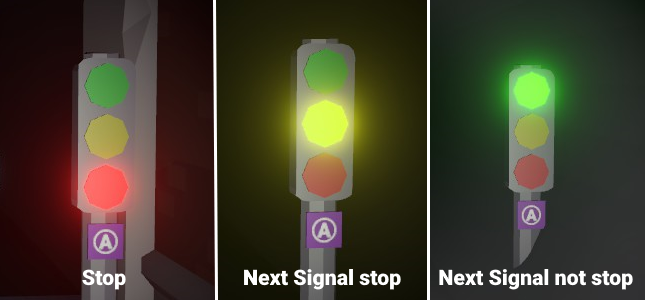
Auto Block Signals also usually have three aspects. Proceed, caution and stop. When the next main signal (route or auto) shows stop, it will always show caution instead of proceed. This allows you to know whether you need to brake to stop for the next signal.
Pre Signals
Last, but not least, there are Pre Signals. You can spot them from far away because they are angled at 45 degrees.
Pre Signals are the only signals that cannot show a stop aspect, because you never need to stop at a Pre Signal as they only exist to inform you about the next main signal.
These signals are mostly placed in stations where you are too far away from the next main signal to see it. Thus you can wait at the platform until the next signal is no longer showing stop and continue to let passengers on and off.
They also sometimes appear in sharp turns where you can't see very far.