
Hello, this is Team Samoyed!
Teamfight Manager 2 will be sharing consistent development logs every 2–3 weeks to keep you updated on our progress. We appreciate your interest and suppor
In this edition, we’re covering the match schedule configuration and the ban/pick AI.
Match Schedule Configuration
In the previous game, a season was played as a league over one year, followed by a World Championship once the league ended. Moreover, there wasn’t a notion of specific dates—the game’s time advanced in one-week increments. That format was chosen because the previous game was designed for a lighter playstyle, aiming for fast-paced matches that emphasized the ban/pick process.
However, Teamfight Manager 2 is targeting a more realistic and complex management experience. In-game elements such as ban/pick and tactics have become significantly more intricate and weighty compared to the previous title. Accordingly, we have revised the match scheduling process as follows:
- Each schedule is now organized on a daily basis.
- Matches are no longer grouped in one-week bundles. Instead, on each day, a set number of matches are played per tournament.
In addition, the overall tournament structure for a season has been changed as follows:
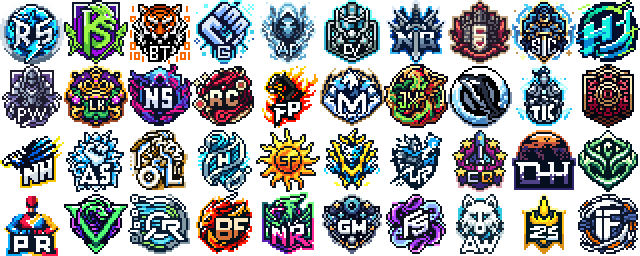
Icons representing each league’s teams
- There are four leagues—Korea, China, Europe, and North America—each consisting of 10 teams.
- Each league conducts two seasons per year: a Spring Season and a Summer Season.
- Each league is divided into a regular season and playoffs, with the top 6 teams from the regular season advancing to the playoffs.
- Playoffs follow a double-elimination format.
- International competitions consist of two tournaments: the Masters Cup and the Champions Cup. The top teams from the Spring Season qualify for the Masters Cup, and the top teams from the Summer Season qualify for the Champions Cup. Seeding for each league in international play may vary each year based on performance.
- For teams that do not qualify for the Masters or Champions Cup, a separate tournament is held between rival leagues (Korea–China and Europe–North America).
- Player recruitment is permitted from the end of the Champions Cup until the start of the Spring Season, and from the end of the Masters Cup until the start of the Summer Season.
For international competitions, the current plan is for 16 teams to qualify, divided into groups of 4 for a group stage, followed by a single-elimination tournament among the top 8 teams. However, after further testing, this format may be altered. We are also considering adding other regional leagues or a secondary division, and we’re still deliberating on finer details such as whether each regional league should have its own slightly different format. These elements may change as development progresses.
With Teamfight Manager 2, as matches have become much more complex, there are significantly more factors to research and prepare compared to the previous game. The new schedule is intended to give you more time between matches to analyze other teams’ data, manage your team’s finances, prepare training and tactics, and scout new players. We’ll introduce these various management elements one by one in future development logs.
Ban/Pick AI
As the match simulation has evolved, significant changes were also needed for the ban/pick AI used by opposing teams. The biggest difference from the previous game is the introduction of positions—now, when selecting champions, you must also decide which position to assign each one.
For smooth testing, we initially continued using the existing ban/pick AI. However, we discovered that the old AI tended to use a single champion in too many different positions. Because it tested multiple combinations and inferred a champion’s value based on team compositions, the previous AI would often deploy a seemingly strong champion into any available position. While a moderate degree of versatility can be interesting, having every champion play every position quickly becomes confusing and unrealistic. Therefore, we needed to adjust the system so that each champion is primarily used in the position where they perform most efficiently. Of course, this issue is complex—it’s tied not only to the ban/pick AI but also to champion balance and game rules—so we are continuously experimenting with various approaches.
In addition, Teamfight Manager 2 sets several new objectives for the ban/pick phase, and we are working to adapt the system accordingly:
- Reflecting Team Identity: We want each team’s ban/pick style to vary slightly based on the coach’s preferences. Some teams might focus exclusively on a “Plan A,” while others might react flexibly based on the draft, opting to ban the opponent’s key picks or to execute effective counters.
- League-Specific Tendencies: Building on each team’s identity and the inherent traits of players in each league, our goal is to enable each league to develop its own key picks and meta. This way, in international competitions, teams will encounter a new style of play compared to their domestic league—and overcoming that challenge will be essential for success.
- Preventing Repetitive Strategies: We’re also refining the AI so that if a player discovers a successful ban/pick or tactic, the AI can better counter its repeated use. The aim is to encourage players to continuously innovate and improve their strategies, rather than sticking to the same approach.
Although these goals are challenging and it’s uncertain how fully they can be achieved, we are committed to doing our best to realize this vision.
To quickly review the changes in the ban/pick AI—as mentioned in previous logs—we have implemented a simulator. In this simulator, various ban/pick AIs can be deployed to each team, and matches are automatically simulated between teams. You can then review each team’s win rate, the champions they selected, and the complete lists of bans and picks from each match. Using these statistical data, we compare the win rates of the old ban/pick AI with the newly implemented one, as well as examine champion usage by position, all to drive further improvements in our ban/pick system.
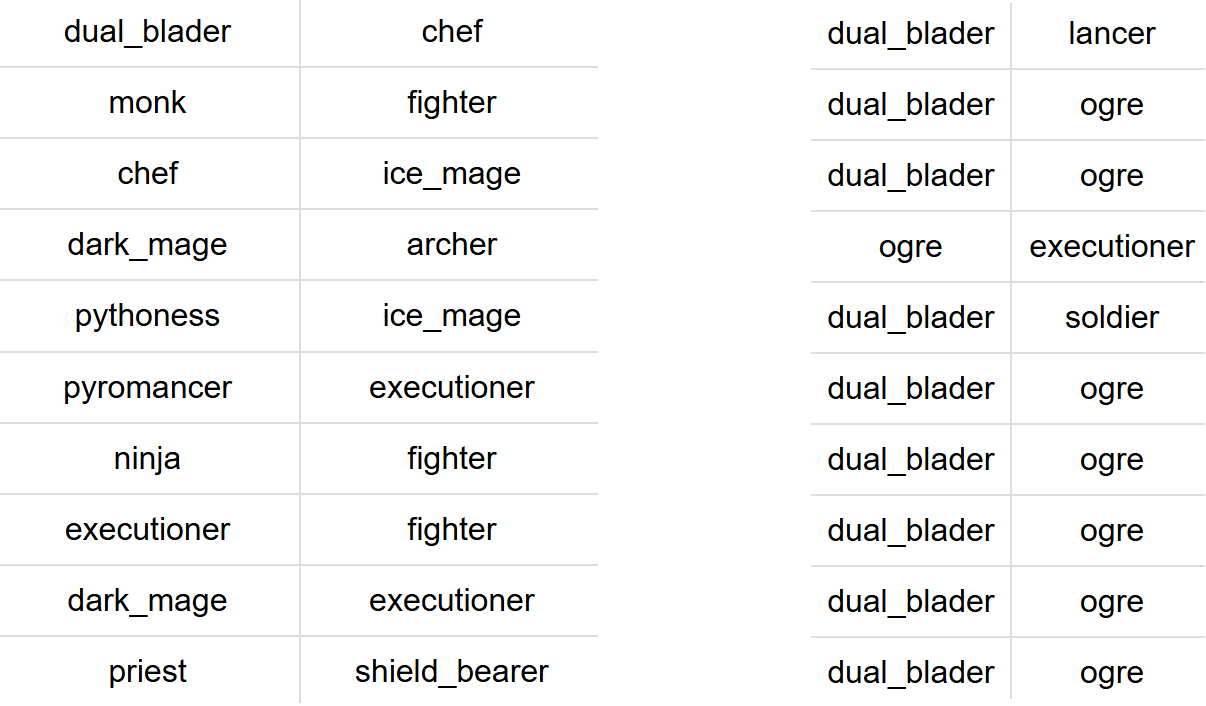
The image above shows data from the simulator indicating which champions were chosen for the first two bans by each ban/pick AI. The image on the left represents the bans chosen by the original AI, while the one on the right shows the bans selected by the improved AI. Previously, because the AI relied solely on probabilistic exploration, the bans varied too much from match to match and often failed to effectively counter the opponent’s strongest picks. We have now adjusted it so that the AI prioritizes banning the most threatening champions during the ban phase in line with its tactical approach.

Additionally, the image above displays a list of the top five champions most frequently used in the top lane by four different teams in our simulation. Comparing these lists shows that while certain strong champions are commonly selected for that lane, there are subtle variations in picks that reflect each team’s unique identity and tactics. This ensures that while teams avoid choosing champions that feel out of place, they can still maintain a distinct team flavor in their ban/pick strategy.
Simulation Improvements
Alongside these efforts, we are continuously working to improve the in-game simulation AI. Currently, the average match lasts around 6 minutes, with most matches falling within a 4- to 8-minute range. Although the optimal match duration may change based on further playtesting, our goal is to strike a balance—ensuring matches are not so long as to become tedious, while also avoiding a pace that feels overwhelmingly frantic as match phases pass too quickly. At present, we’re aiming for the laning phase to conclude in roughly 3 minutes, followed by another 3 minutes for the mid-to-late game phase, which we believe creates a good overall flow.
Of course, with longer match times, we are also considering the addition of features that allow players to fast-forward through certain parts of a match—such as 2x or 3x speed options or the ability to view only key moments.
That’s it for this development log! Thank you for taking the time to read this lengthy post. We look forward to seeing you in the next update!