
Hello, this is Team Samoyed!
Teamfight Manager 2 will be sharing consistent development logs every 2–3 weeks to keep you updated on our progress. We appreciate your interest and support.
In this edition, we’ll take a closer look at how player stats, tactics, and related elements function within the match engine.
Player Stats
In Teamfight Manager 2, the primary goal for player stats is to ensure that each stat holds its own unique value. In the previous game, while stats such as Attack, Defense, and Champion Mastery each played a different role, it was hard to say that each stat truly had a distinct value. This was also tied to the game’s management elements—in the previous title, you started in an amateur league, and as time went on, the overall team stats would gradually increase until, by winning the World Championship, you’d see the game’s ending. In such a system, as stats and finances steadily grow, there’s little reason to specifically recruit a player with one particular stat; you’d simply use the player with the higher overall stats.
However, when your budget is limited and you must construct your squad carefully, the decision becomes more nuanced. For instance, if you have two players both with a total stat sum of 50—one with 40 Attack and 10 Defense versus another with 10 Attack and 40 Defense—you need to deliberate which balance of attributes better fits your strategy. With limited funds, every point matters, and choosing the best possible player within your budget becomes essential.
As we will elaborate in future logs, Teamfight Manager 2 is designed with a more realistic approach to team management. We wanted to ensure that when you manage your squad, you’ll face deep strategic decisions about how to compose your team.
Before diving into those aspects further, let’s review the basic components that make up a player’s stats:
- Mechanics: Influences the player’s control abilities. Higher mechanics mean you’re better at landing non-targeted skills and evading enemy attacks. (This was briefly mentioned in previous logs.)
- Decision-making: Affects the player’s judgment. A player with high decision-making can better predict enemy gank risks, determine the proper timing for exchanges, and more accurately assess the pros and cons of various tactical maneuvers.
- Mental Strength: Impacts a player’s mental resilience. Players with low mental strength might perform poorly in lane (e.g., suffering consecutive solo kills) or see their stats sharply drop under high-pressure conditions.
- Focus: Plays a key role in the late game. Players with low focus are more prone to mistakes as the game prolongs, resulting in an overall drop in performance.
- Champion Proficiency: When a player chooses their preferred champion, their overall performance significantly increases; conversely, playing a non-preferred champion causes a marked drop.
- Position Proficiency: Playing in a role in which you lack proficiency leads to a reduction in overall performance
In this development log, we introduce a more complex interplay of scenarios. To help illustrate, let’s first examine the champion compositions for both teams featured in this log.
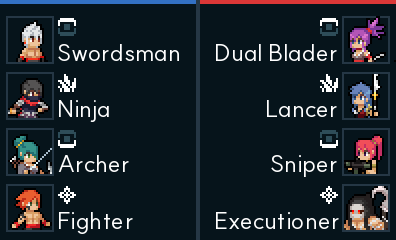
For the Blue Team, from the top lane onward, the composition is Swordsman, Ninja, Archer, and Fighter; for the Red Team, it is Dual Blader, Lancer, Sniper, and Executioner.
In the composition above, notice an early-match scene where the Fighter successfully makes a top lane intervention. Although the sequence is somewhat lengthy and complex, let’s break it down step by step:
- The Fighter is the Blue Team’s Support, and the Archer is the Bottom laner. At this moment, the bottom lane is heavily pushed, and the opposing Support, Executioner, is visible in the lane.
- A fight has broken out in the top jungle, and with the support joining the skirmish, a favorable situation could be created.
- The Fighter moves to the top lane and successfully takes down the enemy top laner.
A player with high decision-making can, as illustrated above, assess diverse in-game situations accurately—allowing them to act ahead of the enemy or anticipate their moves.
As seen here, while Mechanics and Decision-making both directly impact a player’s in-game AI, they influence different aspects: Mechanics govern the fine details of control, whereas Decision-making governs the evaluation of situations and the selection of appropriate actions.
Additionally, Mental Strength, Focus, Champion Proficiency, and Position Proficiency act as indirect modifiers that adjust the core in-game performance represented by Mechanics and Decision-making under various circumstances.
Now, let’s revisit team management from a broader perspective. When constructing your squad on a limited budget, you must align your roster with the meta and your strategic vision. For example, you might adopt one of the following strategies:
- Aggressive Early Pressure: If your goal is to secure an early or mid-game advantage and finish the game quickly, you might be willing to sacrifice some Mental Strength or Focus. The idea is to gain an early edge—since failing to do so often results in defeat later. In this case, building your squad around high Mechanics and Decision-making (even if Mental Strength and Focus are slightly lower) can create effective synergy for early picks and rapid execution.
- Late-game Scaling: Conversely, if you plan to endure the early game and aim for a late-game victory, you’ll favor players with high Focus. Additionally, if your draft strategy revolves around coordinated, target-focused engagements, players with lower Mechanics might suffice as long as their Decision-making is strong.
- Top Lane Emphasis: Alternatively, if the top lane is pivotal to your strategy, you might choose a player with exceptionally high stats for that position, while filling the other lanes with players whose stats are comparatively lower but still adequate for supporting roles—allowing you to push the top lane effectively.
This approach—assigning each stat a unique role, building your squad accordingly, and integrating these choices with your tactics and champion picks—is the core design philosophy of Teamfight Manager 2. Note that the stat system is not yet finalized; as development progresses, if we discover an even better configuration that aligns with our goals, further adjustments may be made.
Furthermore, additional attributes such as Confidence, Complaints, Team Relationships, and Communication Levels are still in the works, and we will cover those in future development logs!
Tactics
While the tactics system isn’t completely finalized, we’ll briefly discuss the tactics currently implemented and how they operate.
Team Tactics
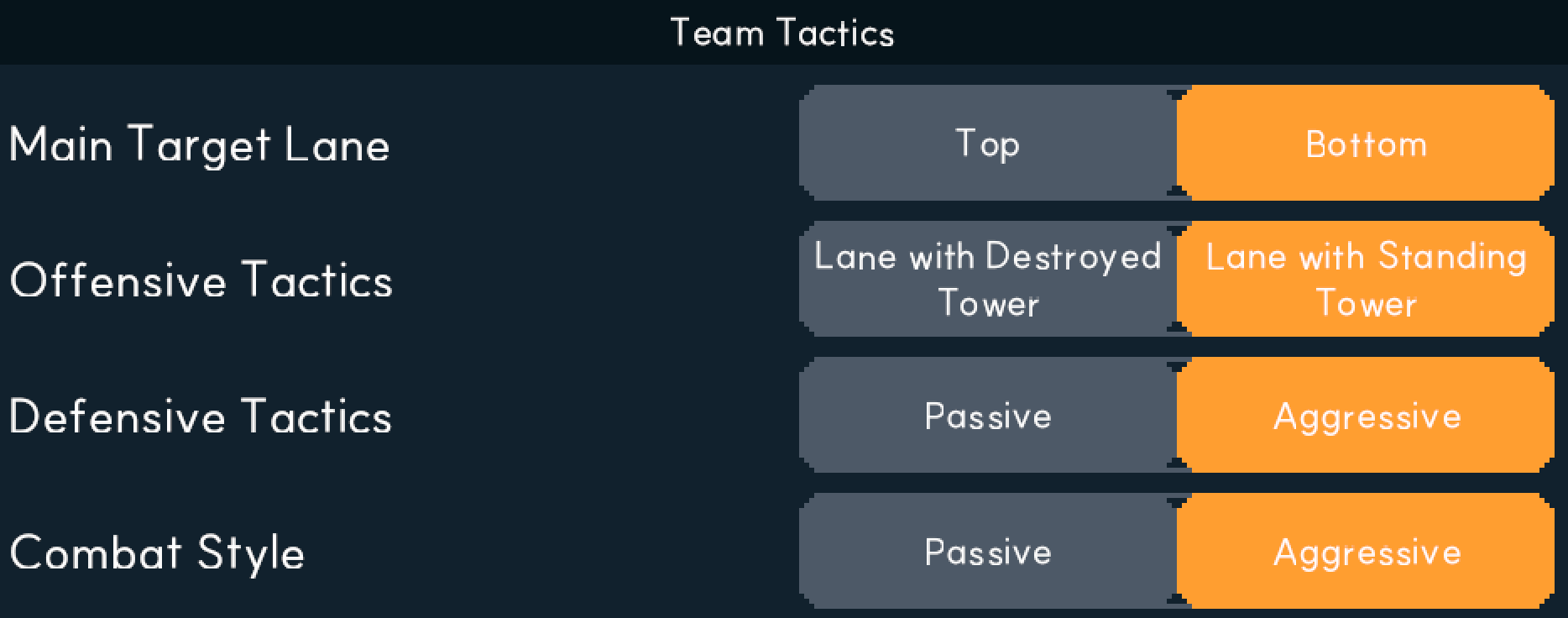
Team tactics affect the overall play direction of the entire team.
- Main Target Lane: Determines whether the team should attack the top or bottom tower first. When the initiative is secured, players focus on breaking the designated lane’s tower.
- Offensive Tactics: After one tower falls, decide whether to pressure the already pushed lane or concentrate on breaking the intact tower.
- Defensive Tactics: With a passive approach, only the minimal number of players defend the tower while the rest continue pressuring their lanes. With an aggressive approach, more players commit to keeping the tower intact.
- Combat Style: An aggressive stance means players will group together to initiate fights or force engagements, whereas a passive stance means they stick together, avoiding uncertain skirmishes and only engaging when a clear advantage is present.
The image above shows a play shaped by team tactics. Through a bottom lane gank, the team manages to take out the enemy Support, Executioner, and the Blue Team then focuses their main target on the bottom lane. Consequently, they pressure the bottom lane while even the top laner, the Swordsman, joins the assault.
Conversely, the Red Team adopts an aggressive defensive tactic. In that scenario, the Lancer roams the jungle and defends the bottom lane as the situation grows perilous. Had the defensive tactic been passive and the Jungler prioritized personal growth, the focus might have shifted from tower defense to safe farming.
Individual Tactics
Laner
Jungler
There are slight differences between laners and junglers regarding individual tactics. Let’s start with the shared element—play style:
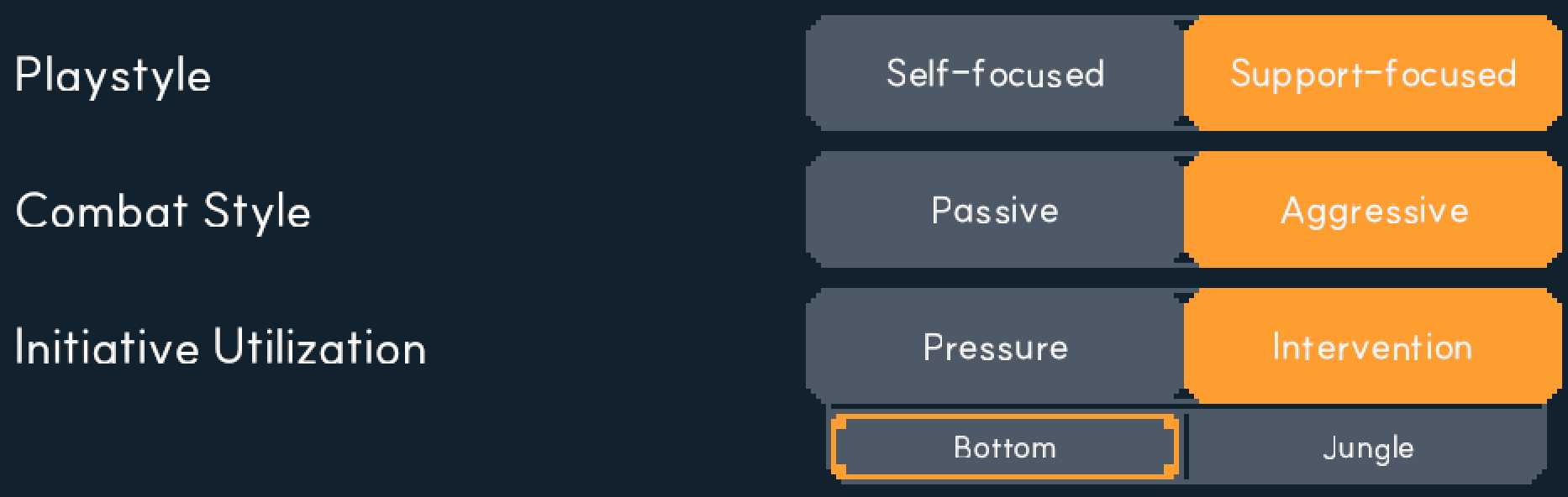
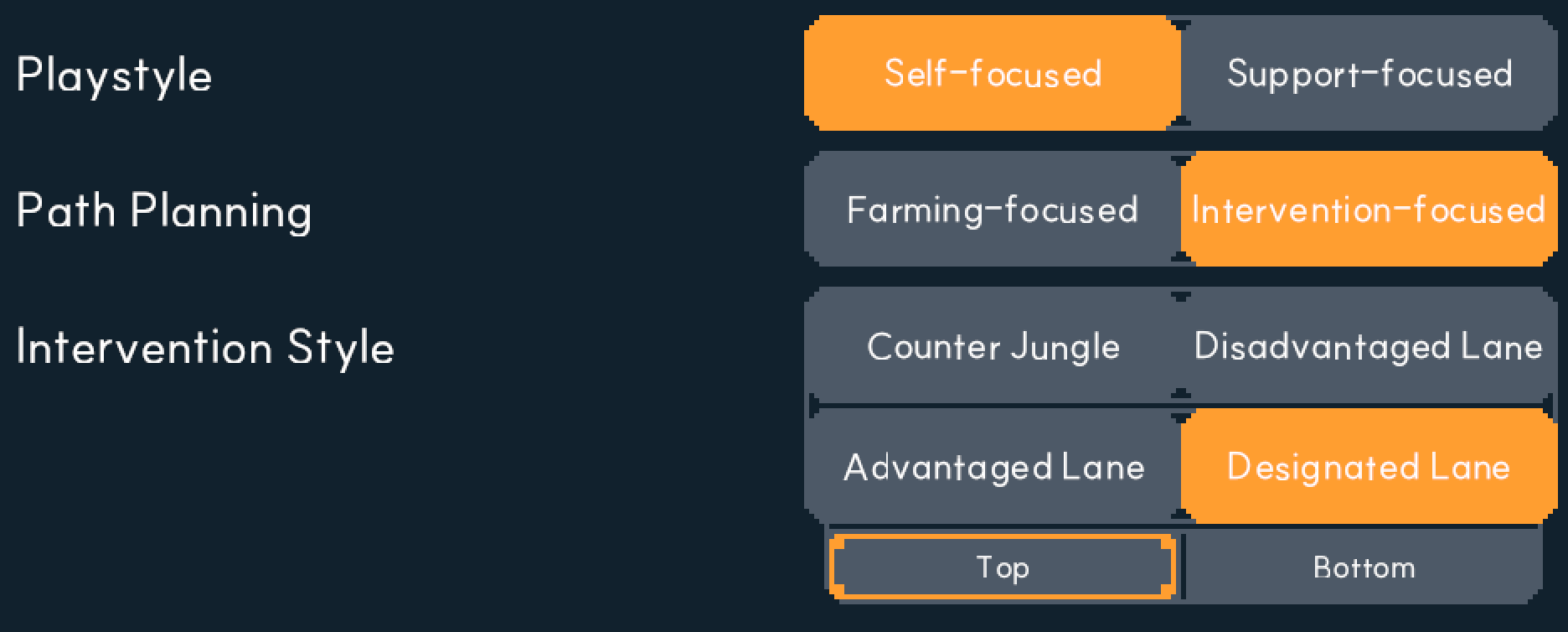
- Play Style: A self-focused player focuses primarily on their own growth, rarely leaving their lane even if nearby fights occur or support is requested—unless absolutely necessary. In contrast, a support-focused player prioritizes assisting teammates, even if it means sacrificing some personal growth.
For laners, the tactical considerations include:
- Combat Style: An aggressive laner actively engages in early trades and seeks out kills, while passive laner focuses on conserving health and growing safely.
- Initiative Utilization: When choosing to pressure, a laner with the initiative will push their lane harder, and under other conditions may be more inclined to roam to other lanes. (For example, as noted earlier, if the initiative utilization focuses on lane pressure, the Fighter's roaming is less likely to occur.)
For junglers, the tactical design includes:
- Path Planning: Balances the focus between jungle farming and gank participation.
- Intervention Style: Determines how the jungler targets opponents during engagements. If set to counter-jungle, the jungler will harass the enemy jungle and steal camps; otherwise, they prioritize ganks based on specific conditions in designated lanes.
The current tactical implementations operate as described above, though since the overall game framework is still being finalized, further playtesting is needed. For example, we are considering enhancements such as:
- Instead of selecting from a set of options, using a slider to adjust the intensity of a tactic might be more suitable.
- As the game progresses from early to mid to late stages, more granular tactical adjustments may be necessary.
- Adding additional tactical options, such as tower dive attempts.
Calls
Lastly, let’s briefly discuss the concept of “calls,” which is still under development.
Within the match engine simulation, players make “calls” during engagements, retreats, and other situations. Calls are a way to share information about the game state and personal decisions—for example, calling to group for a fight, to retreat, or to indicate that an enemy has disappeared. In the image above, you can see that while most teammates issue calls, the Sniper retreats during the early team fight. Fortunately, the team still secures the win, but differences in calls and team synergy can ultimately affect the outcome.
We are working on adding a variety of call types and developing a system to visually display them so that players can assess team coordination and information sharing.
Technical Insights
In this section, we’ll briefly explain how we are technically implementing the design directions mentioned above.
Stat Balancing
If stat balance is lost, certain attributes may become entirely useless. Our balancing goals for player stats are as follows:
- On average, each point in any stat should have similar value.
- The effectiveness of each stat may vary slightly depending on the champion—some champions might benefit more from Mechanics, while others gain more from Focus.
- Tactics can also influence the relative value of each stat.
These differences mean that even teams with similar overall strength can perform very differently based on how they are managed. In drafting and tactical planning, the aim is to maximize each player’s strengths, pushing the limits of their capabilities.
The challenge is to verify and adjust whether these balancing goals are being met. Relying solely on playtesting is insufficient, so we use statistical data to verify that outcomes align with our goals.
To this end, we’ve built a tool that runs countless simulations across various stat configurations and game scenarios, generating data for balancing purposes. Running 1,000 match simulations takes at most five minutes, providing us with a broad range of research data and statistical insights.
Of course, the simulation data might not perfectly mirror actual gameplay (since bans, picks, and other factors can cause significant variations), but our primary focus is ensuring that every element feels meaningful and engaging to the player. We continually combine playtesting with statistical analysis to refine the match engine.
Evaluating Tactical Impact
For tactics, we are examining their impact from two main perspectives:
- When all other factors (player stats, champion compositions, etc.) are held constant, we measure the win rate differences that result solely from changing tactics.
- Across all random matches, we analyze how tactical choices affect in-game metrics. For instance, an aggressive combat style should statistically lead to more kills, and a specific main target lane should correlate with a noticeable difference in the timing of tower destruction.
By collecting these statistics, we ensure that the influence of tactics is neither overwhelmingly dominant nor insignificant. In parallel, we conduct test plays to ensure that these tactical differences are tangible and impactful during actual gameplay, continuously refining the match engine as we move forward.
This concludes this development log. Thank you for reading this extensive post, and we look forward to seeing you in the next update!