
When I was in elementary school, I couldn’t trust the ground beneath my feet. I feared it might one day sink into a sea of magma. Fortunately, that was a misunderstanding on my part. When you look at a cross-section of the Earth, it seems like there’s a vast amount of molten rock beneath the crust we live on. But in reality, it’s not liquid. Due to the high pressure underground, it remains solid even at high temperatures.
This phenomenon was discovered hundreds of years ago, back when science was still called alchemy. By applying high pressure to a substance, you can prevent it from melting or boiling. This discovery revolutionized navies centuries later.
Pressurized Water Reactor
One of the critical issues in reactor development was finding a way to isolate water contaminated with radioactive materials. As water passes through the reactor core, a nuclear reaction called the (n-p) reaction is triggered by the fast-moving neutrons. This reaction transforms the oxygen atoms in the water into radioactive isotopes of nitrogen. Although these isotopes have a short lifespan and decay back into oxygen within seconds, they emit powerful gamma rays in the process.
When contaminated steam is sent to the turbines, it generates strong radiation around them. This means that no one can approach the turbine area for some time after operation. Additionally, extra shielding is required in the turbine room, which adds weight and takes up space—something undesirable in a cramped submarine. Moreover, in emergencies, immediate repairs to water leaks are necessary. Having inaccessible areas in such situations is terrifying.
To address this, reactors with two separate water circulation systems, known as the primary and secondary loops, were devised. Contaminants circulate only within the primary loop. The secondary loop is completely isolated, ensuring that the turbines and other systems are not exposed to radiation.
However, this method has its drawbacks. The thermal conversion efficiency is poor. When transferring heat from the primary loop to the secondary loop through thin alloy pipes, some energy is lost. This means that the primary loop needs to be at a higher temperature to convert the water in the secondary loop into steam. So, let’s apply pressure to the water.
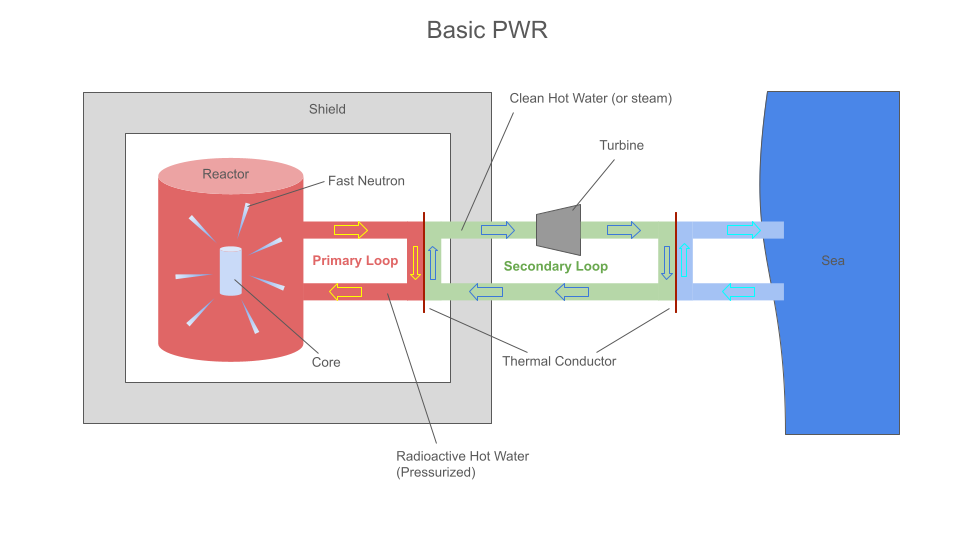
A typical submarine reactor is called a Pressurized Water Reactor (PWR). Pressurized water means exactly that—water kept under pressure so it can remain in liquid form at high temperatures. Pressurized water doesn’t boil at 100°C; it can reach much higher temperatures. This ability to heat water to extraordinary temperatures led to the creation of nuclear-powered submarines.
A True Nuclear Submarine
Despite the iconic term “nuclear submarine,” traditional games have rarely emphasized the differences. Simply changing the 3D model of the hull isn’t enough. I wanted to make the differences in power plants more distinct. Nuclear submarines are powerful but complex, while diesel submarines are simple and easy, though they require battery charging. Therefore, it was necessary to create an operable reactor system.
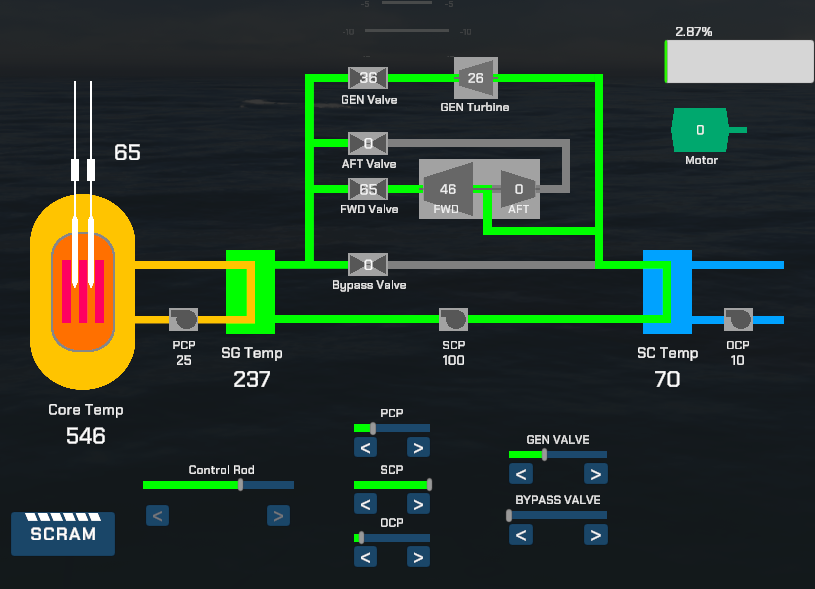
In this game, you can operate a Pressurized Water Reactor (PWR). However, since I couldn’t find blueprints for submarine reactors, I based the design on standard commercial power plants. Instead of actual reactor physics, a simplified thermal equilibrium model is used. The turbine output is a function of the secondary loop pressure. Since pressure is a function of temperature and volume, you can ultimately control the parameters with control rods and valves. The temperature difference between loops is calculated as a thermal equilibrium model, which includes additional pumps to circulate the fluid at sufficient speed.
A well-designed reactor system has stability. Theoretically, when the throttle is opened, the temperature drops, and the water density slightly increases. This makes it easier for neutrons to slow down, increasing the nuclear reaction and returning to the original temperature. Submarine reactors, which need to change output frequently, are likely designed this way. However, since I couldn’t obtain definitive information, it hasn’t been replicated yet. Nevertheless, I find this more enjoyable as a game. A bit of busyness adds to the fun.
Players will operate the reactor control rods, cooling system, turbines, and valves. These systems are unique and may be a bit confusing at first. However, as you get better, you’ll be able to control the output with minimal operations.
The next video shows the reactor control panel currently under development. This video has been accelerated 12x.
I am aware of submarines equipped with other types of powertrains. France is one example. Additionally, traditional diesel-electric submarines are popular worldwide. Therefore, I plan to implement three types of designs:
- PWR
- PWR + electric motor
- Diesel-electric + AIP
Of course, there are submarines that don’t fit into these categories, but for now, they will be substituted with the closest match. However, I might do additional programming for legendary boats like Project 705. I love that boat.
Some submarines from the Soviet Union and the United States were equipped with more advanced liquid metal cooled reactors, which use liquid metal instead of water. These submarines were a significant technical success. However, considering the need to maintain a fleet at low cost, they were clearly an excessive investment. It was just as important to avoid bankrupting the country as it was to deter war.
Finally, I’m not an expert in reactor engineering, so I don’t fully understand the actual mechanisms. If you find any missing parts, please let me know in the comments! Community collaboration will make the game better!