
Finally a new hotfix should be live within the next hour or two.
The list of changes isn't huge, but are generally more substantial than prior fixes.
----------------------------------
Added rudder angle readout to helm.
Reworked the kedge anchor to apply force more strongly, over shorter distances. This should make it easier to move the hull short distances, and no longer require placement of the anchor to be near the maximum allowable length.
Further increased mouse sensitivity options.
Added global volume slider. This is the first stage of more complex audio options, right now just controls the volume of all audio -- which should help the multi app folks.
Started some UI layout and design changes to support eventual text scaling.
Fixed ladder interactions when using non-standard keyboard axis setups.
Significantly overhauled the function and calculations behind lateen sails based on feedback. This is likely to introduce some new issues, as it is a significant change, so you thoughts would be appreciated. (Though I'd still like to stress that the aim here isn't 100% realism, though I'd like to be serviceable.)
These changes can be broken down into the following areas:
1 - Chord and Aspect ratio.
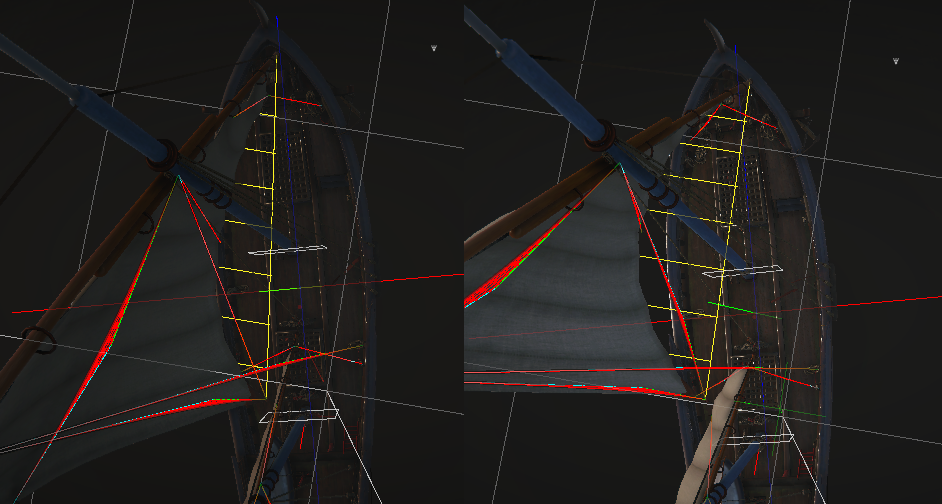
The chord of the sail is now measured from a top down view, along with the aspect ratio, and the position of thickest chord relative to chord span.
The aim is to roll this in to AOA tracking, but for now it is used to generate a dampening effect when the aspect ratio is too high or too low.
This means a full flat sail will generate no lift, and high thickness to chord ratio will significantly degrade performance.
2 – Thrust
Thrust is now calculated based on each sail’s chord line, along with the thrust potential of each sail. This also accounts for hull direction and velocity. This allows for lateral and sternward motion, accounting for the increased drag on the hull. As forward speed increases (relative to hull), the lateral forces are dampened by the keel, resulting in straighter motion.
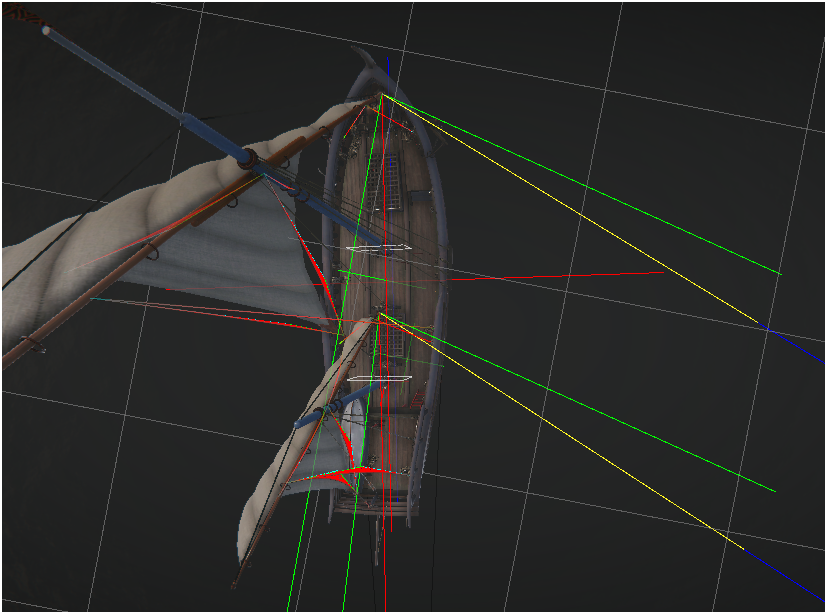
For example in image-2, the hull is stationary. (Ignore sail placement, as I left them in their default position)
Green represents the direction of the wind coming from starboard, with the wind deflecting off the chord line towards the stern.
Blue represents the thrust direction being applied to the hull for each sail.
Yellow represents the same, but accounting for keel forces. (currently 0 as hull is stationary.)
This means the ship will be driven mostly to port, without making much headway.
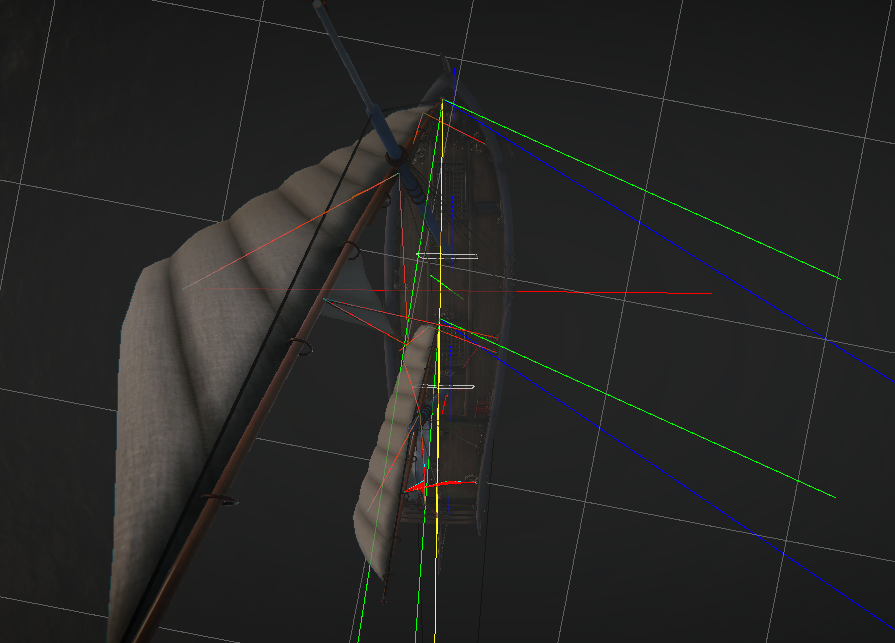
Now in image-3, the ship is moving forward at a fairly high speed.
Colors represent the same, but in this case the Yellow thrust lines have moved inline with the keel due to hydrodynamic forces, resulting in mostly stable forward thrust.
3—Heel
Heel is also now calculated per each sail, affected by the relative strength of each sail. Additionally, heel direction and intensity is based upon a sail’s chord line relative to the wind, without focusing on the orientation of the hull or yard. This should result in more predictable outcomes, particularly when the sail/yard are at extreme angles.
Stability may be excessively effected by this -- currently making adjustments.