
Hey everyone,
My name is Mark, and I'm one of the game designers working on Hell Clock. We’re super happy with all the positive reactions to our Demo, and a lot of you have been mentioning the speed, the “power surges”, and just how fun it feels to progress in the game. So today I wanted to give you a peek behind the curtain and talk about our design philosophy around progression and difficulty.
I started seriously researching progression design in 2017, for Relic Hunters Legend. I had always been a big RPG gamer, but I wanted to REALLY dissect progression. Every single game these days slaps some kind of progression system, and 99% of the time it feels tacked-on and shallow compared to the “real” ones such as Diablo 2.
So I took a deep dive into this subject, and analyzed dozens of games, both good and bad, to see what makes progression systems “tick”.
And what I discovered is that the satisfying feeling of power has absolutely NOTHING to do with how difficult or easy a game is. But it has EVERYTHING to do with pacing.
Difficulty Means Nothing
If you are constantly feeling stronger than the enemies, the game is boring. If you are constantly feeling weaker than the enemies, the game is also boring. This is also one of the many reasons why games where enemies scale automatically to match player level feel so bland.
Good progression is a kind of storytelling. It needs to have drama. Ups and downs. You need to struggle a bit, then overcome the struggle, even feel invincible for a while, but then realize that there are even bigger challenges out there which will humble you - but will also fuel your desire to overcome them!
I’m a visual thinker, so let’s try and visualize what I’ve just said:
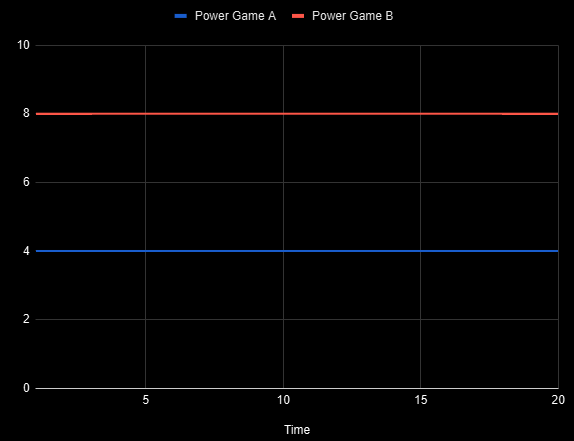
In this graph we see two boring games: in game “A” (Blue) you feel constantly underpowered, and defeating enemies always feels like a struggle. In game “B” (Red) it’s the opposite: you constantly feel OP and enemies are a joke. Although these two hypothetical games might seem very different, the end result is the same: they are boring us asleep.
Now let’s see how an ideal game might look like compared to these two:
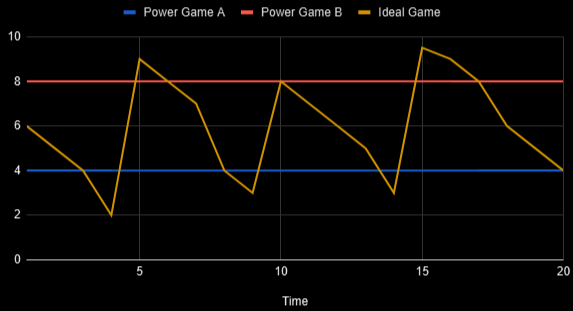
You can already see how much more dynamic this looks. And if it reminds you of a rollercoaster, that’s no coincidence: rollercoasters are a literal, physical representation of this basic principle of all entertainment. Hills and valleys. Ups and downs. Struggling and overcoming.
Our Model
We designed Hell Clock with a model that embodies this idea of dynamic progression. We don’t have a catchy name for it (or any name at all, actually), so we just refer to it as the “Climb, Wall, Breakthrough and Payoff” model.
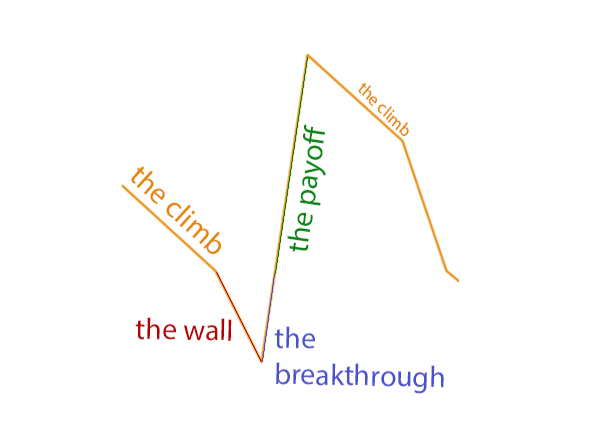
“The Climb” describes a moment where we feel like the enemies’ power is slowly and steadily creeping in on ours. We are still capable of defeating the obstacles, but it feels like they are getting more difficult faster than we are getting stronger. In the Demo, you can see this in action on the first floors.
“The Wall” is when the build-up from the Climb reaches its climax: either a boss fight, a new enemy type, a new area, a new mechanic, SOMETHING is introduced that suddenly makes us feel vulnerable and weak, like all of our power means nothing. In our Demo, you might feel this the first time you meet Bosses like The Jailer, or The Merchant and when you reach the Caves biome.
But wait, we don’t ragequit yet, because here comes “The Breakthrough”: a missing piece that was JUST out of reach before, but is now ours. It could be a new item, a new skill, a new piece of information, anything that can give us an edge. In the Hell Clock Demo, this is the first power spike you get from your Blessed Weapon, or The Great Bell, or your first Unique Relic.
Then it is finally time for “The Payoff”, our just reward for our struggles, when we get to feel untouchable, like we just “solved” or even “broke” the game, and everything that felt challenging before is now trivialized. In the Demo, that’s when you get to blast through the levels and melt in seconds some of the Bosses who were giving you trouble in previous runs.
But of course, the cycle has to restart, so we slowly start to feel like “The Climb” is setting in again…
Models Are Not Recipes
But of course, while all of this sounds great in theory, it is far from trivial to implement in practice. And every game comes with its own quirks and challenges, so what works for us might not work for another game, and vice-versa.
So far, from the reception we got for the Hell Clock Demo, it seems you enjoy this approach - at least for the duration of a small Demo, of course.
Our challenge now is to give you the same feeling over the entire campaign! But we are confident that as long as we keep playing the game a lot, listening to your feedback, and willing to change what isn’t working in our game, we will get there.
TL:DR - Always easy bad. Always hard bad. Rollercoaster good.
Thanks a lot for reading!
Cheers,
~ Mark