The end of June is here, bringing us to the June development log. A lot of exciting things are in the works. Two patches/updates have been completed this month to deal with bugs and other issues. More updates are of course to come over time. Due to the developers taking a vacation for the last three weeks of July, there won't be a July devlog. But we are happy to announce that when we are currently getting ready to interview possible candidates for the new programmer position at Raidho Games. They will eventually partake in the following devlogs and share what they are working on once they are comfortable doing so. We hope you enjoy this devlog and we are eager to be back to work very soon!
Focusing on the Fjord
By Mathilde - Community Manager, 3D-artist
June really has flown by! While I have been busy with a lot of writing and organizing both external in our Discord and other platforms, there has also been a lot of internal work this month, including multiple board meetings for Raidho, Hamar Game Collective, and another game studio in-house. It's definitely been a busy month, but I've been happy to work on the Fjord horse and finally be satisfied with the new look of it. While the Fjord is still not finalized, it's getting close. The only thing left is some tweaking, polishing, and adding a small amount of feathering to the legs and possibly some ear fluff.
While I spoke more in-depth about the process of sculpting, baking, and polishing the Fjord here, it all started with creating the new high-detailed mesh from the low-detailed mesh. I always start out by mapping out the biggest muscles on the horse, usually the shoulder and thigh. There is a lot of back-and-forth to avoid getting tunnel vision. Then I moved on to smaller details such as the tendons and muscles in the neck, legs, and face. In the end, I added the smaller details such as skin wrinkles and crevices.
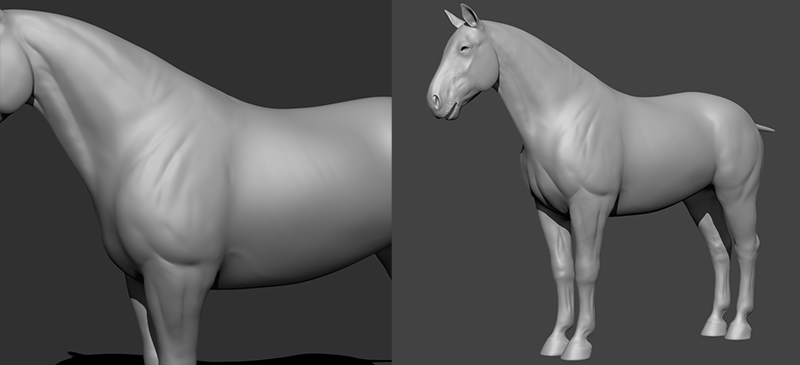
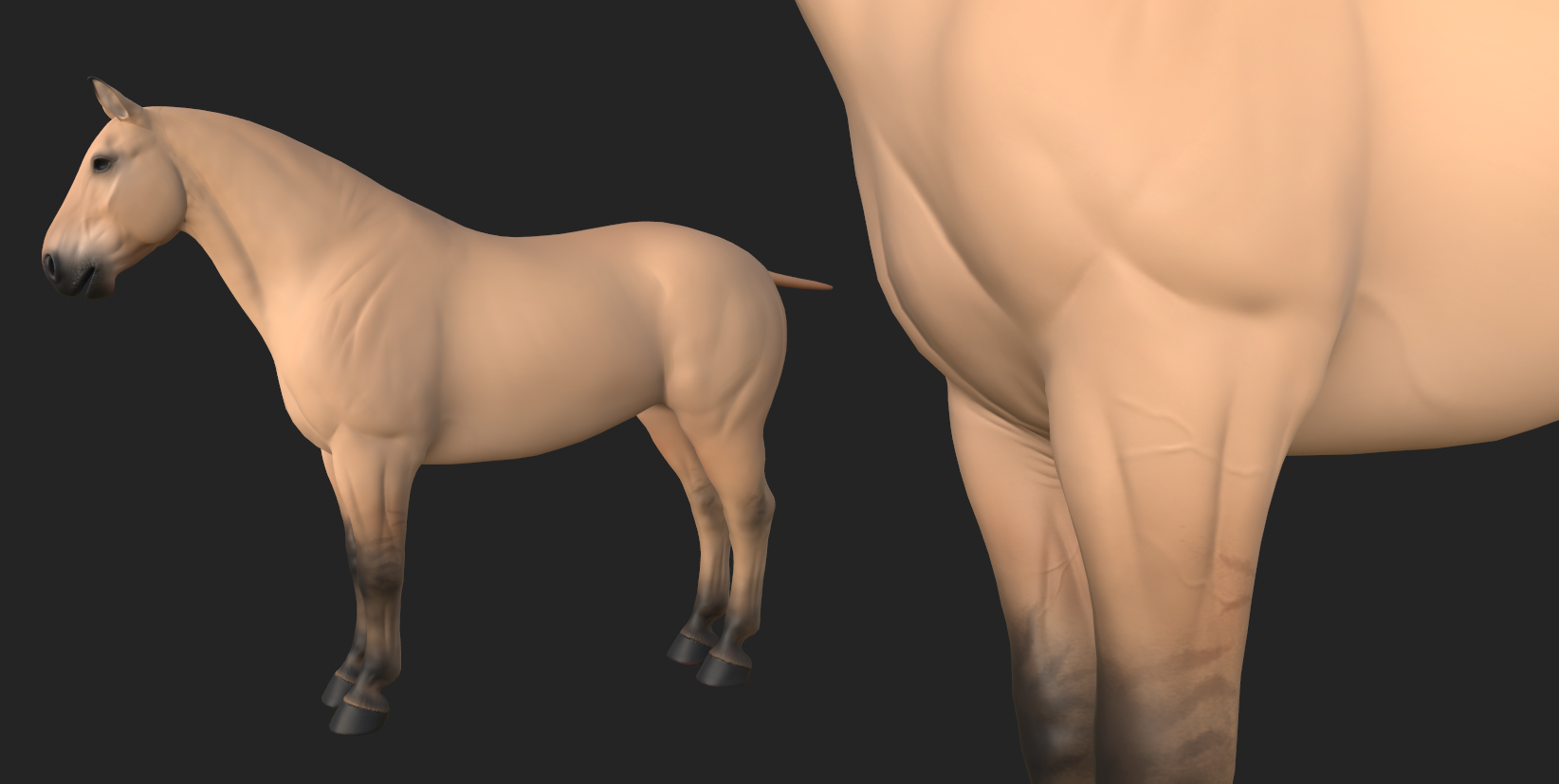
When I was pleased with the high-detailed mesh, it was time to do some baking. To simplify the term baking in game development, it is when you project a high-detailed mesh onto a low-detailed mesh. Making the low-detailed mesh look like the high-detailed mesh, just much more optimized. When I was happy with the bake, I went in and hand-painted in sharper details and added even more details. I like to do this as a polish since baking sometimes doesn't translate all of the finer details. This is where I defined the muscles, and crevices and added more definitions to the existing details. I gave the muzzle skin texture, dimples, and cracks to not look flat and lifeless. As a final touch, I like to add veins in the face and legs.
When I do these polishing tasks on the Fjord, I like to go back and forth looking at the horse with added fur textures just to see if the details added are expressed properly through the fur or not. When I was pleased with the final look of the detailed map with the fur, I moved back to the low-detailed mesh to make additional tweaks. We posted a few photos of the Fjord in a Norwegian Fjord horse enthusiast group for final feedback, and we got a lot of great pointers. I fixed the angle of the fetlocks and made the front of the horse less bulky and the back of the horse a bit more bulky to even out the imbalance there was before. The forelock got a major up-scaling and the ears were scaled down a tad.
The only thing missing now is additional fur such as feathers on the legs, extra hair in the ears, and possibly a small amount of throat/chin hair. Before doing this, I want to find a good way to blend these hair cards into the existing body mesh as we want to avoid hard edges between the coat and where the additional hair is sticking out. I might go more into detail about this later.
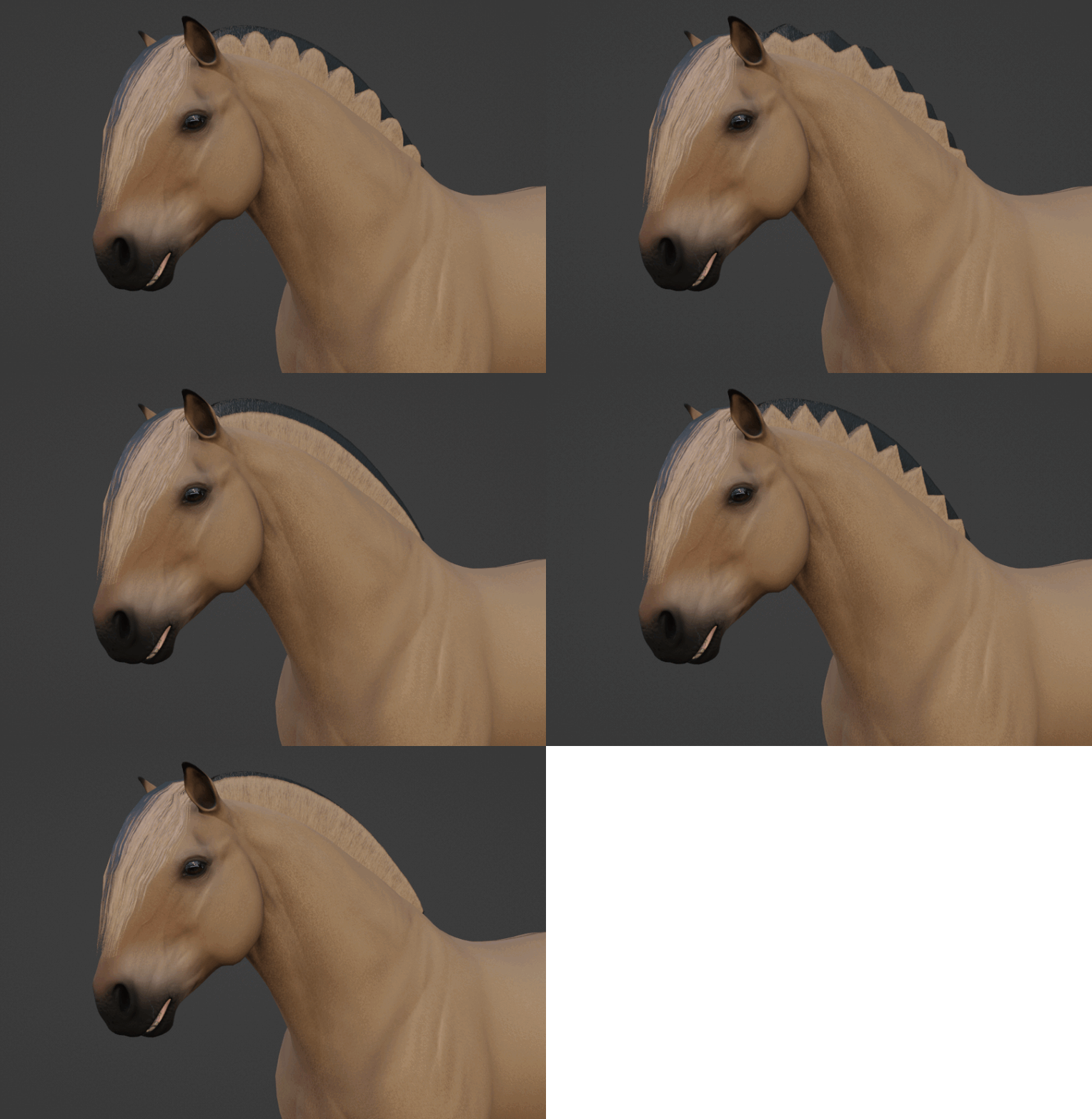
This last week, I got back to the roached mane. While we had a few styles for it last year when we first introduced the Fjord, I had to remake this style as it wasn't very efficient to work with. That has been fixed, and all of the current styles work with both the Fjord horse and the Norwegian Warmblood. It's still a bit finicky, but it's definitely an improvement. I've added a couple more styles after this GIF, but you'll get to see those later. While it may look a bit silly to have such a thick roached mane on a Norwegian Warmblood, which usually is known for its thin mane, we thought it would be a shame to limit this style to only one breed. If you disagree, you are more than welcome to say so! But for now, the plan is to make every hairstyle available for every breed.
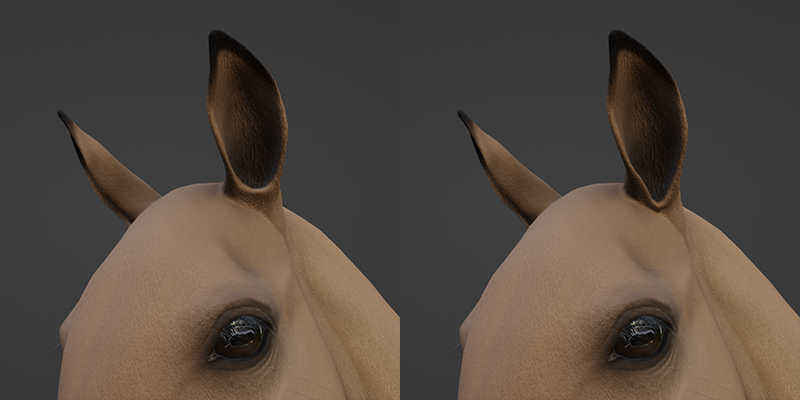
As a final tweak this week, I decided to fix a detail that has been bothering me for some time, but that I was never able to quite put my finger on. After receiving feedback from the team and digging for reference images of hairless horse ears (they are not easy to come by), I was able to change the shape of the ear and make it look more like an actual horse ear. On the left of the picture underneath is the old shape of the ears, while on the right side, you can see the new shape. This small, but major tweak really did change the look of the ear. And they now, at least I think so, they look a lot better.
While I am looking forward to a short summer break, I am definitely excited to get back on July 31st to continue working. We still have another week of development to go before taking a break, but we won't have a devlog for July. Instead, the last week of development before the break will be documented in the work-in-progress channel over at our Discord server, and it will be added to the August devlog once the time comes.
Embarking on the environment everhaul
By Tirna - Project Manager, 3D-artist
Lately, I have been diligently working on another environment for the Early Access version. While this environment style differs from what you initially encountered, it brings us closer to our desired final result. Although it may not reach the same level of realism, these assets serve as excellent placeholders, helping us gain a deeper understanding of what to create and how different elements can harmonize.
Initially, I focused on creating a prototype for the area where your character's property would be located. However, we wanted to explore more freely, the final map remains uncertain, until we have written more of the story, and can learn more about what we need and where we need certain parts to be located. We are prioritizing the technical aspects for now. I conducted several test rounds, which led me to create a new scene. This scene will likely only be available during the early access phase. Our intention is to experiment with various environments, such as open fields, dense forests, and sparser woodlands. Although we plan to incorporate water elements eventually, as it is uncharted territory for me, I have decided to treat it as a separate milestone to avoid making too many mistakes and ruining what we have now.
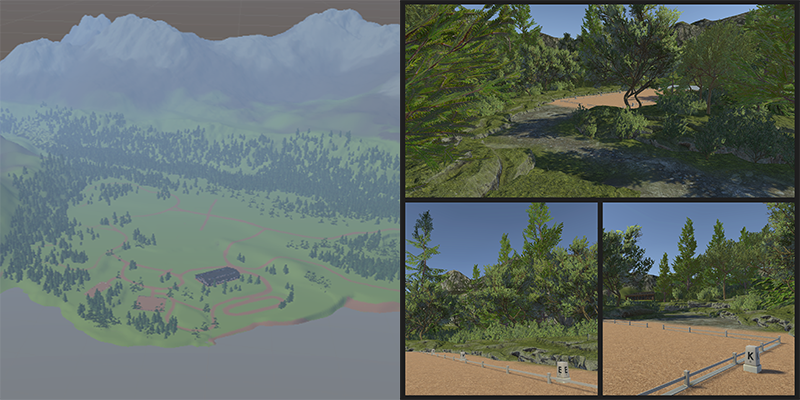
We went through numerous iterations of the terrain for the upcoming environment scene. The pictures displayed above here represent an earlier iteration that we no longer use. However, we may draw inspiration from them at a later stage of development.
Finally, we settled on the terrain we desired for the Early Access version and have been devotedly working on it ever since. This environment offers a diverse range of landscapes, allowing you to enjoy our trail paths or wander freely in open fields. Although this piece of the environment is still a work in progress, I assure you that I am striving to deliver it as quickly as possible while ensuring it remains captivating and inviting.
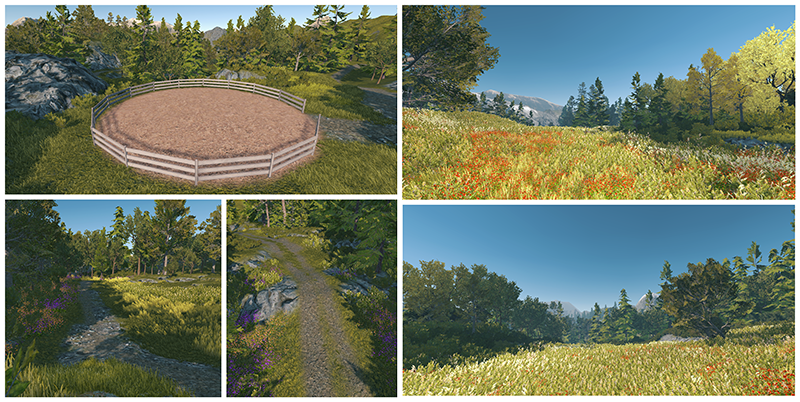
As a last note, the indoor riding arena has undergone substantial optimization, resulting in smoother performance. While a few visual changes have been made, its overall design has remained largely unchanged.
Moving horses, pi problems, and morphing shoulder
By Marius - Animator
While, technically, it was made in May the slow canter finally got an update that I felt was good enough to be implemented to the game. Now this was made during crunch time the week we were meant to launch and normally I would have just had time to do the forwards animation, but while doing an all-nighter (Don’t do them, people!) I managed to make and remake the turning animations for the slow canter unprecedentedly fast and got to implement them into the game for Steam to test.
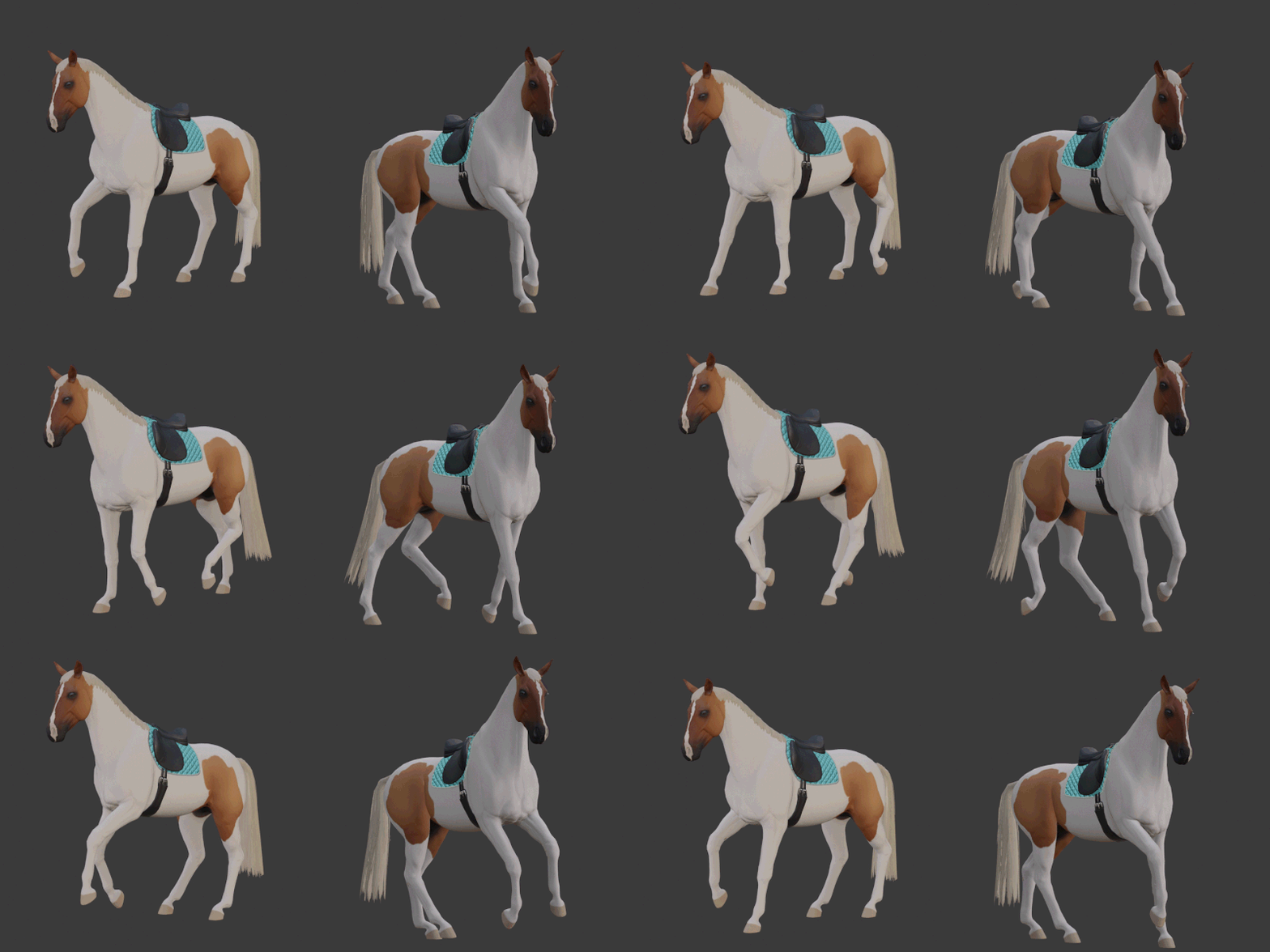
After the early access there was a lot of financial work that prevented me from animating, but as soon as I had time I had a look into what we were missing from movement options. While not every movement option is implemented in the game yet (mainly backing up), I need to have the animations ready before we can add them when we are ready to test it.
There is one problem with the animation I saw that we lacked, it seems to not be a normal movement for a horse. The lacking movement was turning while backing up and when I couldn’t find a satisfying reference, I asked Maja and Mathilde to film their horses doing that movement; the problem is.. they wouldn’t. So I had to get creative.
You could argue that we should not animate the movement that a horse would not want to do, but as a player, you will want to have all the movement options that make sense for you to be able to do; you would feel the missing movement option, so I had to test for things that could work.
The first solution I came to was the easiest one: Just rotate the horse around an axis point and make the feet stick. There was just one problem… Pie, I mean Pi (π). Pi has been a problem for about every turning animation I have made, but with this animation, it was especially bad. The problem with pi is that when I place the hooves, the farther away from the axis it is the more it has to move. This often leads to the closest hooves almost not moving at all and the farthest ones moving too much, and don’t even get me started on hoof rotation! Okay, I’ll start: I try to keep the hoof rotation so that the hoof doesn't slide on the ground the same as with placement, but that can lead to the leg bending weirdly to accommodate for the twist. You can avoid this by letting the hoof slide when appropriate if no other solution presents itself, it is normal to change the angle of the hoof without lifting it in some cases. Though I can’t remove pi from the equation, I can try to mitigate it as much as I can; but in this case, it just would not look good. The banana bend was a little too mechanical and no matter how I slid the hooves it did not look right.
I started the animation anew with another mindset. Instead of having one turning animation where the horse's rotation is constant, I would mix two animations into a longer movement. I chose to take the backing-up animation with the animation for turning while standing still. So while the root motion would be constant the horse would move more step-wise, moving its hips left and right and the body speeding up and slowing down depending on the steps.
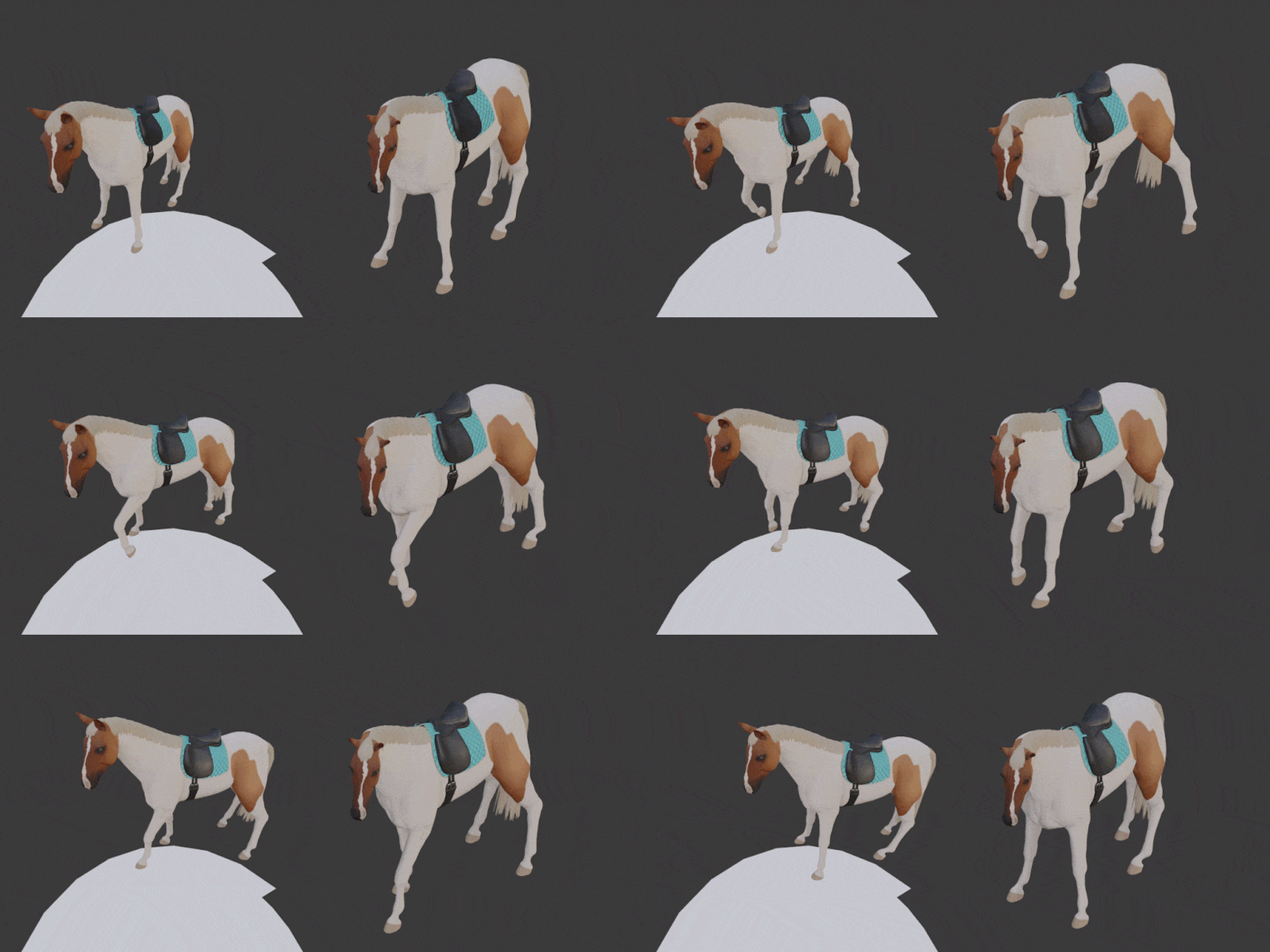
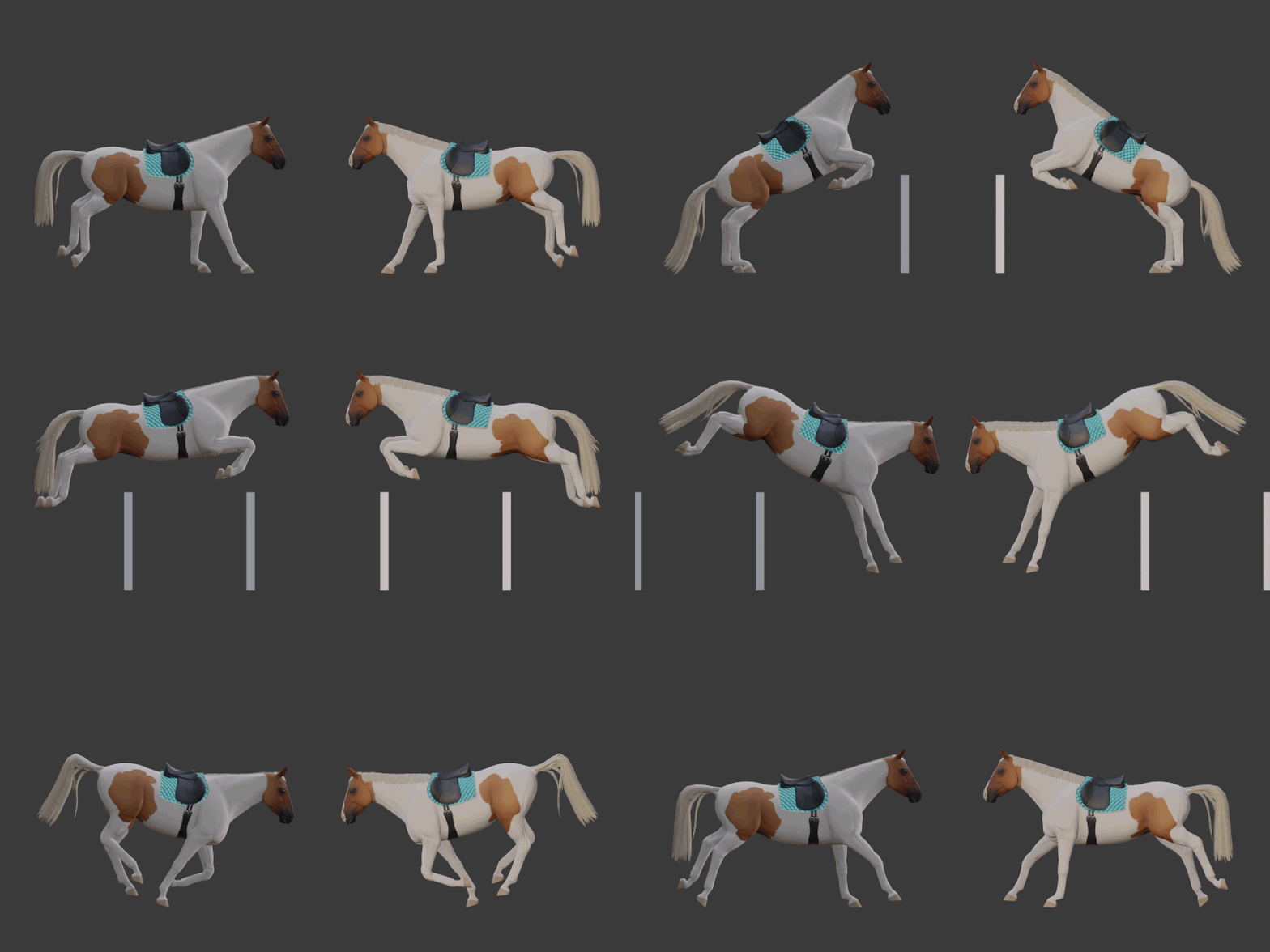
I usually start with the extremes when making animations that are meant to be blended between. This is to ensure that we have access to the whole spectrum of the movement as fast as possible, even if some of the in-between movements may look weird. That is why the current in-game jump is too high, it was made for the highest planned jump height (also the reference I used was riderless so it is a little short in jump length). We saw the need to make a jumping animation that is more in line with our current jumps, especially since we haven't implemented jump blending yet.
This jump is made to be a little lower while also jumping farther and is meant to replace the current jump as the standard. As I have worked with jumping a lot before, there were not many surprises slowing down the work. The biggest surprise was the finding of an exceptionally good reference that I would guess doubled the working speed of the animation. I did have to fix some skinning problems we noticed though, that luckily did not negatively affect any other animation.
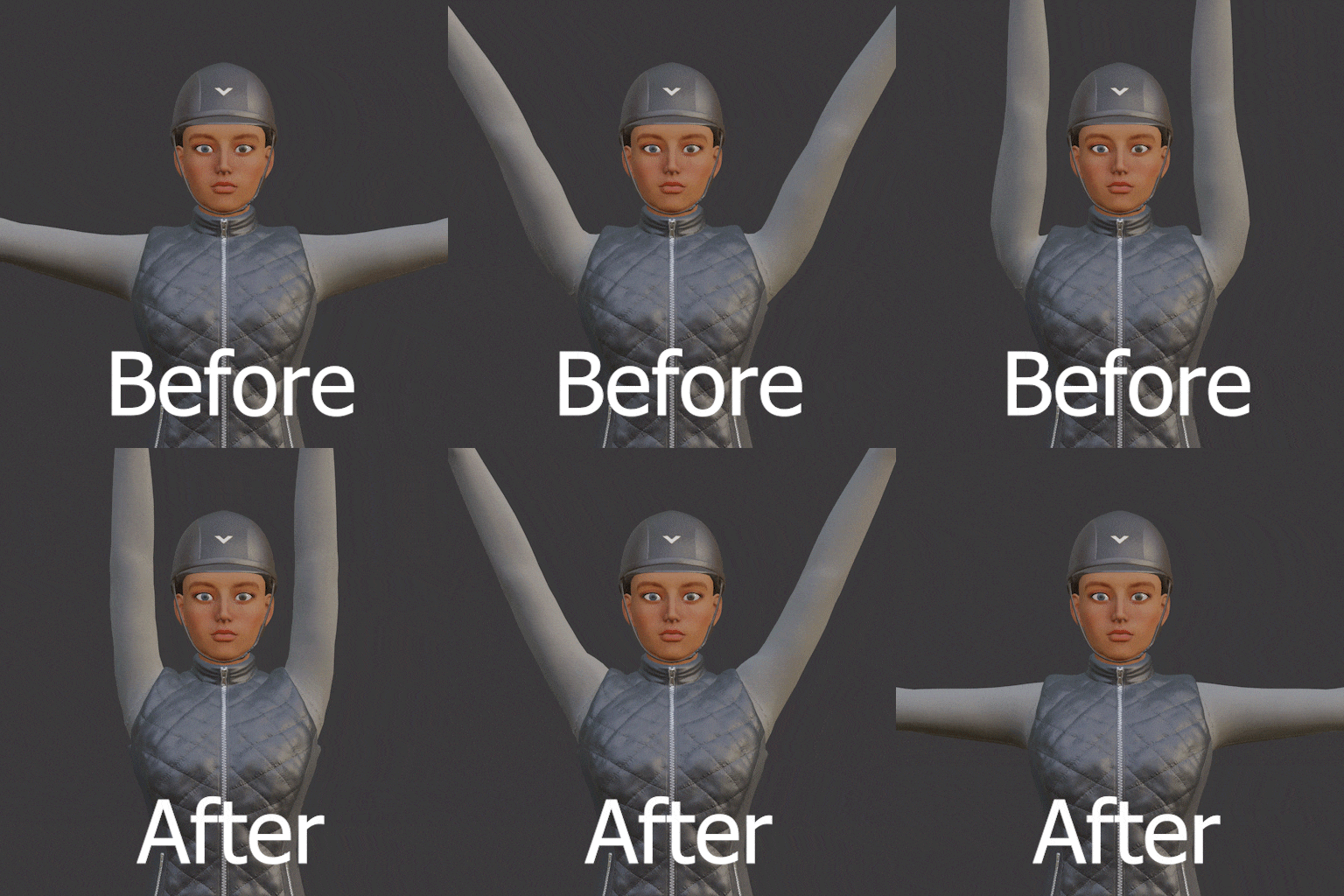
While I am an animator a big part of my job is making the rigs that I use to animate. And while I can rig I would not describe myself as a 3D rigging artist, as there are areas of rigging I almost haven't touched at all, and try to keep my rigs simple. I say that while knowing that gaming rigs should be simple, as the more complicated they are the more processing power they use. The most glaring blind spot for me though is that I have never been confident in blend shaping and avoided it for as long as possible. Though a rig should be as good as possible before starting on corrective blend shapes, the time has come to start making them for the human character.
While diving into corrective blend shaping I found it way more fun to work with than I remember, but I still have to experiment and find what works best. One blend shape is well and good, but when you have to blend between them it gets a little more complicated. I have mostly worked just on the shoulders as of now and will hold off on other places until I have made them blend between each other well, as the shoulders are one of the places with the most movement, making it hard to fix. That said though even if I turned off shoulder movement in this gif to test just the arm deform, it makes a world of difference.
Please be aware that the content featured in these devlogs represents an ongoing work in progress and may be subject to further changes. We are committed to continuously developing and refining our game. To stay informed about the latest updates and connect with the rest of the Astride community, we invite you to join our dedicated Discord server community here! For additional information about Astride, please visit our official website.