
Which was, lets face it, inevitable.
Why volumetric internals in the first place?
Purely accessibility.
Not having to worry about the specifics or play human Tetris inside the vehicle seemed quite appealing.
Once it was up and running, new players struggled to recognize their 3.52m^3 engine doesn't fit inside the 2.63m^3 remaining space. Whereas your engine sticking out the top would register straight away.
What are geometric internals
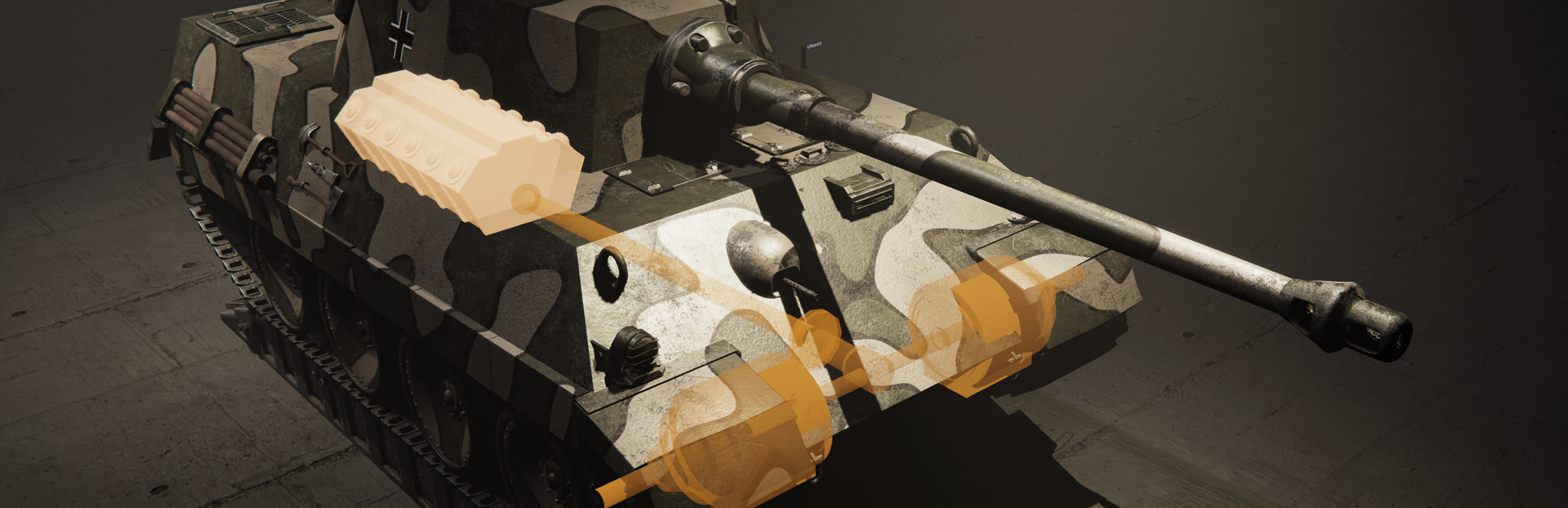
Geometric internals will determine whether the internals fit by checking that none of the internals intersect with one-another, and there are no internals partially outside of the vehicle.
This means getting rid of the big bar at the top.
The current system (volumetric internals) determines whether the internals fit in the vehicle by checking that the sum of every component's used space is less than the space available.
Why the switch?
It's too easy to design perfect tanks - turning Sprocket into more of a tank decorator than a tank designer.
There aren't enough cases of designs having unavoidable flaws because they were designed around a certain feature. I find this a big part of what makes historical designs so interesting.
The volumetric internals model also falls apart with open hulls and turrets (on the tail-end of the roadmap).
It's quite a core game change, so the sooner it's done the easier it will be.
Prototype
V0.12412 brought ammo racks as the first test for geometric internals.
This allowed for a much more accurate damage model, reload times and capacities.
Designs gained another layer of personality. Knowing the locations of your enemy racks allowed for a quick knock-out.
Together with the armour strength changes, this allowed you to effectively hide ammo behind sloped turret cheeks or sponsons and be well defended, letting you take that one extra hit.
The enjoyment of placing these racks of these leaves something to be desired, which I'll be iterating on.
Changed internals
- Crew members will be placed, with a variety of standing/seated/lying positions. Ideally some of these only accessible in certain eras. Setting the space per crew member will be removed, tying efficiency solely to the roles assigned to them.
- Torsion bars will take up space along the floor, generally forcing vehicles using it to be taller. Fuel, ammo, etc can be placed between the torsion bars.
- Spring suspension will take up space along the walls of the hull, generally forcing vehicles using it to be wider. Fuel, ammo, etc can be placed between the springs.
- The engine will be connected to the transmission(s) via a driveshaft. You may have a driveshaft dividing the crew compartment if you want to reap the traction benefits of a front-mounted sprocket wheel (Or an incentive to put the engine in the front). The drive shaft may need to be threaded between the turret basket and the torsion bars, or between the driver's legs.
- Fuel tanks will be placeable and resizable like the current ammo racks.
- The cannon breech will split the turret space in half, requiring more realistic turret widths. Cannons will need enough space behind the breech to load shells, something two-piece ammo can fix. Cannon elevation/depression blocked by other internals.
- An overhaul of turret baskets. Separating the basket from the ring and allowing a degree of control over their shape.
Future changes possible
- Recoil can become a major concern, ensuring there's enough space in the vehicle for the breech to slide back.
- The shape differences between V, inline and radial engines can be simulated.
- A post-penetration replay.
Possible freeform changes
As many of you might know, I'm not happy with freeform. It achieves the desired creative freedom, but it's tricky to use and difficult to get polished to game standards.
Geometric internals open up a possibility to tweak freeform, allowing faces to be placed, moved and deformed as though they were individual steel plates.
Most of the unintuitive/fiddly constraints of freeform were due to the need for a sealed compartment, to calculate the internal space for volumetric internals. These constraints will be able to be removed, allowing for a less constrained freeform.
Plates will become purely there as a way to put steel between your internals and the enemy, as it should be.
These changes fix the existing issues:
- Plates will be able to be split and only affect the split face, removing excess points.
- Inverted faces will be a thing of the past.
- Extrusions/superstructures will be easier, as plates can be dragged and dropped onto the hull before editing, instead of having to be split and extruded from the hull.
- The damage model can be simplified to have no definition of inside and outside.
Generated compartment design can remain exactly the same. All current designs can be converted over perfectly fine.
The Freeform changes will come separately, some time after the geometric internals update, to keep the update's scope reasonable.
UI possibilities
Placeable internals allow much cleaner design interfaces for certain modules.
Namely the crew and designer, which can be changed to clicking and selecting the desired member, only displaying options for the selected them (already demonstrated with placeable ammo racks). This will allow for more depth in crew design, which would cause too much clutter with the current approach.
Accessibility
Initial placement can still be guessed based on the related attached parts (e.g. commander under the attached commander's cupola), only requiring minor adjustments by the player.
The difficulty of internal placement should be quite scalable, since the size of most things can be adjusted when necessary, including the compartments themselves.
This shouldn't dramatically increase build time in the form of tedious building, only increase the amount of time spent thinking about your overall layout (the fun part).
I'd love to hear your thoughts and suggestions on this in the comments. I'm personally very excited for this next step.
- Hamish