
Welcome great nobles,
We would like to thank you for your patience. Today we are back with another Dev Diary in which we will talk about the game economy, like we promised earlier.
Our Discord has already seen some movement, gathering fans, so if you want to discuss with us about Noble’s Life or any other matter, we sincerely welcome you there and appreciate your involvement.
But now, let’s jump into our topic at hand!
How nobles gathered wealth?
Well, it was done differently almost in every other place and time (after all, the Middle Ages spanned at least one thousand years!), but simply put, they had their “subjects” - people that were dependent on them in some way.
In France, it’s a little bit more complicated though, because in the 11th century there was a feudal revolution which resulted in fragmentation of powers, that had existed in many different forms throughout the Hundred Years’ War. This situation gave many possibilities even for low nobles to exploit their people.
That’s why we would like to give the player many options to choose from when dealing with their subjects. Yet, it doesn’t mean there will be only a choice between, loved by the literature from that period, idealistic good lord and merciless, coldhearted tyrant. There are other ways to manage your people, e.g., diverse methods for the subjects to repay their rights to use the land, trade, extract materials and so on.
The basis of that would be handing over part of the fruits of their labor like agricultural products, animals (mostly food) and other goods. Of course there's always room for monetary charges. In addition to that, there is a duty to serve in the subject's noble's army.
The player can enforce their every law, and if they think it's appropriate to the matter at hand, add some more restrictions. They certainly can set new special taxes, custom duties, or regulations, but shouldn't be carried away because everything will have its consequences (about rebellions in the future Dev Diaries, but we’ve already talked a little about it on our Discord server ;) ). On the other hand, the player's noble can invest their gained funds into lowering or even exempt from the taxes, building new facilities, and lending their specialists which, in return, will boost the economic development on their lands.

Charles VI the Mads’ golden Écu. On the obverse there's written Charles by the grace of God king of the Franks, and on the reverse Christ conquers, Christ reigns, Christ commands. In our honest opinion, it is one of the most beautiful coins of that period. Here we present it as our in-game model, these écu will be the basic means of payment. There will surely be English coins, so the player's noble could exchange favors with their occupants. Will there be more models of coins? Well... we will think about it ^^
So how does it work exactly?
To answer this question we will have to explain the basic gameplay loop. For the game needs, we initially assumed that the main timeframe for the resource growth would be a month. The player, after completing their tasks, making all of the decisions, considering the audience, overlooking their manor and many more other activities that they can do in their free time (which won't be necessary), can skip the time to the next turn. The month passes, the world is going its way, the goods and taxes are making their way to the treasury, the recruits gather combat experience, etc., and for the players there are other decisions to make and challenges to conquer.
This solution is necessary for the game, because even if we want it to be as realistic as possible, we want Noble's Life, paraphrasing Hitchcock, to show the life of a noble, from which we've cut out the boring parts. Playing it day by day or slowing the time lapse of those quasi turns will be available for rare fabular occasions or when the danger from the opponents army arises.
Adding to that, the taxes and recruits from the outside of our city walls will need time to actually show up, it's not immediate. The war is underway and the roads aren't always the safest place, so maybe it's advisable to help your tax collector with a bunch of soldiers that will escort him en route. On the other hand, the experienced knight that manages the recruitment program among the peasants, can contribute to boosting your army's value, by choosing the more suitable people for that role. It isn't the only way to use these forces. As we mentioned a few times already - the decisions and multiplitude of options in Noble's Life are vital for finding your own ruling style.
We will probably come back to the topic of the economy many times yet. This Dev Diary is just an introduction to this subject. At the end, I would like to mention that the resources which the player gathers will be able to be kept in check in many different, immersive ways, from the book records, to their own warehouse inspection. That way, everything feels like on the palm of their hand and the player can clearly see if they are almost drowning in resources or if there is only one ripped sack of grain, when the scouts report the approaching of a hostile army.
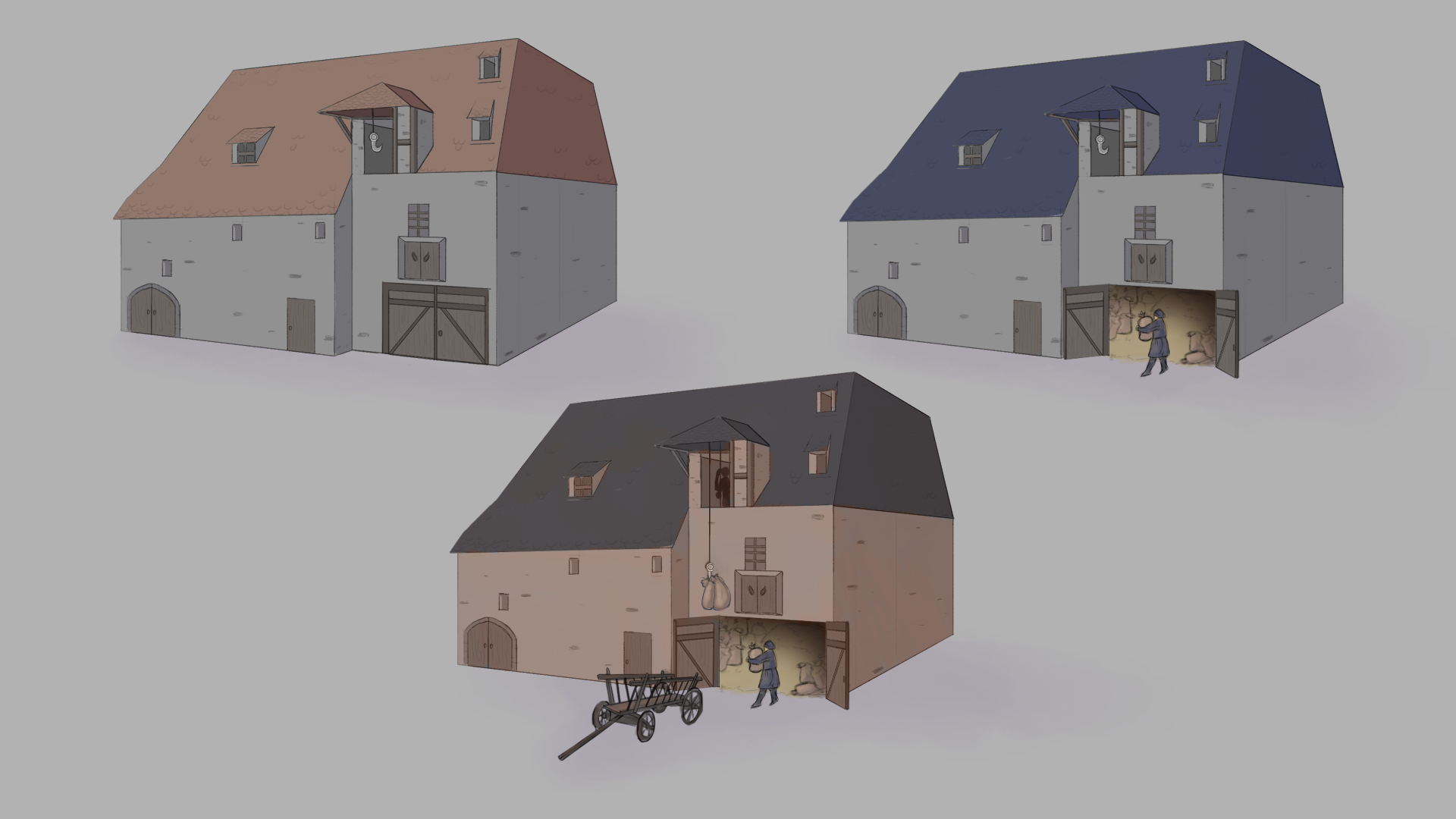
Early concept art of granary. The sufficient food resources are very important, not only when our city is already under the siege, but there's always a chance for the winter to hold longer than anticipated, crop failure or even lack of basic manpower, e.g., when the Black Death is ravaging the lands about which we've wrote two weeks ago (see Dev Diary #1 - Black Death).
Next week we will probably release another Dev Diary, in which we’ll come back to the topic of in-game reality, vampires, satyrs, dances and... cookies! Fear not, we won't change our game into some fantasy world, but there always were many superstitions in every era, so they’ll surely have an impact on the Noble's Life: Kingdom Reborn as well.