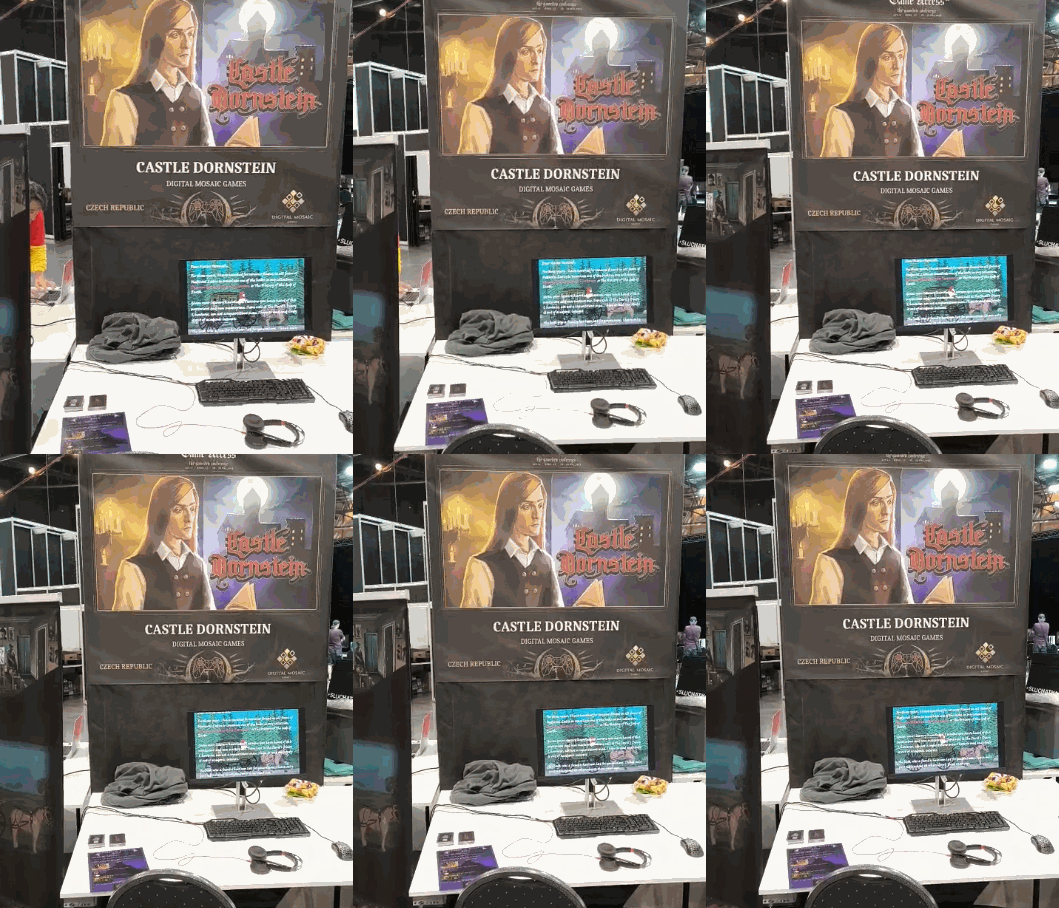
Greetings, adventurers! We've picked up a lot of new followers and wishlists recently, so we thought it would be a good idea to introduce the team.
Digital Mosaic is a five-person, international team who share a passion for game dev and point-and-click games. Hailing from the Czech Republic, Ireland, Italy, and the United States, we've been hard at work collaborating on a game we can't wait to share with you all. But before you step into the castle, let's take a moment and meet the game devs!
David Broček (Art Design, Story)
What was your favorite toy as a kid?
It probably sounds cheesy, but I loved making my own games and toys from paper. I always drew some characters, cut them out with scissors and played with that. Something like very amateur versions of board games.
What game has most inspired your work on Castle Dornstein?
Black Mirror – going to a big mansion/castle is a trope that has been done many times, but I will never stop loving it.
What is a personal touch that you have added to the game?
I would say that my main contribution is giving the game the vibe of a Bohemian story including all the Slavic and Germanic culture. Steve Avigliano then took these blueprints and wrote the most interesting scenarios and characters.
What part of this game’s development are you most proud of so far?
Very corny answer, but I am very proud of my team. Not trying to be wholesome, but it is just incredible how we are able to cooperate and work hard on a game, with everyone being on opposite sides of the world, and fully busy with our adult lives. We managed to create this great project and I am just proud of each one of them.
As for my personal contribution, I think I am proud of the story synopsis I created originally for the game. I believe it is one of my best stories I have ever written, and if I ever had extra time I would love to write this as a full book.
Daragh Carroll (Animation, Art Design)
What got you interested in game art and animation?
I was an extremely artistic kid ever since I was big enough to hold a crayon and I was always obsessed with learning how things were made. I spent hours trawling through DVD extras watching behind the scenes documentaries for movies, TV shows and so on. I was also hopelessly addicted to games from a young age. I think there was a behind the scenes video on the disc for The Lord of the Rings: The Two Towers game for PS2 which made me realise that games don't just spring out of holes in the ground like dwarves. That woke me up to the fact that somebody makes games, and I was hooked.
What is a personal touch you've added to the game?
I think the closeup / POV shots. Scenes where you are looking through Hemlock's eyes. Those often come from a place of deep inspiration. Usually the rest of the guys on the team aren't even expecting them or they are not planned. Like the balcony POV shot teased in our recent trailer. That one just hit me out of the blue.
(You can find the trailer here:)View game page
What tools or software could you not live without when making the game
Anyone who knows me knows I'm an Aseprite ride or die. Every frame of animation you see in Castle Dornstein was painstakingly placed within an Aseprite cel. I love how simple the UI is and there's heaps of great plugins if you go looking. Aseprite is my go-to.
A late development addition to the workflow has been MakhamDev's Pixel Composer. If you're familiar with node-based VFX software, think that but for pixel art. Essentially it's been amazing for handling things like Particle effects (Rain, Snow, Fire) and probably has even more uses I haven't even thought of.
What is a fun fact about you?
I’m a big Star Trek guy, there’s a First Contact poster on my wall, Jean Luc Picard is looming over me as I write this with that disapproving stare. I also have a crippling RuneScape addiction that has definitely contributed to at least 3 months of delay on Castle Dornstein.
Vincent Cortese (Programming)
What was your favorite toy as a kid?
LEGOs, without a doubt. The freedom to build anything from my imagination was my first introduction to creative design. It's not a huge leap from building castles with LEGOs to building Castle Dornstein with code.
What’s the biggest challenge you’ve faced while working on this project?
I think scope management. It's incredibly tempting to add "just one more room" or "one more puzzle," but learning to refine and polish the core experience has been the most important lesson.
What part of this game's development are you most proud of so far?
The puzzle design. We've worked hard to create challenges that feel logical within the world and reward observation.
What tools or software could you not live without when making the game?
A physical notebook and a good pen. There's no substitute for scribbling down ideas, coordinates, drawing maps and connecting plot points by hand.
If you could give one piece of advice to someone who wants to make games, what would it be?
Start small. Your first project should be something you can realistically finish in a month or two, like a simple puzzle or a short story. Finishing a small game is infinitely more valuable than having a folder of half-finished epic RPGs.
Daniel Kobylarz (Music, Audio SFX)
What is a personal touch that you have added to the game?
Aside from voices, music, and SFX, some games will have audio ambiences, and I’ve made many of these for Castle Dornstein so that for example when you are inside the castle, you can hear the walls creak, the wind outside, and other ominous things. It adds a lot of audio immersion and I can’t wait for players to hear them.
What tools or software could you not live without when making the game?
I’ve been using Sonar Cakewalk for audio work for like 15 or so years, so probably that. Although I have broken a pretty big rule in that I'm changing my main software in the middle of the project, as now I'm fully switched over to Cubase. I also have come to love Aseprite for simple artwork – it’s so fun and I love the UI.
What made you become interested in game music?
At first it was just something to do during my summers at the end of high school / college. I went to school for music and I’ve loved videogames since I was a kid so it felt natural! Funny enough I worked on games for years and years before I had one get released; people would drop off and not be serious about it but I was determined. That first actual game release was Kathy Rain, and since then I’ve carved out a nice little spot in point-and-click games for my music.
If you could give one piece of advice to someone who wants to make games, what would it be?
Don’t delay another day, go online on forums / discords and start reaching out to people!
Steven Avigliano (Writing)
What is a fun fact about you?
I performed improv comedy for years. I still tap into those skills when writing scenes. Improv helped me get comfortable with the idea of not knowing what comes next and letting scenes go wherever they want to go.
What are you most excited to share with players?
I can’t wait for players to walk around the village and meet the people of Krkanov. You can drink with the guys in the pub, barter with the old beggar, and get yelled at by the old lady in the market. The village has a lot of personality.
What was the first point-and-click adventure game that you played?
Wishbone and the Amazing Odyssey. Does anyone remember Wishbone? The TV show about the dog that teaches kids about classic literature? The Odyssey game is my first memory of spending hours yelling at the computer screen because I couldn’t solve some puzzle. For years afterward, I kept my handwritten notes about how to beat the final shields-and-axes puzzle because I put so much time into it. It felt like a major accomplishment as a 10-year-old.
Has working on this project taught you something new about yourself as a developer?
You have to be flexible with your ideas. In game development, collaboration is key. Sometimes, a scene that works on paper doesn’t make sense when you add the artwork. A cool puzzle idea might actually break the logic of the game. And so the writing inevitably changes when you start animating and coding. But the changes are always for the best. I’ve learned to write with that in mind.