
Today we're showing off the weapon the player starts with, the Tazer.
Design
The design approach we took for this gun was that we wanted something that was both interesting and still useful once the player had found a few more weapons, and it could be used as a tool for some problem solving in the level.
Gameplay
The main fire mode shoots a jolt of electricity at a fixed range, it does low damage, but has a good fire rate.
The alternative fire mode which is obtained if the player finds the upgrade module allows the gun to charge and hit multiple targets at once. Right now we have the gun hitting up to 4 targets(which can be expanded with an upgrade), and for fun we made it so if the player hits the head on the first target and the subsequent targets also have heads (some enemies in Retchid don't have heads) then we pop them all at once.
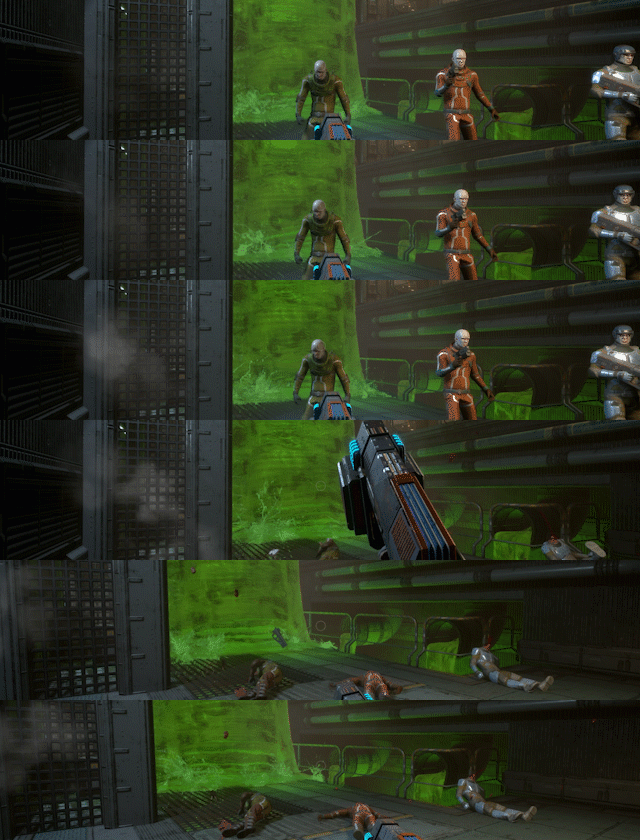
In some areas of the game you'll come across exposed wires, and power boxes. If the player shoots these objects, it'll trigger things like doors that stop shorting out, usually allowing a shortcut back to a previous place or a secret. In the case for the power box, it could be malfunctioning electrifying the water, so when it is shot it'll stop malfunctioning, the water stops being electrified and the player can now safely travel this area.
The player can also shoot puddles of water electrifying it temporarily, creating a shocking experience to any enemy passing through it.
WARNING: Do not shoot while under water.
Technical
Tazer alt-fire can hit multiple target at once. The gist is, you aim at a specific AI and hit it. If there are other AI in the vicinity, there's a chance for the Tazer beam to hit some or all of them at once. There are 3 rules that determine this behavior:
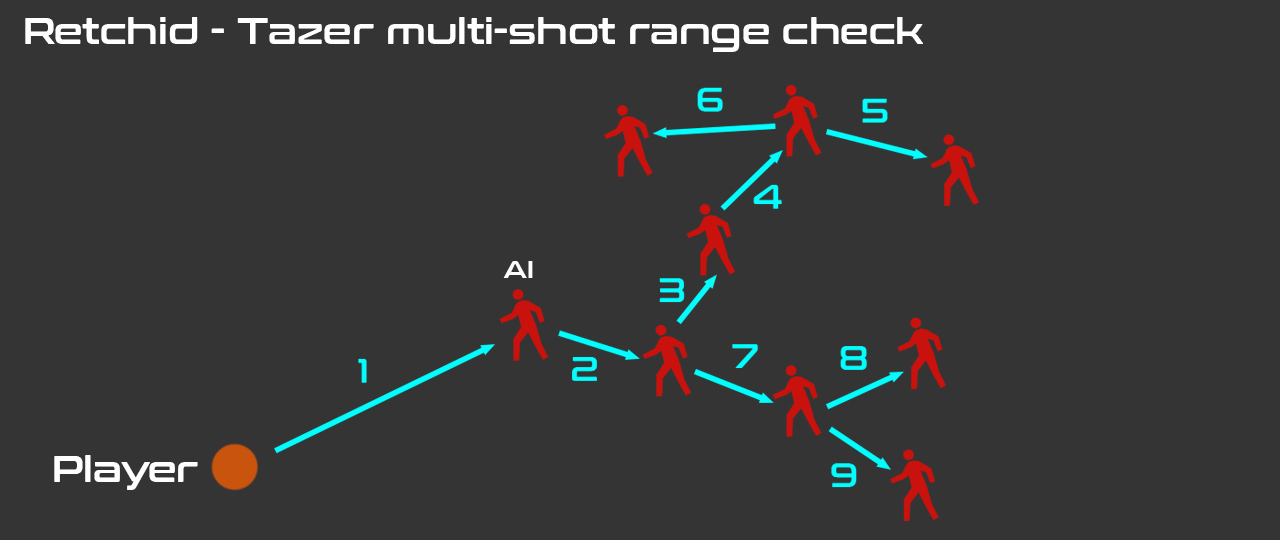
- AI to AI distance: considering that the beam travels from one AI to another AI, the distance from "current" AI to "next" AI has to be within a specific limit
- AI count/charge: the longer you charge the gun, the more AI you can hit
- Beam propagation: once you hit the first AI, the beam will travel following the closest path to the next AI (next AI has to be within a specific distance). Once the beam reaches a "dead end", meaning that there isn't any other AI within the beam distance propagation from the last hit AI, it travels back to the previously hit AI (but won't damage them twice) to check if there other valid paths to AI that are within the beam range. The beam range is always considered from the "current" AI. This will happen recursively as long as you haven't reached the max damaged AI count
Have a good day!
-FBS Team