
We are bringing Animal Wednesday to Steam! Recently we started a weakly series about animals in Zooconomy. So far we showed 3 animals in our social channels, but due to increased amount of work we decided to post about them in one place and just share link to it.
You can check previous animals in our twitter. Today we'll tell you about Northern rockhopper penguin.
Northern rockhopper penguin
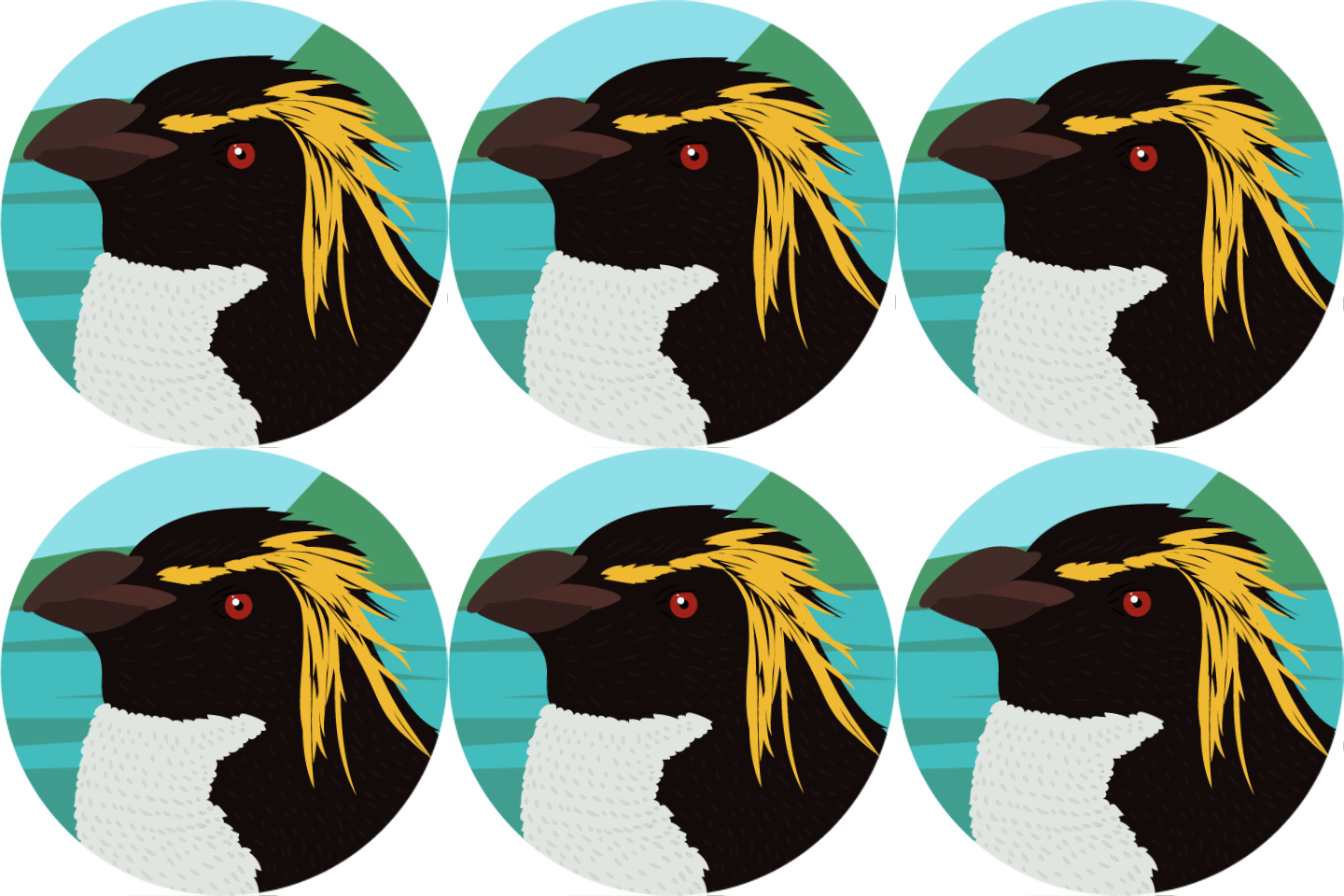
The Rockhopper penguin has yellow crest on its head, consisting of two separate parts and made up of long, thin, yellow feathers, forming eyebrows that stretch behind each eye of the animal. The crest is black on the back of the head. The head, neck, tail, flippers and the upper parts are black, whereas the under parts are white. The legs are short and the feet are webbed, colored in pale pink and equipped with black claws. The underside of their flippers is white and fringed with black. The Rockhopper penguins have red eyes. The beak is thick, colored in pinkish-red to reddish-horn. Chicks of this species are identified by grey head and upper parts and white under parts. Juveniles, on the other hand, exhibit duller bare parts and shorter crest, compared to that of adult penguins. Both sexes look alike, though males are noticeably larger than females, having thicker beaks.
Distribution
Although the area of their distribution depends on species, these birds are usually found in the sub-Antarctic as well as parts of the southern Indian and Pacific Oceans. Breeding areas of the Northern rockhoppers are Amsterdam and St Paul Islands, and islands of Tristan da Cunha. These penguins live on rocky shorelines, nesting and constructing their burrows in tall grasses known as tussocks.
The rockhopper penguin was split into three distinct subspecies in 1992; the southern, eastern and northern rockhopper penguin. The three subspecies are distinguished by differences in the length of the tassels of the crests, the size and colour of the fleshy margin of the gape, colour pattern on the underside of the flipper and differences in the size of the supercilliary stripe in front of the eye. Additionally, the northern rockhopper penguin is larger than the other two subspecies.
The current population is estimated to be between 100,000–499,999 breeding pairs at Gough Island, 18,000 to 27,000 pairs at Inaccessible Island, and 3,200 to 4,500 at Tristan da Cunha. In the Indian Ocean, the population was 25,500 pairs on Amsterdam Island, and 9,000 pairs on St Paul Island in 1993; there has been no information available on population trends there since the 1990s.
The northern rockhopper penguin is classified as endangered because of the decline in numbers over the last three generations (or 30 years).
That's it for today. See you all next time.
Join our Discord channel
Follow us in Twitter
Follow us in VK