
This time we climb higher to meet the largest eagle living in the northern hemisphere - the Golden Eagle.
Golden Eagle
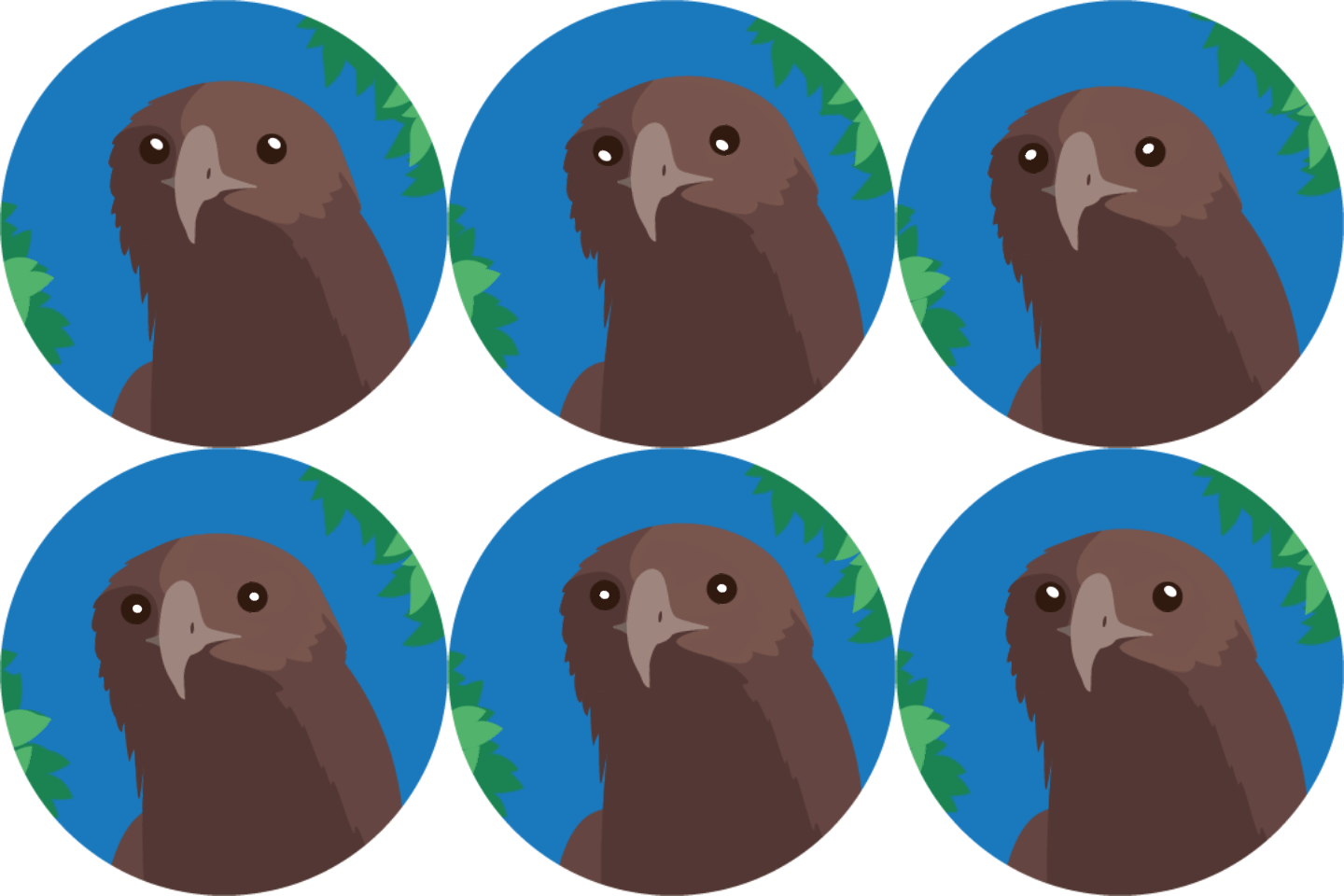
The golden eagle is a very large raptor, 66 to 102 centimetres (26 to 40 in) in length. Its wings are broad and the wingspan is 1.8 to 2.34 metres (5 ft 11 in to 7 ft 8 in). Golden eagles' wingspan is the fifth largest among living eagle species. Adults of both sexes have similar plumage and are primarily dark brown, with some grey on the inner wing and tail, and a paler, typically golden colour on the back of the crown and nape that gives the species its common name. Unlike other Aquila species, where the tarsal feathers are typically similar in colour to the rest of the plumage, the tarsal feathers of golden eagles tend to be paler, ranging from light golden to white. In addition, some full-grown birds (especially in North America) have white "epaulettes" on the upper part of each scapular feather tract. The bill is dark at the tip, fading to a lighter horn colour, with a yellow cere. Like many accipitrids, the bare portion of the feet is yellow.
Golden eagles are sometimes considered the best fliers among eagles and perhaps among all raptorial birds. They are equipped with broad, long wings with somewhat finger-like indentations on the tips of the wing. Golden eagles are unique among their genus in that they often fly in a slight dihedral, which means the wings are often held in a slight, upturned V-shape. When they need to flap, golden eagles appear at their most laboured, but this is less common than soaring or gliding. Flapping flight usually consists of 6–8 deep wing-beats, interspersed with 2–3 second glides. While soaring, the wings and tail are held in one plane with the primary tips often spread. A typical, unhurried soaring speed in golden eagles is around 45–52 kilometres per hour (28–32 mph). When hunting or displaying, the golden eagle can glide very fast, reaching speeds of up to 190 kilometres per hour (120 mph). When stooping (diving) in the direction of prey or during territorial displays, the eagle holds its legs up against its tail, and holds its wings tight and partially closed against its body. When diving after prey, a golden eagle can reach 240 to 320 kilometres per hour (150 to 200 mph). Although less agile and manoeuvrable, the golden eagle is apparently quite the equal and possibly even the superior of the peregrine falcon's stooping and gliding speeds. Although most flight in golden eagles has a clear purpose (e.g., territoriality, hunting), some flights, such as those by solitary birds or between well-established breeding pairs, seem to be play.
Distribution
Golden eagles are fairly adaptable in habitat but often reside in areas with a few shared ecological characteristics. They are best suited to hunting in open or semi-open areas and search them out year-around. Native vegetation seems to be attractive to them and they typically avoid developed areas of any type from urban to agricultural as well as heavily forested regions. In desolate areas (e.g., the southern Yukon), they can occur regularly at roadkills and garbage dumps. The largest numbers of golden eagles are found in mountainous regions today, with many eagles doing a majority of their hunting and nesting on rock formations. However, they are not solely tied to high elevations and can breed in lowlands if the local habitats are suitable. Below are more detailed description of habitats occupied by golden eagles in both continents where they occur.
The species is distributed over a vast territory, covering Eurasia, northern Africa and North America. These birds range from Alaska to central regions of Mexico through most of western North America. In addition, they can occasionally be found in small numbers throughout eastern Canada, and there are scattered pairs, living in the eastern United States.
In the Arctic fringe of Eurasia, golden eagles occur along the edge of the tundra and the taiga from the Kola peninsula to Anadyr in eastern Siberia, nesting in forests and hunting over nearby arctic heathland. Typical vegetation is stunted, fragmented larch woodland merging into low birch-willow scrub and various heathland. In the rocky, wet, windy maritime climate of Scotland, Ireland, and western Scandinavia, the golden eagle dwells in mountains. These areas include upland grasslands, blanket bog, and sub-Arctic heaths but also fragmented woodland and woodland edge, including boreal forests. In Western Europe, golden eagle habitat is dominated by open, rough grassland, heath and bogs, and rocky ridges, spurs, crags, scree, slopes and grand plateaux. In Sweden, Finland, the Baltic States, Belarus and almost the entire distribution in Russia all the way to the Pacific Ocean, golden eagles occur sparsely in lowland taiga forest.
Conservation
At one time, the golden eagle lived in a great majority of temperate Europe, North Asia, North America, North Africa, and Japan. Although widespread and quite secure in some areas, in many parts of the range golden eagles have experienced sharp population declines and have even been extirpated from some areas. The number of golden eagles from around the range is estimated to be between 170,000 and 250,000 while the estimates of breeding pairs are from 60,000 to 100,000. It has the largest known range of any member of its family, with a range estimated at about 140 million square kilometers.
If its taxonomic order is considered, it is the second most wide-ranging species after only the osprey (Pandion haliaetus). Few other eagle species are as numerous, though some species like tawny eagle, wedge-tailed eagle and bald eagle have total estimated populations of a similar size to the golden eagle's despite their more restricted distributions. The world's most populous eagle may be the African fish eagle, which has a stable total population estimated at 300,000 and is found solely in Africa. On a global scale, the golden eagle is not considered threatened by the IUCN and have status as Least Concern.
That's it for today. See you all next time.
Join our Discord channel
Follow us in Twitter
Follow us in VK