
Hello and welcome to this second devblog (and fifth in total) on old concepts and ideas !
We will review a version of Palallel that is pretty close to what we have today (or at least much closer than the first concept we saw in the first devblog) and another variant.
First concept
In this first concept, the player’s progression is a bit special. We wanted to make a logical structure for levels that would oblige players to exchange in various ways. The game is split into ”worlds” (we use that term to designate all levels that follow each other). Each player has its own path across multiple levels in the world. I will show you an example where the structure is in a spiral in order to make use of all borders of the screen.
Here is how players will progress in the world (on the next pictures, 1 cell = 1 level) :
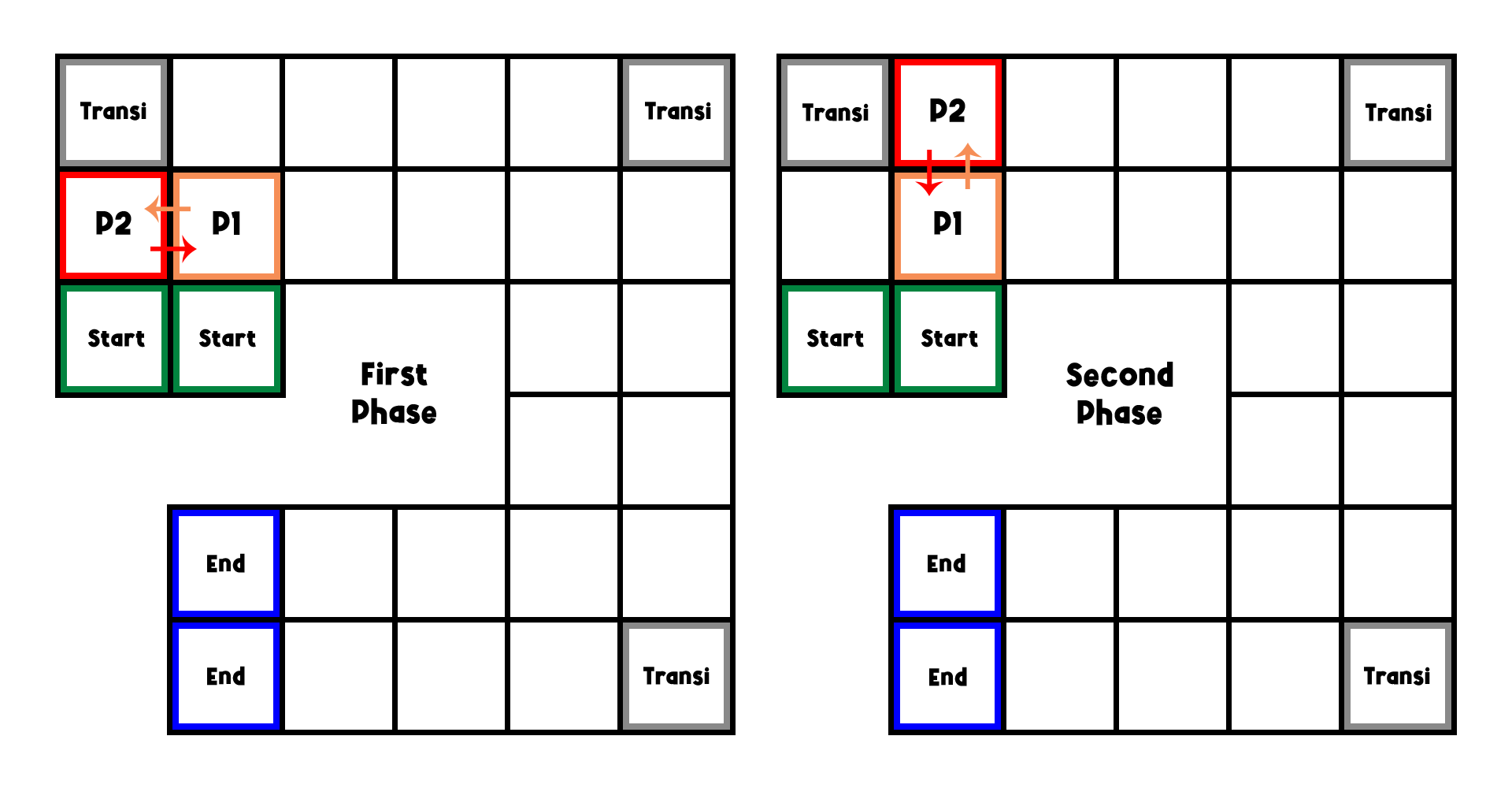
First phase : Each player comes out from their respective start (green cell) and steps into a level where they can exchange with the other player (red & orange) by sending objects on the border of the screen. They need to complete a puzzle to access the next level.
Once the level is complete, player n°2 (red) will enter a transition level (grey) that will lead him to the second phase.
Second phase : Player n°2 will reach the third level where he will need this time to exchange with the other player on the bottom of his screen.
Player n°1 will stay at the same level but this time, he will exchange with his partner on the top of his screen. With the help of his partner, player n°1 will access his second level after a puzzle. The same goes for player n°2 that will access his fourth level.
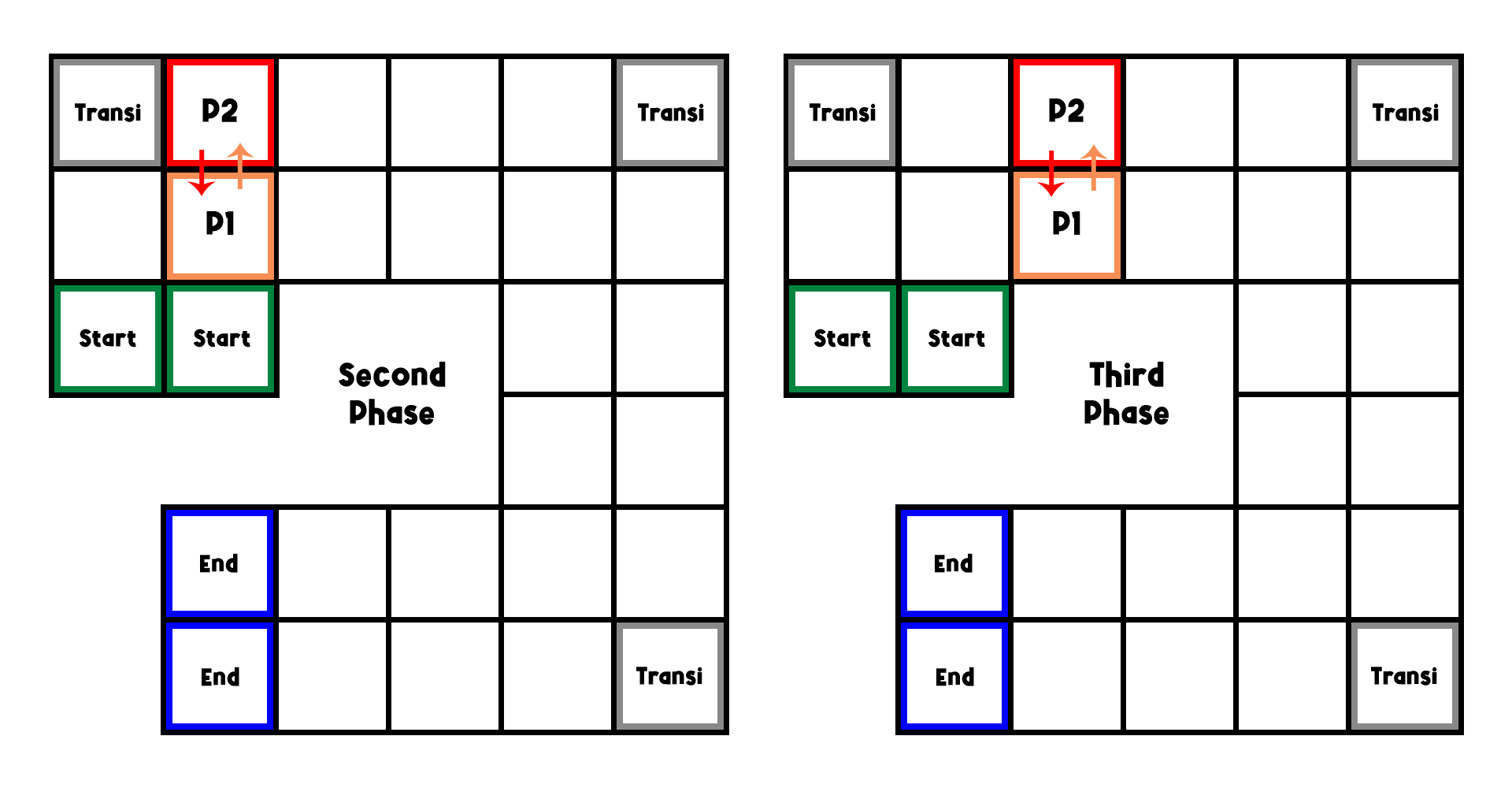
Third phase : Each player will pass through a succession of multiple classic levels without transition. They will only exchange up & down. Each level will feature a different puzzle.
Once these levels are complete, they will reach another transition level that will switch the side from where the player can exchange from vertical to horizontal.
What seemed interesting is this idea was the fact that it allowed us to bind levels together in one big group. This would have helped us split the game into separate parts in which players can experiment with multiple mechanics in depth. The benefit of splitting mechanics into separate parts is to create a smooth progression curve for players. I could extend on this subject a lot but I think the learning curve in a puzzle game (and in Palallel in particular) deserves his own devblog.
We choose to move this concept aside for three main reasons :
- The game would most certainly feel repetitive and dull as the way of progressing through levels can’t really change (sequence of levels, transition, sequence of levels, transition, ...).
- The amount of work required to creating logical worlds like this is quite big and as our team is composed only of 3 people, it seemed too complex.
- Finally, we would have a hard time creating variety in puzzles when the exchange mechanic is only in one way.
Variant
We will now move on quickly to the next variation that looked promising but unrealizable. This idea comes from a Canadian horror movie named “Cube”. In this movie, the characters wake up in an enormous complex filled with square rooms link with each other. Each room contains a ‘potentially’ deadly trap.
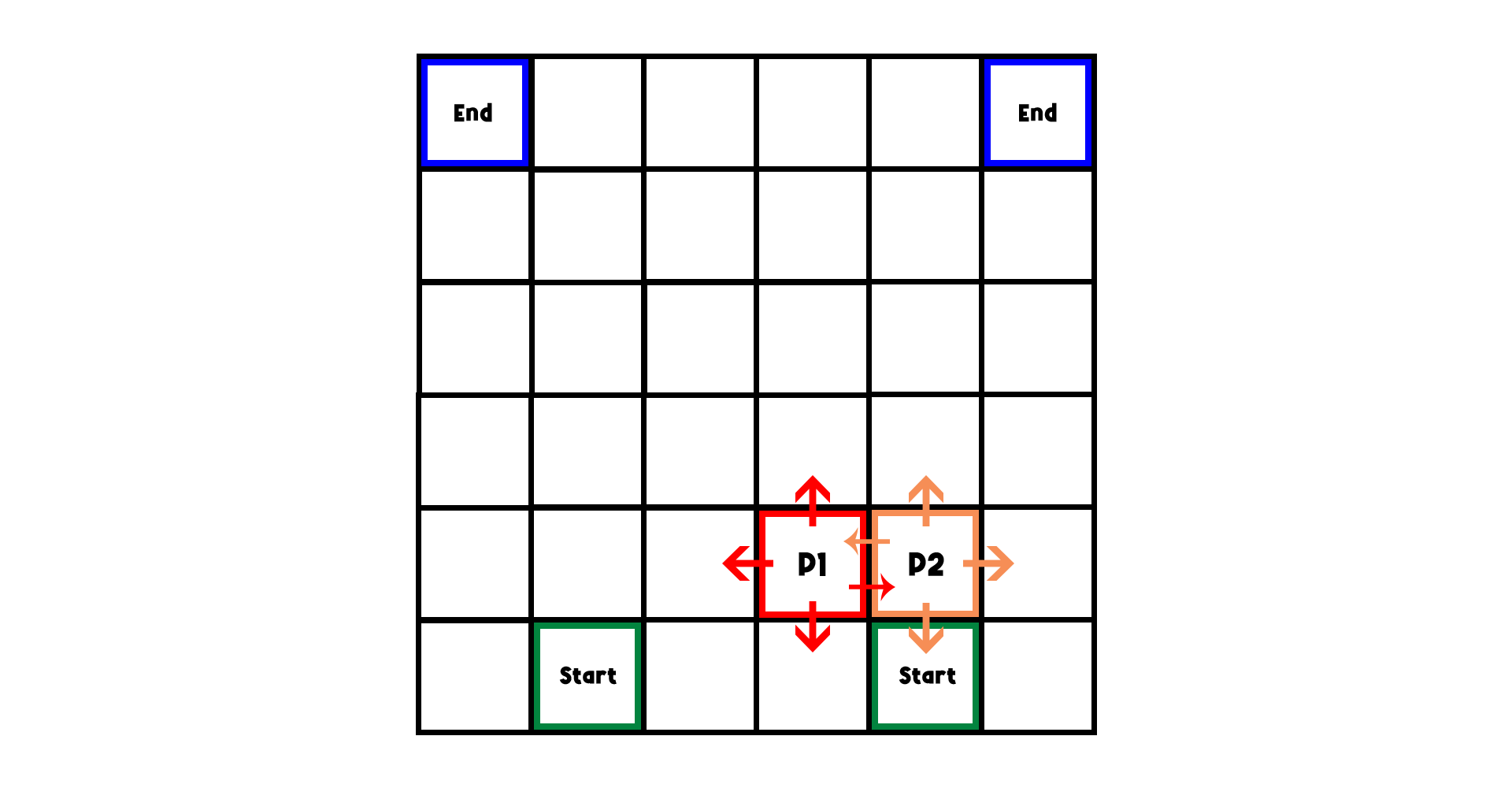
This concept is keeping the idea with a grid of levels linked with each other. Each player has a starting cell (green) and he can moves from cell to cell as long as the other player isn’t on the cell he wants to go to.
Some cells are unreachable by default but can be unlocked with the help of the other player by activating mechanisms (buttons, pressure plates, ...). A mechanism can be linked with any cell of the grid.
One player may need his partner to activate a mechanism located two cells from where he stands in order to unlock the access of another unexplored room.
The goal for the players is to reach their respective end cells (in blue) at the same time.
This version would have allowed us to create many complex puzzles and many intriguing mechanisms that could affect one or more rooms at the same time. There are many possibilities and unlike the first concept I showed above, repetitiveness wouldn’t be present as the “grid” could take any shape (long hallway of 2/3 cells, a diagonal, ...).
However, like the first concept, this would require a huge amount of work to balance such a game. You would need to create a “path” among rooms that players need to follow to reach their goals but you also need to make sure that they can’t bypass this path and cut through 90% of the content with a poorly calibrated level design.
It has been decided to keep levels independent from one another in order to keep the level creation simple and to keep certain freedom with the exchange between players. If levels aren’t linked, players can exchange from anywhere (left & right, up & down).
That concludes our fifth devblog on discarded concepts and ideas. I hoped you found something interesting there. We are currently planning some playtests in the coming days to evaluate some heavy modifications of the game. If the results are conclusive, we will have a lot to show you soon.
Have a nice Sunday,
Corentin PB