
Hello everyone and welcome to this first devblog ːpraisesunː
We’ll start this weekly series by talking about some directions we considered at the start of the project and with it, the choices we made, and the options we dismissed.
Allow me to introduce to you one of the original concepts of the game :
Before 'Palallel', something called ‘Coop Platformer Split Screen’ happened. This idea was about a platform coop game in 2D as the title suggests (didn’t see that coming) where you cannot see the other player. The selling point of this game was a mechanic used to exchange objects between the players. Objects were sharable from one player to another by sending them to the edge of the screen.
The exchange mechanic has a bit evolved since then but before we dive into this mechanic, let’s talk about what the game feels like. The ‘platform’ aspect of the game was much more important. On the contrary, the ‘puzzle’ part of the game was almost inexistent to give way to an action-packed cooperative experience. We chose a scrolling asymmetric camera that could only go up and down. Here is an example (I know it’s ugly, i'm sorry ːisaacː) :
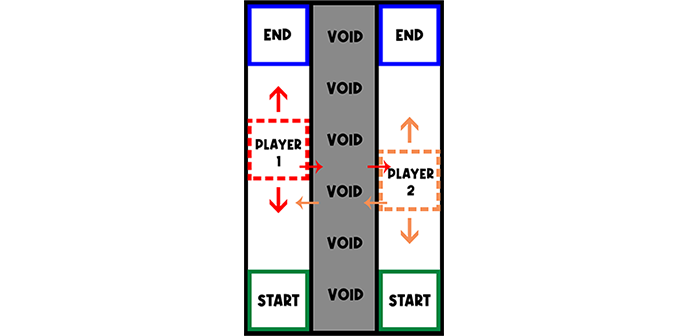
Players begin in their start area (in green) and must reach their respective end area (in blue).
The two dotted zones on the center are the player’s cameras. A camera can travel vertically by following the character’s movement. Players can backtrack to the beginning or go up to the end of the level as they wish.
The path of each player is filled with obstacles that will slow down your progression to the top. These obstacles will require a lot of communication and sync from both players to be overcome.
To cooperate, players will have to exchange objects (red and orange arrows that pass through the void) by sending them to the edge of their where the other player is located. The object will be received on the opposite side of the other player’s screen at the same height it was sent.
Even though we find some similarities between this concept and Palallel like the fact that the players can’t see each other or the exchange mechanic, the game’s direction has shifted a lot. The question is: why ?
Three main reasons :
- The platformer part was interesting to develop and to play but seemed (for us at least) to restrain the number of different mechanics. Besides, the exchange system wasn’t a good fit for a pure platform game in our eyes. This mechanic had more potential in a puzzle game environment. That’s why we chose this path, without totally excluding the platform part.
- In this original concept, we wanted players to have a feeling of vertical progress by cooperating throughout the climb. Later we decided to extend the exchange mechanic to all edges of the screen and no longer restrict the exchange to a single edge. But this change would have been hard to implement and make logical with a moving camera and the vertical level layouts (more details down below). Furthermore, the fact that the objects were sent to a fixed height has upsides and downsides. On one side, it makes the players think carefully about when they need to exchange objects and when and on the other side, this can lead to a frustrating experience filled with backtracks. As a whole, we simplified this mechanic by adjusting the level design to exploit it the best we could.
- An overhaul of the level design has been made, we went for smaller, closed, levels and a fixed camera to focus more on the puzzle-game aspect and less on the platform one. This comes with a lot of benefits like resources saving on servers, giving players a clean and easy-to-understand setting, a more manageable level design, ... This will be discussed a lot more in further devblogs about the networking and the different mechanics of the game.
Of course, this led us to rule out many interesting ideas. However, we won a lot more on many aspects already discussed in the three previous points.
Finally, I would like to address something: All the things we excluded from our current project Palallel aren’t completely out of the picture. The game is still in development and a concept may reappear in one form or another.
Thank you for spending time to read this devblog, I hope you found it somewhat interesting. We will see you very soon on Saturday or Sunday on another subject. Feel free to give suggestions about what you would like to see on future devblogs. Think about adding the game to your wishlist, it helps us a lot.
See you soon,
-- CorentinPB