
Most honorable Knights,
in this update, I'll talk about combat. But first, I want to thank everyone who wishlisted the game after hearing about it at this year's GamesCom... it was quite a few people, which made this great event even better.
Here Frazer from MicroProse and I are chatting about news on the game:View game page
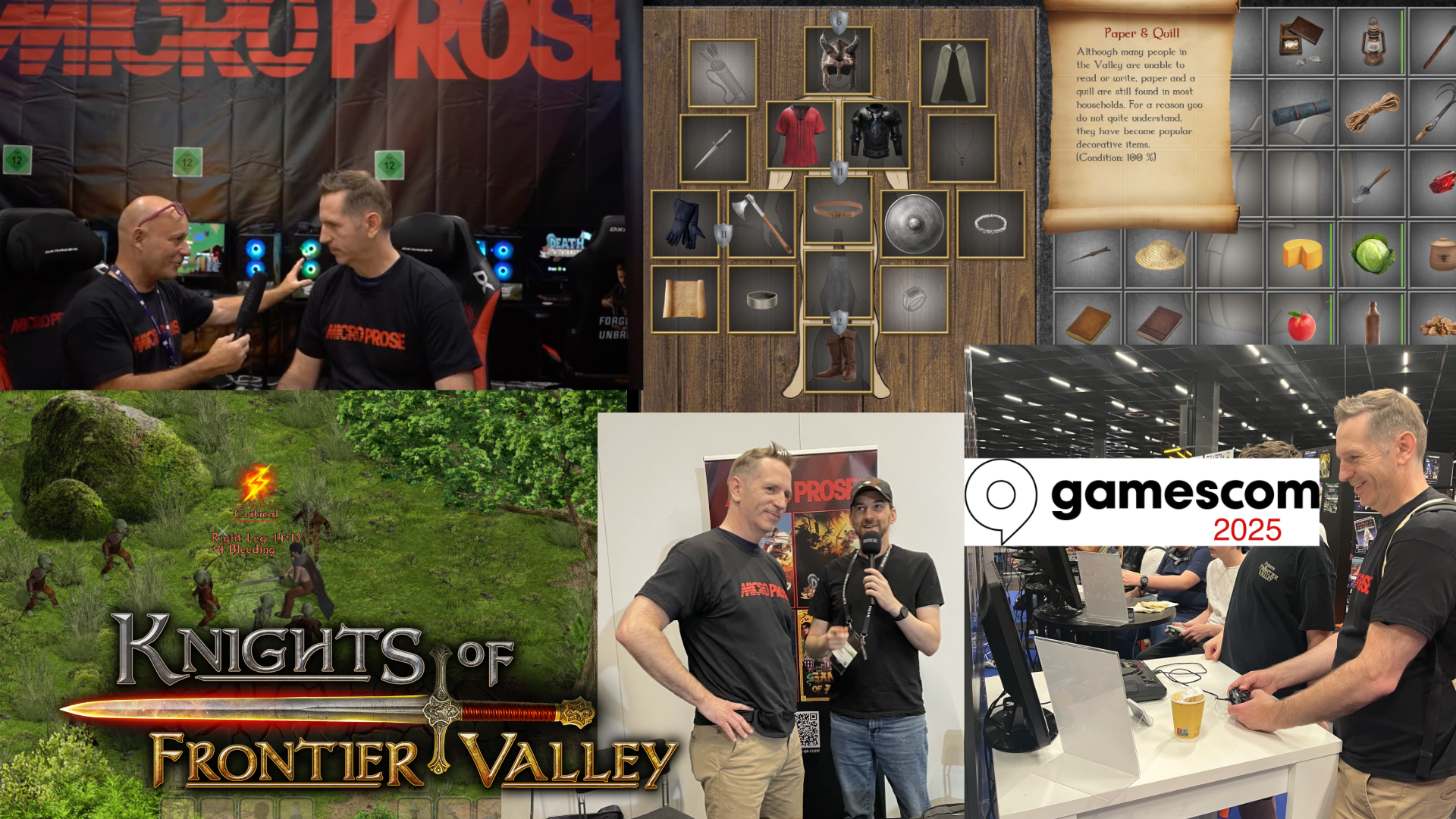
There's also a 60-second pitch recorded at GamesCom by German influencer Dr. Proof (in German), and
another great clip about KoFV, also by him (and also in German).
GamesCom is now over, but as they say, "after the event is before the event". The Comic & Games festival is coming up in Lucca, Italy in October - hope to meet you there.
Now on to combat!
Quick vs Tactical combat
While characters like mages and thieves might frequently try to avoid a direct confrontation, it will be hard to not ever get involved in combat. And that is just fine, since tactical combat is one of the key features of Knights of Frontier Valley! In fact, combat happens often, and it is a major source of loot and experience.
When a battle starts, you are given a choice: do you want it to be resolved automatically ("Quick Combat"), or would you prefer to control all your character's actions in tactical combat?
During Quick Combat, a real battle takes place where the computer controls both sides. It runs much faster than tactical combat, though the speed can be adjusted.
While a battle is ongoing, the remaining combatants, the PC's injuries, and the power balance are updating in realtime. When things get ugly, you may try to run away. That is, if you still can... your chances of escaping will lower with any sustained leg injury and when the number of friendly combatants goes down. So if things turn out to not go in your favor, do not wait too long!
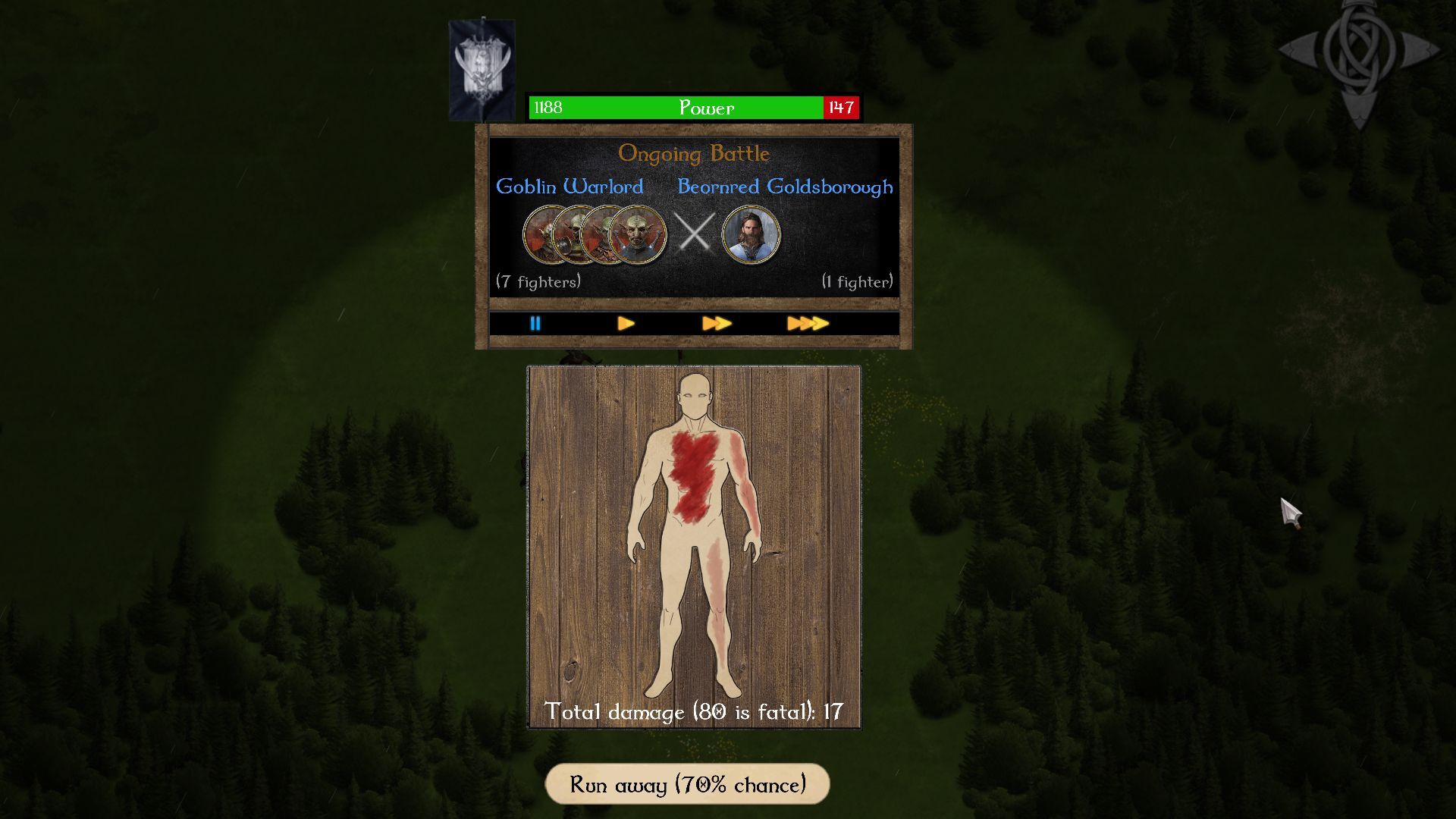 Too many goblins for brave but inexperienced Beornred. If he fails to escape, they won't show mercy
Using Quick Combat is best when you will likely win the battle. For tougher ones, it is advisable to take matters in your own hands via tactical combat.
Combat rounds, action points, and initiative
Tactical combat is turn-based and plays out in rounds. Combatants start each new round with 10 action points (AP) which can be used towards moving, turning, attacking, casting spells, interacting with objects in the environment, or using items from the inventory. If a character ends his round with any remaining AP, the leftover points will automatically improve the defense.
After a character completes one action, the next actor is determined, which is the one with the highest initiative value. That value is a combination of the character's reaction attribute, their remaining AP, and a dice roll that occurs at the beginning of the round. When characters act, they spend some of their AP which automatically lowers their initiative ranking, so most likely another character gets to act next.
Characters may act several times during one round until they have no AP left. When all characters have used their AP (or decided to end acting for this round), a new round begins.
Action sectors and attack range
Characters can only attack enemies within their "action sectors". Those sectors represent a character's field of view and attack range - each sector covers an area of 45 degrees, and usually, there are three of them shown, totalling to a an actionable area of 135 degrees in front of the character.
When the field of view is limited, for example when wearing a heaume (a full helmet with only a small opening for the eyes), fewer action sectors are available to operate in - in this case, only one. On the other hand, characters who learned the "Intuitive vision" perk have a wider action area.
So action sectors each cover an area of 45 degrees sideways, but how far the cone extends outwards depends on the attack range of the equipped weapon. When using a ranged weapon, the action sectors become very long 45-degree cones, while characters fighting with their bare hands will have to get very close to their enemies in order to attack them.
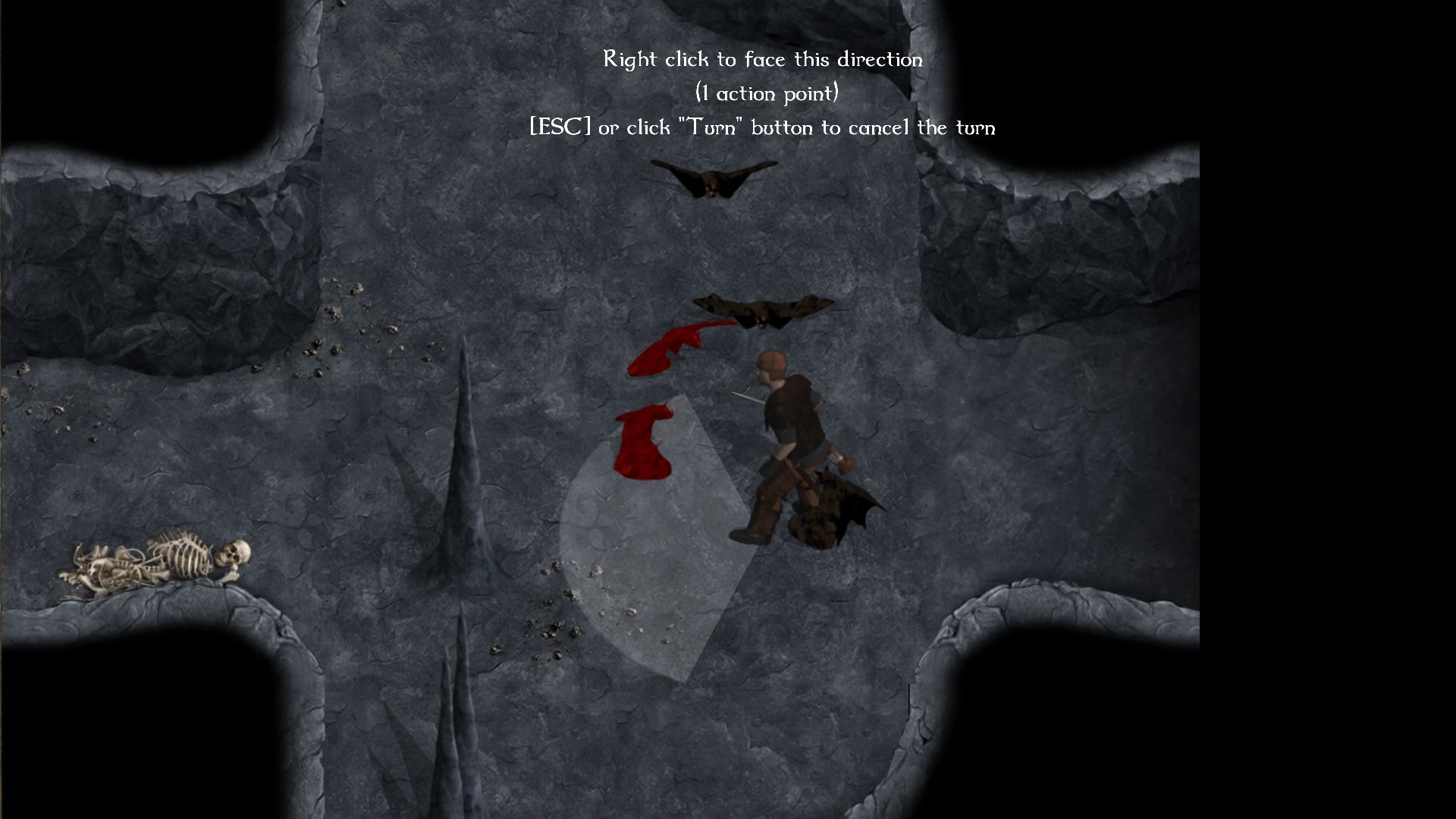 Given the direction this character is facing, he can attack two of the vampire bats around him
Attacking and defending
Many factors go into the evaluation whether an attack is successful or not. Weapon skill, dexterity, encumbrance, light conditions, the difference in size category between attacker and defender, the defender's leftover AP, and a dice roll come into play to determine whether the attack went into the right direction and might be a hit.
If so, the target might still be able to evade (using the reaction attribute, evasion skill, and a dice roll) or block with a shield (shield skill).
If the attack dice roll result greatly exceeds the defending one, the attack is considered a "masterful strike' and will be very hard to evade or block.
Evading or blocking is not possible against surprise attacks.
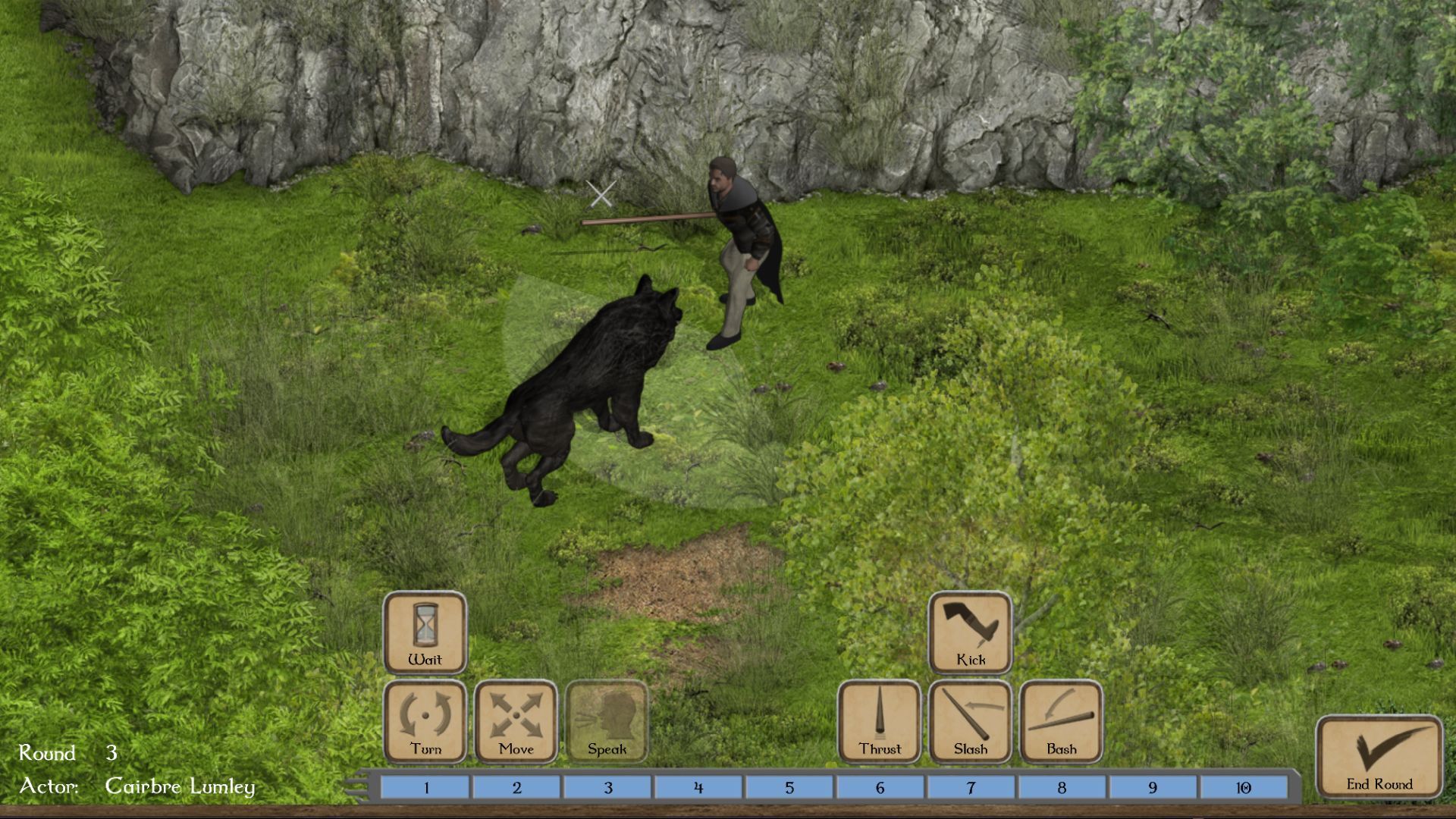 This character can use his staff for various attacks against the hellhound, each targeting different areas. The number under each attack button indicates how many AP it will cost: thrust forward = 6 AP, slash sideways = 7 AP, and bash downwards = 8 AP. The character is also close enough to do a kick (7 AP).
Damage, body parts, bleeding, and death
If an attack goes through, damage is determined by the weapon's damage rating plus a dice roll (and for melee attacks, also the attacker's strength), and then gets reduced by the target's armor rating at the affected body part. With the "Gap stabber' perk, a sneaky attacker may target small gaps where pieces of plate armor connect, bypassing it completely on success.
If a hit causes a large amount of damage, it is considered a crtitical hit and might cause additional effects - the target might get stunned, disarmed, or suffer from something else nasty.
Damage is counted for each body part separately. For humanoid characters those body parts are the head, the torso, each arm, and each leg. Non-humanoid charactes have other body parts like wings or hind legs.
A body part can only take so much damage before it becomes "crippled' and stops functioning. If your arm has sustained maximum damage, you will not be able to hold a weapon or a shield. Badly injured legs prevent you from running, kicking, or (if both are crippled) moving at all.
Damage comes in the form of tissue and bone damage. Tissue damage heals much faster than bone damage, but might cause bleeding or an infection.
Bleeding is dangerous - until the bleeding is stopped by applying a bandage or through other means, your blood loss will continuously increase, weakening you until you bleed to death. Bleeding also heals naturally while tissue damage heals, but it is a slow process and you might not survive for long enough to see it complete.
In rare occasions, single hits causing high damage against the head or torso can be instantly fatal - think of brain damage or a stab to the heart! Just like it was in medieval times, it is critically important to protect your vital organs.
When a character takes too much combined damage across all body parts, it is time to say good-bye (death). The maximum damage a character can survive may vary between different types of characters - for most humans, it is 80 points (this value can losely be considered as "Hit Points").
A high endurance attribute value increases the maximum damage that can be sustained before dying.
Moving and turning
Tactical combat is "gridless", meaning characters can be positioned accurately anywhere and are not limited to hopping from cell to cell in a grid.
How far you can move depends on your remaining AP - traveling one "distance unit" (roughly three yards/meters) costs two AP. There are two ways of moving your character:
1) When accurate positioning is not necessary (like when you are just trying to get away from an enemy), a double-click at the destination point on the map will move your character to that spot (or as far as your remaining AP allow). You can also do a single click to see the cost of the move first, and then cofirm or cancel.
2) To accurately position your character, use the "combat move mode". This mode is the tool of choice to prove your tactical finesse! While in combat move mode, you can see the effect of a move in advance - how many AP it will cost, which enemies will be in attack range, and which direction the character will be facing after arrival. You can position yourself pixel-perfectly between enemies to ensure that your chosen target will be in range, your shielded side will face the right way to maximize your defense, and that there will be enough AP left for an attack after arrival.
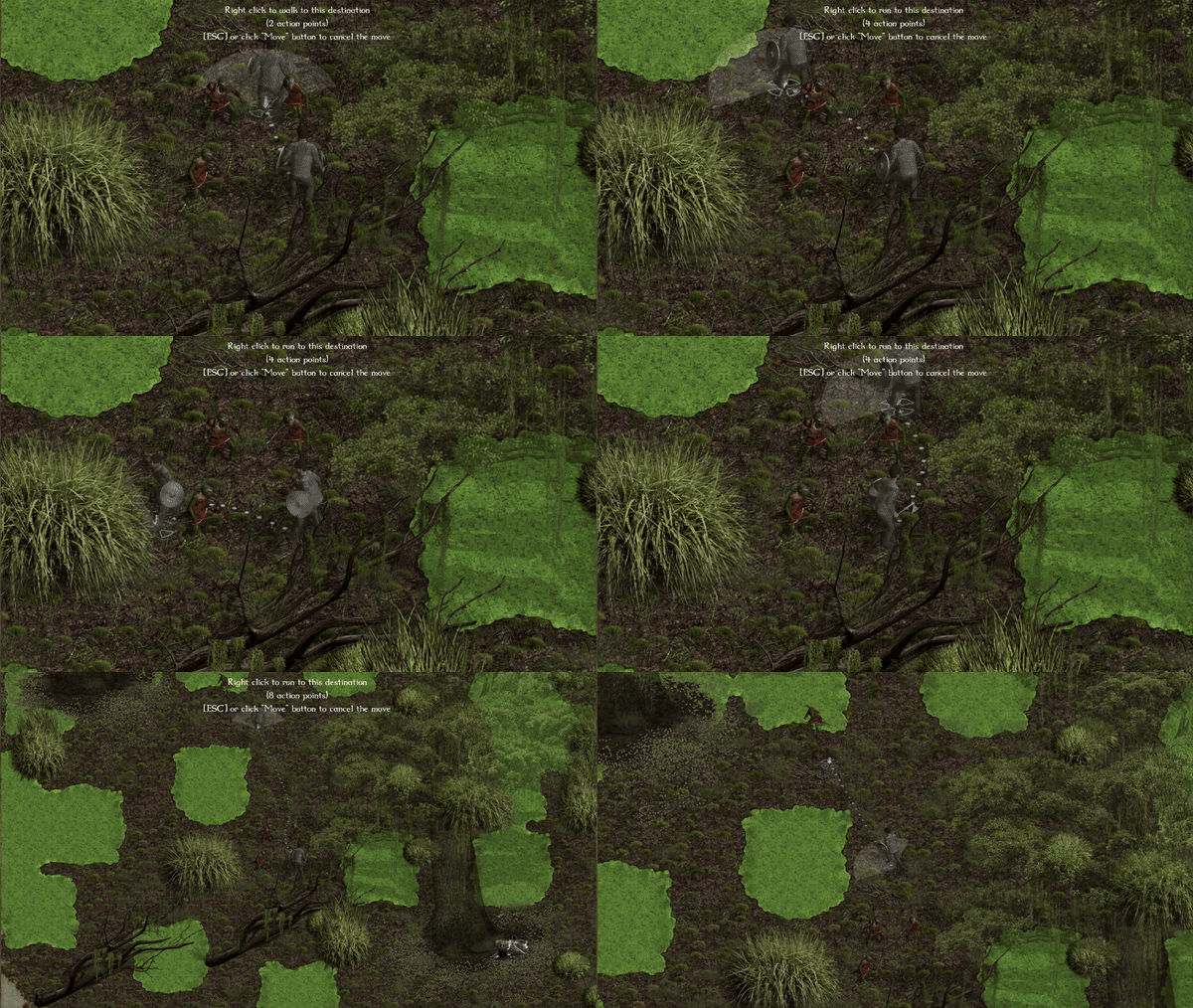
If you just want to change the direction you are facing without changing position, you can do so too at the cost of a single AP.
Standing guard
This part is not implemented yet, but a mode will be added where a character can "stand guard", allowing for an automatic attack against the first enemy moving through his action sectors during their turn. This is particularily useful when using a polearm with a long attack range.
Being engaged in melee
Any character who gets attacked with a melee weapon becomes "engaged in melee", limiting the possible actions. For example, you will not be able to sift through your backpack to look for that healing potion while a troll keeps bashing at your head with an oversized club. You may use items from your satchel though (your quickslots), as those are easily accessible.
You might also not be able to escape from the map while engaged in melee (characters with the profession branch "Skirmisher" may learn the "Escapist" perk, which increases that chance).
After not being attacked at close range for a turn, the "engaged in melee" status clears.
Interacting with the environment
Many interactions with objects in the environment are also possible during combat (the others would not be useful or take too long).
If things get tough, you can close doors to block the path for any non-humanoid characters (if you have the right key, you can also lock a door, stopping anyone who cannot break it down. Beware the fabled "Shadow" though, an undead creature that can move through keyholes).
You can extinguish light sources for a better chance of hiding away, or pick up a weapon dropped by your enemy after a successful "disarm" maneuver.
You can mount a horse to get away faster (fighting on horseback is also possible but requires a high "Horsemanship" skill), or take the stairs to escape from the battlefiled - some enemies might follow you though.
Like with any other combat action, interacting with objects uses AP.
Tactical combat is complex, but much of its complexity happens behind the scenes. I am looking forward to hearing what you all think of the combat workflow once you can download the demo later this year.
Until next time,
Martin