
Hello, my name is Lukas. I am the game designer and producer here at Polyslash, and today I’ll be explaining how construction works in Tribe: Primitive Builder, and how we got to where we are right now.
Tribe: Primitive Builder is a game about survival on a lush island located somewhere in the Philippine Sea. You play as a chosen member of the Nei-Ju tribe responsible for its expansion, managing resources, and pleasing the gods.
When we first started thinking about the basic concept of Tribe: Primitive Builder, we knew we wanted to create a hybrid “survival city-management” game. Both of these game types have buildings as a significant and common part of gameplay, so that’s where we started. Before moving into the game design part of the entire experience, we consulted heavily with the concept artists in our team. We knew we wanted buildings that could be easily expanded (with more complex resources and the size itself) and something that would fit with the theme of the game nicely (prehistoric tribe, if you didn’t know by now). After several iterations and heated discussions, we created our first example building:
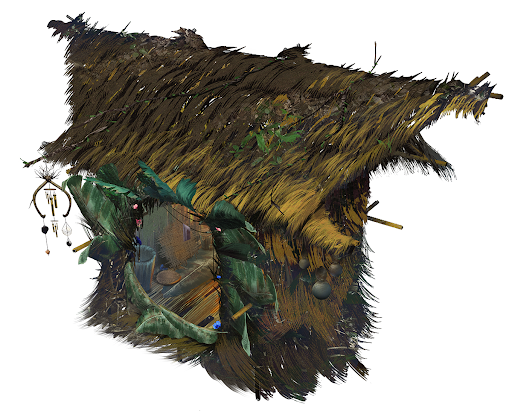
A building made out of grass, leaves, and sticks - a good starting point for any growing village.
When we made the concept and decided that it was the direction we wanted to take the game in, we started the nitty-gritty design work of making this not only a fancy piece of art, but an actual game mechanic.
As mentioned before, we wanted to go with a building that can easily be modified to form a larger place to live in. The square shape of the building made that possible. We prototyped a few potential ways of placing buildings next to each other and finally concluded that in Tribe: Primitive Builder, we will be able to build exactly what you see in the concept, as well as larger houses (up to a 2x2 square shape) by combining them.
In the meantime, when the designers were hard at work in figuring out how best to construct things, our concept artists were trying to find ways to make the house feel like it was becoming more complex over the course of the game. The designers already knew what resources the players would have access to at certain milestones, so they took those and created these building variations:
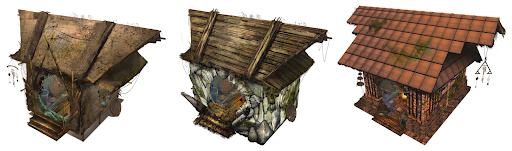
The buildings, following the player's progression, were divided into separate tiers - starting from grass and leaves and ending on bricks and tiles; a total of four tiers of building progression. We were and still are very happy with that outcome.
During the entire design process, the team was researching a lot about how to construct a home in the middle of a jungle using your bare hands or basic tools. There were hundreds of sources to learn from, and we highly recommend you check them out on YouTube. Who knows when you might need to build a shelter in the jungle?
After better understanding how to build something in the wild, the team started breaking each building into bits and pieces. Inspired by the videos and articles, we broke the entire building down to the smallest objects. It gave an insanely detailed approach to construction, but it took more than an hour to complete one building. This, while true to reality, proved to be way too much for anyone in the team to handle. We took a step back and re-evaluated our approach. While doing it this way would make it more ‘real,’ Tribe: Primitive Builder was not meant to be a simulator. After a few more iterations, we concluded that we wanted to achieve a middle point, somewhere in between what was done in real life and what would be an arcade type of mechanic. So, the buildings got divided into small parts that would later become stages of construction.
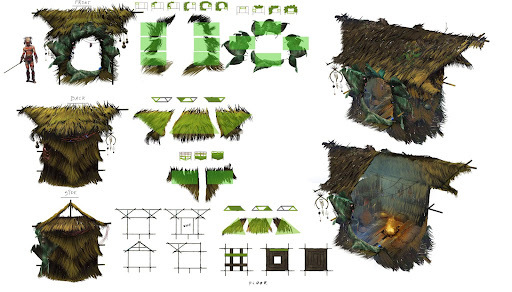
The pillars, floor, roof, and each wall was treated as a separate part of the entire construction. In a simple explanation of our idea - you start off the construction by placing the pillars in the ground and creating the entire “skeleton” of the house. After that, you add the floors, the walls, and finally the roof. This process would be similar for all houses regardless of their tier. What they don’t have in common is what resources they need and how you place them.
The design of construction was nearing its completion. We had a good idea of what buildings are going to be made of and how we are going to build them. We also added a few smaller elements to the entire process. For example, we allow the player to carefully pick where the building will appear (which you can see on one of the screenshots on our store page), flatten the terrain, clear out from anything that could block construction, store the necessary resources near the construction site (to mitigate the need to run back and forth from the site to the forest), and define where the door and windows will be located (yes, there are windows at a certain stage).
When the design was done, and the concepts were completed, our 3D team took what we created and made the buildings a reality (sort of). Now that you understand how we got here, let me show you how the buildings look when finally realized in-engine:
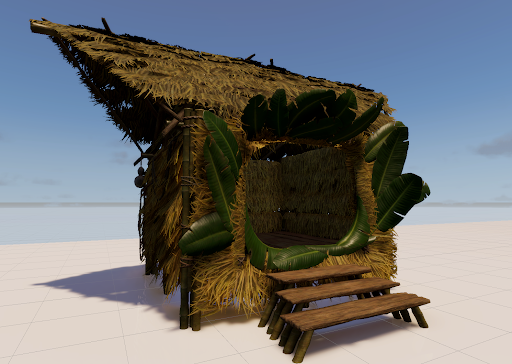
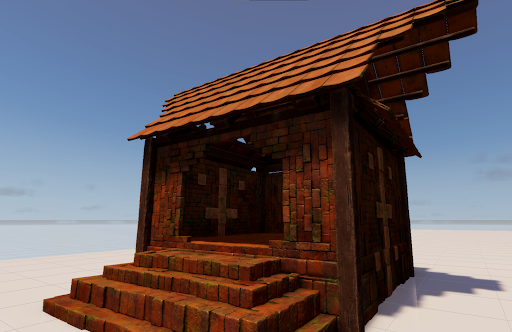
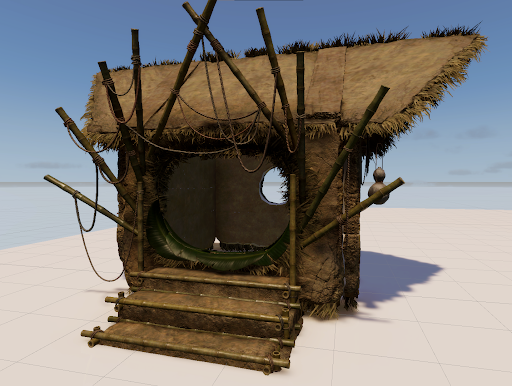
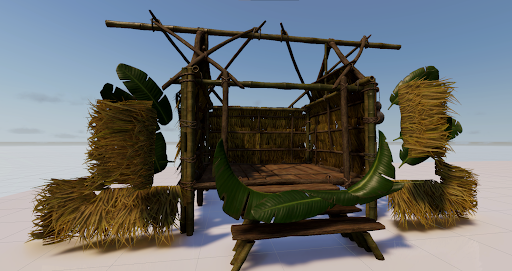
However, Tribe: Primitive Builder isn’t just a game about building houses. We knew that we had to take this idea and turn it into something more connected with the “resource management” and the “tribe” part of the game, but that is a larger topic for another devlog.
If you liked this sneak peek into how Tribe: Primitive Builder is becoming a reality, please let us know. If you find any other behind-the-scenes topics interesting, don’t hesitate to write to us in the comments or on our official Discord channel.