
Hi everyone! This is the new issue of Developers' Diary No. 12, and today we are talking to our programmer, Igor Konyaev, about the various difficulties that we encountered while creating the weapon system in terms of the game design.
What do you start with when working on weapons mechanics?
Igor: When one starts the work on creating some kind of mechanics or mechanics system, the game designer faces the question: “How to do this?” And only after that it follows: “How has this been implemented by others?” Every time you need to examine competitors and decompose game systems into individual mechanics in order to identify the advantage of one or another mechanic. After collecting enough material, you need to first think about two things:
- What mechanics can be easily borrowed from the competitors? These are usually fundamental mechanics that have a low entry threshold for your target audience. For example, all RPG fans know that in your game there will be the character upgrade system and resource management. And many expect to see these mechanics in the ordinary performance. This point also includes filtering mechanics which destroy the gaming experience, developers are often mistaken and it also needs to be taken into account. For the latter, it is useful to study the gaming forums of competitors;
- How can mechanics be combined and modified to create a new gaming experience? The most difficult thing is to find a balance between the familiar and the completely new. Any breakthrough idea may be unnecessary to anyone due to the fact that it is ahead of time or interacts poorly with other game systems.
Only the simplest calculations and prototyping can help with these two points in the first stages.
How do you work with the ranged weapons?
Igor: To make it simple, we will work with the several types of the ranged weapons that have a damage parameter (Damage), an effective range (Range) and the number of the supported modifications (Mods):
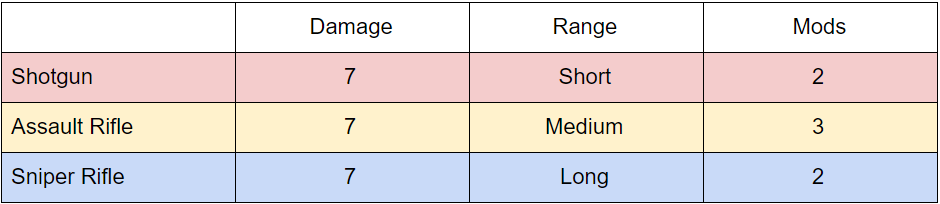
From the table you can see that the damage for all the guns is the same. It would be different if there were no external conditions that are laid in the creation of weapons. In this example, the effective range parameter equalizes all types of weapons and makes them effective only in their category, without losing in damage.
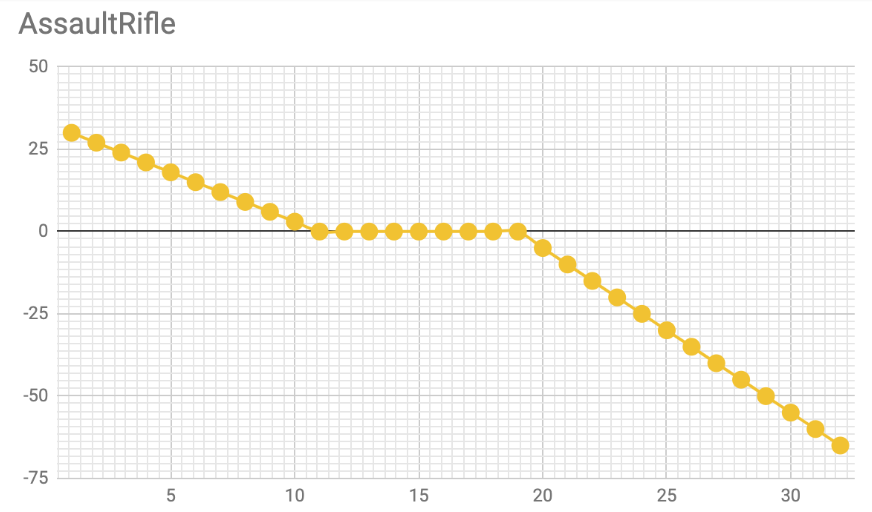
The graph of the effectiveness of assault rifles at a distance from 0 to 32 tiles
Modifications make major changes to the balance of weapons. For example, if you put the sight on an assault rifle (Assault Rifle), then in terms of effective range, it will come a little closer to a sniper rifle (Sniper Rifle), but lose accuracy at close range. This problem can be solved by putting a more expensive combined sight, which does not affect the firing accuracy at short distances. It is also worth considering that there is no way to put a sight or silencer on a shotgun (Shotgun), just as you can not put a combined sight or stabilizer on a sniper rifle, which reduces the spread of damage. In simple terms, the balance is achieved by advantage in some situations and lack of advantage in others.
We also take into account different types of enemies against which different types of weapons and different types of ammunition will be effective. For example, incendiary ammunition will work against humans, but not against machines, because the first can burn, and the latter can not. Against large masses of opponents, it will be more effective to use weak weapons that can save ammo, and fighting the bosses it is easier to use strong long-range weapons to reduce the risks of taking large damage at close range (works not with all bosses).
And the last point: different weapons can be used by different characters due to their physical abilities and skills (we will speak about them in other issues). As such, there will be no rigid class system in relation to the weapons used in the game. The differences are only in the thing which of the characters can use heavy or precision weapons, and which can not.
What about melee weapons?
Igor: In addition to ranged weapons, we are implementing a unique melee weapon that will deal damage at close range. For example, an energy whip can inflict damage on several tiles around, this introduces an imbalance, so we create a counterbalance unexpected for the player in the form of an enemy who has a similar type of attack.
What can you tell about more technical details when balancing the weapon?
Igor: We are currently working on creation of a universal rating calculation system for weapons. In simple terms, the average is calculated for all weapons parameters. Based on this average, we calculate the price of a weapon in a store, its chance of appearing from the enemies (its rarity), and see how it will work in different external conditions against different enemies. Based on the calculations, the system will help to balance the economic part of the weapon and the economy of the game as a whole.
In the following diaries, we will continue to explore the topic of difficulty of balancing weapons. In the meantime, subscribe in the social networks and wishlist our game in Steam. See you soon!