We are thrilled to announce the release of our latest game "Twisted Logic: Abbotsfield" - a first-person psychological horror game with a twist! One or more players must team up to unravel cryptic logic-based case files as you explore a haunted house to exorcise the demonic force
We are thrilled to announce the release of our latest game "Twisted Logic: Abbotsfield" - a first-person psychological horror game with a twist!
One or more players must team up to unravel cryptic logic-based case files as you explore a haunted house to exorcise the demonic force haunting you.
We are thrilled to announce the release of ROCKETS ARE SUPER HARD: RELAUNCH - a free major update that remasters our punishingly difficult local co-op party indie game! Out now on Steam: Here’s what’s new: 🎨 A complete visual overhaul of the entire game end to end. Launch those
We are thrilled to announce the release of ROCKETS ARE SUPER HARD: RELAUNCH - a free major update that remasters our punishingly difficult local co-op party indie game!
Out now on Steam: https://store.steampowered.com/app/675270/Rockets_Are_Super_Hard
Here’s what’s new:
🎨 A complete visual overhaul of the entire game end to end. Launch those rockets in style with a higher, shinier fidelity!
🚀 We’ve polished and consolidated our core campaign into 20 missions spanning a range of difficulties.
📝 A new tutorial video to help get your party started.
Hey Orbitects! We've got a few more quality of life improvements that we've added to the game, listed below: We’ve introduced a fix to battery and wire logic to increase stability and reduce crashing in latter waves. As a fail safe, we have also introduced Wave Point Boosts being
Hey Orbitects!
We've got a few more quality of life improvements that we've added to the game, listed below:
We’ve introduced a fix to battery and wire logic to increase stability and reduce crashing in latter waves.
As a fail safe, we have also introduced Wave Point Boosts being earned after each wave, and not after each run.
We’ve fixed the completion screen that wasn’t displaying correctly upon game completion.
We’ve fixed the Achievements bug that wasn’t trigger upon game completion.
We’ve introduced “play in background" (I.e the game will no longer pause when minimised or unfocused).
Hi all - happy to announce that the Orbitect Original Soundtrack is available now to download as DLC! You can find a link to it below. Thanks and happy listening!
Hi all - happy to announce that the Orbitect Original Soundtrack is available now to download as DLC! You can find a link to it below. Thanks and happy listening!
Hey Orbitects! We’ve just put out our latest patch which includes some quality of life improvements to the game, listed below. Added a tips page to the main menu to help new players Reduced voice line trigger, randomised for each playthrough Fixed random seed generator Removed "l
Hey Orbitects!
We’ve just put out our latest patch which includes some quality of life improvements to the game, listed below.
Added a tips page to the main menu to help new players
Reduced voice line trigger, randomised for each playthrough
Fixed random seed generator
Removed "low hp warning" label from blocks and panels
Reduced the amount of red flashing on blocks and panels. Flashing will now only occur when a block or panel is at or below 20% of it's max HP
Hey Orbitects! We’ve just put out our latest patch which includes some balance tweaks under the hood. Chiefly, we’ve redressed the pricing of Wave Point Boosts , the permanent power ups you can acquire to improve your station between runs. The starting boosts have been made cheap
Hey Orbitects!
We’ve just put out our latest patch which includes some balance tweaks under the hood. Chiefly, we’ve redressed the pricing of Wave Point Boosts, the permanent power ups you can acquire to improve your station between runs.
The starting boosts have been made cheaper, allowing players to make improvements earlier on! Note, however, this means that subsequent boosts have been made a little more expensive to compensate.
If you’ve been playing for a while and have already purchased a number of boosts, please use the RESET button and then re-spec your build using the new, lower costs. You should now be able to afford a lot more of them… :)
This is a reblog from the Propulsion Games devlog . As Orbitect is just a few short weeks away from release, I wanted to write something that I like to think is one of the few things I do best: meandering reflective introspection. Orbitect is a game which is near and dear to my h
As Orbitect is just a few short weeks away from release, I wanted to write something that I like to think is one of the few things I do best: meandering reflective introspection. Orbitect is a game which is near and dear to my heart. My feelings towards it are directed in, revolve around, and go well beyond the game itself. In this post I’ll explain more by breaking it down into three key reasons why. Buckle up.
1. Orbitect is Indie
‘Indie’ is somewhat of a nebulous term these days, as video game development teams come in myriad forms of sizes, experience, and budgets. I’m not going to argue the semantics one way or another, but instead try and articulate what indie means to me and why I feel as though Orbitect is an indie game incarnate.
I have written in the past about the power of transferable skills. This is something I feel passionate about because a “generalist” can be seen as a pejorative — someone whose skill-sets are lesser than. Intellectual wanderers who flit from subject to subject and never do any one thing that well. But making indie games — like many things in life to me — are about problem solving. And problems come in so many different shapes and sizes and are solved in all sorts of weird and wonderful ways.
The philosophy of “no one person is any one thing” is baked into our team. Our game designer James has extensive game production experience. Our programmer Ryan has embraced a love for technical art and visual effects. I designed the music and sound effects but also created some data-driven tooling for us (which I spoke about here) and co-ordinated our outsourcing. I have never designed the narrative for a game, but as a sci-fi geek and a prolific waffler of the written word, I took the reins and have had a blast as the writer / narrative designer for this game (it’s not a narrative driven game by any means but I dare you not to at least chuckle at the puns!). We have supported one another with our variety of experiences, played it fast and loose with our roles, respected one another’s skills, perspectives and experiences, and created something that has been incredibly fulfilling — and genuinely great — as a result.
Our version of indie development pushes beyond the creatively stifling culture of heuristics, processes, formality in job roles, and generally inaccessible job requirements that feel self-referential in nature (“you need to have shipped three games as a Senior Bloopy-bloop to be able to ship this game as a Lead Bloopy-bloop!”) which compartmentalizes people and their ambitions. These are the forces that prevent people venturing outside of their pigeon hole — lest the imposter syndrome fester — and prevents bringing new perspectives and a vibrant diversity to this wonderful creative endeavour. When you develop an indie game there is a technical and creative freedom that is almost indescribable. You do not wait to be told or given permission. There is nobody to say yes or no on how to achieve a specific something, or that an opinion or suggestion isn’t your role to decide. A good idea is a good idea, but more importantly what’s key is that you are given the freedom to prove your chops and deliver on that idea yourself.
I’m not saying that these things are unimportant — in fact I believe that done for the right reasons and in the right way, they are crucial to sustainably embracing the complexity of a studio growing at scale while working on a singular creative vision. And they arguably (rightfully) exist to help assuage any collaboration conflicts, get people in roles that require a very specific skill-set, and prevent a toxic austere culture that could develop from people who think their view is the right one regardless of the value of experience. But why can’t we have the best of both worlds? We’re a core team of three, with select others helping us out periodically. We can embrace all of the structure, governance and controlled workflow that comes with production, best practices and general experience in a specific role — but at the same time play fast and loose enough with formality and structure so that we can pivot, iterate and learn in a way that is truly agile, nimble and exhilarating. With this mindset, there isn’t an outside-looking-in, or an attempt to ‘break into the industry’ at a specific role; it is the industry that forms around and encapsulates you as you contribute to it. And while this is all approached with a humble humility and awareness that you never truly stop learning, it is that curiosity and openness that drives forward progress in any meaningful way. You may not be able to do everything as well as you’d like, but you have the freedom to try anything and see where it takes you.
For me, this is the mentality of indie games, and it has been the mantra of Orbitect development.
To play a complete devil’s advocate to this, I will say on reflection that we have made many mistakes. We prioritised things in the wrong order. We would often think we had consensus on something when we actually didn’t (owing to our light touch on documentation). Our look and feel — and even the game’s genre — evolved substantially over time as the nature and intention of the project changed (more details about that below!). These are lessons learned that we will take with us into the next adventure, but I would make all of these mistakes again — and then some — if it meant we could keep the close, fluid, trusting, collaborative, creative and vibrant environment that we have created for ourselves.
2. Orbitect is real
The second reason I love Orbitect is that we’ve actually made it.
Last year I wrote some thoughts reflecting on a decade of writing music for games. I had noted that a substantial amount of projects not used were because the projects were cancelled.
For all the exhilaration and creative freedom that I’ve spoken about above, the reality of life is such that after the initial honeymoon-period excitement of a great idea for an indie game dies down, then other competing priorities, the various challenges and setbacks, the reality of needing to put food on the table, and the sheer power of will required to get started and slog through the nitty-gritty parts of a project will set in, and projects end up faltering and folding.
That’s why the fact that we’re nearing the release of Orbitect — Propulsion Games’ fourth title — feels triumphant in and of itself. I can take barely a modicum of credit for this; up until a year or so ago, Propulsion Games was primarily a labour of love from my brother Ryan, with me making a periodic appearance to provide soundtracks before swanning off again onto another project. The first few releases of the Propulsion Games portfolio is truly a testament to Ryan’s inspiring work ethic, discipline and motivation (Ryan if you’re reading this — there I said it, okay?).
Orbitect was a bit different. It started off in 2020 as a hobby project between Ryan and two friends (Martin and Lewi). The game was a cube-and-panels construction physics-based resource management game. The construction element was extremely fun to watch, but the resource management elements proved harder to make unique and notable in a genre that already has so many quality titles. When our friend James entered the fold, we experimented with completely re-designing the genre, keeping the core blocks-and-panels construction, but changing practically everything else about the game. Heck, I even scrapped the soundtrack and started again from scratch (the original music is here if you fancy a listen).
The game pivoted towards rogue-lite styled gameplay, and our ideas and skills started to coalesce into a project with real potential. As the weeks turned into months, our ambitions grew and we had pushed ourselves further than we had in any title previously. With Ryan still at the helm as our one and only programmer, the project continued to evolve into a team-based project with many of us playing a variety of roles and learning from one another, imbued with the indie spirit (as I’ve waxed lyrical about further up).
Over the next few months, our powers combined like a proverbial Captain Planet, and Orbitect in its current form emerged. We previously shared a two year development video of Orbitect, which I'll link to again below — you can see the identity crisis that it went through and how it emerged with clarity as the weird little genre mashup that it is:
We found ourselves in a position in 2023 where the stars aligned and three of us were able to dedicate a day in the working week solely to Orbitect. It’s not lost on me that this is an incredibly rare, privileged and wonderful thing to happen. To be able to wake up in the morning and spend the day working with your nearest and dearest on a video game project? It’s a dream come true for me, and is one of the biggest markers of professional success. If everything with Propulsion Games were to end tomorrow, I will be forever grateful that we got to have this time together. Incredible.
3. Orbitect is fun
When it comes to trying to measure the success of making a game, intrinsic joy aside, what I’ve said here means diddly squat unless the games we make are actually fun to play. Every major and minor revision we made during development was in the pursuit of finding the fun.
Ultimately, we are not in control of the actual commercial success of Orbitect. Whilst I believe in the predictive power of data, and acknowledge there are certain metrics available that can provide insights on indicative success — I’m not going to pretend to be an expert in navigating an already saturated and often unpredictable market, or that I can predict the unit sales of this weird little project when there are so many variables at play.
I spend an inordinate amount of time researching the topic of indie game ‘winners’, general discoverability, and understanding the elusive contemporary kingmaker: The Algorithm™. I read lots of case studies on games that talk about their success, with the implication of such analysis being that their journey is replicable. However, you could argue that there is Berkson’s paradox at play here; we do not read about the games with similar journeys that do not make it into the collective consciousness.
I oscillate between fascination at the fractal-like levels of research that can be undertaken to understand this arena and utilise its lessons, and throwing my hands up in the air and resigning myself to the fact that so many of us are trying to write, analyse, and advise knowledge in a topic that is inherently unknowable to any truly accurate predictable degree. At least in a way that’s relevant to a game like Orbitect.
What I do know for sure is that I actually enjoy playing Orbitect (and I’ve got a lot of games to work through). It is a game that is genuinely fun to play. Over and over again. There have been many occasions where a day of work has been waylaid due to us watching one another simply play the game. I see that as a good sign. Who knows. Time will tell!
Conclusion
There we have it. A dream come true — a 1,000+ day journey that has been an absolute joy to work on. An experience that has pushed me beyond what I thought I was capable of and inspired me to push myself even further.
A game that is truly indie to me. A game made by and with my family and friends. A game that we were able to bring to life and a game that’s actually fun to play. These are the things I think of when I think of Orbitect.
There’s also some relief that we’re nearing the end of this mammoth journey. And a melancholy that we’re nearing the end of this mammoth journey — but ultimately, slightly confusingly, a feeling that actually we’ve only just begun on this mammoth journey.
This is a reblog from the Propulsion Games devlog . Setting the scene. What's up, world? For anyone who works in and around super small indie video game studios, you'll have noticed that individuals often have multiple roles in the project. People wear many hats. So many hats. Mo
For anyone who works in and around super small indie video game studios, you'll have noticed that individuals often have multiple roles in the project. People wear many hats. So many hats. More hats than a birthday party, fancy wedding and a day at the races combined. Maelstroms of hats. Hats everywhere. Hatters gonna hat, after all. So for a project like our upcoming game Orbitect, which is an ambitious physics-based construction roguelite with a complex tapestry of configuration, it was super important that we utilised our time in a sensible, efficient way in order to stay as focused and efficient as possible so that we could realise our vision without spending decades in the process and tying ourselves in a myriad of nebulous (albeit rewarding!) knots.
This post is about an example of how our small but mighty team have used some spreadsheet-based automation to streamline selections of our production in order to iterate and refine our gameplay balancing at speed and scale. We'll be writing more in the future about exactly how we tackled the balancing itself, as well as how Orbitect is utilising configuration on the programming side, but for now - feel free to treat yourself to a little insight into how we've joined the two together in data-driven harmony.
What's our problem?
In Orbitect, the player uses blocks and stat-based panels to craft a space station capable of destroying waves of space debris. Destroying that space trash earns the player money and resources to repair, upgrade and expand their station, so on and so forth, ad infinitum (well, until the end of the campaign at least). We have designed many levers of configuration in order to control the flow and feel of gameplay. For example:
Panels: How much does one cost? What's it's health? Strength? Defence? Speed? Efficiency? How much to upgrade or repair? How much damage can it do? What description does the player see?
Debris: How massive, or metallic, or explosive are they? How much money is earned from destroying it? What's the probability of reward if the debris is destroyed? What reward does the player get if they destroy it?
Waves of debris: When and how does debris appear? How much debris appears in a given wave? How long does the wave last? What does the play get for clearing a wave?
Wave Patterns: What type of ways can debris appear in a wave? Which direction? How often? How fast? Does it target a specific part of your station?
Bosses: When in the campaign do they appear? How difficult are they? What do you get for defeating them?
Stat Rewards: What rewards are available and for which stats? Are all panels affected from a reward? How much is rewarded?
Gameplay boosts: How much does each one cost? How much do they affect gameplay?
Other player values: How much money does the player start with? You get the picture…
All in we have just over 70 configurable attributes to work with, each with dozens (or more) entries comprising the overall configuration of the game. Can you imagine if we had to keep track of this manually in-engine? Tweaking the configuration to refine the game's campaign experience would be a time consuming, miserable, communicative monstrosity and would most likely fail before it began. Thankfully, we are making use of a data interchange format called JSON to store attributes and their values across various files.
When it comes to refining the game design itself - updating multiple values quickly and accurately directly in the JSON is still a challenge. It'd still require us to manually scroll through and edit various attributes. And if we had multiple waves, debris, panels etc in the game (which we do), then we'd have to do this multiple times.
So what did we do about it?
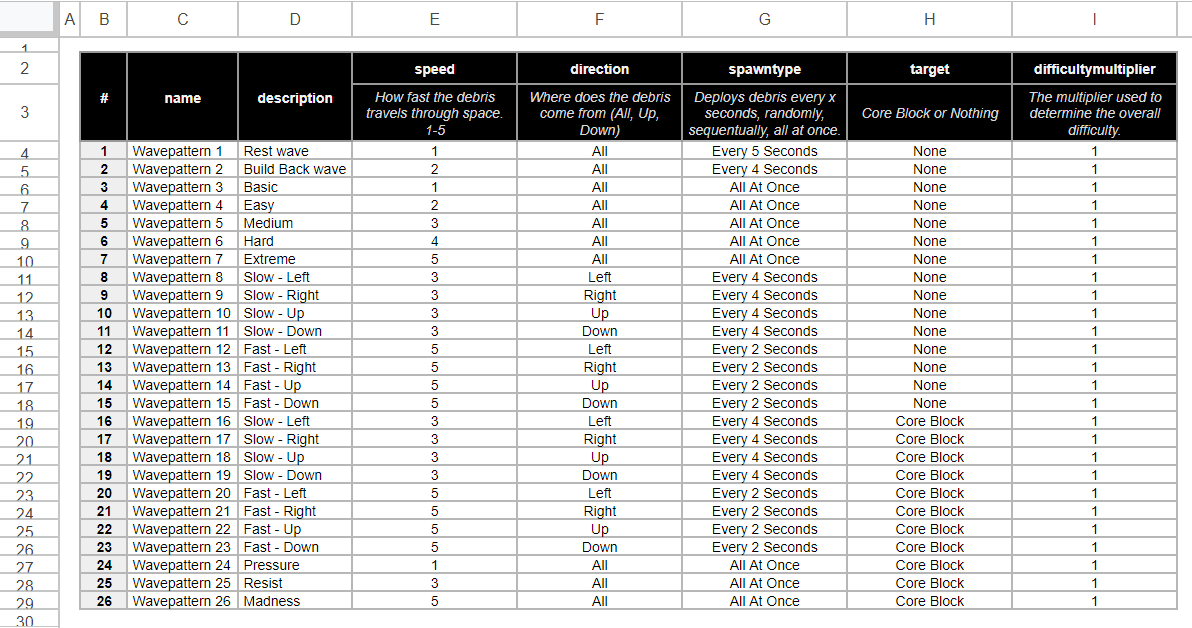
Enter: The Spreadsheet. That's right. We've employed the old reliable stalwart that holds the entire knowledge working world together - a spreadsheet. We used one to lay out the various configurations across multiple tabs. For example:
These are placeholder values! Don't go getting all excited.
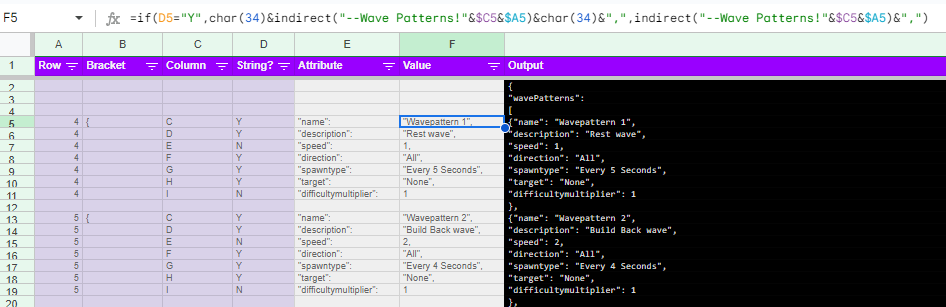
Not only is this useful because of the use of rows, columns, and formatting that we all know and love, but because we can make use of formulas to create feux-JSON configurations in the spreadsheet itself. For example:
We specify a row and column from our easy to understand spreadsheet that corresponds to a cell containing an attribute name. We do the same for that attribute's value.
We hardcode in some curly brackets that will be needed in the JSON no matter the configuration values.
We add a Y/N column to flag whether the value is a string (because if so we need speech marks for a string).
We use the "indirect" function and Char(34) with the above to create a formula that acts as a concatenation and pre-populates the feux-JSON with spreadsheet values where they are needed. Some logic is also needed here to remove a comma from the last value in an encased sequence.
We can scale the JSON for all entries by adding 1 to our row reference (or a letter along for our column reference) in the next row down so that all rows from the spreadsheet are captured in the JSON file.
Thanks to the excellent JSONLint for providing an excellent validator!
Here's a snippet of one to illustrate what it looks like:
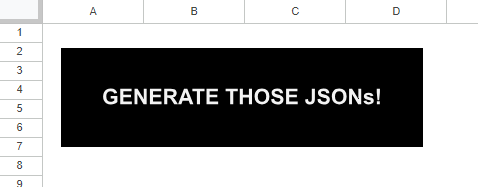
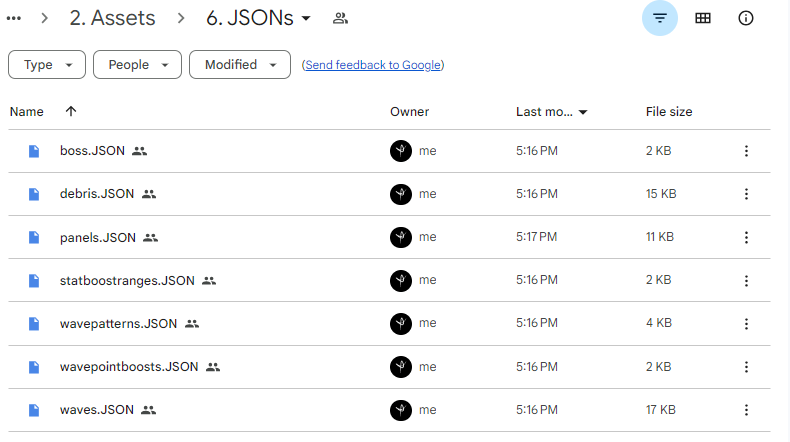
Making the feux-JSON.Great! That's already saved us some time trawling through JSONs. However, we were still maybe spending around five minutes copying, pasting, zipping up and sending to one another every time we wanted to tweak a few parameters and test out the gameplay implications. Given we are iterating repetedly during our development, we had an opportunity to further help ourselves. So we utilised a google apps script (with thanks to this thread and this thread) to automatically copy and paste our feux-JSONs into (real life) JSON files, and store them onto a specific folder in our shared google drive, for anyone in our team to pick up and play in their local build (and eventually use in the main development build). We even made a little button to run the apps script and export them!
Not the best looking button in the world, but I'm a spreadsheet geek, not an artist. What do you want from me?Behold! Exported JSONs hot off the press (of the button).
Now at the click of a button we have fresh Orbitect gameplay configurations ready to use the next time we run the campaign in-game. The couple of hours invested in making these little innovations (can I be so bold as to call them innovations? Probably! If you've read this far down then you must like this approach too, right?) has saved us exponentially more time in the run up to release. It has paid for itself within a couple of development days.
So there we have it. Is it rocket science? Hardly. Just a good old spit-and-sawdust approach to saving us a little bit of time, hundreds of times. Little friction-busting steps like this along the way help our team to release a game that reaches for the stars, and takes out the trash along the way.
We wanted to thank you for playing the Orbitect demo and leaving us feedback. We're now going to be working away feverishly on the build up to the release of the main game. If you enjoyed what you played then please consider adding Orbitect to your wishlists!
We wanted to thank you for playing the Orbitect demo and leaving us feedback. We're now going to be working away feverishly on the build up to the release of the main game. If you enjoyed what you played then please consider adding Orbitect to your wishlists!
Hi everyone! It's been a fantastic Next Fest week so far and we've been thrilled at how many people have checked out the demo! We've been busy collating all your feedback, reading your comments, and even watching (/lurking?!) one or two of your livestreams - and we've made a few
Hi everyone!
It's been a fantastic Next Fest week so far and we've been thrilled at how many people have checked out the demo! We've been busy collating all your feedback, reading your comments, and even watching (/lurking?!) one or two of your livestreams - and we've made a few small but meaningful updates that will hopefully mean even more fun for everyone!
🎯 We've introduced overkilling debris. If your weapons destroy an entire piece of debris right off the bat with a single hit, you'll instantly get all of the credits and resources for that without the debris first breaking up into more pieces. This mean you'll be earning more money and resources to spend on your station much earlier.
🛠️ We've made it clearer when you're in build mode vs. when you're in view mode. Because time passes more slowly in build mode, not being sure what mode you're in meant that the game felt slower when spending most time building. We've got plans to make this work even better in the future, but hopefully this little tweak will help in the meantime.
🎓 You can skip parts of the tutorial if you don't fancy hearing all of the instructional dulcet tones of our wonderful narrator.
That's all for now! Enjoy! Wishlist! Play! Live! Thrive!
This event is for the demo stream of Orbitect - in development by Propulsion Games! About the game: Space debris is out of control! Craft a station to take out the trash in this physics-based construction roguelite mashup. Attempt the role of an Orbitect in this roguelite physics
This event is for the demo stream of Orbitect - in development by Propulsion Games!
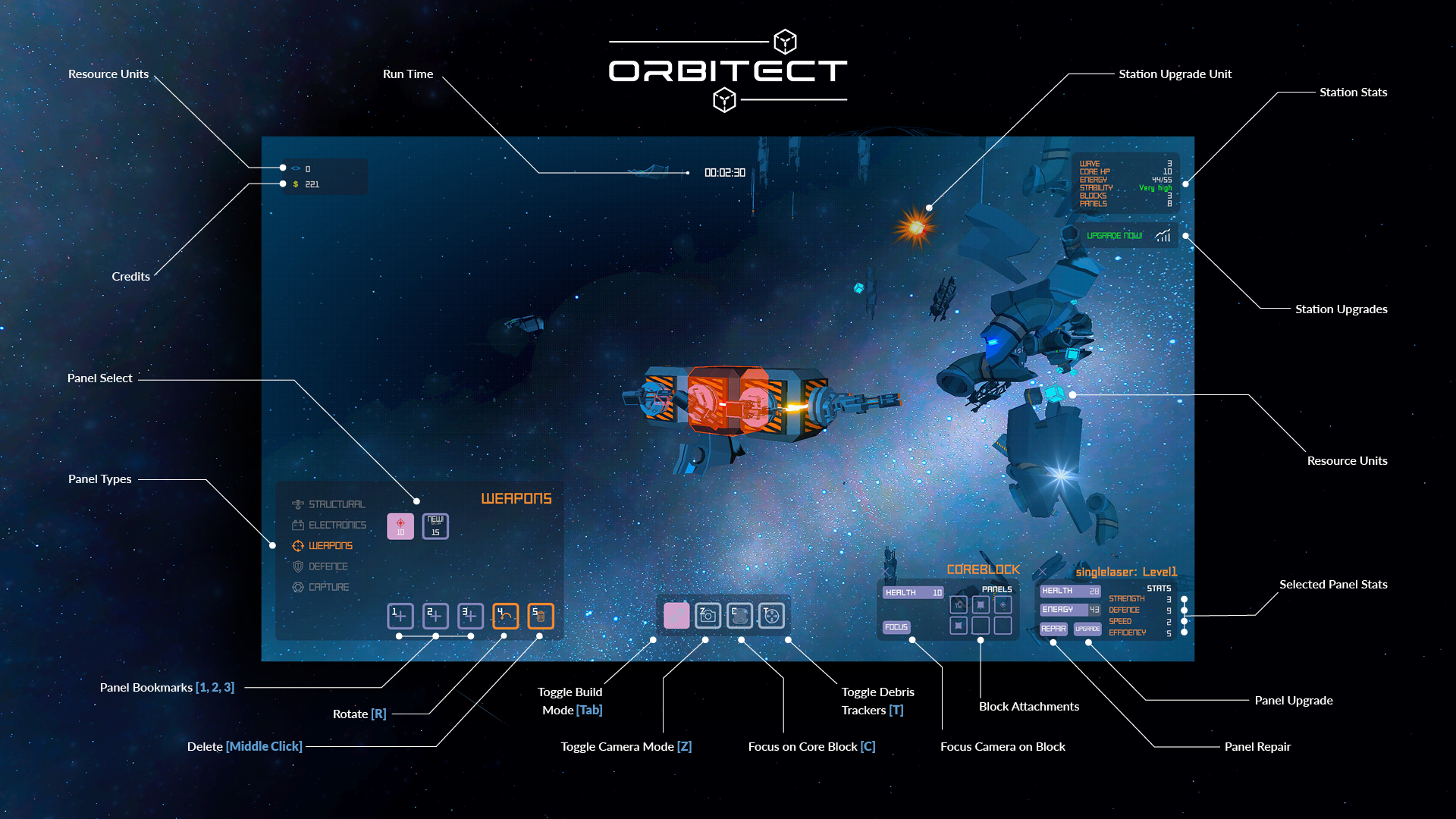
About the game: Space debris is out of control! Craft a station to take out the trash in this physics-based construction roguelite mashup. Attempt the role of an Orbitect in this roguelite physics-based space construction game! Your job is simple; space is a dirty place, time to turn that waste into wealth.
Attempt the role of an Orbitect in this roguelite physics-based space construction game! Your job is simple; space is a dirty place, time to turn that waste into wealth.
Fight against increasingly challenging waves of space debris as you journey through the galaxy
Craft elaborate free-form space stations using the hoarded resources you’ve harvested from the debris. Who ever said hard work didn’t pay off?
Fuse blocks and different panel types in real time, scaling your weaponry and defences to protect the core - upgrading and expanding with the resources earned from taking down debris
Strive for a dizzying equilibrium as you balance your build in the vast, endless reaches of the universe
Earn boosts from each playthrough to augment your next - even in defeat, there’s something to be gained
LET'S GO! In case you missed it - the Orbitect demo is out now for you to play! We hope you enjoy it and as always please let us know any thoughts, feedback or suggestions!
LET'S GO! In case you missed it - the Orbitect demo is out now for you to play! We hope you enjoy it and as always please let us know any thoughts, feedback or suggestions!
This event is for the demo stream of Orbitect - in development by Propulsion Games! About the game: Space debris is out of control! Craft a station to take out the trash in this physics-based construction roguelite mashup. Attempt the role of an Orbitect in this roguelite physics
This event is for the demo stream of Orbitect - in development by Propulsion Games!
About the game: Space debris is out of control! Craft a station to take out the trash in this physics-based construction roguelite mashup. Attempt the role of an Orbitect in this roguelite physics-based space construction game! Your job is simple; space is a dirty place, time to turn that waste into wealth.
Attempt the role of an Orbitect in this roguelite physics-based space construction game! Your job is simple; space is a dirty place, time to turn that waste into wealth.
Fight against increasingly challenging waves of space debris as you journey through the galaxy
Craft elaborate free-form space stations using the hoarded resources you’ve harvested from the debris. Who ever said hard work didn’t pay off?
Fuse blocks and different panel types in real time, scaling your weaponry and defences to protect the core - upgrading and expanding with the resources earned from taking down debris
Strive for a dizzying equilibrium as you balance your build in the vast, endless reaches of the universe
Earn boosts from each playthrough to augment your next - even in defeat, there’s something to be gained
Hi everyone, We wanted to take a little moment to talk about Propulsion Games and introduce you to our small but dedicated team! We started off Propulsion Games as two brothers working on game jams games and other indie projects. Over time we’ve expanded our team to friends, fami
Hi everyone,
We wanted to take a little moment to talk about Propulsion Games and introduce you to our small but dedicated team!
We started off Propulsion Games as two brothers working on game jams games and other indie projects. Over time we’ve expanded our team to friends, family, and other folk! Our Orbitect core development team consists of:
🚀 Ryan - Director of Propulsion Games and pretty much our sole Programmer. Basically living in the code.
🎹 Matt - Audio, Narrative, anything involving a spreadsheet, and general hype person.
🤯James - Game Design. Responsible for making Orbitect fun.
👀Lucy - Graphic Design, so that means logos, capsule art and most of the awesome marketing materials that you see!
🐛Lewi - Playtesting, and design feedback. We can’t guarantee there will be no bugs, but thanks to Lewi there sure will be less of them!
🔭Martin - Playtesting, and design feedback. Helping us out when physics makes our brains hurt!
We’ve also collaborated with one or two other awesome people outside of the core team which you’ll be able to read about in our Credits once the game is released.
If you want to read more about us (thanks, I guess?) you can on our website! here: https://www.propulsiongames.com/about
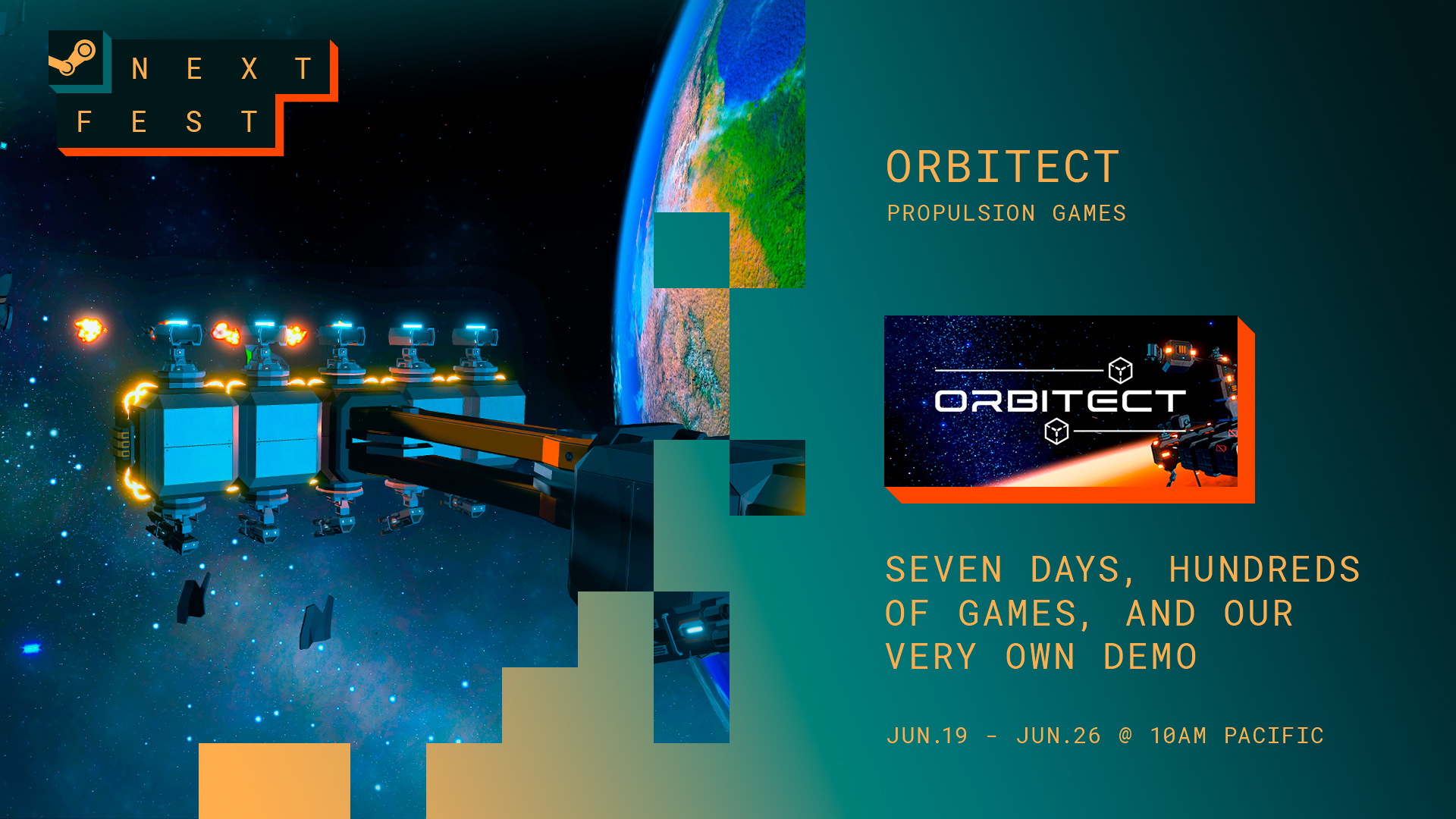
Hi everyone! After much blood, sweat and tears (not literally, we’re all fine) from our small but dedicated team, we are thrilled to announce that Orbitect will be participating in Steam’s Next Fest starting Monday ! A demo will be available for you to try, and in the coming days
Hi everyone!
After much blood, sweat and tears (not literally, we’re all fine) from our small but dedicated team, we are thrilled to announce that Orbitect will be participating in Steam’s Next Fest starting Monday!
A demo will be available for you to try, and in the coming days we’ll be sharing more details about the game, streaming gameplay, and answering all of your questions.
We’re really excited to share Orbitect with you and hope that you enjoy the demo!