Hello, everyone. I’m Haru, the developer of Candy House.
First of all, thank you to everyone who has purchased the game or added it to their wishlist!
Candy House has now sold more than 200 copies, and the number of wishlists has surpassed 500.
For a game developed independently by one person, this is an important milestone. I sincerely appreciate every player who has supported the project.
In addition to sharing this good news, I would also like to use this series of announcements to discuss the ideas behind the story, its fairy-tale references, and the creation of its characters.
There is quite a lot to talk about, so I will divide the development notes into several posts and release them over time.
For anyone interested, I hope you will enjoy learning how this modern adult reinterpretation of Hansel and Gretel was created.
From Hansel and Gretel to Candy House
Hansel and Gretel is a fairy tale familiar to people around the world.
In the original story, Hansel and Gretel live in poverty. After being persuaded by their stepmother, their father abandons the two siblings in the forest.
The first time, Hansel uses small stones to find the way home. The second time, however, the breadcrumbs he leaves behind are eaten by birds, causing the siblings to lose their path.
While wandering through the forest, they discover a house made of sweets. The witch living inside plans to fatten them up before eating them.
In the end, the siblings defeat the witch and safely return home with her treasure. Their stepmother is gone, and the remaining family is reunited.
Because Candy House is an adult game, its story takes place in the modern day, after both Hansel and Gretel have reached adulthood.
At the beginning of the game, their father has already passed away. Following his death, the already fragile relationship between Hansel, Gretel, and their stepmother has become increasingly distant.
In that sense, the foundation of Candy House is similar to the original fairy tale. Both stories begin with a family that has already fractured and lost its warmth.
Since the original story ultimately ends with the family being reunited, I wanted Candy House to reinterpret that conclusion in a way suited to an adult work.
In the end, the broken family is once again brought together by something “sweet”♡
However, the relationship they create is completely different from the family they once knew.
Modern Counterparts of the Fairy-Tale Characters
The main characters of Candy House correspond to the original fairy-tale characters in the following ways:
Hansel → Hansel as an adult
Gretel → Gretel as an adult
Stepmother → The stepmother of the modern household
Witch → The mysterious cake shop owner
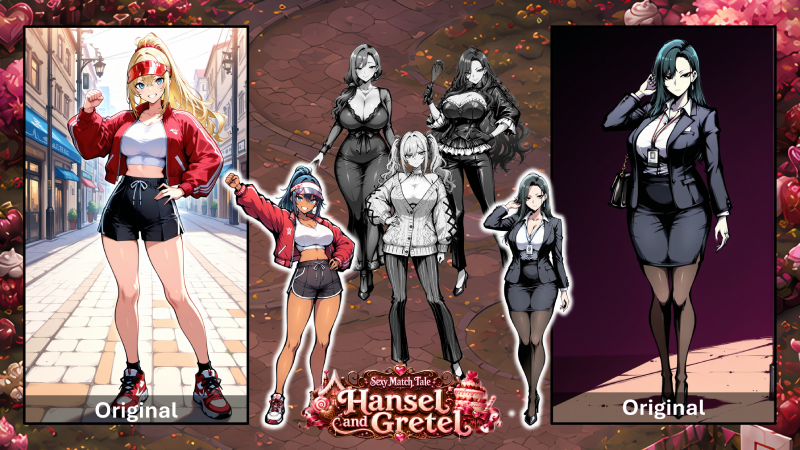
Bird A, which eats the breadcrumbs → Lina
Bird B, which eats the breadcrumbs → Ami
The setting has also been changed from a fairy-tale forest and candy house to a modern city and cake shop.
Many seemingly ordinary events in the game are based on scenes and symbols from the original tale.
Players who have already completed the game may find it interesting to revisit the story with these parallels in mind. You might notice details that were easy to overlook during your first playthrough.
Designing Lina and Ami
The first characters I would like to introduce are Lina and Ami.
Although each of them appears only once in the main story, they both play an important symbolic role.
When planning the cast, I wanted these two women to contrast clearly with the three central female characters: the stepmother, Gretel, and the cake shop owner.
Lina was therefore designed as an energetic, athletic university student, while Ami became a gloomy and exhausted office worker with a distinctly urban atmosphere.
Ami’s early design was already quite close to her final appearance.
The main adjustment was to preserve her tired and withdrawn personality while allowing her to express more of the charm and presence of a mature woman.
Lina’s design changed much more significantly.
She was originally going to have blonde hair. However, I eventually realized that this made her visual impression too similar to Gretel’s. The two characters risked weakening each other’s presence.
I therefore redesigned Lina with healthy, tanned skin and more recognizable athletic characteristics.
Her expressions and body language were also made more direct and open, emphasizing her confidence, friendliness, and energetic personality.
The “Breadcrumbs” That Were Eaten
In the original fairy tale, birds eat the breadcrumbs Hansel leaves behind, causing the siblings to lose their way home.
In Candy House, this event was reinterpreted through Lina and Ami, who each eat part of the cake that Hansel is supposed to bring home.
When the cake disappears, Hansel loses more than a box of desserts.
He also loses the possibility of returning to his ordinary life.
Just as the original Hansel loses the trail leading home, the Hansel of Candy House truly begins to lose his way from this moment onward.
However, he is not lost on a path through the forest.
Instead, he becomes lost within the family relationships, common sense, and personal boundaries that he once believed in.
That concludes the first part of this development commentary.
If you enjoyed Candy House, please consider leaving a Steam review or recommendation. Every review provides meaningful support to an independent developer.
You are also welcome to join our Discord community, where you can share your thoughts about the game, your favorite characters, and what you would like to see in future projects.
Perhaps a future game will include even more characters, themes, and situations that match your personal tastes!